


AI Data Guard. Put AI governance inside the agency boundary.
Observe and govern data exposure, model use, AI spend and model output from an agency-controlled mediation point, independent of the model or provider selected. A Data Mediation™ composition template, included with the license and adapted by the delivery partner for each agency.
Observability first. Available now on the Contracts page, deployed by authorized
partners on their timeline Request a quote
AI use grows faster than control.
Copilots, chat assistants, analytics tools and AI-enabled applications spread across an agency before there is a consistent control surface. Sensitive information may leave in a prompt. Model responses may create downstream risk. Consumption is distributed across providers and cost centers. Controls embedded in prompts, individual applications or one model platform cover only part of the journey. A policy cannot enforce itself.
For state and local governments the same pattern appears in benefits eligibility, unemployment insurance, child welfare and licensing systems, where AI assistants are being introduced over records that carry statutory privacy obligations.
Applications address the mediation agent, not the provider.
Client applications, copilots and agents address the mediation agent instead of the AI providers directly. Every prompt and streamed response passes through the rule set in real time. Provider keys are held in the Credential Vault and attached on the way out, so client applications never hold them. Enforcement acts in both directions: before data leaves and before a response lands.
The policy lives in the agency's network, not on paper and not inside a provider's platform. The agency can change model or provider without rebuilding the policy around it. Two providers or twenty, the license is the same. Adding one is a configuration change, not a commercial event.
What the license carries.
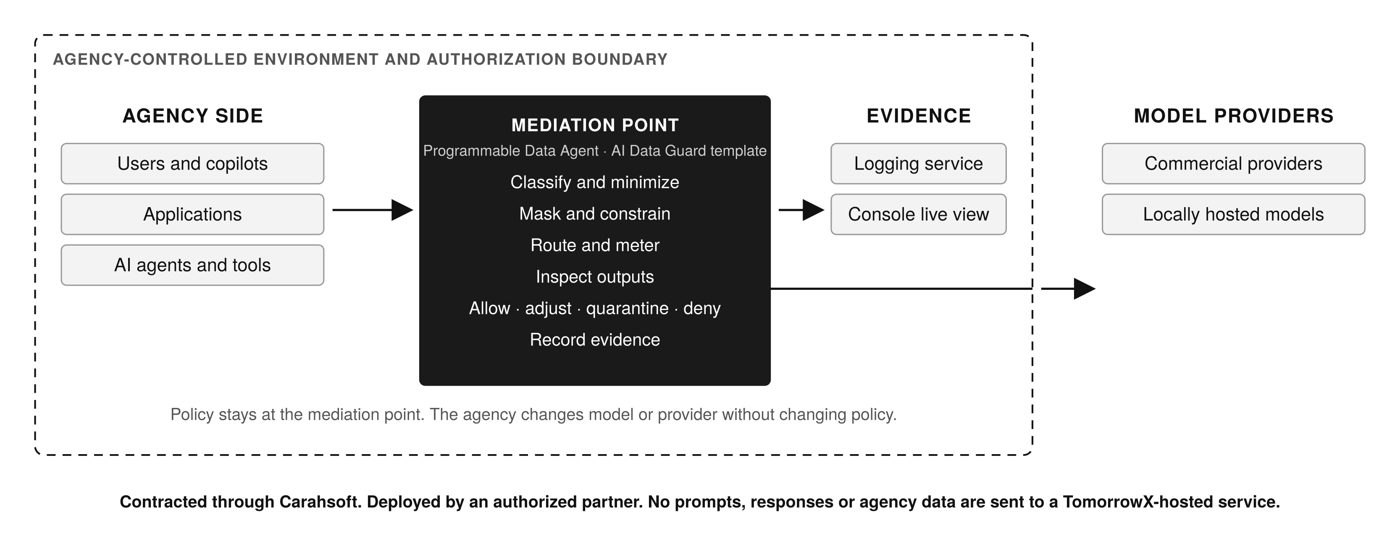
AI Data Guard at the mediation point inside the agency-controlled environment.
- Applications and agents address the mediation agent.
- Classify the data crossing the AI boundary. Apply masking, minimization, routing and access policy in motion. Attach the provider key from the Credential Vault.
- Inspect the streamed response against the agreed deterministic and AI-informed controls. Meter the consumption.
- Allow, adjust, quarantine or deny according to policy. Retain the decision as evidence.
Four other ways to respond, and what each costs.
The value of AI Data Guard is time to launched capability. Mitigate risk, control cost and
evidence compliance now, rather than at the end of a two-year build during which none of
the three is true.
Start with Observability. Adopt when the evidence supports it.
Both are listed on the Contracts page. Agencies that already know where enforcement
belongs can move directly to Adoption.
Delivered inside the agency environment on the partner's timeline.
- Fiscal year planning. The recommended FY27 phasing is Observability in Q1, an Adoption decision in Q2 with the Observability fee credited in full, and expansion by mediation point through the year.
- Where it runs. As a container in the agency's own cloud environment, including AWS through AWS Marketplace, or on-premises. No prompts, responses or agency data are sent to TomorrowX. There is no call-home function.
- Delivery. By an authorized partner within the Carahsoft ecosystem, or by one of TomorrowX's global partners authorized to deliver in US public sector with appropriate clearance. Deployment is scheduled with the partner at order. TomorrowX does not access or operate within the agency network.
- Beyond the template. Agencies that need controls beyond the included AI Data Guard template can order Composition Engineering, a fixed-scope service in which TomorrowX builds the compositions and rule sets and the delivery partner deploys them.
- Support. TomorrowX supports the control point. The delivery partner supports what it builds on it.
Three questions agencies ask first.
What is the agency buying? A software subscription on contract that includes the deployment scope in the SKU. AI Data Guard is a composition template included with it. The agency orders one line from the Contracts page.
Where does the data go? Prompts and responses stay between the agency and its chosen model provider, governed at the mediation point. Nothing is sent to TomorrowX. TomorrowX does not receive agency data.
Does it need its own authorization? The control point runs inside the agency's own environment and authorization boundary. It is not SaaS. The agency's authorizing official determines how it is treated within the existing authorization process. TomorrowX supplies the architecture and control documentation the assessment needs.
More questions See how to buy
Request a quote for AI Data Guard · TomorrowX@carahsoft.com · (571) 590-6500 · Related: Cyber · Interoperability · The control plane must be yours