


AI Data Guard. AI governance inside the agency boundary.
Every prompt and every response passes through one agency-controlled control point. Sensitive data is redacted, AI spend is metered and provider keys never leave the agency. Nothing on either side is rebuilt and nothing leaves the boundary.
Start with a three-month Observability term Request a demo
Which best describes the reader?
I run AI, security or modernization for an agency
What AI Data Guard controls, where it runs and what the agency receives.
I am buying or contracting
Straight answers on phasing, delivery, authorization and what happens next.
I deliver for public sector customers
Why to build a practice around Data Mediation™ and how partners are selected.
In more depth
Copilots, assistants and AI-enabled applications spread across an agency before there is a consistent control surface. Sensitive information may leave in a prompt. Consumption is spread across providers and cost centers with no common view. A policy cannot enforce itself.
The four usual responses each cost something. Blocking providers moves usage somewhere unmonitored. Configuring each provider separately has cost customers close to $1,000,000 a year in reporting and misaligned controls. Building it has cost larger enterprises above $2,000,000 and two years. A third-party gateway inspects every prompt outside the agency's control, which is the thing being prevented.
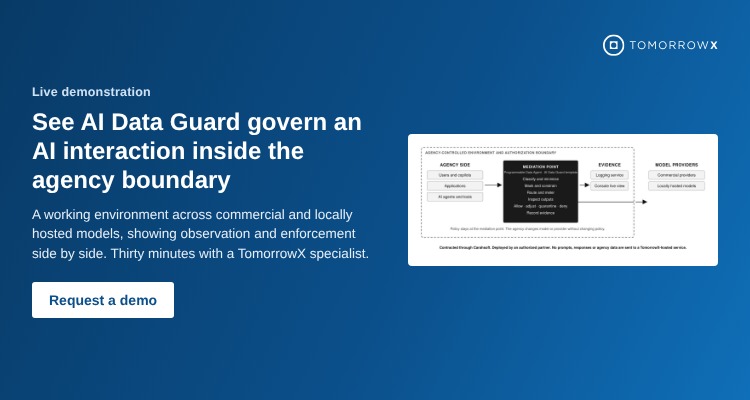
One control point between the applications, users and AI models that request data and the systems that hold it. Requests pass through it and rules decide what is allowed, what is redacted, what is logged and where it is routed. TomorrowX created the category and implements it through the Composable Agentic Platform, which runs a Programmable Data Agent at each mediation point.
It runs inside the agency's own network or cloud tenancy. Nothing on either side is rebuilt, which is why it reaches the systems nobody is allowed to touch. One mediation point or fifteen, it stays one architecture, one rule set and one audit trail. In NIST SP 800-207 terms, a mediation point is a policy enforcement point.
AI Data Guard is a Data Mediation™ composition template included with the license, and the starting point most requested by US public sector agencies. Client applications, copilots and agents address the mediation agent instead of the AI providers. Provider keys are held in the Credential Vault and attached on the way out, so client applications never hold them.
The delivery partner adapts the template for the agency, so one agency's AI Data Guard will differ from another's. That is by design. Two providers or twenty, the license is the same.
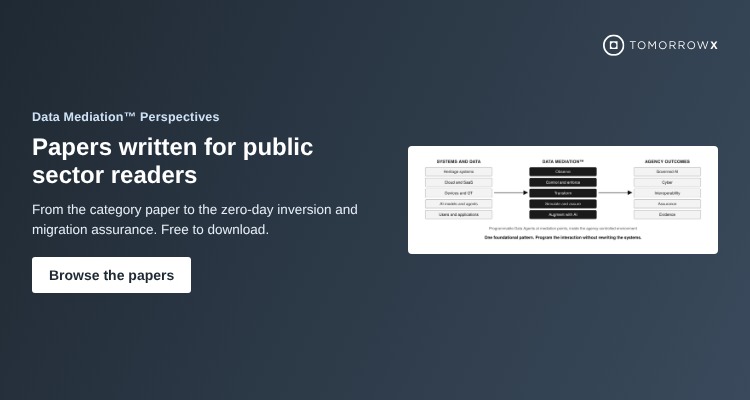
What the agency is solving does not change the license. Where mediation occurs, how much traffic passes through it and how much of the agency it covers is what changes it. The same control point serves four programs.
AI Data exposure, model use, spend and output governed at the mediation point, independent of provider.
Cybersecurity Heritage MFA, inline zero-day protection and transaction controls around systems that cannont enforce modern policy themselves.
Interoperability Heritage and modern systems connected by changing the interaction, not the systems.
Assurance Migration and cutover evidence journey by journey before it becomes irreversible
- A container in the agency's own cloud, including AWS through AWS Marketplace, or on-premises, including isolated and air-gapped environments.
- No call home. The license key is pasted into the agent definition once. The software never contacts TomorrowX and needs no outbound access to run. A missing or expired key is shown as such and the agent keeps running.
- Designed for deployment within the agency's own authorization boundary, under the agency's own authorization process.
- Fail-open or fail-closed by configuration. Active/active with recovery by DNS switchover. Every policy decision retained as evidence.
Security and authorization questions >>
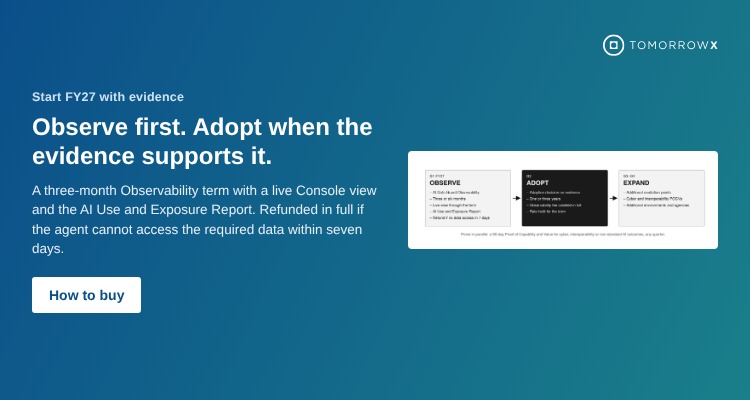
A three-month AI Data Guard Observability term at one agreed observation point. The agent observes; it does not enter the live interaction path. The agency gets a live view of AI use through the Console for the whole term and the AI Use and Exposure Report at the end of it: evidence for the AI use-case inventory, produced from the data path rather than a survey.
Access to the data that makes mediation possible is the only unknown, and TomorrowX carries that risk. Refunded in full if the agent cannot access the required data within seven days. The fee credits forward in full against the first year of Adoption. Scope the estate first; the price follows the scope.
Connect with a TomorrowX specialist
Schedule time with the TomorrowX team at Carahsoft to walk through
the demonstration, the agency's AI traffic sources and where a mediation point belongs.