


Tenna Systems Solutions for the Public Sector
Tenna Systems: A Force Multiplier for Dominating Contested Environments
The modern battlefield is controlled by those that can best overcome Electronic Warfare (EW) and signal interference. EW is particularly concerning to our military, security, and intelligence operators as it is invisible, cheap to deploy, expensive to defend or deter, and capable of taking down some of the most valuable infrastructure available to the Department of War (DoW). Operational commanders lack persistent visibility into RF threats that can ground aircraft, misdirect precision munitions, and compromise C2—while adversaries weaponize this blindness at scale. Why this matters now: Russia/China have industrialized GPS jamming/spoofing. Commercial drones, precision weapons, and autonomous systems multiply attack surface. Traditional SIGINT can't scale to match threat growth.
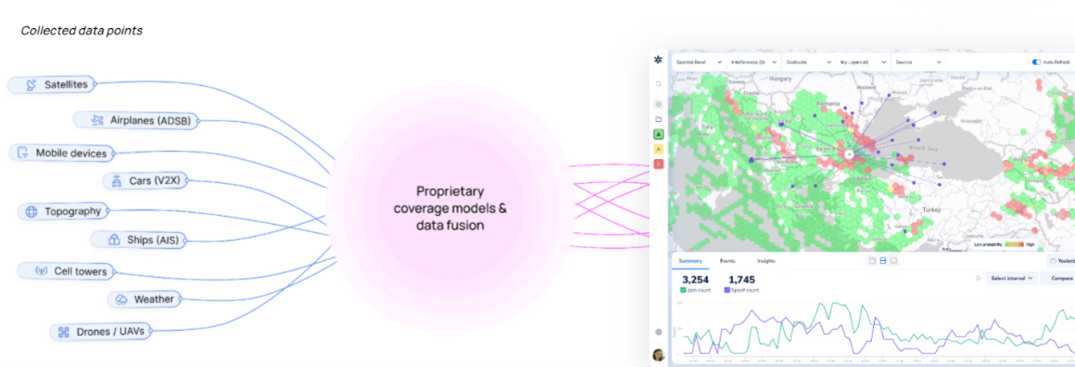
Tenna System directly responds to the EW challenge by transforming already-deployed sensors data into a real-time map of where your navigation and communications will work under adversary RF attack- so ISR platforms avoid contested airspace, precision weapons hit intended targets, and tactical units maintain C2 in denied environments. Unlike competitors that deliver siloed, hardware-intensive EW solutions costing hundreds of millions of dollars, Tenna addresses asymmetric EW by offering an equally low-cost, software-only approach focused on EW awareness, defense, and deterrence. By leveraging crowdsourced data from already-deployed sensors & COTS receivers, the platform acts as a force multiplier for operators in contested environments. The solution is comprised of three primary systems:
1. Arena (TRL 9) - Unmatched Spectrum Visibility
The Arena system provides extremely precise, granular, real-time monitoring of RF coverage gaps and interferences for threat detection and response that is unmatched by any competing solutions. Through a software-only approach, Arena maps and predicts signal activity, detects anomalies and interference. Developed for DoW and its Allies, Arena is also actively used by the Israeli Air Force’s EW and SIGINT units.
Current Warfighter Use-Cases:
- Map adversary jamming/spoofing patterns (EOB)
- Optimize ISR asset tasking for emitter geolocation
- Provide real-time RF interference awareness and route planning for ISR platforms and precision munitions
2. Tracer (TRL 7) - Precise RFI Geolocation
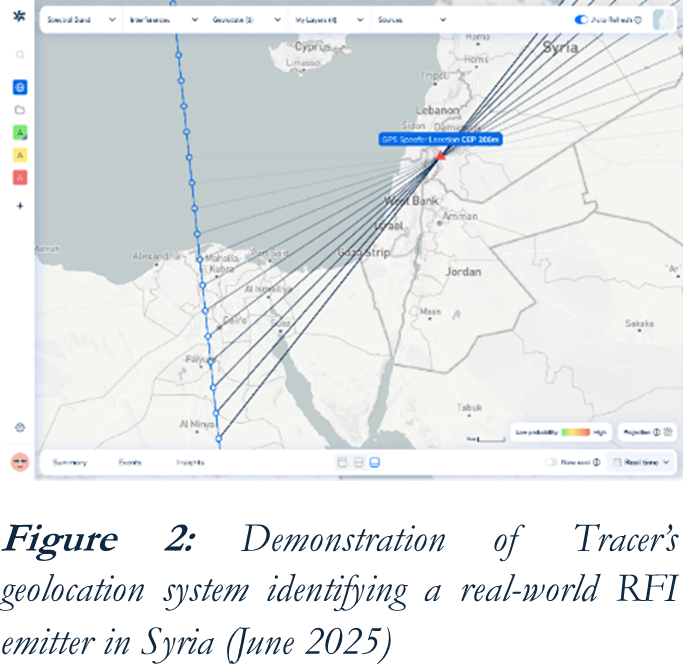 Developed through an Army SBIR, Tracer offers the ability to detect, identify, and geolocate the precise location of interference sources. Tracer’s novel algorithms and techniques can utilize a network of already-deployed receivers to help DoW accurately geolocate interference sources, offering a low-cost & unmatched ISR capability. Proven in active combat operations and high profile contested battlespaces, including by the Israeli Air Force during Operation Rising Lion, 2025.
Relevant Warfighter Use-Cases:
- Low-cost ISR & counteroffensive planning to counteract adversarial spoofing
- Route planning support and intel
- Awareness and defense of airspace and UAV deployment
3. Halo (TRL 5) - EW Resilience
Tenna leverages an Arena-based middleware system to transform legacy GNSS receivers into resilient, networked systems by sharing real-time GNSS threat intelligence across distributed sensors. This collaborative, software-only approach enables existing platforms to intelligently trust or reject GNSS signals, improving resistance to spoofing and jamming without hardware upgrades. Tenna works with leading terrestrial, airborne, and space-based receiver manufacturers and operators to embed GNSS interference awareness and resilience directly into fielded systems.
Relevant Warfighter Use-Cases:
- Transforming existing legacy DoW receivers into smart receivers capable of rejecting spoofing and overcoming jamming
- Providing an additional level of protection to EW hardened assets
- Enabling both embedded (on-device) and remote (off-board) spectrum intelligence workflows