Cybersecurity Solution Providers
As Government IT modernization advances and interconnectivity initiatives expand, the need for cybersecurity solutions is more crucial than ever. Cyberattacks are on the rise across the Public Sector, which poses a significant risk to critical infrastructures, applications, networks and cloud environments.
The dedicated Cybersecurity Team at Carahsoft specializes in providing IT security solutions to Federal, State and Local Government, as well as Education and Healthcare organizations. We aim to safeguard the entire cyber ecosystem with proven technology. Our certified Government Product Specialists help our customers build comprehensive cyber solution stacks to meet evolving Government security requirements.



Your Trusted Government IT Security Solutions Provider
Carahsoft has established strategic, long-term relationships with the industry’s leading cybersecurity manufacturers to offer Government entities proven, cost-effective protection for infrastructures, networks, cloud environments and assets. Our comprehensive Cybersecurity Solutions Portfolio covers the essential areas to protect your organization, including:
- Network and Infrastructure: safeguard foundational systems
- Security Operations and Incident Response: monitor, respond to and neutralize threats
- Endpoint Security: secure access points across all devices
- Identity and Access Management: manage user IDs and permissions
- Web and Messaging Security: guarantee secure online communication
- Risk and Compliance: ensure government security compliance
- Mobile Security: safeguard device and apps
- Data Security: protect information data at every stage
- IoT and Industrial Security: protect interconnected devices
- Cyber Skills Training: enhance team’s IT security expertise
- DevSecOps: integrate security into application development
- Quantum Security: future-proof data security and integrity from quantum decryption
- Artificial Intelligence: accelerate risk detection, generate incident reports and automate threat response in real time
Explore our extensive Cybersecurity Solutions to meet your specific needs.
-
 All Cybersecurity Vendors
-
 Leading Cybersecurity Solutions (21)
-
 Network & Infrastructure (41)
-
 Security Operations & Incident Response/XDR (38)
-
 Endpoint Security (27)
-
 Identity & Access Management (51)
-
 Web & Messaging Security (23)
-
 Risk & Compliance (58)
-
 Mobile Security (12)
-
 Data Security (64)
-
 IoT & Industrial Security (14)
-
 Cyber Workforce Development (23)
-
 DevSecOps (27)
-
 Quantum Encryption Security (30)
-
 Artificial Intelligence (29)
-
 Cyber Threat Intelligence (20)
-
 PenTesting (5)


All Cybersecurity Vendors
Contracts and Purchasing Agreements
Carahsoft holds various contracts that enable us, our vendors and reseller partners to serve Public Sector customers throughout the United States and Canada. Our contracts include:
- Agency-specific agreements
- Government-wide acquisition vehicles
- State, Local, healthcare and education cooperative purchasing contracts


Request a Quote
Continuous Access Verification for Maximum Security
Traditional security measures struggle to protect agencies against today’s sophisticated cyber threats, leaving Government networks vulnerable to attacks. Ensure critical systems are secured from the inside out with Zero Trust, a modern security approach that verifies every user and device before granting access to sensitive information. Explore our Zero Trust Portfolio to enhance your cybersecurity posture.


Frequently Asked Questions
Your starting point will depend on your security framework and goals. Start with visibility and a risk assessment, as it is essential to understanding the assets you need to protect and where your vulnerabilities lie. This foundation will help you improve your organization’s cyber posture over time. Next, implement basic protections such as firewalls and data backups to defend against ransomware and most external malware threats. Afterward, consider adding layers of security by deploying endpoint protection, identity management, network detection, insider threat monitoring and SIEM/SOAR solutions. If your organization uses cloud or AI technologies, choose security tools designed for these environments, such as those that support cloud security or DevSecOps.
No single product can tell you whether you are fully protected against modern cybersecurity threats. Cybersecurity is a layered approach that protects your users, identities, endpoints, networks, applications, cloud environments and data while enabling you to detect, respond to and recover from an attack. The goal is to understand your current architecture, identify gaps and overlaps, prioritize risk and then choose the right combination of technologies and services to meet those requirements.
There are several ways to secure your environment from threats. One way is to adopt a Zero Trust framework or a similar compliance framework to assess your organization. AI tools can be used to automatically map your agency to these frameworks. From there, you can conduct traditional penetration testing and comprehensive table-top or purple team exercises to identify and mitigate potential breaches or threats.
Implementing a Zero Trust Architecture is not achieved by installing a single product. Instead, it is an ongoing security approach that continuously verifies who or what is trying to access your systems and grants access on a need-to-know basis. Adopting Zero Trust happens in multiple phases:
Phase 1: Start by discovering and listing everything in your environment, including identities, devices, applications, data and networks.
Phase 2: Strengthen identity controls with tools like multi-factor authentication, single sign-on and conditional access. Be sure to include all types of users, including privileged users, service accounts, machine identities, contractors and third parties.
Phase 3: Replace network-based trust and set up authorization controls to ensure users can access only the applications they need for their work.
Phase 4: Secure your devices by ensuring endpoints are encrypted and managed properly.
Phase 5: Protect your applications and data with DevSecOps tools and data access controls.
Phase 6: Set up continuous monitoring to spot and respond to suspicious activity across your entire environment.
Start by implementing data discovery and data tagging processes, typically available through a Data Security Posture Management (DSPM) solution. DSPM tools help you accurately identify and track AI applications within your organization. Additionally, use AI discovery applications to assess cloud risks and monitor AI application access. Lastly, establish a data observability pipeline that funnels all data requests through a central application, allowing you to monitor the AI prompts employees submit and gain better visibility into overall AI usage across your agency.
Protect your account credentials by implementing a Privileged Access Management (PAM) solution that works alongside your cloud identity engine. Security tools can also help identify and remediate Active Directory (AD) misconfigurations, and deception honeypot technology can protect stored credentials. Additionally, implement Single Sign-On (SSO) with Multi-Factor Authentication (MFA) to provide an extra layer of security for your accounts.
Establishing strong guardrails around AI usage involves several key steps. First, implement thorough data tagging to support your data access policies. Next, use application access management and Data Loss Prevention (DLP) controls to restrict and monitor sensitive information. Specialized tools can also track and control the prompts employees enter into large language models (LLMs). Data tagging helps strengthen existing policies for managing data access.
Knowing where your data is stored helps you create better access-control policies through cloud gateways, such as CASB (Cloud Access Security Broker) or ZTNA (Zero Trust Network Access), identity management, and DLP solutions. In addition, AI prompt security solutions can monitor and block employees from entering company information or sensitive keywords into AI systems to protect organizational integrity. These protections are enforced through desktop agents or browser extensions, which can also educate the user once an issue is detected.
Protect production-level applications with lightweight, low-code solutions that operate in real time. Protecting your organization’s most valuable assets requires continuous and dynamic security measures, sometimes at the execution or even the agent layer. Adopting agentic security is essential to safeguard AI access and automate security across your enterprise tools.
What is the process for achieving CMMC Level 2 certification? How can we make this process as easy as possible?
Answer: CMMC is a security framework for the defense industrial base (DIB). To achieve Level 2 certification, start by working with a Registered Practitioner Organization (RPO) to get expert guidance on implementing required security controls and preparing the necessary documentation. If you need help meeting specific CMMC requirements, Carahsoft offers solutions to address control gaps or can connect you with a Managed Security Services Provider (MSSP). An MSSP can provide a secure data enclave for storing Controlled Unclassified Information (CUI), allowing you to inherit the necessary controls and pass your audit more quickly without installing your own security infrastructure.
Operational Technology (OT) networks present unique challenges as they are highly sensitive, difficult to update, and often cannot be taken offline.
The first step in securing OT networks is to use passive monitoring solutions that can identify OT-specific protocols and network traffic, then analyze them for vulnerabilities or signs of attack. Next, separate OT devices from IT networks to ensure connections are made only in secure, controlled ways. Carahsoft provides secure remote access solutions that let remote operators connect to OT systems through encrypted channels and segmented networks. These solutions can record each session, making it easier to detect and respond to any abnormal activity.
Technology by Policy: Cybersecurity
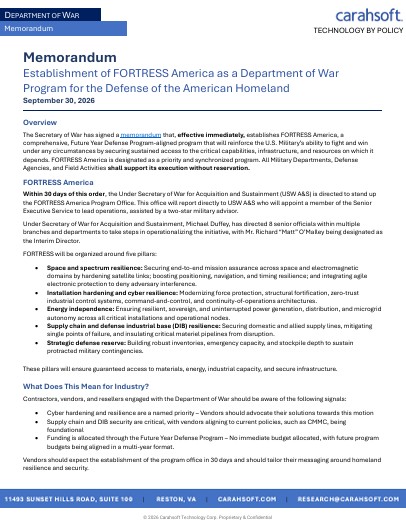
Establishment of FORTRESS America
This memo establishes FORTRESS America, a Future Year Defense Program-aligned program that will reinforce the U.S. ...
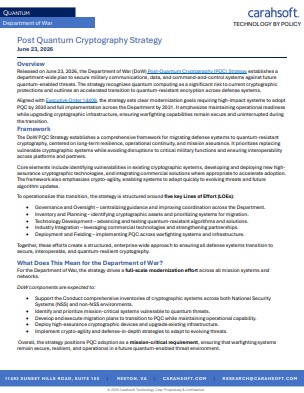
Post Quantum Cryptography Strategy
The DoW Post‑Quantum Cryptography Strategy secures military systems against future quantum threats by driving ent...
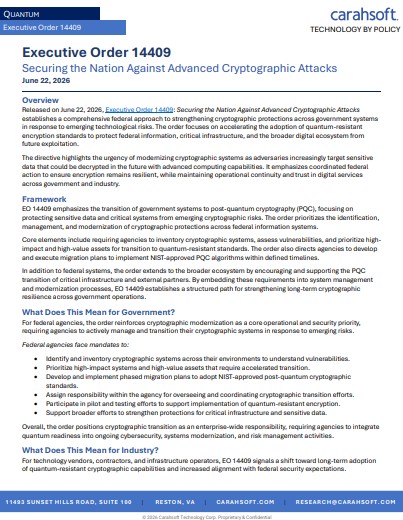
Executive Order 14409: Promoting Advanced AI Innovation and Security
Executive Order 14409 secures federal systems against emerging quantum threats by accelerating the transition to po...
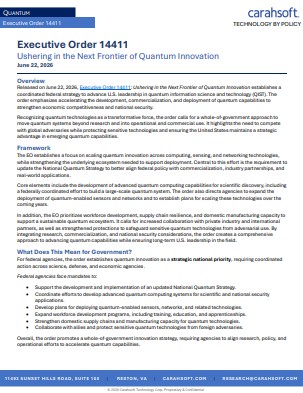
Executive Order 14411: Ushering in the Next Frontier of Quantum Innovation
Executive Order Ushering in the Next Frontier of Quantum Innovation accelerates U.S. leadership in quantum technolo...
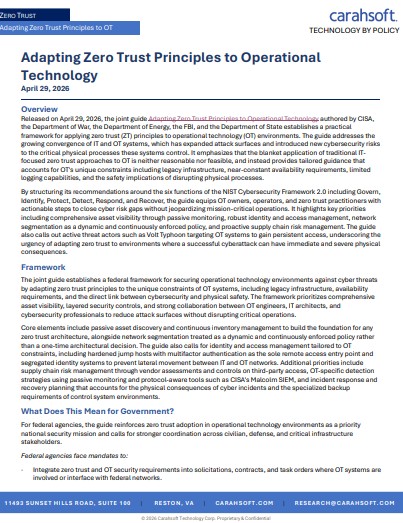
Adapting Zero Trust Principles to Operational Technology
A joint federal guide for applying zero trust principles to OT environments, addressing legacy constraints and help...
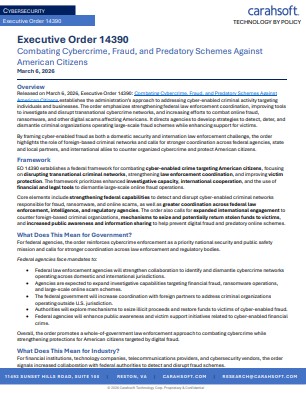
Executive Order 14390: Combating Cybercrime, Fraud & Predatory Schemes Against American Citizens
Executive Order 14390 Strengthens coordination to combat cybercrime, disrupt transnational fraud networks, enhance ...
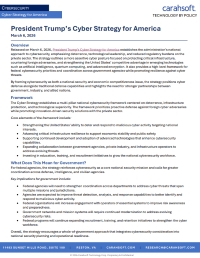
President Trump’s Cyber Strategy for America
Released on March 6, 2026, President Trump’s Cyber Strategy for America establishes the administration’s national approach to cybersecurity, emphasizing deterrence, ...
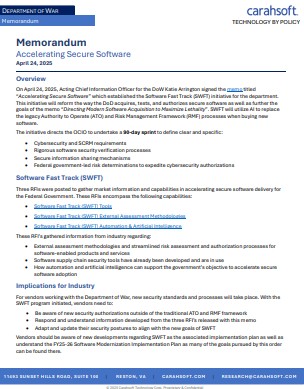
Accelerating Secure Software
Establish the Software Fast Track (SWFT) to streamline how the DoW acquires, tests, and authorities secure software...
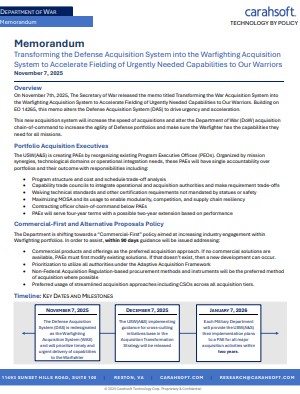
Transforming the Defense Acquisition System into the Warfighting Acquisition System
Encompassing DoW memorandum ordering sweeping acquisition reforms such as establishing new Portfolio Acquisition Executives (PAEs)...
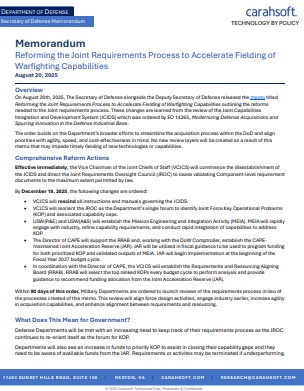
Reforming the Joint Requirements Process to Accelerate Fielding of Warfighting Capabilities
Rescinds the Joint Capabilties Integration and Development System (JCIDS) and establishes new roles and responsibil...
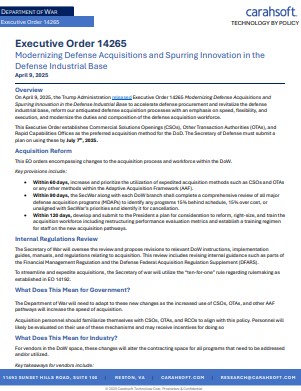
Executive Order 14265: Modernizing Defense Acquisitions in the Defense Industrial Base
Establishes Commercial Solutions Openings (CSOs), Other Transaction Authorities (OTAs), and Rapid Capabilities Offi...
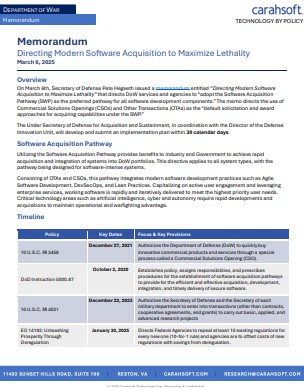
Directing Modern Software Acquisition to Maximize Lethality
Directs the usage of Commercial Solutions Offerings (CSOs) and Other Transaction Authorities (OTAs)as default solic...
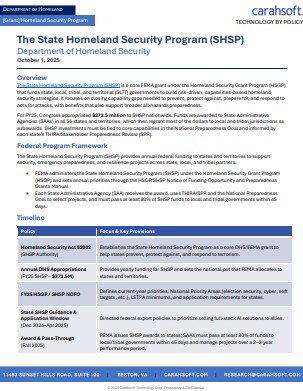
The State Homeland Security Program (SHSP)
FEMA State Homeland Security Program (HSGP) grant of $373.5M awarded to each state/territory’s SAA to fund TH...
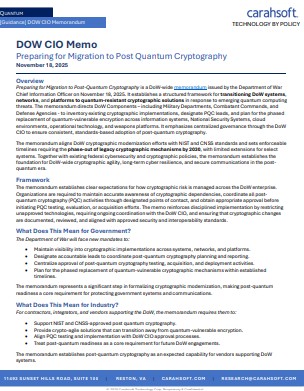
Preparing for Migration to Post Quantum Cryptography
Directs DoW organizations to inventory and transition cryptographic systems to quantum-resistant standards by estab...
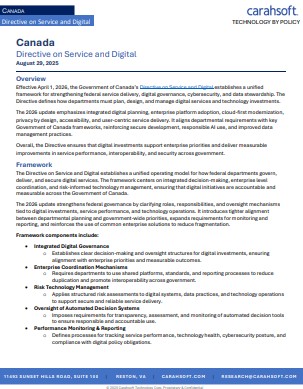
Canada Directive on Service and Digital
The Directive on Service and Digital establishes a government-wide framework for modernizing federal service delive...
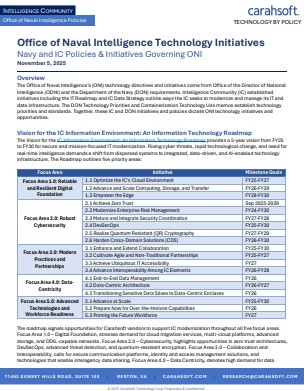
Office of Naval Intelligence Technology Initiatives
Intelligence Community and Department of the Navy technology directives drive the Office of Naval Intelligence’s transition toward a secure, data-centric, and AI-enabled i...
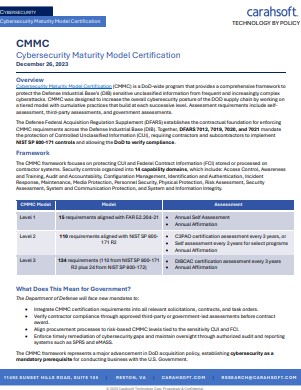
Cybersecurity Maturity Model Certification
A standardized cybersecurity framework for consistent protection of Federal Contract Information and Controlled Unclassified Information across the defense supply chain.
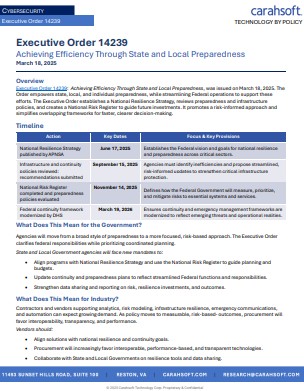
Executive Order 14239: Achieving Efficiency Through State and Local Preparedness
Executive Order 14239 promotes efficient and coordinated emergency preparedness by streamlining state and local rea...
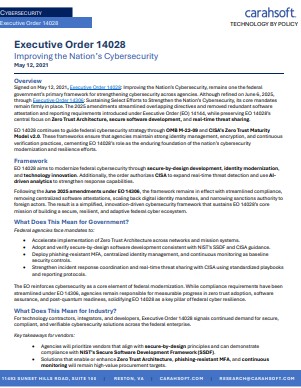
Executive Order 14028: Improving the Nation’s Cybersecurity
Under Executive Order 14028, national cybersecurity is advanced through modernized federal defenses, enhanced incid...
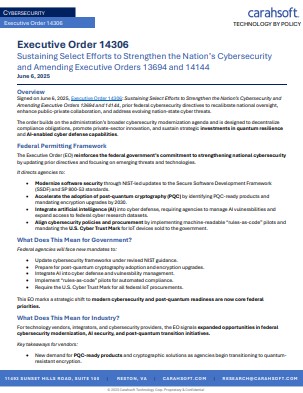
Executive Order 14306: Sustaining Select Efforts to Strengthen the Nation’s Cybersecurity
Strengthens and sustains federal cybersecurity efforts by reinforcing national cyber defenses and updating existing...
Trending Topics: Cybersecurity




Bitwarden Introduces Privileged Controls to Address PAM Deployment Friction as AI-Enhanced Attacks Raise Credential Risk

Socure and NextgenID Partner to Pair AI Identity Intelligence with the Nation’s Only Certified High-Assurance IAL3 Platform
Bitwarden Advances Government Readiness with FIPS 140-3-Validated Cryptographic Module

NDay Security, an NVIDIA Inception Member, Discloses Cyber-Physical Device Vulnerabilities Using Non-Frontier AI Models


 October 29, 2026

 10:00 AM ET





Education: Learn About Cybersecurity Innovation

Community Blog: Trends in Cybersecurity
-
RegScale Named a Sample Vendor in the Gartner® Hype Cycle™ for AI Governance Technologies, 2026
October 14th, 2026
RegScale’s AI-powered CCM approach helps automate compliance, reduce risk and improve audit readiness.
-
The Death of GRC and the Rise of GRR: May the Resilience Be With You
October 12th, 2026
Learn how GRR replaces GRC practices with continuous compliance, real-time assurance and stronger cyber resilience.
- Tagged Cybersecurity, Federal Government, GRC, RegScale
-
The Wright Brothers’ Lesson for Modern Cybersecurity Leaders
October 9th, 2026
Discover how CISO leaders can use data-driven measurement, risk-based prioritization and GenAI governance to maximize cybersecurity investment.
- Tagged Artificial Intelligence, Cyber Workforce Development, Cybersecurity, Governance Risk and Compliance, MyCISO, NIST, State and Local Government, Zero Trust
-
RegScale Recognized in the 2026 Gartner® Market Guide for Regulatory Intelligence Solutions
October 7th, 2026
Learn why Gartner® recognized RegScale in its 2026 Market Guide and how continuous compliance and regulatory intelligence are transforming GRC programs.
-

Rethinking Supply Chain Mission Assurance: How BlueVoyant C-SCRM Helps Agencies Move from Risk Visibility to Risk Reduction
October 6th, 2026
Learn how agencies can operationalize C-SCRM with continuous supplier risk monitoring, validated intelligence and coordinated remediation support.
-
How We Earned CMMC Level 2 by Operating Securely 90% Faster
October 5th, 2026
Learn how RegScale achieved CMMC Level 2 certification by leveraging continuous controls monitoring to reduce assessment effort by 90%.
- Tagged CMMC, Cybersecurity, Department of War, Federal Government, FedRAMP, RegScale
-
Integrating Holistic AI Security: From AI Adoption to AI Governance
October 2nd, 2026
Discover how AI governance, security controls and risk management help organizations securely adopt AI.
-
The Third Ring of Security: Expanding Protective Intelligence for Modern Security Operations
October 2nd, 2026
Discover how Protective Intelligence strengthens situational awareness, supports faster decision-making and enhances event security.
- Tagged Artificial Intelligence, Cybersecurity, Education Technology, Law Enforcement Technology, State and Local Government, Zignal Labs
-

The Top 5 Insights from the SANS 2026 Government Security Forum
September 22nd, 2026
AI is reshaping Federal cyber defense. Explore key insights from the SANS 2026 Government Security Forum on incident response and machine-speed threats.
- Tagged Artificial Intelligence, Axonius, Claroty, Cybersecurity, ExtraHop, Federal Government, Horizon3.ai, Nucleus Security, SANS Institute, Tanium, Wiz