


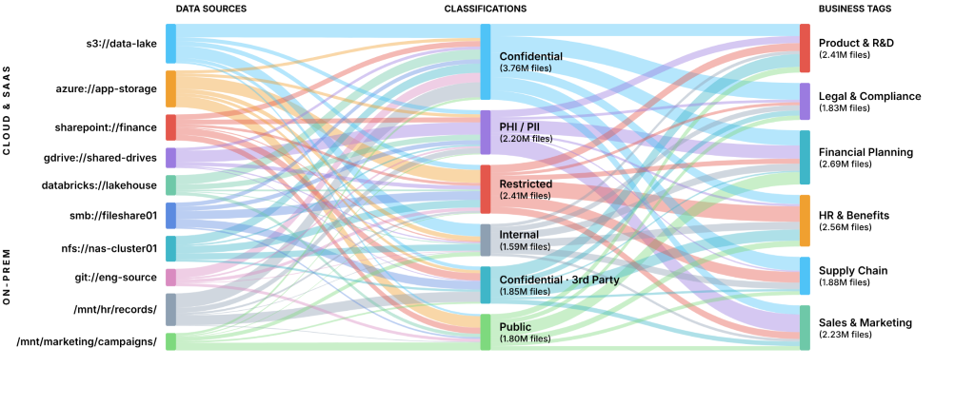
Figure: One view of where agency data lives, how it is classified, and which teams use it, so you can protect sensitive information and put the right data to work.
Government agencies hold some of the most consequential data in the country, citizen records, case files, research, procurement histories, controlled unclassified information, and most of it is scattered across legacy systems, shared drives, and cloud repositories that no one has fully mapped. That gap is now the single biggest obstacle to putting AI to work in the public sector. You cannot responsibly feed a model data you cannot see, classify, or govern.
Secuvy closes that gap. Our AI Data Platform discovers, classifies, and tags agency data wherever it lives, in place, without moving files or disrupting systems of record. Classification is non-pattern based, which means Secuvy identifies sensitive and mission-critical information, CUI, PII, PHI, student records, investigative material, without requiring someone to write rules for every variation in advance. Contextual linkage connects related data across systems to the applications and users touching it, so agencies can finally answer who has access to what, and why.
From there, governance becomes continuous rather than episodic. Discovery runs on an ongoing basis and feeds current results directly into active AI pipelines, so the data reaching a model is the data that should reach it. The same evidence base supports FISMA, FedRAMP, NIST 800-171, CMMC, FERPA, and state privacy requirements, audit readiness as a byproduct of operations, not a separate annual scramble.
The result is measured in weeks, not budget cycles. Agencies deploying Secuvy move from unknown data estates to governed, AI-ready ones fast enough to matter within a program year, and they do it without ripping out existing infrastructure or standing up a new data lake.
Know your data. Protect what matters. Then let your mission teams move at the speed the technology actually allows.
Public sector FAQ
1. Where does Secuvy run, and does our data ever leave our environment?
Secuvy deploys inside your boundary, on-premises, in a government cloud region, or in an air-gapped enclave. Classification happens in place: the platform reads and tags data where it already sits and writes metadata, not copies. No agency data is transmitted to Secuvy, and no file is moved, duplicated, or altered to be analyzed.
2. We already have DLP and a data catalog. Why is this different?
DLP watches data in motion against rules you've already written. A catalog inventories what someone remembered to register. Secuvy works on the unregistered majority, the shared drives, archives, and mailboxes nobody mapped, and identifies sensitive material without a pre-written pattern for each variant. It's meant to sit underneath those tools and feed them, not replace them.
3. How accurate is classification, and who is accountable when it's wrong?
Accuracy improves through a confirm-and-learn loop: Secuvy proposes classifications, your data stewards confirm or correct them, and the model adapts to your agency's actual document types. Every decision is logged with its basis, so a disputed classification can be traced and defended in an audit or a FOIA response rather than attributed to a black box.
4. Half our problem is data we shouldn't still be holding. Does Secuvy help with that?
Yes, the same scan that surfaces sensitive material also surfaces redundant, obsolete, and trivial content, including duplicates spread across shared drives and departed employees' storage. Agencies use the output to support records disposition under their retention schedules, shrink the FOIA and e-discovery review surface, and reduce what's exposed in the first place. Less data to govern is often the cheapest risk reduction available.
5. What does this require from our staff to run?
The scanning and classification are automated; the human effort concentrates in review. You'll want data stewards who know their own records well enough to confirm or correct proposed classifications during the initial tuning period, typically a part-time commitment from a few people per domain, front-loaded and tapering as the model learns your document types. No new data engineering team, and no migration project for your IT staff to absorb.