


Explore Latent AI Solutions
In environments where connectivity is limited or unavailable, AI must operate independently and reliably. Latent AI delivers edge-based solutions that help defense and government teams run AI directly on devices in the field. Whether supporting autonomous systems or enabling secure communication, Latent AI solutions are designed to perform across land, sea, air, and space.
Adapt and Deploy AI in Any Environment
Built for disconnected and forward-deployed operations, Latent AI combines rugged hardware with optimized edge AI software to help teams deploy and manage AI systems wherever the mission requires.
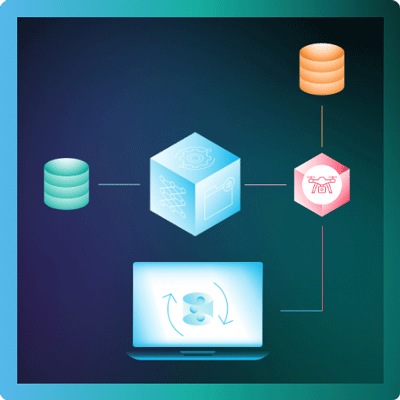
Latent FTS enables teams to configure, deploy, and maintain AI capabilities directly in operational environments. Instead of relying on centralized infrastructure, users can update and refine models at the tactical edge.
Key capabilities include:
- Mission-specific configuration
Adapt AI models to align with platform type, operational goals, and performance requirements, from small unmanned aerial systems to larger autonomous assets. - Scalable autonomous operations
Support both individual systems and coordinated multi-unit deployments in disconnected or contested environments. - On-device sensor processing
Process radar, infrared, electro-optical, and other sensor inputs locally for faster decision-making. - Continuous field optimization
Adjust model performance in real time to improve object detection, tracking, and situational awareness. - Secure operational data collection
Store and analyze mission data locally for post-operation review without external dependencies.
Latent Linguist provides secure, real-time speech translation that works fully offline. It allows personnel to speak, listen, and read across languages in the field without depending on internet access or third-party interpreters.
This solution supports:
- Wearable systems for hands-free mobility
- Desktop and kiosk configurations for interviews or checkpoints
- Vehicle-based and mobile command integrations
- Rack-mounted configurations for multi-user environments
All processing happens directly on rugged hardware. With strong encryption and offline functionality, sensitive information remains protected and stored on the device.
From Development to Deployment
Latent AI’s development ecosystem supports the full lifecycle of edge AI systems, from data preparation through secure deployment. Organizations can accelerate production timelines while maintaining control, security, and performance visibility.
AI Development and Data Tools

This solution streamlines dataset preparation by reducing manual effort while preserving expert validation.
Capabilities include:
- AI-assisted annotation workflows that significantly reduce labeling time
- Intelligent search tools for identifying similar objects, tracking motion, and refining datasets
- Human validation layers to ensure dataset integrity for mission-critical applications
- Recognition through competitive government innovation programs
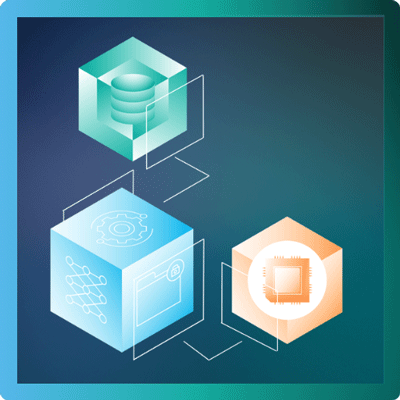
Latent Agent simplifies edge AI development and management by allowing developers to interact with models using natural language prompts. This reduces operational complexity and shortens deployment timelines.
Key advantages:
- Automated model deployment and adaptation workflows
- Rapid iteration from prototype to field-ready implementation
- Integrated monitoring and performance controls
Latent AI Efficient Inference Platform (LEIP)
LEIP provides a structured environment for building, refining, and maintaining AI models optimized for edge hardware. It enables secure experimentation in the lab and seamless transition to field deployment.
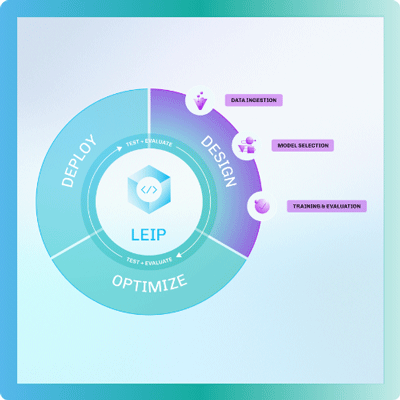
LEIP Design supports selection and refinement of model and hardware combinations based on operational requirements such as power constraints, latency expectations, and memory limits.
Features include:
- Guided workflows that align datasets with validated configuration templates
- Access to a broad library of benchmarked model setups
- Interactive evaluation of performance trade-offs
- Secure retraining pipelines for incorporating new data
- Modular reuse across hardware targets and mission scenarios
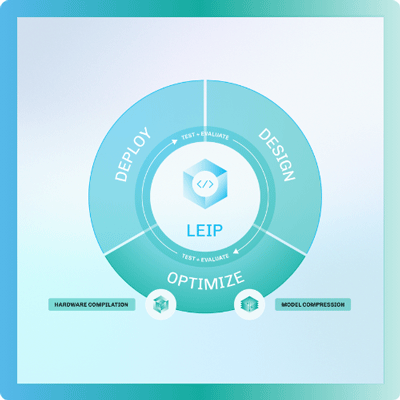
LEIP Optimize automates model adaptation for specific hardware platforms, removing the need for deep hardware specialization.
Capabilities include:
- Compatibility with widely used ML frameworks
- Support for computer vision and transformer-based architectures
- Seamless integration into existing development pipelines
- Model encryption and preparation for multiple hardware targets
- Built-in intellectual property protection features
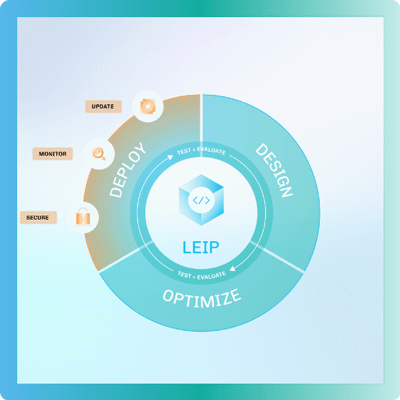
LEIP Deploy delivers a standardized runtime layer that enables secure, consistent deployment across devices.
Core components include:
- Cross-platform runtime compatibility
- Lightweight inference engine
- Support for C++ and Python integrations
- APIs for third-party application connectivity
- Version management and model protection controls
- Real-time performance monitoring
- Model updates without application redesign
Unique identifiers for traceability and governance