GTS VirtualHealth
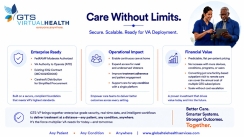
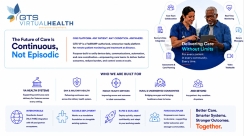
Care Without Limits
FedRAMP-Authorized Virtual Care Infrastructure for Federal Healthcare
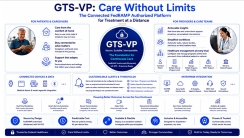
GTS VirtualHealth, also known as GTS-VP, helps federal healthcare organizations monitor, engage, and manage patients beyond facility walls through one secure virtual care platform.
Purpose-built for public sector healthcare, GTS-VP supports remote patient monitoring, treatment-at-a-distance, patient engagement, secure communication, assessments, education, care coordination, and clinical workflow support across home, outpatient, community, transitional, and selected inpatient care environments.
Unlike traditional remote patient monitoring tools that focus primarily on collecting device data, GTS-VP helps care teams turn patient information into coordinated action.
FedRAMP Moderate Authorized
VA Authority to Operate (ATO)
VA IDIQ Contract #36C10A23D0005
Request a Demo | Schedule a Consultation
Secure Infrastructure for Continuous Care
Federal healthcare organizations are being asked to expand access, improve outcomes, reduce avoidable utilization, and support care beyond traditional facility-based encounters.
The challenge is not simply adding more digital tools.
The challenge is deploying secure, scalable infrastructure that can operate inside federal requirements while supporting real clinical workflows.
GTS-VP provides that foundation.
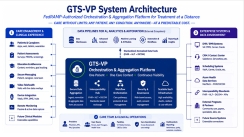
The platform enables care teams to maintain visibility into patient status, support earlier intervention, strengthen patient engagement, and coordinate care across patients, caregivers, providers, and programs.
What GTS-VP Enables
GTS VirtualHealth brings together the core capabilities required to deliver remote care and treatment-at-a-distance through a single platform.
GTS-VP supports:
- Remote patient monitoring
- Secure patient, caregiver, and provider messaging
- Integrated video telehealth
- Structured assessments and surveys
- Patient education and digital content delivery
- Care plan support
- Clinical alerting and escalation workflows
- Approved device and data integration
- Population dashboards and longitudinal patient visibility
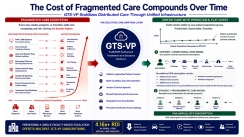
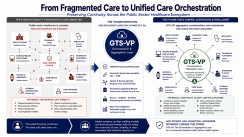
By consolidating these capabilities, GTS-VP helps reduce fragmentation, improve workflow continuity, and give care teams a more complete view of patient activity between encounters.
One Platform. Multiple Care Models.
GTS-VP supports a wide range of federal healthcare use cases, including:
- Chronic disease management
- Post-acute and transitional care
- Rural and access-constrained populations
- Behavioral health and patient engagement
- Specialty and complex care programs
- Rehabilitation and recovery workflows
- Multi-condition patient management
The platform allows care teams to support patients across multiple conditions, devices, workflows, and care pathways without requiring separate point solutions for each program.
Designed to Complement Existing Investments
Healthcare organizations rarely start with a blank slate.
GTS-VP can operate as a standalone virtual care platform or integrate alongside existing remote patient monitoring tools, medical devices, EHR environments, patient engagement systems, and clinical workflows.
This allows agencies to extend current infrastructure, improve visibility, and coordinate care without forcing unnecessary replacement of systems that already work.
Built for Federal Healthcare
GTS VirtualHealth is designed for the security, compliance, interoperability, and acquisition realities of federal healthcare.
The platform is FedRAMP Moderate Authorized, operates under a VA Authority to Operate, and is available through VA IDIQ Contract #36C10A23D0005 and Carahsoft public sector acquisition pathways.
GTS-VP supports standards-based interoperability, including FHIR and HL7, and is designed to help healthcare organizations connect data, devices, workflows, and care teams across complex operating environments.
Predictable Economics for Scalable Virtual Care
Many virtual care and RPM solutions become more expensive as organizations add conditions, devices, workflows, or care team members.
GTS-VP uses a flat per-patient pricing model designed to support scalable virtual care with greater budget predictability.
A patient can be supported across multiple conditions, devices, care teams, and workflows within the same platform license. This allows organizations to expand care delivery without introducing separate software cost escalators for every added layer of complexity.
Move Beyond Traditional RPM
Federal healthcare organizations need more than remote patient monitoring.
They need secure virtual care infrastructure that supports continuous patient engagement, coordinated care delivery, clinical visibility, interoperability, and treatment-at-a-distance across the continuum of care.
GTS VirtualHealth provides that foundation.
Care Without Limits. Any patient. Any condition. Anywhere.
Request a Demonstration | Schedule a Consultation | Contact GTS VirtualHealth
Frequently Asked Questions
GTS VirtualHealth (GTS-VP) is a FedRAMP Moderate Authorized virtual care and treatment-at-a-distance platform that enables healthcare organizations to remotely monitor, engage, educate, and manage patients across home, outpatient, community, transitional, and selected inpatient care environments. The platform combines remote patient monitoring, patient engagement, care coordination, clinical workflow automation, assessments, education, and interoperability into a unified virtual care infrastructure.
Yes. GTS VirtualHealth provides comprehensive remote patient monitoring (RPM) capabilities, including connected medical devices, patient-reported outcomes, real-time monitoring, clinical alerts, dashboards, and care coordination workflows. Unlike many RPM solutions, GTS-VP also supports treatment-at-a-distance, virtual care delivery, patient engagement, assessments, education, secure communications, and workflow automation through a single platform.
Many remote patient monitoring solutions focus primarily on collecting and displaying patient data. GTS VirtualHealth helps healthcare organizations operationalize that data through patient engagement, care coordination, treatment-at-a-distance workflows, clinical alerts, educational content, secure communications, and workflow automation. The platform functions as both a remote patient monitoring solution and a broader virtual care infrastructure platform.
Yes. GTS VirtualHealth can function as a standalone remote patient monitoring and virtual care platform or integrate alongside existing RPM solutions, telehealth platforms, electronic health records, medical devices, patient engagement tools, and source systems. Organizations can use GTS-VP to extend, connect, orchestrate, and maximize the value of existing technology investments without requiring a complete replacement of current systems.
Yes. GTS VirtualHealth supports standards-based interoperability, including HL7 and FHIR, enabling integration with electronic health records, healthcare data exchanges, Azure Health Data Services, connected medical devices, and other clinical systems. The platform is designed to aggregate, normalize, and operationalize information across multiple systems to improve clinical visibility and workflow efficiency.
GTS VirtualHealth was designed for Federal healthcare organizations, Veterans health programs, military healthcare environments, public health systems, hospital systems, specialty care programs, academic medical centers, and healthcare organizations supporting geographically dispersed patient populations.
GTS-VP supports a broad range of clinical programs, including cardiology, hypertension, diabetes, chronic obstructive pulmonary disease (COPD), chronic kidney disease, behavioral health, PTSD, ALS, multiple sclerosis, dementia care, spinal cord injury and disorders (SCI/D), chronic pain management, rehabilitation, post-acute recovery, and hospital-at-home initiatives. The platform was designed to support multiple conditions through a single patient profile and operational framework.
Yes. While GTS VirtualHealth was purpose-built for treatment-at-a-distance, remote patient monitoring, chronic disease management, and care-at-home programs, the platform also supports continuity of care across outpatient, community-based, transitional, rehabilitation, long-term care, and selected inpatient environments where care teams require enhanced visibility and coordination.
Yes. GTS VirtualHealth helps healthcare organizations expand access to care for rural, remote, mobility-limited, and underserved populations by enabling continuous monitoring, virtual care delivery, patient engagement, and treatment-at-a-distance regardless of geographic location.
GTS VirtualHealth creates a unified operational environment where patients, providers, caregivers, devices, workflows, and source systems can work together through a single platform. By reducing fragmentation and improving visibility across the continuum of care, healthcare organizations can improve patient engagement, treatment adherence, workflow efficiency, and clinical decision-making.
GTS VirtualHealth provides the digital infrastructure necessary to support remote patient monitoring, treatment-at-a-distance, hospital-at-home programs, chronic disease management, patient engagement, population health initiatives, and enterprise virtual care strategies. Organizations can deploy GTS-VP as a standalone platform or as an orchestration layer connecting existing technologies to accelerate digital health transformation.
GTS VirtualHealth combines remote patient monitoring, patient engagement, care coordination, interoperability, clinical workflow automation, and treatment-at-a-distance capabilities into a single platform. Organizations can expand patient populations, add new clinical programs, connect additional devices, and support more complex care pathways while maintaining operational consistency and predictable costs.