


Bacula Solutions for the Public Sector
Bacula Enterprise is the backup and data protection platform of choice for the world's most demanding public sector and research environments — including Idaho National Laboratory, NASA, Sandia, and the U.S. Department of Defense supply chain, alongside leading research universities such as Harvard, MIT, and Carnegie Mellon. Built on a modular, Linux-native architecture with 45+ enterprise plugins and predictable per-agent/core licensing, Bacula protects everything from classified workloads and exascale HPC clusters to mainframes, hybrid clouds, and cloud-native containers — without the per-workload license tax of legacy platforms.
Enterprise Plugins
PB Largest Deployment
Years in Production
Validated Crypto
Per-Workload License Tax
On This Page
Core Platform
Bacula Enterprise Edition
Bacula Enterprise is a high-performance, modular backup and recovery platform engineered for environments where the cost of an outage is measured in millions — and where the cost of the backup software itself can no longer scale linearly with the data being protected.
Unlike legacy platforms that charge per-TB, Bacula Enterprise uses a predictable per-agent/core subscription model that decouples software cost from data growth. The same subscription protects physical servers, virtual machines, containers, databases, mainframes, cloud workloads, SaaS applications, and HPC parallel filesystems.
Predictable Economics
Per-agent/core subscription model eliminates per-TB licensing surprises and scales to exabyte deployments.
Open Architecture
Built on open standards with full SBOM transparency. No vendor lock-in. No proprietary appliance required.
Linux-Native Server
Hardened Linux backup server architecture eliminates Windows-class attack surface from the backup control plane.
Enterprise Support
Expert global support from Bacula Systems engineers — the original developers and maintainers of the platform.
Architecture
Open, Modular, Linux-Native Architecture
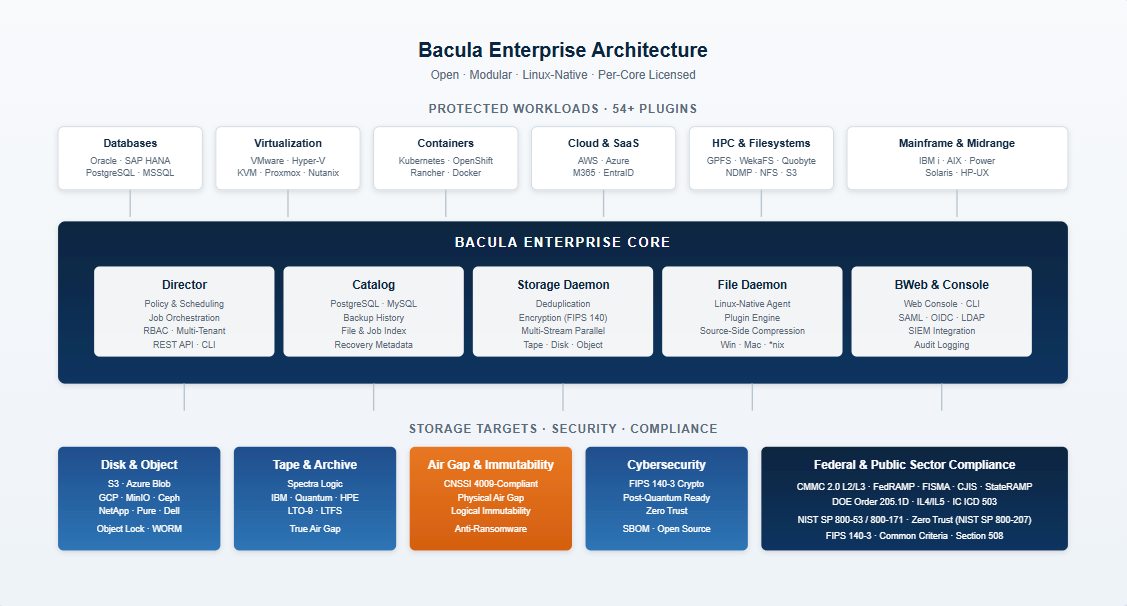
Bacula's three-daemon architecture — Director, Storage Daemon, and File Daemon — provides clean separation of policy, data movement, and source-side processing. Each component scales independently, runs on commodity hardware, and integrates with existing identity, monitoring, and security infrastructure.
Director
Centralized policy, scheduling, catalog, and RBAC. Multi-tenant ready. Full REST API. SAML, OIDC, and LDAP authentication. SIEM-ready audit logging.
Storage Daemon
Pluggable storage layer supporting tape libraries, disk pools, S3-compatible object storage, deduplication appliances, and air-gapped media — concurrently.
File Daemon
Lightweight agent runs on Linux, Windows, macOS, AIX, Solaris, and HP-UX. Source-side compression, encryption, and plugin execution.
Why Linux-Native Matters
The backup server itself is not a Windows machine. The control plane, catalog database, and storage daemons run on hardened Linux — removing an entire class of attack surface that affects every Windows-based backup platform.
For deeper technical detail, see the Bacula Linux-vs-Windows Backup Architecture whitepaper available in the Resources section.
Coverage
Plugin Ecosystem — 45+ Enterprise Plugins
Where competitors charge separately for VM protection, cloud connectors, application-aware backup, and database modules, Bacula Enterprise includes its full plugin ecosystem in the base subscription. One license. Every workload.
Databases
10
- Oracle (RMAN-integrated)
- Microsoft SQL Server
- PostgreSQL · MySQL · MariaDB
- SAP HANA · SAP on Oracle
- MongoDB · IBM Db2 · Sybase
- InterSystems IRIS
Virtualization
11
- VMware vSphere (CBT)
- Microsoft Hyper-V
- KVM / libvirt · KubeVirt
- OpenStack · OpenShift Virtualization
- Proxmox VE · Nutanix AHV
- Oracle VM · XenServer · RHEV
Containers & Cloud-Native
5
- Kubernetes (CSI snapshots)
- Red Hat OpenShift
- Rancher · Tanzu · EKS/AKS/GKE
- Docker
- Longhorn
Cloud & SaaS
5
- Amazon Web Services (AWS)
- Microsoft Azure
- Microsoft 365
- Microsoft Entra ID
- Google Workspace
HPC & Filesystems
7
- IBM Storage Scale (GPFS)
- WekaFS · Quobyte
- HPCAccelerator
- NDMP (filer integration)
- Object Storage (S3 protocol)
- NFS / CIFS / SMB
Mainframe & Midrange
4
- IBM i (AS/400)
- IBM AIX
- HP-UX
- Solaris (SPARC & x86)
Applications
4
- Microsoft Exchange
- Microsoft SharePoint
- SAP
- Active Directory · LDAP
Each plugin is purpose-built by Bacula engineers, fully documented, and supported under the same enterprise contract. The complete Bacula Enterprise Plugin Configuration Guide is available in the Resources section.
Cyber Resilience
True Air Gap & Cybersecurity
Most backup vendors marketing "air gap" deliver immutability — a logical control on a system that is still network-connected. Bacula Enterprise delivers a CNSSI 4009-compliant true air gap, where the backup media is physically disconnected from any reachable network during the protected interval. This is the standard required by classified environments, the IC, DOE Order 205.1D for energy sector cyber security, and serious financial-services threat models.
Physical Air Gap (CNSSI 4009)
Tape libraries with scheduled load/unload cycles, rotating offline media pools, and out-of-band orchestration. The gold standard for ransomware-proof recovery.
Logical Immutability
S3 Object Lock (Compliance & Governance modes), Linux ext4/XFS append-only volumes, and WORM-mode disk pools — for operational tiers that need fast recovery with strong tamper resistance.
FIPS 140-3 Validated Crypto
End-to-end AES-256 encryption with FIPS 140-3 validated cryptographic modules, satisfying federal procurement and DoD encryption requirements.
Post-Quantum Ready
Roadmap support for NIST-selected post-quantum algorithms (ML-KEM, ML-DSA) for long-retention archive protection against harvest-now-decrypt-later threats.
Zero Trust Architecture
Mutual TLS between all daemons. Per-job credentials. RBAC with attribute-based access control. Aligned with NIST SP 800-207.
SBOM & Open Source Transparency
Full Software Bill of Materials provided per release. Open-source heritage means full code auditability — no opaque appliance firmware.
High-Performance Computing
HPC & Research Computing
Bacula is the data protection platform of choice for the world's most demanding scientific computing environments. From DOE national laboratories running classified weapons codes to NASA mission-data systems and the research computing centers at Harvard, MIT, and Carnegie Mellon, Bacula handles billions of files and exabyte-class environments where every other backup platform fails to scale.
Parallel Filesystem Support
Native plugin support for IBM Storage Scale (GPFS), WekaFS, Quobyte, and HPCAccelerator. NDMP integration for filer environments. Direct S3 protocol support for Ceph and other object-based backends.
Scale-Out Architecture
Designed for petabyte-scale environments with thousands of concurrent backup streams. Linear scalability — add Storage Daemons as data volumes grow, without re-architecting the platform.
Tape Library Mastery
Native Spectra Logic, IBM TS4500, Quantum Scalar, and HPE StoreEver integration. LTO-9, LTFS, and dual-copy archive workflows out of the box.
HPC Scheduler Integration
Slurm, PBS, and LSF compatibility — backup jobs can be queued, prioritized, and throttled alongside compute workloads without disrupting science.
Cloud & Hybrid
Cloud & Hybrid Cloud Protection
Bacula Enterprise runs natively in major public clouds and bridges them seamlessly with on-premises and classified environments. The same per-agent/core license covers every cloud, every region, every workload — with no surcharges for cross-cloud movement or restore-out fees.
Amazon Web Services (AWS)
Native EC2, EBS, RDS, and S3 protection. AWS Marketplace listing for streamlined procurement. Government cloud region availability under verification.
Microsoft Azure
VM, SQL, Blob, and Files protection. Azure Marketplace availability with simplified billing through CSP and direct enterprise agreements.
Hybrid & Multi-Cloud
One Director can orchestrate backups across on-prem, sovereign cloud, and commercial cloud simultaneously — with policy-based tiering and replication.
S3 Object Lock
Compliance and Governance modes both supported. Cross-region replication. Glacier tiering. Bring-your-own-key (BYOK) and customer-managed CMK encryption.
Cloud-Native
Container & Kubernetes Protection
Bacula provides application-consistent, cluster-aware backup and recovery for Kubernetes — including stateful workloads, persistent volumes, custom resource definitions, and full namespace migration. The Bacula Kubernetes plugin runs as a CSI-aware operator, leveraging native volume snapshots while preserving cluster-state portability.
Distribution Coverage
Kubernetes (vanilla), Red Hat OpenShift, Rancher, VMware Tanzu, AWS EKS, Azure AKS, Google GKE, and on-prem distributions.
Stateful Application Support
Application-quiesced snapshots for databases running in pods (PostgreSQL, MongoDB, MySQL, etc.) using pre/post-snapshot hooks.
Cluster Migration
Backup from one cluster, restore to another — including across cloud providers and across air-gapped environments.
Persistent Storage
Longhorn, CSI snapshot APIs, and block-storage backup for stateful workloads. Application-aware backup of databases inside pods.
Federal & Public Sector Standards
Compliance & Federal Standards
Bacula Enterprise is engineered for the regulatory landscape of U.S. federal, state, and local government — with detailed compliance mappings published as Bacula whitepapers (available in the Resources section) covering each major framework.
CMMC 2.0 (Levels 2 & 3)
Defense Industrial Base contractor data protection. NIST SP 800-171 Rev. 2 control mapping.
FedRAMP / FISMA
Federal cloud authorization. Moderate and High baseline control coverage. NIST SP 800-53 Rev. 5.
DoD Impact Levels
IL2, IL4, and IL5 deployment patterns documented for major government cloud platforms.
CJIS Security Policy
FBI Criminal Justice Information Services compliance for state and local law enforcement.
StateRAMP
State government cloud authorization. Aligned with state-level NASPO and ValuePoint requirements.
DOE Order 205.1D
Department of Energy cybersecurity program. Critical for national lab and energy sector deployments.
IC ICD 503
Intelligence Community Directive — IT systems risk management framework.
FIPS 140-3
Validated cryptographic modules for federal procurement compliance.
Zero Trust (NIST SP 800-207)
Architectural alignment with federal Zero Trust mandate. CISA Zero Trust Maturity Model coverage.
Section 508
Accessibility compliance for the BWeb administrative interface.
IEC 62443 (OT)
Industrial control system security for OT and critical infrastructure deployments.
TISAX / VDA ISA
Automotive-sector compliance for U.S. defense supply chain and global OEM partners.
Contact Us
Bacula Systems Team at Carahsoft
Email: BaculaSystems@carahsoft.com
Phone: (888) 662-2724