


Forecast environmental risk before it becomes operational disruption.
An operationalization layer — not a replacement for NASA science.
NASA's pain points map to three gaps HelioShield can address.
Lead-Time + Observability
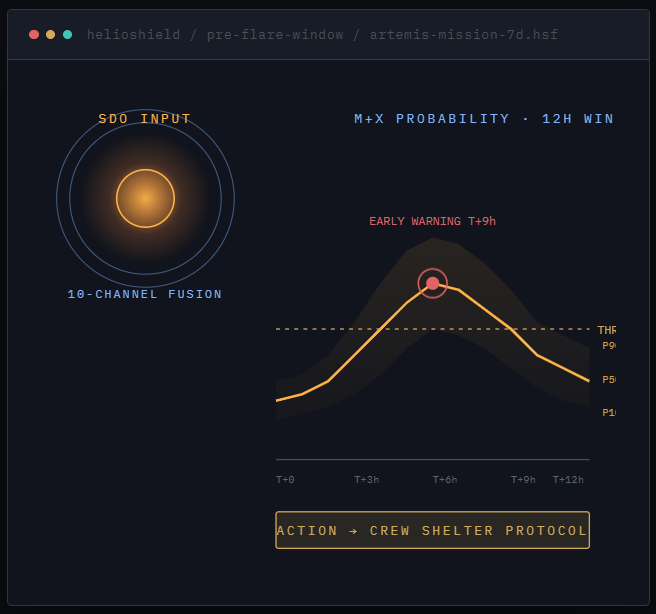
HelioShield pulls signal upstream from solar imagery before the in-situ decision window closes. The goal is earlier indication of potentially consequential solar activity — before the event unfolds at L1 — extending the time available to plan, position, or shelter.
Rare Severe Events + Uncertainty
Mission-relevant risk lives in the rare tail. HelioShield is optimized for M+X relevance, multi-wavelength fusion, and uncertainty bands rather than mean-case skill. Operators get decision-ready percentile outputs, not just point predictions.
Research-to-Operations
NASA has science assets; operators need calibrated thresholds, lead-time skill, and repeatable decision-ready outputs. HelioShield is the R2O bridge — translating benchmark-grade research into outputs that fit mission tempo, audit trails, and threshold logic.
What HelioShield does today.
M+X recall @ 12h
Transformer pre-flare forecaster on held-out archival data. Optimized for rare-event recall, the metric mission operators actually need.
M+X F1
Top CaiT (class-attention image transformer) classifier result on 10-channel SDO imagery. Multi-wavelength fusion, not single-channel skill.
UQ percentiles
Quantile outputs already implemented for threshold-based decisions. Operators get bands, not just point estimates.
Public data sources
Integrated pipeline: 9,222 samples × 198 engineered features. Reproducible from public sources end-to-end.
Honest Bounds — Still Unproven
Skill vs. climatology and persistence baselines, false-alarm ratio by lead time, real-time inference at operational tempo, and downstream geomagnetic validation remain open work. HelioShield is presented as a credible operationalization layer in development — not a finished operational system. The path from these archival-data results to a NASA pilot is the conversation we want to have.
An upstream warning layer for Artemis-era operations.
- Lead-time improvement measured against accepted baselines — climatology, persistence, and current operational forecasts.
- Rare-event recall on trusted, agency-curated event sets, not on cherry-picked test windows.
- UQ calibration on workflow thresholds operators already use, so percentile outputs map cleanly to existing decision logic.
- Mission-aligned outputs sized to crew-protection windows, EVA planning cycles, and Artemis-era operational tempo.
- Audit trail for every prediction — provenance, model version, input data window, confidence band, and threshold trigger.
Today, conditional, and roadmap.
Pre-flare warning layer
SDO multi-wavelength imagery → transformer pre-flare forecaster → quantile uncertainty outputs → threshold-aligned alerts. Operating end-to-end on archival data; real-time inference is the next milestone.
NVIDIA Earth-2 / PhysicsNeMo coupling
Pair HelioShield with Earth-2 / PhysicsNeMo-class terrestrial models as a downstream consequence layer for atmosphere-density, drag, and environment-aware mission planning. Subject to access and integration scope.
Geomagnetic validation extension
Downstream geomagnetic validation — connecting solar pre-flare prediction to ground-side and near-Earth impact. Planned post-pilot once the warning layer demonstrates lead-time skill against operational baselines.