Secure, Cost-Effective Data Protection for Kubernetes & KubeVirt
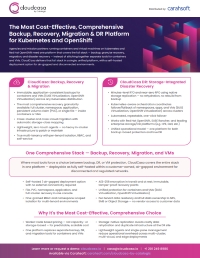
CloudCasa by Catalogic helps public sector organizations modernize data protection for Kubernetes and containerized VMs (OpenShift Virtualization, SUSE Virtualization, Spectro Cloud Palette VMO) while meeting strict requirements for security, resiliency, and operational simplicity, at the most cost-effective price point on the market.
As agencies increasingly adopt cloud-native platforms to deliver digital services, CloudCasa provides a centralized, policy-driven backup and disaster recovery solution that protects mission-critical workloads across on-premises, hybrid, and multi-cloud environments.
Operational Resilience and Fast Recovery
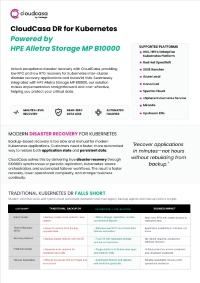
CloudCasa enables fast and reliable recovery from outages, cyber incidents, or regional failures—supporting continuity of operations (COOP) and disaster recovery (DR) mandates.
Agencies can recover individual applications or VMs, entire clusters, or complete environments across regions or clouds, reducing downtime and operational risk.
Governance & Compliance
CloudCasa also addresses public sector governance and compliance needs. Built-in encryption, role-based access controls, and audit-friendly workflows help organizations align with security and regulatory requirements, while flexible deployment options—including SaaS and self-hosted models—support data sovereignty, isolated networks, and air-gapped environments.
Cost & Simplicity
By eliminating the need for complex backup infrastructure, CloudCasa lowers operational overhead and allows IT teams to focus on delivering citizen services rather than managing tooling.
Its Kubernetes-native architecture integrates seamlessly with platforms such as Red Hat OpenShift, SUSE Rancher and major cloud providers (AWS EKS, Azure AKS, etc.), making it well-suited for agencies at any stage of cloud adoption.
Why CloudCasa for Public Sector?
Overall, CloudCasa enables public sector organizations to protect critical data, improve resiliency, and confidently scale cloud-native initiatives—while maintaining the security, control, and compliance required for government and regulated environments.
At 1/3 the cost of alternatives on the market, CloudCasa helps keep costs down, allowing more of the constantly shrinking budget to be used on other solutions.