From Compliance to Capability: Key Insights from CS5 CMMC Global Conference 2025

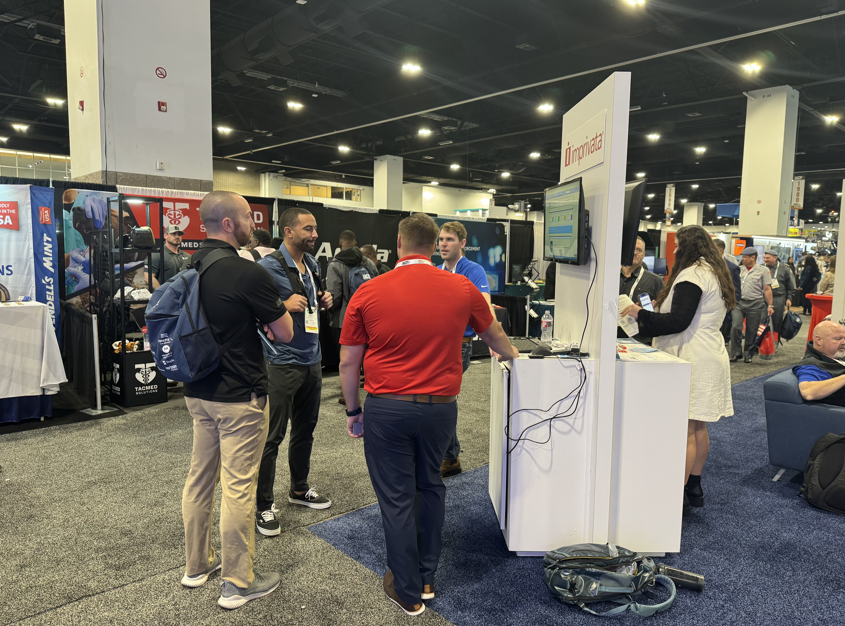
The CS5 CMMC Global Conference 2025, the official conference of The Cyber AB, brought together more than 1,000 senior leaders from the Department of War (DOW), the Cyber AB, Federal agencies and the broader Defense Industrial Base (DIB) in Washington, D.C. The conference served as the essential gathering for defense contractors and DIB suppliers to chart the next phase of Cybersecurity Maturity Model Certification (CMMC) implementation, cyber resilience and supply chain security.  Speakers explored key themes, including:

  • CMMC’s Next Phase: Turning Compliance into Capability and Defending the Digital Nation
  • AI-Driven Compliance
  • Driving Operational Excellence through Documentation
  • Combat Readiness: Scaling Across the Defense Ecosystem
  • Strengthening Supply Chain Resilience

CMMC’s Next Phase

Turning Compliance into Capability

CMMC’s next phase represents precision in action and marks a national shift from policy compliance to operational defense. The United States now views information security as a foundational element of national defense. Safeguarding Controlled Unclassified Information (CUI), whether technical information, operational intelligence or logistical data, is inseparable from mission readiness and warfighter support. The DIB now operates as the digital frontline of national security, where compliance is no longer optional but an essential layer of protection.

Defending the Digital Nation

Contractors demonstrate that they not only meet Federal requirements but also actively share the responsibility of defending the nation’s digital infrastructure. CMMC represents both a compliance framework and a patriotic commitment to protecting critical information, ensuring that data remains secure in an era where proximity to the battlefield no longer determines risk.

AI-Driven Compliance

Artificial Intelligence is transforming the CMMC landscape by acting as a force multiplier for speed, accuracy and operational efficiency. Across the Defense Industrial Base, AI-enabled tools are drafting policies, tagging evidence, detecting anomalies and summarizing documentation that once required extensive manual effort. Large language models (LLMs) can rapidly produce preliminary content that validates cybersecurity readiness and synthesizes complex data, enabling DIB contractors to prepare security readiness at scale. Speakers emphasized the need for human oversight to ensure that AI-generated output is validated and aligned with compliance integrity, as automation without governance creates new vulnerabilities. In practice, organizations should leverage AI to enhance efficiency and maintain traceable audit trails, while reserving decision-making, evidence validation and risk assessment for qualified staff. 

When implemented responsibly, AI enables a balanced model of collaboration between human expertise and machine efficiency, accelerating readiness without compromising accountability or security.

Driving Operational Excellence through Documentation

Governance, Risk and Compliance (GRC) platforms serve as key accelerators by automating version controls, maintaining audit trails, centralizing repositories and linking policies directly to evidence. Updating documentation frequently ensures team alignment and simplifies compliance upkeep as levels role out and evaluations are conducted. Embedding documentation into corporate culture ensures long-term sustainability and empowers teams to focus on meaningful security efforts rather than reactive updates.

Best Practices:

  • Automate version controls and standardizes templates to ensure consistency
  • Use GRC systems to consolidate documentation and eliminate silos
  • Treat documentation as continuous validation: write it, organize it and prove it
  • Integrate compliance reviews into routine workflows to sustain readiness and confidence

Combat Readiness: Scaling Across the Defense Ecosystem

The official enforcement of Title 48 of the Code of Federal Regulations on November 10, 2025, will operationalize CMMC as a mandatory requirement for Federal contracts, transforming cybersecurity from a best practice into an enforceable procurement standard across the DIB.

As CMMC Phase 1 begins, compliance must be achievable and affordable, particularly for small and mid-sized contractors that anchor the defense supply chain. Organizations should use this time to budget to train and develop strategies for compliance, leveraging hyperscalers and automation to accelerate readiness. Speakers emphasized that scalable readiness, supported by harmonized frameworks and the reduction of overlapping requirements, is critical to sustaining momentum toward full certification.

Early preparation is essential, as a limited number of assessors may create scheduling delays once enforcement expands. Companies that act now by documenting, training and aligning their operations with Federal standards will not only meet compliance expectations but also reinforce their resilience, competitiveness and commitment to securing the nation’s defense ecosystem.

Strengthening Supply Chain Resilience

High-profile cyber intrusions reaffirmed a simple truth: supply chain security is the foundation of national security. Every organization must know what it protects, how it protects it and how that protection is verified through certification. Compliance is no longer just a cost of doing business; it is both a competitive advantage and a national defense imperative. Contractors should prepare their teams to understand eligibility requirements, strengthen internal controls and treat certification as an investment in long-term success. By embedding compliance into corporate culture and operational workflows, companies not only safeguard data but also enhance brand credibility, reduce systemic risk and ensure continuity of operations across the DIB.

Each contractor that fortifies its cyber posture strengthens the resilience of the entire supply chain because securing the DIB is securing the nation.

How Carahsoft Can Help

Whether your organization is preparing for its first CMMC assessment or advancing its cybersecurity maturity, there are continuous opportunities to strengthen readiness and collaboration across the Defense Industrial Base.

Explore CMMC Resources

Visit Carahsoft’s CMMC page to access compliance guides, vendor solutions and educational content designed to support Defense Industrial Base organizations at every maturity level. From understanding capability domains to preparing for assessments, our resources help organizations make informed decisions throughout their CMMC journey.

Download our comprehensive Cybersecurity Maturity Model Certification Framework Guide to understand the requirements, assessment processes and best practices for achieving CMMC compliance across all maturity levels.

Connect with CMMC Experts

Gaining CMMC compliance can be a complex and time-consuming process, but Carahsoft can guide your organization through every stage. Partnered with more than 200 cybersecurity vendors, Carahsoft connects DIB organizations with the right technologies, service providers and experts to address every maturity level and capability domain.

Contact the Carahsoft Team at (888) 662-2724 or CMMC@carahsoft.com to discuss your organization’s specific compliance needs and discover tailored solutions from our network of cybersecurity partners.

Attend Upcoming CMMC Events

Stay informed on the latest CMMC developments through Carahsoft-hosted workshops, webinars and training sessions. Through our network of partners, policy insights and educational events, Carahsoft helps organizations advance their cybersecurity maturity and meet evolving compliance requirements. Register to receive updates on upcoming CMMC-focused events and training opportunities.

Building the Future of Higher Education Through Strategic Partnerships

After more than 20 years of simplifying and facilitating technology procurement for higher education institutions, Carahsoft has developed a unique perspective: the greatest opportunities for innovation emerge when technology providers and campus leaders work together strategically, not just transactionally. Today’s most successful higher education IT initiatives share a common thread — they’re built on partnerships that align institutional needs with provider capabilities from the start.

This collaborative approach is transforming how campuses modernize infrastructure, strengthen cybersecurity and enable research excellence. Here’s what we’ve learned about building partnerships that deliver measurable results.

Understanding the Higher Education Technology Landscape

Campus CIOs are leading one of the most exciting periods of transformation in higher education history. The integration of Artificial Intelligence, machine learning and advanced analytics is opening new possibilities for research, student success and operational efficiency. At the same time, institutions are successfully navigating budget optimization, evolving institutional priorities and the ongoing need to strengthen cybersecurity posture.

From our vantage point as a Public Sector distributor working with hundreds of technology providers, resellers, implementation partners and thousands of institutions, we see tremendous momentum. Campuses are successfully deploying innovative solutions. Providers are developing platforms specifically designed for the unique needs of higher education. The opportunity now is to accelerate this progress through stronger collaboration and shared service.

What Campus Leaders Need to Succeed:

The most effective technology investments share common characteristics. They align with institutional strategy while delivering quick return on investment. They address current staffing realities rather than requiring extensive internal expertise. They integrate seamlessly with existing systems and workflows. Most importantly, they come with implementation support that helps institutions realize value quickly.

What Technology Providers Understand:

Leading providers recognize that higher education is a diverse marketplace with unique needs across institutions. A comprehensive research university has different needs than a liberal arts college or community college system. Successful vendors tailor their offerings to match institutional capacity which provides modular implementations that can scale over time as budgets and expertise grow.

Carahsoft’s Unique Position in Higher Education Technology

Our role as The Trusted Education IT Solutions Provider® and a Public Sector distributor gives us a distinctive perspective that benefits both institutions and providers. We facilitate numerous higher education technology transactions annually through cooperative contracts like OMNIA Partners, NASPO ValuePoint, The Quilt, E&I Cooperative Services and Internet2. This position allows us to see patterns and opportunities that emerge across the entire ecosystem.

View Carahsoft’s comprehensive suite of EdTech Contracts.

Operational Intelligence That Drives Better Outcomes:

Through more than two decades of higher education partnerships, we’ve developed deep knowledge of what drives successful technology adoption. We understand which contract vehicles institutions prefer and why. We know which implementation approaches deliver the fastest time-to-value. We’ve seen which vendor partnerships create the most sustainable long-term relationships.

This intelligence allows us to facilitate introductions and partnerships with a high probability of success. When a campus CIO describes their modernization goals, we can connect them with providers who have delivered similar outcomes for comparable institutions or state systems. When a technology provider wants to expand in higher education, we can share insights about institutional priorities, procurement preferences and implementation best practices.

Portfolio Breadth Enables Better Solutions:

Carahsoft’s portfolio spans Cybersecurity, Artificial Intelligence, MultiCloud, DevSecOps, analytics, identity management and more. This breadth enables us to help institutions build integrated solutions rather than purchasing point products. We can facilitate “Better Together” approaches where complementary technologies from multiple vendors create more comprehensive capabilities.

Accelerating Success Through Strategic Collaboration

Streamlined Procurement Accelerates Deployment:

Higher education institutions can access pre-negotiated pricing and state specific terms through cooperative contracts, satisfying lengthy RFP requirements and negotiations with vendors. This allows IT teams to focus resources on implementation and adoption rather than procurement administration.

Learn more about Carahsoft’s education contract vehicles and how they simplify procurement for your institution.

Implementation Support Addresses Resource Constraints:

Through Carahsoft’s reseller network, institutions can access partners who specialize in higher education deployments. These partners offer managed services, implementation support and ongoing optimization that address staffing challenges. This allows campuses to deploy more sophisticated solutions than internal resources alone would permit.

The Path Forward: Partnership as Strategy

As the higher education technology landscape continues to evolve, the institutions and providers that thrive will be those who embrace strategic partnership as a core operating principle. For campus leaders, this means viewing technology procurement not as a transaction but as relationship-building. For technology providers, this means investing in deep understanding of higher education operations, budget cycles and institutional priorities.

Carahsoft and our reseller partner are committed to facilitating these strategic partnerships. Our team of higher education specialists brings decades of combined experience in both campus IT operations and technology provider relationships. Together, we can ensure that every institution has access to innovative solutions that enable research excellence, student success and operational efficiency.

Ready to explore strategic technology partnerships for your institution? Contact Carahsoft’s higher education team to discuss your modernization goals and discover solutions tailored to your needs.

Technology providers seeking to expand in higher education? Connect with our team to learn how Carahsoft can accelerate your growth through strategic partnerships and streamlined procurement.

Top 5 Insights from IACP Annual 2025 

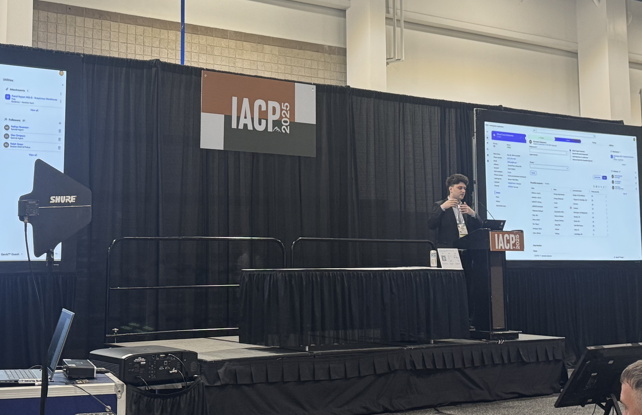
The 2025 International Association of Chiefs of Police (IACP) Annual conference served as a premier gathering for law enforcement and partners to share the latest in technology and industry solutions.

Carahsoft and its partners attended to connect on the latest in law enforcement technology.  

Five key themes stood out throughout the sessions:  

1. AI-Assisted Investigations 

In the session “The AI-Powered Investigator: Surfacing Insights in Law Enforcement,” speaker Jeremy Peterson presented on leveraging artificial intelligence (AI) to enhance law enforcement investigations while maintaining compliance and auditability. While AI offers tremendous potential for supercharging investigations, its function as a “black box” means it lacks the transparency required in regulated environments. With the use of multiple specialized AI agents, law enforcement can utilize guardrails and clear audit trails for working within structured workflows, rather than relying on a single generic AI. In one case study, Special Agent Isabella Rossi investigated a multi-state burglary operation, where AI identified connections between stolen crypto-mining hardware and a warehouse fire, helped draft legal documents like subpoenas and generated lookout alerts. Solutions from industry innovators such as Veritone and Tranquility AI are already helping agencies put these concepts into practice, offering AI-powered tools that enable law enforcement agencies to rapidly analyze data and tailor solutions to their specific workflows, expediting investigation processes.

2. Protecting Officers Through Drones 

In the panel “Don’t Let Them Go in Blind: Evolving Drones as First Responders to Protect Every Patrol Officer,” speakers discussed the role of comprehensive Drones as First Responders (DFR) for law enforcement. DFR designed with public safety in mind effectively address critical challenges in the field, including staffing shortages, response times and officer safety. Outdoor DFR systems, which are currently operational across multiple jurisdictions with multiple docks per city responding to thousands of monthly calls, have demonstrated the ability to arrive on scene in under two minutes, reduce crime through rapid visual documentation, decrease use of force incidents and clear 20-40% of calls without officer dispatch. New indoor drones address the situational awareness gap that occurs when officers enter buildings, providing capabilities for confined space navigation, perching for up to three hours, two-way communication replacing traditional throw phones, 4K night vision and obstacle avoidance technology. They are all deployable within 30 seconds from a patrol vehicle. The new technology offers remote piloting, freeing officers to focus on incident command rather than drone operation. 

3. Instant Translation with AI Services 

At the panel “Enhancing Emergency Communications with an End-to-End AI Assistive Platform,” speaker Brad Flanagan, Prepared’s Public Safety Answering Point (PSAP) Ambassador, discussed how AI-powered platforms are improving the efficiency of for 911 emergency call centers by providing comprehensive support and incident resolution. Translation-based AI systems, such as those created by Prepared and Hyper, offer real-time language interpretation in over 240 languages through text, automatic transcription and AI agent conferencing, significantly reducing wait times for interpreters and improving emergency response, including instances where cardiac arrests and domestic violence situations were handled more effectively. The platform consolidates multiple location verification systems into a single interface, reducing address errors from six per month to a timeframe of six months, despite having less experienced staff. AI translators enable rapid incident review and reporting by automatically organizing call recordings, radio traffic and transcripts, reducing review time. The current system includes AI-assisted call triage during high-volume situations, post-call performance analysis within two minutes, live guidance for call-takers on protocol-specific questions and training simulations for staff development. AI platforms provide field responders and administrators with real-time data insights and analytics to improve emergency response quality and efficiency. 

4. Cybersecurity in the Modern Age 

During the session “Cyber Threats to Critical Communications Systems,” speaker Travis Randall discussed the evolving cybersecurity threats that Public Safety organizations face. Agencies are increasingly vulnerable due to their combination of sensitive data and critical high-availability systems, such as dispatch, 911 and radio networks. The primary threat is ransomware groups, who often operate through a sophisticated criminal ecosystem of developers, affiliates and access brokers, conducting attacks at scale that have significantly disrupted emergency communications. Randall details how these attacks typically exploit valid credentials, unpatched vulnerabilities, misconfigured VPNs and weak access controls to compromise networks, often using legitimate system tools rather than obvious malware to evade detection. To stay on top of ransomware groups, agencies must employ essential defensive measures like offline backups, multi-factor authentication, privilege management, vulnerability patching and continuous network monitoring.  

5. Improving Awareness with Real-Time Crime Centers 

In the session “Real-Time Crime Centers: A Real Possibility for Small and Midsize Agencies,” speakers Chris Henningsen, President at the National Real Time Crime Center Association, and Chris Settle, Police Chief of Culpeper Police Department, discussed the operation of real-time crime centers. The speakers emphasize that real-time centers serve as technology hubs providing situational awareness and acting as force multipliers during staffing shortages, are attainable for agencies of all sizes. Centers can start small with minimal resources, such as a computer, radio and analyst, and scale over time based on demonstrated successes and measurable outcomes. Key components include integrating existing resources like traffic cameras, body-worn cameras, license plate readers, drones and community partner camera feeds to provide officers with critical information before arriving at scenes, often achieving response times of seconds rather than minutes.  

Some of the benefits include that real-time crime centers can: 

  • Reduce investigation time with camera networks and LPR technology 
  • Enhance recruitment and retention by demonstrating technological investment and officer safety support 
  • Enables officers to connect with back-up support, who can view footage and provide aid in real-time 

Henningsen and Settle stress that effective implementation requires cross-training staff, tracking progress through data analytics and continuously pursuing partnerships with technology vendors, such as Flock Safety, to share resources and best practices.  

Maintaining pace with the evolving technology landscape ensures that law enforcement and confidential data remains protected. Through AI, real-time crime centers, drones and ransomware protection, law enforcement remains committed to protecting civilians.  

Missed IACP Annual? Attend Carahsoft’s 2026 law enforcement innovation summit to learn more about the latest technology and solutions in law enforcement.  

Securing Government AI: Why Federal Agencies Need a Trust Layer for Accountable, Compliant Deployment

Federal agencies must deploy AI fast – but safely. The White House’s Executive Order, new OMB guidance requiring Chief AI Officers, and citizen expectations are driving rapid adoption. More than 1,700 AI use cases are already live across Government, doubling in just one year.

The challenge? Traditional security can’t keep up with AI systems operating at machine speed and scale. Federal agencies need Zero Trust architecture built specifically for AI agents, not retrofitted legacy systems. The recent addition of Nuggets’ Trust Layer solutions to the GSA Schedule provides exactly that foundation.

The Zero Trust Imperative for Government AI

Here’s the reality: AI agents make thousands of decisions per second across multiple systems. Without Zero Trust verification, agencies can’t prove who authorized what action, when or with which data.

The core challenges are clear:

  • Speed vs oversight: AI operates faster than current security can verify
  • Scale: Thousands of simultaneous agent interactions with no unified oversight
  • Accountability gaps: No audit trails for autonomous decisions in black-box systems
  • Compliance blind spots: NIST IAL2/IAL3 standards weren’t designed for autonomous AI
  • Sophisticated threats: AI-powered spoofing attacks that overwhelm legacy defenses

Federal agencies face intense pressure to adopt AI, but risks around bias, privacy, accountability and public trust threaten safe deployment. The gap between what agencies must deliver–secure, transparent, compliant services—and what legacy systems can support continues to widen.

Why Legacy Solutions Can’t Keep Up

Traditional identity systems were built for humans, not AI agents. While protocols like Agent-to-Agent (A2A) and Model Context Protocol (MCP) enable coordination between agents and tools, they don’t verify trust, intent or authorization, especially when handling sensitive Government data.

Point solutions create security silos and compliance blind spots. Legacy frameworks simply don’t account for autonomous decision-making, leaving agencies without proof of who or what acted, when and with proper authorization. Without this foundation, compliance and accountability are left to chance.

The Trust Layer Solution: Zero Trust for AI

Nuggets provides purpose-built Zero Trust architecture for agentic AI. Recognized by Gartner as a leader in decentralized identity, our trust layer embeds verification into every AI interaction, no matter the agent, system or data involved.

The comprehensive architecture creates compliance by design through three core capabilities:

Verifiable Identity: Cryptographically verified identity for every human, organization and AI agent that works across all platforms, contexts, devices and systems.

Complete Audit Trails: Every AI decision creates tamper-proof records with consent receipts and authorization proofs that meet Federal accountability requirements.

Standards Compliance: Built-in adherence to NIST IAL2/IAL3, AAL2 and UK Digital Identity Trust Framework requirements, ensuring agencies can deploy AI while meeting stringent security standards.

The result: a Zero Trust foundation on which agencies can deploy autonomous AI systems with confidence that every action is verified, compliant and auditable. This will enable both rapid innovation and Government accountability.

Real Impact: Government AI That Works

For Government IT leaders, the practical outcomes are substantial and measurable. Agencies using Nuggets’ trust layer achieve:

Operational Confidence: AI agents operate autonomously while maintaining security standards, delivering efficiency without sacrificing oversight.

Compliance Assurance: Built-in adherence to Federal identity verification requirements eliminates compliance guesswork.

Mission Success: Complete audit trails for all AI interactions and decisions ensure accountability while preventing unauthorized actions that could compromise sensitive operations.

Real-world use cases demonstrate the impact: automated document processing across agencies with complete audit trails, AI-driven eligibility checks and fraud detection that withstand regulatory scrutiny, secure inter-agency data sharing with verified agent identities and AI-powered citizen services that maintain privacy while delivering efficiency.

Each deployment proves that agencies can achieve both AI innovation and Government accountability, systems that are trusted by regulators, citizens and the mission itself.

The GSA Schedule Advantage

Procurement complexity often slows Government adoption of new technologies, but Nuggets eliminates these barriers. The solution is available through multiple pre-vetted contract vehicles, including GSA Schedule No. 47QSWA18D008F, SEWP V contracts, ITES-SW2, NASPO ValuePoint, OMNIA Partners and E&I Contract.

This means agencies can move from evaluation to deployment quickly, leveraging Carahsoft’s established Government relationships and support infrastructure. No lengthy procurement delays, no security gaps, no compliance questions.

Ready for Trusted AI Deployment?

As agencies expand AI capabilities, traditional security cannot keep pace with the speed, scale and complexity of autonomous systems. Purpose-built Zero Trust infrastructure is essential for agencies that must balance innovation mandates with compliance requirements and public accountability.

See how Federal agencies are deploying AI that’s secure, compliant, transparent and trusted. Schedule a personalized demo to explore how Nuggets’ Trust Layer can secure your agency’s AI deployment with the accountability that Government operations require.

Deploy AI that’s trusted by regulators, citizens and your mission. Contact Carahsoft at (844) 214-4790 or Nuggets@carahsoft.com. Learn more at www.carahsoft.com/nuggets.

Carahsoft Technology Corp. is The Trusted Government IT Solutions Provider, supporting Public Sector organizations across Federal, State and Local Government agencies and Education and Healthcare markets. As the Master Government Aggregator for our vendor partners, including Nuggets, we deliver solutions for Geospatial, Cybersecurity, MultiCloud, DevSecOps, Artificial Intelligence, Customer Experience and Engagement, Open Source and more. Working with resellers, systems integrators and consultants, our sales and marketing teams provide industry leading IT products, services and training through hundreds of contract vehicles. Explore the Carahsoft Blog to learn more about the latest trends in Government technology markets and solutions, as well as Carahsoft’s ecosystem of partner thought-leaders.

Enabling Rapid Compliance with Sysfleet’s RPA Tools

As technology evolves, Government agencies seek to modernize effectively, securely and efficiently. By utilizing Sysfleet’s RPA tools, agencies can reach compliance, automate workflows, embed data loss prevention and promote solution-based, application life-cycle models.

The Power of RPA

Robotic Process Automation (RPA) tools refer to automation software that performs repetitive, rule-based tasks. In Government agencies, increasing efficiency is a primary concern, as it enables agencies to deliver solutions in a timely fashion.

There are three main benefits to RPA tools. RPA tools:

  1. Shorten the life cycle of requests
  2. Eradicate human error by automating menial tasks
  3. Improve security by detecting anomalies

Traditionally, Government struggles with high-risk projects; projects require an investment of time to gain approvals, and market monopolies result in high premiums. RPA enables Government to shorten the life cycle of projects, which reduces costs and expedites delivery time.

With the added capabilities of artificial intelligence (AI) and machine learning (ML), RPA tools can replace old-school application program interfaces (APIs) development, which can be draining and slow. Through hyper-automation, RPA enables users to carry out operations swiftly.

Meeting Government Needs with RPA

Before onboarding new technology like RPA tools, the Government expects certain inherited features, such as web content, accessibility controls, guidelines and FedRAMP certification. Sysfleet Consulting LLC, a technology solutions company that simplifies business processes, automates workflows and improves efficiency through system integration, is equipped to address the unique needs of Government agencies and enterprises.

Sysfleet helps Government agencies and enterprises gain compliance and audit readiness with its RPA solutions. Sysfleet’s RPA solutions have a unique focus on compliance automation. By transforming manual workflows into controlled, automated processes, Sysfleet embeds audit readiness and data security directly into agency workflow. Additionally, Sysfleet’s RPA tools can modernize with existing legacy systems without disrupting ongoing operations, cutting down on modernization costs. Sysfleet has delivered measurable results, enabling agencies to cut down on processing time by 30-70%, saving hundreds of labor hours quarterly.

Products to Enable Rapid Compliance

As an official Microsoft partner, Sysfleet utilizes applications such as Power Automate, UiPath and Blue Prism Automation to help customers automate repetitive tasks. Through the Power Platform’s  Center of Excellence (CoE), a Microsoft product that enables data loss prevention, Sysfleet automatically captures data, enabling users to follow and trace data trails. Additionally, Power Platform maps to National Institute of Standards and Technology (NIST) and  Federal Regulation section 508, and can operate within existing Government cloud boundaries and other external systems.

Benefits of the RPA-Enabled Automation

Sysfleet improves operational performance through automation. Traditionally, State Government approvals take years, draining time and resources. With Sysfleet’s RPA tools, agencies can shorten internal approval time by 55%, gaining a return of investment within just six months. The tools automate safely and are easy to scale to existing applications. Additionally, Sysfleet’s RPA tool can expedite long manual processes that traditionally contain human errors due to their complexity.

Carahsoft and Sysfleet

Through strategic partnerships, Sysfleet ensures secure, scalable, future-ready solutions. Sysfleet has proven leadership in Government automation projects, delivering measurable results in mission-critical workflows. By partnering with Carahsoft, Sysfleet is further empowered to support the Public Sector. Carahsoft enables Sysfleet to reach Government customers nation-wide, to help agencies expedite the procurement process, scale and reach marketing and offer solution bundling.

Learn how agencies can accelerate modernization and embed security into every workflow.

Carahsoft Technology Corp. is The Trusted Government IT Solutions Provider, supporting Public Sector organizations across Federal, State and Local Government agencies and Education and Healthcare markets. As the Master Government Aggregator for our vendor partners, including Sysfleet, we deliver solutions for Geospatial, Cybersecurity, MultiCloud, DevSecOps, Artificial Intelligence, Customer Experience and Engagement, Open Source and more. Working with resellers, systems integrators and consultants, our sales and marketing teams provide industry leading IT products, services and training through hundreds of contract vehicles. Explore the Carahsoft Blog to learn more about the latest trends in Government technology markets and solutions, as well as Carahsoft’s ecosystem of partner thought-leaders.

Why CMDBs Alone Aren’t Enough for Effective Asset Management

Federal agencies rely on Configuration Management Databases (CMDBs) to track and manage their assets. But here’s the challenge: CMDBs depend entirely on the data that gets fed into them.

When discovery tools miss devices, when multiple tools report the same device but with different details, when manual processes slow down or when new virtual environments spin up outside of standard procedures, those assets are either invisible or in conflict in your CMDB.

IT and security teams are forced to turn to manual processes to prevent duplicate or inaccurate CMDB records and update missed asset changes. Yet even then, the system inevitably lags behind the reality of the assets in Federal environments. 

As a result, your inventory becomes incomplete or outdated and creates real risks, from failed audits to unaddressed vulnerabilities to disruptions in critical business operations.

Your Federal team faces a difficult choice. You can spend significant time and resources continually auditing the CMDB, manually joining data from disparate tools to seek out the truth. Or you can accept the risk that comes with low-quality, “dirty” data. Neither option is ideal when you are accountable for meeting Federal security requirements.

Fortunately, there’s a third, and much better option.

How to complement a CMDB with automated, actionable asset intelligence

To get a full picture of your asset landscape, you need to architect your asset data framework so that it continuously updates both itself and your CMDB. This is where the Axonius Asset Cloud platform comes in.

The Axonius Asset Cloud is an actionability platform that addresses the common gaps in CMDBs by automating asset discovery and inventory across the entire IT and security footprint. You get an always-current, comprehensive and accurate inventory of your entire asset ecosystem. Axonius also looks for potential policy violations and helps administrative and security teams in prioritizing configuration and vulnerability response efforts.

The Axonius Asset Cloud natively provides more than 1,200 adapters that connect to and integrate with commonly deployed security and IT tools, including 27 CMDB platforms. These adapters continuously collect information on 40+ types of assets across IT and security, including devices, users, software, vulnerabilities and configurations.

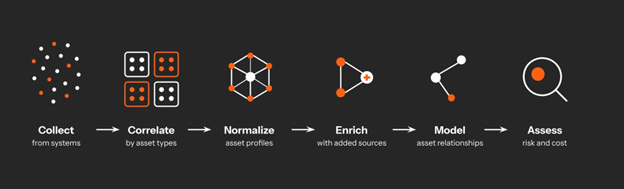
Axonius turns raw, noisy and overlapping data into a complete, accurate and always up-to-date model of your entire environment through the Axonius Asset Intelligence pipeline. The bar we set for the information Axonius serves is decision-grade output. Each stage in this intelligence pipeline solves a specific class of data engineering problems that static inventories, vulnerability scanners, SIEMs and CMDBs struggle to optimize on their own.

The Axonius Intelligence Pipeline

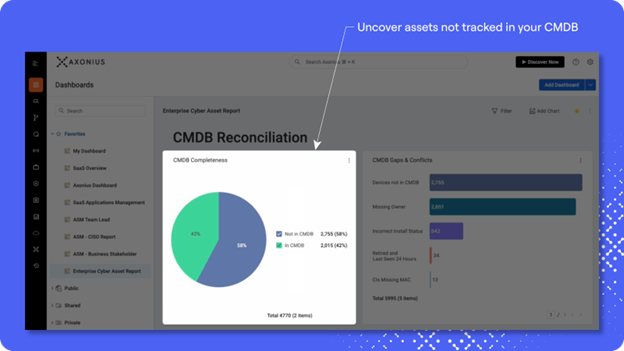
After building this normalized and correlated view of the assets and risks in your environment, Axonius then compares them to what’s in your agency’s CMDB, deletes unwanted or redundant tools from the list and adds any missing assets or metadata to your inventory. You can finally trade hours of data cleanup for decisive moves that secure your systems.

Uncover assets not tracked in your CMDB

Security operations teams benefit from the Axonius Asset Cloud as well. The platform can automatically create remediation tickets whenever it discovers a vulnerability. Operations teams can be alerted immediately and prioritize their response to the tickets based on severity or urgency, confident that they have a clear and complete picture of affected systems, users and devices.

Post-incident, the same reports in the Axonius Asset Cloud give teams confidence that the incident has been fully resolved by confirming that affected systems, applications or user accounts have been successfully and completely remediated.

Supercharging your CMDB with Axonius accomplishes multiple objectives:

  1. Your agency gains a real-time, comprehensive view of all its assets, maximizing your CMDB investment and empowering both IT and Security operations.
  2. You can instantly identify rogue or non-compliant assets and respond to ticket requests within a day.
  3. You can uncover unused or legacy assets that are costing your agency money or putting it at risk.
  4. You significantly reduce manual CMDB upkeep and free up hours for higher-impact work.
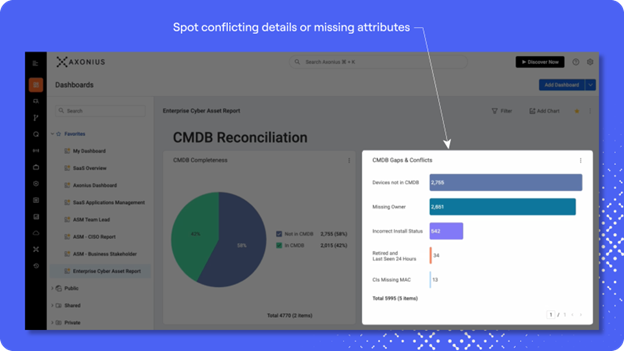
Spot conflicting details or missing attributes

Axonius in action: How the platform works with ServiceNow

Let’s take a look at how this works using the ServiceNow CMDB as an example. First, select the configuration items (assets) you want to ingest into ServiceNow. Axonius imports the selected data into ServiceNow via APIs. This allows you to query, visualize and take action on all of the CMDB data imported into the system.

From there, the platform goes to work, scanning assets, creating tickets, updating inventory and removing assets that should not be in the CMDB, all in real-time. You can then generate reports that highlight vulnerability gaps and items that require correction.

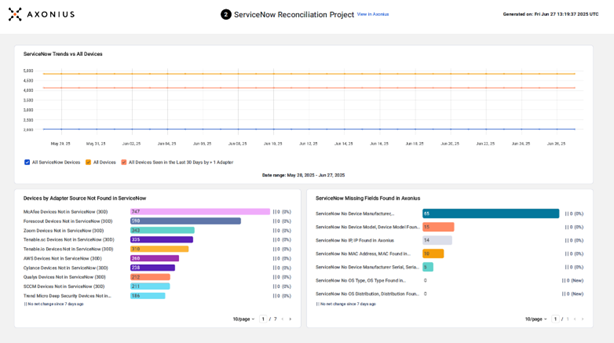
Axonius complements CMDBs, such as ServiceNow, by highlighting asset trends and identifying missing devices and fields.

You can use the combination of Axonius and ServiceNow, or other CMDBs, to ensure compliance with FISMA, CISA BOD 23-01 and other relevant standards. The Axonius Asset Cloud platform can pull compliance data from ServiceNow, eliminating the need for manual compliance tracking through the CMDB.

Want to see Axonius in action? Here’s a quick demo by James Flores showing how Axonius improves CMDB coverage.

Leveling up your CMDB

In a time when Government efficiency is under the microscope, agencies need more than a CMDB alone to manage their assets effectively. While CMDBs are valuable for tracking configurations and relationships, relying on them as the sole source of asset information can be time-consuming, impractical and potentially inaccurate. This leads to significant lost hours, unnecessary costs and damaging security vulnerabilities.

The best option—the only option, really—is to complement your CMDB with a solution that gives you instant visibility into its coverage.

The Axonius Asset Cloud allows you to identify gaps, track trends, update CIs and asset data in the CMDB and power incident response teams. It levels up your CMDB to save time, money and your organization from potentially serious security risks.

Learn more at https://www.axonius.com/federal-systems.

Carahsoft Technology Corp. is The Trusted Government IT Solutions Provider, supporting Public Sector organizations across Federal, State and Local Government agencies and Education and Healthcare markets. As the Master Government Aggregator for our vendor partners, including Axonius we deliver solutions for Geospatial, Cybersecurity, MultiCloud, DevSecOps, Artificial Intelligence, Customer Experience and Engagement, Open Source and more. Working with resellers, systems integrators and consultants, our sales and marketing teams provide industry leading IT products, services and training through hundreds of contract vehicles. Explore the Carahsoft Blog to learn more about the latest trends in Government technology markets and solutions, as well as Carahsoft’s ecosystem of partner thought-leaders.

Cloud Security: Complex Threats, Clear Solutions

Cloud technology, for many years, enticed agencies looking for savings and efficiencies. Organizations pursued “cloud-first” policies that migrated data and applications away from onsite infrastructure and into the control, at least in part, of cloud service providers. While the cloud offered promising advantages, some agencies encountered unexpected cost challenges along the way. And lately, malicious actors have gotten exceptionally good at exploiting cloud vulnerabilities.

There isn’t one way to secure your cloud platform, unfortunately. You need a holistic, Zero Trust approach that combines security controls with cyber policies and procedures. Strong encryption and access rules, automated updates, clear visibility and detailed incident response plans are all critical. Knowing who’s responsible for what should go without saying. And repatriating data — bringing it back on premises, for example — is often a commonsense answer. 

“Agencies have to comply with stringent regulations … so that means they need a really robust [security] framework, all while managing the complexities of the cloud environment,” said Garrett Lee, Regional Vice President for Public Sector in Broadcom’s Enterprise Security Group. “Cloud, you know, solves some problems, but it also creates some others.”  

In this video interview, Lee explores both the opportunities that cloud computing offers and how to confront its security challenges. Topics include:  

  • What a holistic approach to cloud security entails
  • The cost and security drivers behind data repatriation, and why they matter
  • How to secure four critical domains: endpoints, data, the cloud and networks

Want to learn more cyber resilience strategies? Download Symantec, Carbon Black and Carahsoft’s guide to explore four critical cyber force multipliers that enhance agencies’ security posture amid growing threats and limited budgets.

Carahsoft Technology Corp. is The Trusted Government IT Solutions Provider, supporting Public Sector organizations across Federal, State and Local Government agencies and Education and Healthcare markets. As the Master Government Aggregator for our vendor partners, including Broadcom we deliver solutions for Geospatial, Cybersecurity, MultiCloud, DevSecOps, Artificial Intelligence, Customer Experience and Engagement, Open Source and more. Working with resellers, systems integrators and consultants, our sales and marketing teams provide industry leading IT products, services and training through hundreds of contract vehicles. Explore the Carahsoft Blog to learn more about the latest trends in Government technology markets and solutions, as well as Carahsoft’s ecosystem of partner thought-leaders.

This post originally appeared on GovLoop.com, and is re-published with permission

Efficient, Continuous Identity Verification with 1Kosmos’s Enterprise Identity Wallet

In the age of digital technology, digital identity wallets offer users a transportable, secure way of verifying their identity and certifications. Having a reliable, up-to-date method of verifying identity enables enterprises to swiftly and securely manage procedures.

Switching to Digital Wallets 

Digital wallets provide a flexible, streamlined experience for enterprises, employees, third-party contractors and business-to-business transactions. In spaces where transactions are high-risk, having a secure, verifiable identity to cross-reference is vital to security. Digital wallets can verify end users for active attorney license statuses, active medical licenses or to prove cybersecurity certifications, such as Certified Information Systems Security Professional (CISSP). These can follow employees throughout their employment. 

Utilizing digital wallets in decision-making spaces can help verify end users in addition to their every-day authenticators, similar to step-up authentication. Digital wallets verify identities, eliminating the need for social engineering. If credentials are needed to gain privileged user access, digital wallets help enterprises verify that the end user is who they say they are. For example, during emergencies, such as natural disasters, wallets can help verify that volunteers have active licenses in a timely manner. 

1Kosmos’s Enterprise Identity Wallets 

1Kosmos Identity Blog image

1Kosmos enterprise identity wallets deliver centralized, scalable identity management that enable organizations to securely provision and govern employee digital identities, credentials and access privileges across their entire technology ecosystem.

First, 1Kosmos verifies the end user by validating and verifying their provided documentation. Once verified, 1Kosmos creates a digital wallet by collecting, encrypting and storing an end user’s identification information in a private and permissioned ledger, allowing only the end user to access and share their personal data on their own initiative. This information cannot be accessed by 1Kosmos, as it goes through several layers of encryption. 

These wallets are built with World Wide Web Consortium (W3C) standards, providing an interoperable experience and enables users to reuse wallets and access their identification as often as needed.

1Kosmos’s Digital enterprise identity wallets are classified through a decentralized management system. 1Kosmos’s private, distributed ledger breaks up end users’ identification wallets, updating new certifications and licenses in its own personalized block, utilizing blockchain in the back end to provide a layer of security to encrypt information. Permissions are access based, providing a layer of security through segmentation. 1Kosmos’s wallets utilize attribute-based access control (ABAC) security, granting permissions based on matching data tags. With the proper credentials, end users can access files instantly.  

Protection for High-Risk Transactions

1Kosmos’s enterprise identity wallets have an array of features that make them perfect for high-risk transactions. The wallets have a private and permissioned ledger, offering a distributed identity experience over a centralized one. With Presentation Attack Detection (PAD) Level 1 and Level 2 certifications, 1Kosmos offers protection against deep fake attacks. 1Kosmos offers continuous vulnerability management, FedRAMP high authorization, Kantara certification and Federal Information Processing Standards (FIPS)-140-3 encryption. Perfect for enterprise use and a diverse set of end users, 1Kosmos’s wallets can verify identity, ensuring that all processes are efficient and secure.  

Visit 1Kosmos’s page to learn more about their full service, privacy preserving enterprise identity wallets.

Carahsoft Technology Corp. is The Trusted Government IT Solutions Provider, supporting Public Sector organizations across Federal, State and Local Government agencies and Education and Healthcare markets. As the Master Government Aggregator for our vendor partners, including 1Kosmos we deliver solutions for Geospatial, Cybersecurity, MultiCloud, DevSecOps, Artificial Intelligence, Customer Experience and Engagement, Open Source and more. Working with resellers, systems integrators and consultants, our sales and marketing teams provide industry leading IT products, services and training through hundreds of contract vehicles. Explore the Carahsoft Blog to learn more about the latest trends in Government technology markets and solutions, as well as Carahsoft’s ecosystem of partner thought-leaders.

Secrets to Public Sector Sales Success: Insights from Marion Square’s Harvey Morrison

The Federal Government needs more solutions, not more software. That is the message we at Marion Square get every day from our agency contacts. They do not want lists of product features or emails about why one technology is better than another. They want to know how that technology will meet their very specific needs, how it will fit into their unique IT architecture and, most importantly, how it will help them solve their challenges.

As such, successfully selling to agencies today looks a lot different from what it did a few years ago. It is not about getting 50 meetings with 50 different agencies; that scattershot approach is a waste of time. Instead, it is about ensuring that the right meetings are held and that each one matters.

That is where Marion Square comes in. We help technology vendors align their products with mission impact and operational fit. Our advisory approach blends deep market intelligence with tailored go-to-market strategies that position technology not as a product, but as an answer to an agency’s most pressing needs.

Based on our conversations with agency contacts, here are the key trends shaping Federal buying behavior, and how we recommend vendors respond.

The Three Pricing Archetypes Driving Public Sector Purchasing

The Government is still under immense pressure to bring costs down and increase efficiencies. Over the past few months, we have heard from many clients whose customers have called for price reductions. We advise them on three ways to respond:

Vendors must choose their approach carefully. A bold discount can open doors but risks setting unsustainable expectations. Value bundling requires clear articulation of how those added features meet specific mission needs. And while price cuts may help win deals in the short term, they should be anchored in a broader licensing or adoption strategy to avoid devaluation.

Partnering With Services Companies Is a Winning Strategy

Agencies need help navigating integration, implementation, training and sustainment. That is why partnering with services companies is essential. These firms bring institutional knowledge, procurement relationships and hands-on delivery capacity that agencies trust. When a vendor brings a product plus a credible partner to help stand it up, it reduces perceived risk and increases purchase confidence.

At Marion Square, we help clients align with the right service partners early in their go-to-market process. Doing so allows them to frame their offerings not as standalone tools, but as parts of larger, operationally relevant solutions.

Indeed, we have seen a lot of success when vendors position themselves alongside integrators or mission-focused contractors who already have traction within an agency. The collaboration strengthens the overall value proposition and gives agencies greater confidence that the solution can be deployed effectively and deliver measurable outcomes.

Agencies Look to Vendors For Education, Not Just Products

Many Federal stakeholders are overwhelmed by emerging technologies and new mandates. They value a partner who can help them unpack directives like the Cybersecurity and Infrastructure Security Agency (CISA) Binding Operational Directive (BOD) 23-02, for instance, or understand how artificial intelligence (AI) tools can improve workflows, cybersecurity initiatives and so forth. Vendors who show up with insight, rather than just information, become trusted advisors and separate themselves from the pack.

We also see a significant knowledge gap around the innovation programs already available to agencies. Beyond well-known pathways like Small Business Innovation Research Programs (SBIRs), many Government stakeholders are unaware of other funding mechanisms and pilot opportunities that could support emerging technologies. So, we work with clients to help them think of new ways to present their technology and receive funding for their solutions.

For example, we worked with a client focused on AI data processing who was using a traditional hardware approach. We identified an opportunity to reposition their architecture to align with a lesser-known innovation program, helped craft a targeted proposal and they secured funding. It is proof that vendors can add value by not only educating agencies on their capabilities but also guiding them toward untapped opportunities to fund and implement them.

Join Us This Fall

In October, we will be co-hosting a strategy session with our partner Carahsoft to discuss these and other issues. We will discuss current market trends and provide attendees with insights into crafting winning sales strategies that drive traction. We will cover what it takes to get agency attention, how to build messaging that resonates and how to position each solution as the one that helps Government teams deliver on their mission.

We hope you will join us!

Carahsoft Technology Corp. is The Trusted Government IT Solutions Provider, supporting Public Sector organizations across Federal, State and Local Government agencies and Education and Healthcare markets. As the Master Government Aggregator for our vendor partners, including Marion Square we deliver solutions for Geospatial, Cybersecurity, MultiCloud, DevSecOps, Artificial Intelligence, Customer Experience and Engagement, Open Source and more. Working with resellers, systems integrators and consultants, our sales and marketing teams provide industry leading IT products, services and training through hundreds of contract vehicles. Explore the Carahsoft Blog to learn more about the latest trends in Government technology markets and solutions, as well as Carahsoft’s ecosystem of partner thought-leaders.


Transforming Federal AI Adoption: How Google’s OneGov Agreement Delivers Enterprise-Grade Intelligence

The General Services Administration’s (GSA) OneGov strategy represents a fundamental shift in Federal procurement, moving from fragmented, agency-by-agency purchasing to a unified enterprise approach that leverages the Government’s collective buying power. Google’s new Gemini for Government agreement provides Federal agencies with access to cutting-edge artificial intelligence (AI) capabilities at an unprecedented $0.47 per agency price point. This strategic partnership builds upon Google’s previous Workspace agreement with GSA, establishing a procurement framework that treats the Federal government as a single unified customer.

Breaking Down Silos with Purpose-Built AI Infrastructure

Gemini for Government addresses one of the most persistent challenges in Federal operations: the need for sophisticated automation tools that can operate securely across diverse Government environments. The platform serves as a developer-focused suite specifically designed for Federal agencies, enabling the building, deployment and management of advanced automated AI agents that perform complex, multi-step workflows across an organization’s internal data. Unlike commercial solutions that require extensive customization for Government use, Gemini for Government comes purpose-built with integrated security features and compliance standards that meet Federal requirements from day one.

The platform’s comprehensive approach eliminates the traditional barriers that have prevented agencies from adopting enterprise-grade AI solutions. By providing both prepackaged AI agents and the capability to create custom solutions, agencies can immediately begin automating business processes while maintaining the flexibility to develop specialized applications as their needs evolve.

Democratizing AI Development Across Federal Agencies

One of the most significant advantages of the Gemini for Government offer lies in its accessibility to agencies with varying levels of technical resources. The solution incorporates no-code capabilities through products like Agentspace, enabling Government users to leverage sophisticated AI tools without requiring extensive programming expertise. This democratization of AI development ensures that smaller agencies or those with limited technical staff can participate in digital transformation initiatives.

The platform includes Google’s best-of-breed commercial AI tools, including Agentspace and NotebookLM, all engineered specifically for Federal use. These tools provide agencies with immediate access to advanced AI capabilities while maintaining the security and compliance standards required for Government operations.

Security and Compliance Built into the Foundation

Federal agencies operate under stringent security requirements that often create barriers to adopting innovative technologies. Gemini for Government addresses these concerns through built-in security features, including identity and access management, threat detection, data privacy protections and advanced compliance standards such as SOC2 Type 2. Google Cloud’s extensive portfolio of FedRAMP High-authorized products provides the underlying infrastructure, ensuring that agencies can confidently deploy AI solutions without compromising their security posture.

This comprehensive security framework eliminates the lengthy and expensive process of retrofitting commercial solutions to meet Federal requirements. Instead of spending months or years on compliance validation, agencies can immediately begin leveraging AI capabilities while maintaining full compliance with Federal security standards.

Streamlined Procurement Through Strategic Partnerships

The GSA OneGov Gemini for Government promotional agreement demonstrates how strategic partnerships can dramatically simplify federal procurement processes. Available through Carahsoft’s GSA MAS contract, the deal provides standardized pricing and terms that eliminate the need for individual agency negotiations. The $0.47 per agency pricing includes a standard provisioning of 1,000 users, with the ability to add additional users at no cost during the promotional period.

Google has also provided flexibility to match promotional discounts on other Government contract vehicles based on specific agency procurement requirements. This approach ensures that agencies can access the technology through their preferred contracting mechanisms while still benefiting from the OneGov pricing structure. The promotional agreement runs through September 30th, 2026, providing agencies with ample time to evaluate and implement the solution.

The Path Forward for Federal AI Transformation

The Gemini for Government OneGov agreement represents more than just a procurement vehicle—it is a blueprint for how Federal agencies can access and implement cutting-edge technologies while maintaining security, compliance and cost-effectiveness. As agencies continue to face increasing demands for efficiency and innovation, solutions like Gemini for Government provide the foundation for meeting these challenges while maintaining the highest standards of security and compliance.

Ready to leverage this agreement to access best-of-breed AI tools that can transform your agency’s operations? Contact our Google team at Carahsoft today or call us at (888) 662-2724 to learn more and take advantage of this limited-time promotional offer.

Carahsoft Technology Corp. is The Trusted Government IT Solutions Provider, supporting Public Sector organizations across Federal, State and Local Government agencies and Education and Healthcare markets. As the Master Government Aggregator for our vendor partners, including Google we deliver solutions for Geospatial, Cybersecurity, MultiCloud, DevSecOps, Artificial Intelligence, Customer Experience and Engagement, Open Source and more. Working with resellers, systems integrators and consultants, our sales and marketing teams provide industry leading IT products, services and training through hundreds of contract vehicles. Explore the Carahsoft Blog to learn more about the latest trends in Government technology markets and solutions, as well as Carahsoft’s ecosystem of partner thought-leaders.