Why CMDBs Alone Aren’t Enough for Effective Asset Management

Federal agencies rely on Configuration Management Databases (CMDBs) to track and manage their assets. But here’s the challenge: CMDBs depend entirely on the data that gets fed into them.

When discovery tools miss devices, when multiple tools report the same device but with different details, when manual processes slow down or when new virtual environments spin up outside of standard procedures, those assets are either invisible or in conflict in your CMDB.

IT and security teams are forced to turn to manual processes to prevent duplicate or inaccurate CMDB records and update missed asset changes. Yet even then, the system inevitably lags behind the reality of the assets in Federal environments. 

As a result, your inventory becomes incomplete or outdated and creates real risks, from failed audits to unaddressed vulnerabilities to disruptions in critical business operations.

Your Federal team faces a difficult choice. You can spend significant time and resources continually auditing the CMDB, manually joining data from disparate tools to seek out the truth. Or you can accept the risk that comes with low-quality, “dirty” data. Neither option is ideal when you are accountable for meeting Federal security requirements.

Fortunately, there’s a third, and much better option.

How to complement a CMDB with automated, actionable asset intelligence

To get a full picture of your asset landscape, you need to architect your asset data framework so that it continuously updates both itself and your CMDB. This is where the Axonius Asset Cloud platform comes in.

The Axonius Asset Cloud is an actionability platform that addresses the common gaps in CMDBs by automating asset discovery and inventory across the entire IT and security footprint. You get an always-current, comprehensive and accurate inventory of your entire asset ecosystem. Axonius also looks for potential policy violations and helps administrative and security teams in prioritizing configuration and vulnerability response efforts.

The Axonius Asset Cloud natively provides more than 1,200 adapters that connect to and integrate with commonly deployed security and IT tools, including 27 CMDB platforms. These adapters continuously collect information on 40+ types of assets across IT and security, including devices, users, software, vulnerabilities and configurations.

Axonius turns raw, noisy and overlapping data into a complete, accurate and always up-to-date model of your entire environment through the Axonius Asset Intelligence pipeline. The bar we set for the information Axonius serves is decision-grade output. Each stage in this intelligence pipeline solves a specific class of data engineering problems that static inventories, vulnerability scanners, SIEMs and CMDBs struggle to optimize on their own.
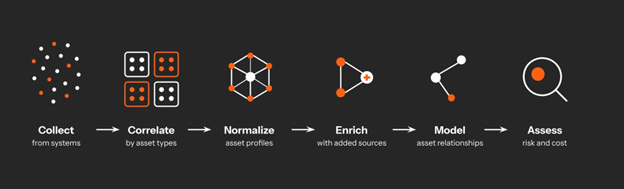
The Axonius Intelligence Pipeline

After building this normalized and correlated view of the assets and risks in your environment, Axonius then compares them to what’s in your agency’s CMDB, deletes unwanted or redundant tools from the list and adds any missing assets or metadata to your inventory. You can finally trade hours of data cleanup for decisive moves that secure your systems.
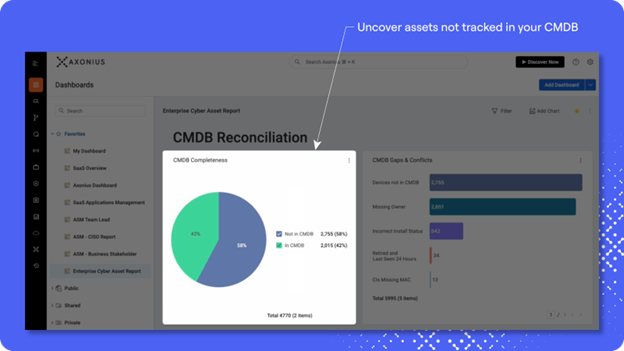
Uncover assets not tracked in your CMDB

Security operations teams benefit from the Axonius Asset Cloud as well. The platform can automatically create remediation tickets whenever it discovers a vulnerability. Operations teams can be alerted immediately and prioritize their response to the tickets based on severity or urgency, confident that they have a clear and complete picture of affected systems, users and devices.

Post-incident, the same reports in the Axonius Asset Cloud give teams confidence that the incident has been fully resolved by confirming that affected systems, applications or user accounts have been successfully and completely remediated.

Supercharging your CMDB with Axonius accomplishes multiple objectives:

  1. Your agency gains a real-time, comprehensive view of all its assets, maximizing your CMDB investment and empowering both IT and Security operations.
  2. You can instantly identify rogue or non-compliant assets and respond to ticket requests within a day.
  3. You can uncover unused or legacy assets that are costing your agency money or putting it at risk.
  4. You significantly reduce manual CMDB upkeep and free up hours for higher-impact work.
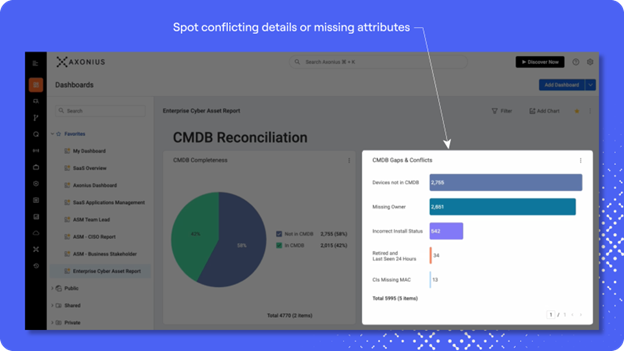
Spot conflicting details or missing attributes

Axonius in action: How the platform works with ServiceNow

Let’s take a look at how this works using the ServiceNow CMDB as an example. First, select the configuration items (assets) you want to ingest into ServiceNow. Axonius imports the selected data into ServiceNow via APIs. This allows you to query, visualize and take action on all of the CMDB data imported into the system.

From there, the platform goes to work, scanning assets, creating tickets, updating inventory and removing assets that should not be in the CMDB, all in real-time. You can then generate reports that highlight vulnerability gaps and items that require correction.
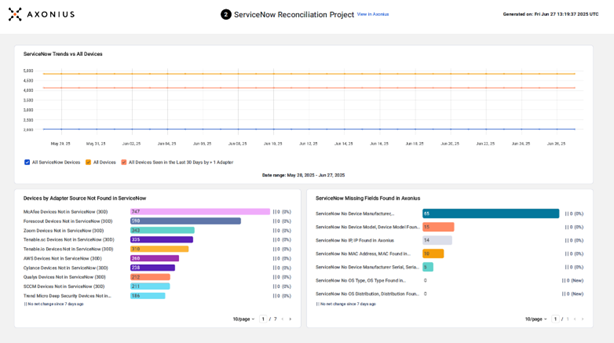
Axonius complements CMDBs, such as ServiceNow, by highlighting asset trends and identifying missing devices and fields.

You can use the combination of Axonius and ServiceNow, or other CMDBs, to ensure compliance with FISMA, CISA BOD 23-01 and other relevant standards. The Axonius Asset Cloud platform can pull compliance data from ServiceNow, eliminating the need for manual compliance tracking through the CMDB.

Want to see Axonius in action? Here’s a quick demo by James Flores showing how Axonius improves CMDB coverage.

Leveling up your CMDB

In a time when Government efficiency is under the microscope, agencies need more than a CMDB alone to manage their assets effectively. While CMDBs are valuable for tracking configurations and relationships, relying on them as the sole source of asset information can be time-consuming, impractical and potentially inaccurate. This leads to significant lost hours, unnecessary costs and damaging security vulnerabilities.

The best option—the only option, really—is to complement your CMDB with a solution that gives you instant visibility into its coverage.

The Axonius Asset Cloud allows you to identify gaps, track trends, update CIs and asset data in the CMDB and power incident response teams. It levels up your CMDB to save time, money and your organization from potentially serious security risks.

Learn more at https://www.axonius.com/federal-systems.

Carahsoft Technology Corp. is The Trusted Government IT Solutions Provider, supporting Public Sector organizations across Federal, State and Local Government agencies and Education and Healthcare markets. As the Master Government Aggregator for our vendor partners, including Axonius we deliver solutions for Geospatial, Cybersecurity, MultiCloud, DevSecOps, Artificial Intelligence, Customer Experience and Engagement, Open Source and more. Working with resellers, systems integrators and consultants, our sales and marketing teams provide industry leading IT products, services and training through hundreds of contract vehicles. Explore the Carahsoft Blog to learn more about the latest trends in Government technology markets and solutions, as well as Carahsoft’s ecosystem of partner thought-leaders.


Why Cloud, Why Now? Modernizing federal IT: Why the cloud is becoming the new standard

The shift to Atlassian Government Cloud unlocks new potential for federal agencies

Modernization has been a Federal priority for over a decade, but the realities of legacy systems, compliance mandates and limited resources have forced IT leaders to make hard tradeoffs. The pandemic accelerated digital transformation, proving just how critical resilient, cloud-based systems are to mission continuity and citizen services.

Yet many agencies have remained tethered to on-premises tools not by choice, but by compliance constraints.

Now that Atlassian Government Cloud is FedRAMP Moderate authorized, agencies can confidently shift core collaboration and service delivery workloads to the cloud with security and compliance in place.

The opportunity to modernize is clearer than ever. With compliance barriers removed, cloud adoption becomes not just feasible, but foundational to moving missions forward.

FedRAMP Moderate removes the guesswork

Atlassian Government Cloud is a dedicated environment built specifically for public sector teams and limited to U.S. Government agency and contractor usage. It delivers the performance Federal agencies need, with the security and compliance they require.

This includes:

  • FedRAMP Moderate Authorization for Jira, Confluence and Jira Service Management
  • Dual-region hosting on AWS commercial US East/West regions
  • Continuous monitoring aligned to FedRAMP Moderate standards

Atlassian’s Government cloud platform is built on the same architecture that powers Cloud Enterprise, offering the scale, reliability and control public sector teams need. It’s designed to reduce friction and deliver continuous innovation while maintaining trust and transparency.

From patching systems to powering missions

Agencies that remain on legacy infrastructure are fighting a battle on two fronts: maintaining outdated systems while trying to meet new mission demands. That approach is no longer sustainable.

Modernizing with Atlassian Government Cloud eliminates the distractions of infrastructure maintenance and opens the door to high-impact work. Instead of managing update cycles or responding to fire drills, IT teams can shift their focus to scaling digital services, working with disparate teams and improving citizen-facing outcomes.

For IT administrators, this shift is transformational. Cloud offloads the operational burden they’ve carried for years—manual upgrades, weekend patching, surprise outages. With that weight lifted, teams can focus on enabling smarter service delivery across the agency.

As Jeff Garrett, Technical Product Manager at the California Department of Health Care Services shared, “I’ve had to maintain server infrastructure in the past. It’s not pleasant. Being on Atlassian Cloud Enterprise means we don’t have to do that anymore. Plus, we can add and remove applications quickly.”

This is how mission work moves forward with greater speed, clarity and alignment.

Built-in collaboration, automation, and insight

Atlassian Government Cloud offers more than security and compliance. It enables new ways of working across teams and departments, aligning your entire agency and harnessing your data.

Consider this scenario: A Federal program team launches a new initiative to expand community outreach. Rather than waiting weeks for a custom workflow, they spin up a new Jira project using a pre-built template with no administrator required. HR and legal teams contribute to project planning in Confluence, while real-time insights track progress across departments. No tickets. No silos. Just forward momentum.

The scenario above shows how teams can move faster using features like team-managed projects and templates in Jira, along with native incident management in Jira Service Management.

In addition to streamlining work, Atlassian Government Cloud will soon include Atlassian Analytics, bringing cross-product visibility and supporting data-driven decision-making across teams.

Beyond what’s available in Atlassian Government Cloud today, we’re also committed to delivering the same innovative features you’ll find in our commercial products, like Confluence Whiteboards and Goals. We’re actively developing our roadmap for Atlassian Government Cloud and will share more information soon.

Migration isn’t a barrier. It’s a supported journey

Atlassian has helped thousands of organizations transition to the cloud, including some of the world’s largest enterprises and Government agencies. We have reliable tooling for migrating data from Data Center to Atlassian Government Cloud that has been hardened through years of supporting migrations to commercial cloud. And for those migrating from commercial cloud to AGC, we’re releasing tooling for this soon.

Federal teams benefit from specialized migration support designed to streamline the process and minimize risk. That includes:

  • A Cloud Migration Manager assigned to each Atlassian Government Cloud project
  • Migration guides, training resources and toolkits to support end-user adoption
  • The choice to engage with a network of experienced solution partners if your agency wants even more support.

Agencies already using Atlassian Cloud are seeing measurable results that support faster delivery, smarter governance and stronger collaboration:

  • Utah Department of Technology Services cut Jira project setup time by 90%, enabling faster response to internal and citizen needs
  • California Department of Health Care Services standardized on Atlassian Cloud and reduced one project’s delivery time from 18 months to 6 months, cutting costs from $2.8M to $600K

With Atlassian, cloud migration becomes a guided path to modernization — not an obstacle.

The results are measurable

The shift to Atlassian Government Cloud delivers tangible results. Early adopters, including public sector agencies and private sector enterprises, are already seeing gains in performance, collaboration, and insight.

In a recent customer impact survey, organizations migrating to Atlassian Cloud reported:

  • Up to a 53% increase in productivity
  • 47% improvement in cross-functional collaboration
  • 44% gain in insight-driven decision-making

These outcomes directly support the goals of Federal agencies: improved cross-team collaboration, greater agility and faster progress on mission priorities. In a time when agencies are under pressure to do more with less, results like these make a big impact.

Take the next step

With FedRAMP Moderate authorization in place, Federal agencies can now adopt Atlassian Government Cloud with confidence. It’s time to move from maintaining systems to empowering missions.

Curious about your agency’s migration path to Atlassian Government Cloud? You can become a part of our Early Access Program. Join the waitlist here!

Carahsoft Technology Corp. is The Trusted Government IT Solutions Provider, supporting Public Sector organizations across Federal, State and Local Government agencies and Education and Healthcare markets. As the Master Government Aggregator for our vendor partners, including Atlassian we deliver solutions for Geospatial, Cybersecurity, MultiCloud, DevSecOps, Artificial Intelligence, Customer Experience and Engagement, Open Source and more. Working with resellers, systems integrators and consultants, our sales and marketing teams provide industry leading IT products, services and training through hundreds of contract vehicles. Explore the Carahsoft Blog to learn more about the latest trends in Government technology markets and solutions, as well as Carahsoft’s ecosystem of partner thought-leaders.
Vice President for StateRAMP Solutions, Carahsoft: StateRAMP: Recognizing the Importance of Framework Harmonization

StateRAMP builds on the National Institute of Standards and Technology (NIST) Special Publication 800-53 standard, which underpins FedRAMP’s approach to cloud security for Federal agencies by offering a consistent framework for security assessment, authorization and continuous monitoring. Recognizing the need for a similar framework at the State and Local levels, StateRAMP has been developed to tailor these Federal standards to the unique needs of State and Local Governments.  

Key to StateRAMP’s initiative is the focus on framework harmonization, which aligns State and Local regulations with broader Federal and industry standards. This harmonization includes efforts like FedRAMP/TX-RAMP reciprocity and the CJIS task force, making compliance more streamlined. By mapping more compliance frameworks to one another, StateRAMP helps Government agencies and industry players leverage existing work, avoid redundancy and facilitate smoother procurement of secure technologies. Carahsoft supports this mission by partnering with StateRAMP Authorized vendors and engaging in initiatives that promote these harmonization efforts, such as the StateRAMP Cyber Summit and Federal News Networks’ StateRAMP Exchange.  

Developing Framework Harmonization 

CSPs often operate across multiple sectors and industries, each regulated by distinct frameworks such as FedRAMP CJIS, IRS Publication 1075, PCI DSS, FISMA, and HIPPA. Managing compliance across multiple frameworks can lead to redundant processes, inefficiencies and complexity. These challenges have emphasized the need for framework harmonization—aligning various cybersecurity frameworks to create a more cohesive and streamlined process.  

Carahsoft StateRAMP Framework Harmonization Blog Embedded Image 2024

With the FedRAMP transition to the NIST SP 800-53 Rev. 5 requirements in 2023, StateRAMP began working towards harmonization with FedRAMP across all impact levels. Through the StateRAMP Fast Track Program, CSPs pursuing FedRAMP authorization can leverage the same compliance documentation, including Plans of Actions and Milestones (POA&M), System Security Plans (SSP), security controls matrix and Third Party Assessment Organization (3PAO) audits, to achieve StateRAMP authorization.  

Reciprocity between StateRAMP and TX-RAMP has been established to streamline cybersecurity compliance for CSPs working with Texas state agencies, higher education institutions and public community colleges. CSPs that achieve a StateRAMP Ready or Authorized status are eligible to attain TX-RAMP certification at the same impact level through an established process. Additionally, StateRAMP’s Progressing Security Snapshot Program offers a pathway to provisional TX-RAMP certification, enabling CSPs to engage with Texas agencies while working towards StateRAMP compliance. Once CSPs have enrolled in the Snapshot Program or have engaged with a 3PAO to conduct an audit, they are added to the Progressing Product List, a public directory of products and their cybersecurity maturity status. This reciprocity eases the burden of navigating multiple compliance frameworks and certifications.  

Harmonized frameworks enable CSPs to align with the cybersecurity objectives of various organizations while simultaneously addressing a broader range of threats and vulnerabilities, improving overall security. StateRAMP’s focus is to align requirements across the Federal, State, Local and Educational sectors to reduce the cost of development and deployment through a unified set of standards. To ensure the Public and Private Sectors work in alignment, StateRAMP members have access to the same guidance, tools and resources necessary for implementing a harmonized framework. This initiative will streamline the compliance process through a unified approach to cybersecurity that ensures adherence to industry and regulatory requirements. 

The Future of StateRAMP  

StateRAMP has rolled out an overlay to its Moderate Impact Level baseline that maps to Criminal Justice Information Services (CJIS) Security Policy. This overlay is designed to strengthen cloud security in the law enforcement sector, helping assess a product’s potential for CJIS compliance in safeguarding critical information.  

At the 2024 StateRAMP Cyber Summit, Deputy Information Security Officer Jeffrey Campbell from the FBI CJIS addressed the challenges state and local entities face when adopting cloud technologies. He explained that while state constituents frequently asked if they could use FedRAMP for cloud initiatives, the answer was often complicated because FedRAMP alone does not fully meet CJIS requirements. “You can use vendors vetted through FedRAMP, that is going to get you maybe 80% of these requirements. There’s still 20% you’re going to have to do on your own” Campbell noted. He emphasized that, through framework harmonization, StateRAMP can bridge this compliance gap, offering states a viable solution to achieve several parallel security standards.  

Another initiative is the NASPO/StateRAMP Task Force, which was formed to unite procurement officials, cybersecurity experts, Government officials and industry experts together with IT professionals. The task force aims to produce tools and resources for procurement officials nationwide to make the StateRAMP adoption process more streamlined and consistent. 

Though still relatively new, StateRAMP is gaining traction, with 28 participating states as of October 2024. As cyberattacks become more sophisticated, cybersecurity compliance has become a larger point of emphasis at every level of Government to protect sensitive data. StateRAMP is working to bring all stakeholders together to drive toward a common understanding and acceptance of a standardized security standard. StateRAMP’s proactive steps to embrace framework harmonization are helping CSPs and State and Local Governments move towards a more secure digital future. 

To learn more about the advantages the StateRAMP program offers State Governments and technology suppliers watch the Federal News Network’s StateRAMP Exchange, presented by Carahsoft.  

To learn more about framework harmonization and gain valuable insights into others, such as cloud security, risk management and procurement best practices, watch the StateRAMP Cyber Summit, presented by Carahsoft. 

Making the Most of MultiCloud

Experts make a clear distinction between hybrid and multicloud environments. The General Services Administration’s MultiCloud and Hybrid Cloud Guide notes that a multicloud architecture reflects the deliberate integration of services from multiple cloud service providers. By contrast, a hybrid architecture integrates public cloud, private cloud and on-premises infrastructure.

In a recent pulse survey of FCW readers, 49% of respondents said their agencies rely on hybrid cloud environments that combine public and private clouds with on-premises systems, and 39% said their cloud environments were based on private clouds. Only 8% identified themselves as multicloud. Multicloud environments are the natural evolution of the government’s move to the cloud. As technologies become more targeted and sophisticated, it is clear that a single product cannot meet all agency needs. Multicloud represents a highly individualized, fluid approach to capitalizing on everything cloud has to offer. Regardless of where they are on their journeys, agencies continue to benefit from advances in cloud technology. That’s because the same spirit of innovation that gave rise to the cloud is giving rise to new solutions for securing and managing cloud environments. Learn how your agency can determine an optimal cloud strategy in Carahsoft’s Innovation in Government® report.


How the Mission Drives MultiCloud Success

IIG FCW MultiCloud JanFeb Blog Embedded Image 2023“For government agencies, security is a key consideration when adopting cloud technologies. The latest solutions can actually help agencies improve their security posture because of the specialized and deep focus that cloud providers bring to their mission of providing scalable and secure compute, network and storage infrastructure. At Google, we take a defense-in-depth approach to security and have over 1,000 professionals whose sole job is to ensure the security of our customers’ data and systems. They have made it their mission to prevent bad actors — whether people, companies or nation-states — from accessing customers’ data.”
Read more insights from Scott Frohman, Head of Defense Programs at Google Cloud.


Choosing the Right Cloud Tool for the Job  

“Adding multicloud environments into an agency’s IT portfolio does come with challenges. In particular, it can create complexity for security teams that must protect the agency’s identities, devices, data, applications and infrastructure. Traditional cybersecurity tools weren’t designed for multicloud environments, and it can be difficult to transition from existing tools to platform-specific and cloud-native ones, but doing so is essential for taking full advantage of cloud’s market-leading security capabilities.”

Read more insights from Jason Payne, CTO at Microsoft Federal.


Seamlessly Embracing a MultiCloud Environment

“Choosing the right cloud solutions can be a daunting task, but knowing what steps to take can significantly streamline the process. Agencies should begin by clearly identifying their business and functional requirements and considering their security needs. Doing so will make it possible to evaluate which cloud service provider (CSP) is positioned to offer the best capabilities for the best cost. Throughout the process, agencies should keep in mind that enterprise data is their single most important asset.”

Read more insights from James Donlon, Director of Solution Engineering for Government and Education at Oracle.


The Move to MultiCloud by Default  

“Automation is essential for multicloud management. Agencies can begin by automating activities and sharpening their skills in their own data centers. Once government IT professionals work with a platform to automate activities in the data center, they can then automate deployments to various clouds and make the process as efficient as possible. When automation is done correctly, agencies also give themselves the ability to move workloads smoothly between environments, whether they want to bring a workload back into the data center or move it to another cloud. The fact that the workload was built on an automation platform means agencies are already a step ahead when it comes to getting that deployment done and reaping the benefits of a multicloud environment.”

Read more insights from Adam Clater, Chief Architect of the North America Public Sector at Red Hat.


A Smarter Approach to Cloud Adoption

“The cloud-smart strategy is to migrate then modernize most workloads because the speed of cloud adoption and the consolidation of operating constructs is crucial. Such an approach also reduces costs, migration manpower and training burdens. In fact, most workloads can move to the optimized cloud of choice as-is if the right abstraction and workload management capabilities are employed. Once applications are in the cloud, they are easier to modernize.”

Read more insights from Jeremiah Sanders, Senior Transformation Strategist at VMware.


Download the full Innovation in Government® report for more insights from these cloud thought leaders and additional industry research from FCW.

How to get StateRAMP Ready Faster with Security Snapshot

Security is of utmost importance to government agencies because they have access to the sensitive information of millions of people. To ensure this information stays private, StateRAMP (State Risk and Authorization Management Program) offers several guidelines to help.

StateRAMP is a nonprofit launched in 2021 and modeled after FedRAMP, a government-wide program that promotes secure cloud usage across the Federal government. State and local governments created StateRAMP to extend this authorization to the relationships between cloud service providers (CSPs) and state and local governments to improve cybersecurity posture. As an independent  nonprofit organization, StateRAMP has created a process for continuous cybersecurity improvement to efficiently and cost-effectively verify the cybersecurity of cloud service providers.

Carahsoft StateRAMP Security Snapshot Blog Embedded Image 2023A main initiative is evaluating the data security capabilities of cloud solution providers that sell to state and local governments. StateRAMP ensures CSPs meet minimum security requirements and helps them obtain verification and achieve certification. These verification statuses were created by StateRAMP and must be certified by a third party. To simplify this certification process, StateRAMP has introduced “Security Snapshot.”

Hurdles to Attaining StateRAMP Verification

StateRAMP has had an Authorized Product List since 2021,updated at the end of every business day. This list is comprised of verified providers who meet the minimum security requirements and provide an independent audit conducted by a Third Party Assessment Organization (3PAO). StateRAMP recognizes three verified statuses:

  1. Ready: The product meets minimum requirements.
  2. Provisional: The product exceeds minimum requirements and has a government sponsor.
  3. Authorized: The product satisfies all requirements and has a government sponsor.

There are 38 cloud service offerings (CSOs), 4 local government agencies, 2 universities and 17 states that are qualified in the above three tiers.

A Simpler Future with Security Snapshot

After StateRAMP’s verification process was introduced, providers encountered several questions. For some CSPs, it wasn’t easy to know if they could achieve a StateRAMP-Ready approval. The fear that CSPs would be left with a public, poor StateRAMP score induced anxiety in starting the approval process. Many agencies were unsure if they were making progress in the right direction. To combat this, StateRAMP released a new solution in early January 2023—the “Security Snapshot.”

Security Snapshot provides detailed information on how companies can get StateRAMP-certified. The snapshot offers a preliminary numerical score that CSPs can share with prospective government clients, which will not appear on the CSP’s record.

This resource acts as an early-stage security maturity assessment tool for cloud products. The intent of the service is to provide a first step toward achieving StateRAMP security status. The criteria are designed to help agencies validate minimum requirements and provide controls and additional benchmarks that would further aid in certification.

The Security Snapshot also helps providers gain quality insight into security postures and third-party cloud solutions such as Software as a Service (SaaS), Infrastructure as a Service (IaaS) and Platform as a Service (PaaS) products. Ultimately, it provides insights for providers and the government branches they serve.

With the introduction of Security Snapshot, CSPs can ease their concerns, knowing they will receive detailed, personalized support to help them qualify for StateRAMP’s verification.


For more information on StateRAMP’s security approach, visit our StateRAMP resource hub and watch our Carahsoft briefing at carah.io/StateRAMP.