Top 7 State and Local Contract Vehicles to Support Your SLG Fiscal Year Requirements

As the end of the fiscal year approaches, State and Local Governments (SLG) and education institutions are ramping up purchasing to ensure every allocated budget dollar is spent and their organization is prepared for further IT advancements in the coming year. Leveraging the right contract vehicles can streamline procurement processes, ensuring timely and efficient acquisition of necessary technologies and services. These contracts can also provide technology vendors and resellers unique opportunities to expand their Public Sector businesses.  

Below, we explore the top contract vehicles that SLGs and education institutions are using as they close out their fiscal year with their preferred reseller partner this month.  

1. NASPO ValuePoint  

NASPO ValuePoint is the cooperative purchasing arm of the National Association for State Procurement Officials, designed to provide access to the best possible IT solutions. It is considered to be the nation’s most significant public contracting cooperative. The contract offers a wide variety of cloud solutions, including Infrastructure as a Service (IaaS), Platform as a Service (PaaS) and Software as a Service (SaaS).  

Carahsoft’s Contract: NASPO ValuePoint contract #AR2472 includes thousands of technology vendors.  

Who Can Use It: State and Local Governments, municipalities and public education entities (K-12 and higher education).  

2. GSA Cooperative Purchasing Program  

The General Services Administration (GSA) Cooperative Purchasing Program  grants SLGs access to Federal GSA Schedule contracts for IT solutions and professional services. The GSA Cooperative Purchasing Program provides a streamlined procurement process for SLGs to purchase IT solutions, often with pre-negotiated and cost-effective pricing structures.  

Carahsoft’s Contract:GSA Schedule #47QSWA18D008F, aggregates solutions from many technology vendors.  

Who Can Use It: State and Local Governments.  

3. Texas Department of Information Resources (TX DIR)  

The Texas Department of Information Resources (TX DIR) has established a Cooperative Contracts Purchasing Program which offers a wide range of product offerings, services and technology solutions to Public Sector customers in Texas and nationwide. The DIR contracts streamline the procurement process by handling all of the preliminary work upfront, making it easier for eligible entities to acquire a wide range of hardware, software, cloud solutions and professional IT services. Public organizations outside of Texas are also eligible to purchase through DIR contracts.  

Carahsoft Contract: Carahsoft holds eight TX DIR contracts, offering a wide variety of products and services from hundreds of technology vendors.  

Who Can Use It: State and Local Governments, public education and other public entities nationwide.  

Top 7 SLG Contracts Blog, embedded image, 2026

4. California Software Licensing Program (CA SLP)  

The California Software Licensing Program (CA SLP), established in 1994 and administered by the Department of General Services’ (DGS) Procurement Division provides SLGs within the state of California with access to discounted software licensing agreements. This vendor held contract expedites and simplifies the procurement process while supporting State Government modernization goals with a host of technology solutions.  

Carahsoft Contract: Carahsoft acts as a reseller on 19 CA SLP contracts, offering solutions ranging from data management to cybersecurity and more.  

Who Can Use It: State and Local Government agencies in California.  

5. E&I Cooperative Services  

E&I Cooperative Services is the largest and most experienced member-owned, non-profit purchasing cooperative focused on education. E&I provides education institutions with access to IT products and services, including learning management systems, classroom technologies and administrative software tailored to their unique needs.  

Carahsoft Contract:E&I Cooperative Services contract #EI00063-2021MA provides E&I members with cloud and managed service solutions and related IT products and services.  

Who Can Use It: E&I members and educational institutions, including K-12 schools, teaching hospitals, colleges, universities and some municipalities. 

6. OMNIA Partners Public Sector  

OMNIA Partners is one of the largest Public Sector cooperative purchasing organizations, providing comprehensive access to a wide variety of technology contracts across hardware, software and cloud solutions. The cooperative purchasing program is focused on efficiency, compliance and value, aiming to further streamline the procurement process for the Public Sector entities that leverage this contract.  

Carahsoft Contract:Carahsoft’s contracts with OMNIA Partners, #R240303 and #23-6692-01, provide SLGs and education institutions with access to technology from over 2000 vendors.  

Who Can Use It: State and Local Governments, public education institutions and nonprofits that are approved OMNIA partners.  

7. CoreTrust  

CoreTrust is a cooperative purchasing organization working together with public procurement leaders to create high quality, cooperative contracts that optimize cost savings, drive compliance and efficiency, providing effective outcomes to public sector agencies. CoreTrust cooperative contracts also actively support local labor markets, ensuring a holistic approach to sustainable growth and impact. 

By leveraging the CoreTrust suite of cooperative contracts, organizations gain access to contracts and discounts from leading suppliers of products and services across a wide variety of industries and benefit from a streamlined procurement process. 

Carahsoft ContractCoreTrust 24COR-018GR offers members access to IT hardware, software, cloud solutions, compatible IT ancillary products, servers and professional IT services. 

Who Can Use It: State and Local Governments, K-12 and higher education, Tribal Governments in all 50 States/Commonwealths, D.C. and Puerto Rico 

Through leveraging these contract vehicles, SLGs and education institutions can easily find and purchase technologies that map to their modernization efforts while ensuring compliance and maximizing investments through their preferred resellers. As the fiscal year draws to a close, these contracts serve as a vital resource for timely and cost-effective procurement, driving end-of-year business to new heights and propelling Public Sector advancements.  

For more information on Carahsoft’s offerings under each of these contract vehicles, please reach out to contracts@carahsoft.com.  

Student Safety and Success: Secure Communications In Education

Teachers, administrators and other staff in education have many regulations to be aware of when communicating with and about students and parents. From the Health Insurance Portability and Accountability Act (HIPAA) and the Family Educational Rights and Privacy Act (FERPA) to a variety of regulations individual to each state, educators have both a legal and moral obligation to keep their communications transparent, auditable and policy compliant. MultiLine by Movius is a secure, cloud-based, cost-effective solution that provides a unique phone number for professional communications utilizing an educator’s personal device, all while establishing clear and strong boundaries between the two forms of communication.

Communication Channels: Not Just Between Teacher and Student

Communication is a vital part of an educator’s job. Being available for a student and for their parents or guardians to answer questions or address concerns strengthens that relationship and promotes a student’s growth and success. However, there are significant challenges that K-12 organizations face when utilizing unmonitored and unrecorded forms of communication. Without a way to monitor correspondence, organizations open themselves to liability risks with legal and compliance blind spots, especially with sensitive information.

In one case, a staff member inadvertently shared student updates with a non-custodial parent. When the issue came to light, it led to a FERPA review. Because the communication took place on a personal device, there was no accessible audit trail, making it difficult to fully document what occurred and increasing compliance risk for the district.

In another example, district leadership discussed an active investigation via personal text messages. When those messages were later requested, some were unavailable or incomplete, creating challenges with documentation and chain of custody. This situation introduced potential legal exposure, along with additional costs tied to e-discovery and review.

These incidents outline only a few ways K-12 institutions risk compliance violations when communication channels between education staff, students, parents and guardians go unmonitored.

The MultiLine Solution

Regarding mobile communications, there are two main modes that education staff utilize: personal devices or a district-issued devices. Each come with their own drawbacks.  Personal devices are convenient and cost-effective, but lack the ability to log, audit and monitor correspondence. On the other hand, district-issued devices have some stricter monitoring capabilities; however, they are expensive to maintain and carrying two mobile devices is inconvenient to staff. An ideal solution to the communication challenges facing K-12 organizations balances the convenience of a personal device and the security of a district-issued device.

MultiLine by Movius is an artificial intelligence (AI)-powered mobile-first experience for voice, Short Message Service (SMS), social messaging and Microsoft Teams. Education staff can download the Movius application on any smartphone, tablet or desktop computer, including any device privately owned by the staff member. Through the application, the user is assigned a secure, district-owned number to the device. This number does not operate under the personal phone’s carrier and does not touch any personal emails, text messages or searches, creating clear separation of personal and professional lines.

MultiLine logs and audits all texts and calls for transparency and accountability, ensuring FERPA, HIPAA and district policy compliance. Every message and call is automatically logged, encrypted with AES-256 and stored in a secure cloud archive, which is accessible by district administrators for monitoring, auditing and parental review. Additionally, MultiLine preserves institutional knowledge through the application, even through staff turnover. As one staff member leaves, their MultiLine phone number can be reassigned to the incoming staff member through the Movius administrative portal. Overall, MultiLine reduces legal exposure and supports risk mitigation.

School districts face budget shortfalls and increasing pressure to stretch every dollar while providing the greatest educational experience possible for their communities. In addition to being secure and transparent, administrations need cost-effective communication solutions. Switching to MultiLine from cellular stipends cuts communication costs by over 50%, while adding policy protection, logging and auditability capabilities.

On June 27, 2025, Kentucky enacted Senate Bill 181 (SB 181), requiring public schools to use traceable, archivable and parent-accessible platforms for all electronic communications between staff and volunteers and students. While it is legally codified in Kentucky, there are several advantages to having strict delineations between personal and professional communication methods in education. Having thorough security, logging and monitoring of staff, parent and student digital correspondence not only minimizes noncompliance risk, but ensures that students are getting the most out of their education.

Watch Movius’ webinar “Improving K-12 Student Attendance and Engagement in 2026 with MultiLine” to further explore the advantages of fully monitored and logged communication channels for education professionals.

Carahsoft Technology Corp. is The Trusted Government IT Solutions Provider, supporting Public Sector organizations across Federal, State and Local Government agencies and Education and Healthcare markets. As the Master Government Aggregator for our vendor partners, including Movius, we deliver solutions for Geospatial, Cybersecurity, MultiCloud, DevSecOps, Artificial Intelligence, Customer Experience and Engagement, Open Source and more. Working with resellers, systems integrators and consultants, our sales and marketing teams provide industry leading IT products, services and training through hundreds of contract vehicles. Explore the Carahsoft Blog to learn more about the latest trends in Government technology markets and solutions, as well as Carahsoft’s ecosystem of partner thought-leaders.

Modernizing Higher Ed IT: Equinix for Research Universities

Leading research universities constantly push the boundaries of human knowledge. Your faculty and students rely on advanced technologies to make breakthrough discoveries, analyze massive datasets and collaborate with experts around the globe. But as these academic ambitions grow, the physical technology supporting them often struggles to keep up.

Legacy on-campus data centers often lack the capacity to handle the intense power and connectivity demands of modern computing. This infrastructure gap creates a severe bottleneck, slowing down critical research and complicating the pursuit of Federal funding.

Carahsoft and Equinix have partnered to help universities overcome these hurdles. By shifting from aging campus facilities to a colocation data center full of modern digital infrastructure, you can accelerate discovery, streamline hybrid cloud strategies and enhance your competitive edge for Federal grants.

Here is how you can design the digital foundation your university needs to thrive.

Powering the Next Generation of AI and HPC

The most complex research projects, particularly those involving artificial intelligence (AI) and High-Performance Computing (HPC), require unprecedented processing power. Legacy campus data centers were not built to support the dense, power-hungry servers necessary for these workloads. As a result, many universities face significant power and cooling limitations for modern GPU-based computing.

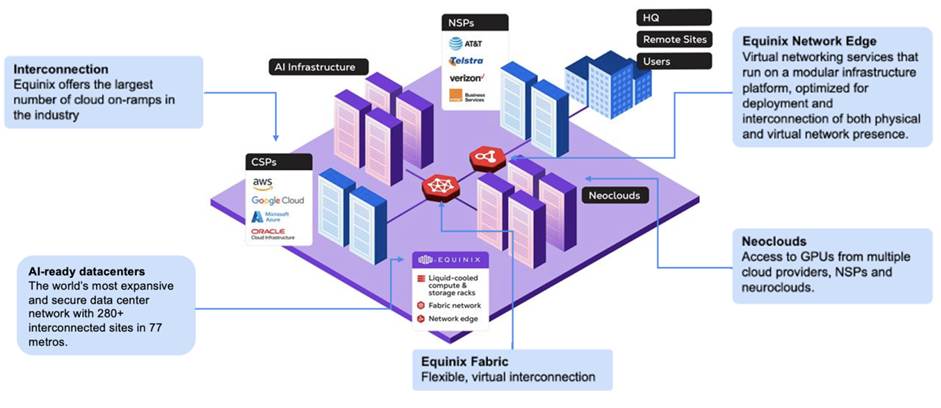
AI-ready data centers are built to handle these precise demands. Instead of sinking millions into renovating aging campus facilities, universities can leverage colocation services that provide the specialized cooling and energy density required to run high-performance supercomputers and deep learning models efficiently.

By offloading the physical infrastructure burden, your IT team can stop worrying about power outages or cooling failures and start focusing on what truly matters: empowering researchers to process massive datasets and reach conclusions faster.

Securing Grants with Strict Compliance

Federal grants are the lifeblood of university research programs and data sovereignty and privacy regulations increasingly shape how and where educational institutions can process AI data.

For IT and security leaders (CISOs), navigating frameworks like CMMC, FISMA High, HECVAT or HIPAA is a top priority.

Academic research often involves working with sensitive or Controlled Unclassified Information (CUI). Storing this data in vulnerable environments puts your institution at risk.

Utilizing colocation facilities can simplify the path to compliance by offering private, direct connectivity that bypasses the public internet. This ensures that sensitive research data remains protected both in transit and at rest. When your university can confidently demonstrate robust security controls and data sovereignty to Federal agencies, you gain a significant advantage in grant competitiveness.

Seamless Collaboration and Hybrid Cloud

Academic research is rarely an isolated effort. True innovation happens when universities collaborate with national labs, Federal agencies, private industry and peer institutions worldwide. This requires secure, high-speed data sharing across vast geographic distances.

Interconnected infrastructure offered by colocation providers allow universities to create secure physical and virtual links into a global ecosystem of research partners. This provides you with the ability to quickly transfer massive datasets to collaborating institutions without the frustrating latency or security risks associated with standard internet connections.

Many IT leaders are adopting hybrid cloud strategies to gain more efficient, cost-effective access to computing resources. To make that strategy work, it is essential to choose a colocation provider with a strong ecosystem that aligns with your specific requirements. That includes the right mix of cloud providers, networks, neoclouds and research partners to support your workloads, performance goals and growth plans. A well-connected provider does more than house infrastructure; it gives you the flexibility, reach and partner access needed to build a hybrid cloud environment that is resilient, scalable and fit for purpose.

Securing Your Digital Future with Equinix

The demands on university data centers will only increase as AI adoption grows and Federal grant requirements become more stringent. A strong digital foundation built on high-performance data centers like Equinix helps universities scale AI infrastructure globally with greater speed and efficiency. This enables institutions to run high-performance computing workloads, securely share sensitive data and connect more easily with the global research community.

Through software-defined, secure interconnection with Equinix Fabric, universities can connect directly to leading cloud and SaaS providers, including AWS, Microsoft Azure, Google Cloud, Salesforce and Workday. This gives research teams fast, reliable access to critical digital resources while reducing complexity and improving control. It also allows institutions to scale workloads to the public cloud during periods of peak demand and scale back when needed to improve performance and manage costs.

Optimize your Cloud Access Strategy

A strategic Carahsoft technology partner, Equinix is is committed to helping universities design future-ready IT infrastructure. Whether your top priority is optimizing your cloud access strategy, supporting your AI infrastructure goals or securing data for your next major research grant, Equinix provides the tools you need to succeed.

If you are exploring ways to modernize your digital infrastructure or want to learn how your peers are navigating these exact challenges, Carahsoft and Equinix are here to help. Reach out to the digital infrastructure specialists at Carahsoft to schedule a brief discussion or an executive briefing to dive deeper into your university’s specific goals.

Let us help you accelerate discovery and power the next generation of academic innovation.

Come meet Equinix at EDUCAUSE 2026 at Booth #210!

Carahsoft Technology Corp. is The Trusted Government IT Solutions Provider, supporting Public Sector organizations across Federal, State and Local Government agencies and Education and Healthcare markets. As the Master Government Aggregator for our vendor partners, including Equinix, we deliver solutions for Geospatial, Cybersecurity, MultiCloud, DevSecOps, Artificial Intelligence, Customer Experience and Engagement, Open Source and more. Working with resellers, systems integrators and consultants, our sales and marketing teams provide industry leading IT products, services and training through hundreds of contract vehicles. Explore the Carahsoft Blog to learn more about the latest trends in Government technology markets and solutions, as well as Carahsoft’s ecosystem of partner thought-leaders.

Third-Party Risk Management in the Public Sector: Lessons from Recent SLED Breaches

Many high-impact breaches affecting State agencies, municipalities and school districts have originated from third-party vendors. According to a 2025 Verizon report, breaches involving third parties doubled from 15% to 30% in just one year. So even while you’re updating your internal security measures, somewhere in your supply chain, attackers are finding ways in through indirect access points by exploiting vendor vulnerabilities often outside the visibility of internal security teams.

A practical starting point for third-party risk management in the Public Sector is to examine recent breaches and identify the blind spots that threat actors continue to exploit. With the right understanding, you can develop a third-party risk management program that addresses security gaps in public entities.

Why Third Parties Are the Biggest Threat Vector in the Public Sector

State, Local and Educational (SLED) institutions rely on dense vendor ecosystems that usually exceed available oversight capacity. Procurement processes tend to prioritize price and functionality, with security requirements treated as secondary. Once your organization signs the contract, visibility often drops off.

Without continuous monitoring, your vendors retain access to your systems and sensitive data, even as they change their security postures without your re-evaluation. These changes introduce new, often undetected security gaps.

Recent Breaches in the Public Sector That Started With a Third-Party

Adversaries continue to exploit vendor vulnerabilities to breach sensitive Public Sector data. Here are a few recent third-party exposures.

Oregon Department of Transportation and the MOVEit Exploit

On June 1, 2023, the Oregon Department of Transportation (ODOT) learned that it was part of the global breach of the file transfer tool MOVEit. A ransomware gang called Cl0p exploited a vulnerability in the third-party tool ODOT used to send and receive data in its routine operations.

The breach exposed the credentials of approximately 3.5 million Oregonians, including:

  • Full names
  • Date of birth
  • Physical address
  • Partial Social Security numbers
  • Driver’s license or identification card number

Although ODOT stated that the data was encrypted, the attackers were still able to access sensitive information due to a previously unknown vulnerability in MOVEit. The takeaway? ODOT’s exposure stemmed from a vulnerability in a third-party tool outside its direct control.. 

State of Maine and the MOVEit Supply Chain Impact

The same MOVEit exploit impacted several Maine State and Local Government agencies. By the time the State became aware of the breach on May 31, the ransomware gang had downloaded approximately 1.3 million records, essentially the entire Maine population.

More than half of Maine’s exposed data came from the Department of Health and Human Services, and another 10-30% from the Department of Education. Stolen data included:

  • Full names
  • Social Security numbers
  • Date of birth
  • Driver’s license number
  • Medical and health insurance information

While the vulnerability didn’t originate from the Maine systems, the State had no mechanism to detect flaws in the vendor’s software in advance.

PowerSchool and the K-12 Data Exposure

On December 28, 2024, PowerSchool, an education technology company, uncovered a breach affecting over 62 million students and 9.5 million educators worldwide. Unlike attacks that visibly disrupt operations, this intrusion went undetected for nine days.

Malicious actors used compromised subcontractor credentials to access PowerSchool’s customer support portal. PowerSchool’s engineers used this portal to access school districts’ student information for troubleshooting.

Because the portal didn’t require multi-factor authentication, a stolen username and password were all it took to gain administrative-level access across thousands of school districts. By the time PowerSchool identified the breach, the hackers had conducted the largest breach of children’s data in U.S. history.

Some districts later confirmed that hackers had accessed records dating back to 1995. PowerSchool paid approximately $2.85 million ransom and the attackers provided a video purportedly showing the deletion of the stolen data, but extortion attempts against individual school districts continued months later. For thousands of districts that trusted PowerSchool with their students’ most sensitive records, the issue wasn’t with the security practices but a vendor security gap they had no visibility into.

The Common Third-Party Risk Blind Spots in SLED

Across recent third-party data breaches, you can spot similar risk-management gaps. Your first step to improve vendor oversight is to identify the blind spots so you can close them before malicious actors exploit them.

No Formal Third-Party Risk Assessment at Onboarding

Many SLED entities rely on third-party-supplied questionnaires or attestations without independently verifying controls. Yet only 4% of organizations have high confidence that these questionnaires reflect the reality of third-party risk. Without independent vetting, you risk trusting controls that don’t reflect real-world security, leaving you exposed.

Point-in-Time Reviews Instead of Continuous Monitoring

Annual risk assessments capture a vendor’s security posture on a single day. Without continuous monitoring, you lack visibility into security control drifts and emerging risks between review cycles.

Contracts Without Security Baselines

In the Public Sector, procurement staff often negotiate contracts without cybersecurity expertise. Your SLED entity might onboard vendors without clearly defining security requirements, leaving you with limited options to enforce security controls later.

No Visibility Into Subcontractor Relationships

When Government agencies sign contracts with vendors, they rarely have visibility into the parties which that vendor relies on to deliver its services. However, exposure extends to everyone your vendor works with.

Supply Chain Risk Management Treated as an IT Issue

If your IT team is the only one responsible for third-party risk management (TPRM), other departments remain unaware of vendor exposure until an incident happens. You’ll have limited visibility across your organization and weaker accountability for vendor risk management.

How to Build a TPRM Program That Works for Public Sector Reality

As regulators and compliance bodies intensify scrutiny of supply chain risk management, your SLED institution needs a program that meets auditors’ requirements and protects sensitive data. Here are the primary steps to building an effective TPRM program that maintains constituent confidence.

Classify Vendors by Risk Tier

Your vendors carry different cybersecurity risks. For instance, a cloud provider that handles sensitive data requires a deeper assessment than a landscaping contractor. Your best approach is to classify vendors by:

  • The data they access
  • Criticality to operations
  • Regulatory exposure
  • Level of system or network access

This classification will allow you to focus on the highest-risk areas.

Standardize Risk Assessment at Onboarding and Throughout the Vendor Lifecycle

Assess your vendors’ security posture during onboarding to establish a clear baseline of cybersecurity risk from the start. After onboarding, set up ongoing monitoring processes to continuously detect changes in third parties’ security practices.

Set Contractual Security Baselines and Right-to-Audit Clauses

Your procurement and GRC team should work from a contract template that includes:

  • Minimum security control requirement
  • Right to audit vendor security practices
  • Data handling and retention requirements
  • Obligation to comply with regulatory changes
  • Subcontractor disclosure and flow-down security obligations
  • Breach notification timelines that meet Government agencies’ cybersecurity requirements

Implement Continuous Monitoring Through Automated Tools

Manual spreadsheet tracking cannot scale across a modern vendor ecosystem. To maintain ongoing visibility into your vendor security posture without requiring staff to manually chase each data point, use automated Government compliance software platforms to centralize vendor data, monitor risk signals and reduce manual tracking.

Establish Cross-Functional Ownership in Your SLED

Every department plays a role in your TPRM program. Procurement identifies new vendors, legal negotiates contracts, IT evaluates security controls and leadership sets the risk appetite. Your program should coordinate all these departments to create shared accountability and a unified approach to third-party risk decisions.

Strengthen Your Public Sector TPRM Program

As an SLED organization, your constituents expect you to protect their sensitive information while delivering essential services. An effective TPRM program will help you maintain public trust while meeting compliance requirements.

Learn how to strengthen your Public Sector TPRM program with Onspring’s platform and book a demo today.

Top 10 Education IT Events in 2026 

As educational institutions continue to navigate rapid technological transformation, staying connected with the latest innovations and best practices has never been more critical. From K-12 districts implementing next-generation cybersecurity solutions to higher education institutions leveraging artificial intelligence (AI) to enhance student outcomes, education technology is evolving at an unprecedented pace.   
Carahsoft Technology Corp., The Trusted Education IT Solutions Provider™, partners with leading technology providers to deliver comprehensive solutions that bridge the digital divide and empower educators, administrators and students alike. Throughout 2026, the education community will gather at events nationwide to explore emerging technologies, share successful strategies and forge partnerships that will shape the future of learning. Below are the key education events where Carahsoft and our partners will showcase innovative solutions designed to meet the unique needs of educational institutions of all levels. 

ISTELive 26 

June 28-July 1, 2026 | Orlando, FL | Hybrid Event 

The International Society for Technology in Education (ISTE) 2026 Conference & Expo is one of the world’s largest and most influential gatherings of educators, administrators and education technology innovators dedicated to transforming teaching and learning with technology. With thousands of attendees from around the globe, ISTELive offers hands-on workshops, cutting-edge keynotes and an expansive expo floor filled with the latest tools, strategies and research to support meaningful, equitable digital learning experiences. Whether you are looking to deepen your skills with AI and personalized learning, build a stronger tech-enabled classroom or connect with a vibrant community of peers passionate about education innovation, ISTELive 2026 delivers actionable insights and inspiring ideas to elevate teaching and drive student success. 

Carahsoft will sponsor and be an exhibitor at ISTELive 26. Visit us at booth #3254 to connect with our education technology vendors and explore their solutions that are transforming teaching and learning. Our team will showcase cutting-edge technologies, including digital learning platforms, classroom collaboration tools, cybersecurity and AI integration. Stop by and learn how Carahsoft can support your mission to enhance student engagement and outcomes through technology innovation. 

EDUCAUSE Annual Conference 

September 29-October 2, 2026 | Denver, CO | In-Person Event 

The EDUCAUSE Annual Conference 2026 connects higher education IT leaders, technologists and institutional decision makers looking to shape the future of campus technology. This flagship event brings together thousands of professionals from around the world to explore strategic innovations, emerging technologies and best practices that address the biggest challenges in higher education, from digital transformation and cybersecurity to data governance and AI-enabled learning. With a rich program of keynotes, panels, interactive sessions and networking opportunities, attendees gain actionable insights, practical solutions and collaborative connections that help drive institutional success and advance mission-critical priorities across teaching, learning, research and administration. 

Carahsoft will have a significant presence at the EDUCAUSE Annual Conference 2026, offering opportunities for attendees to engage with front-line education technology solutions. Join us at booth #501 to explore 24 demo opportunities throughout the Conference, with 12 showcase spots each day, featuring solutions from our leading partners. Participants can attend our industry panel addressing critical topics facing higher education IT leaders. Join Joe Toste for live recordings of the Tech Tables podcast and network with peers at our on-site reception in the CarahCafe. 

Carahsoft’s Sixth Annual EdTech Talks 

October 14-16, 2026 | Virtual Event 

Carahsoft’s Sixth Annual EdTech Talks summit is designed to equip academic IT leaders and education professionals with practical insights into the performance, security, cost-efficiency and modernization capabilities of today’s leading education technology solutions. This three-day virtual event will feature a dynamic mix of Classroom Panels, keynote Assembly Sessions and “Before the Bell” breakout discussions, covering topics ranging from school safety, digital equity, cybersecurity and the evolving student experience. Attendees will also explore emerging use cases for AI and machine learning in K-12 and higher education, with a focus on improving instructional outcomes, streamlining operations and supporting secure, scalable learning environments.  

Carahsoft is thrilled to host the Sixth Annual EdTech Talks, our premier virtual event for education. All presentation recordings and slide decks from the three-day event will be available on demand, allowing educators to access content on their own schedule. A detailed agenda will be posted soon. In the meantime, explore our sessions from the 2025 EdTech Talk Series to see how Carahsoft supports education missions through innovative technology solutions and thought leadership. 

Internet2 Technology Exchange 2026 

October 26-30, 2026 | Minneapolis, MN | In-Person Event 

The Internet2 Technology Exchange 2026 (TechEX26) centers on the practical, day-to-day challenges facing higher-education network and infrastructure teams as campus environments grow more complex. Through technical sessions and peer-to-peer conversations, a consistent theme continues to emerge: campus networks are being asked to deliver more than ever before. Institutions must provide secure, resilient, high-performance connectivity while supporting expanding research requirements, AI-enabled workloads, cloud adoption and hybrid learning environments—often with limited staffing and budgets. Network engineers and architects emphasize the need for better visibility, stronger security and increased automation to maintain reliability and performance across increasingly distributed systems. 

Carahsoft’s sponsorship of TechEX26 reinforces our longstanding commitment to supporting the research and education community. Through our partnership with Internet2’s NET+ program, Carahsoft works with member institutions to deliver reliable cloud and trust solutions that address shared technology challenges across higher education and research organizations. Our team will be present throughout TechEX26 and look forward to connecting with the Internet2 community to explore how Carahsoft can support your institution’s mission-critical technology initiatives. 

As education technology continues to evolve, these events represent invaluable opportunities to connect with peers, discover transformative solutions and gain actionable insights that can be implemented immediately. Whether you are seeking to enhance cybersecurity posture, implement AI-driven learning platforms, improve student data privacy or modernize IT infrastructure, Carahsoft and our extensive network of education technology partners are committed to supporting your mission. We invite you to join us at these premier events throughout 2026 to explore how innovative technology solutions can help your institution overcome challenges, enhance learning outcomes and prepare students for success. 

More Events

NERCOMP 

March 9-11, 2026 | Providence, RI | In-Person Event 

The NorthEast Regional Computing Program (NERCOMP) Annual Conference brought together higher education IT professionals, faculty, researchers and institutional leaders from across the northeast to connect, share expertise and advance innovation in teaching, learning and technology. In partnership with EDUCAUSE, the conference created a collaborative space to exchange practical insights, build meaningful relationships and explore emerging trends shaping higher education IT. Guided by this year’s theme, “Connect Locally, Think Globally,” attendees strengthened regional partnerships while gaining perspective from global best practices, making the conference an essential opportunity to learn, network and help drive forward-looking innovation across the higher education community. 

Carahsoft was a proud sponsor, strategic partner and exhibitor at NERCOMP 2026. We connected attendees at booth our with our education technology vendors and leading innovative solutions. Thought leaders discussed pressing topics facing higher education technology professionals at our industry panel on Wednesday, March 11th, and our team was available to discuss how our tailored solutions can enhance campus operations and drive institutional success. 

CASBO Con 26 

March 31-April 1, 2026 | San Diego, CA | In-Person Event 

The California Association of School Business Officials (CASBO) Con 2026 is a premier annual conference and expo for school business professionals across California. The event brought together more than 2,000 district administrators, financial officers and other school business leaders to connect, learn and grow through high-impact sessions, hands-on learning and access to the California School Business Expo showcasing the latest solutions and services tailored to the challenges and opportunities in K-12 education and community colleges. By attending CASBO Con 26, participants deepened their professional expertise, built valuable networks with peers and industry partners and gained practical insights that advance excellence in school operations and leadership statewide. 

Carahsoft’s sponsorship of CASBO Con 26 reinforced our commitment to supporting California’s K-12 business and financial leadership community. Participants were able to connect with our education technology vendors and discover solutions that address the unique fiscal and operational challenges facing California school districts. Our team showcased technologies from our partners in areas such as financial management systems, cybersecurity, data analytics and cloud infrastructure.

ASU+GSV Summit 

April 12-15, 2026 | San Diego, CA | In-Person Event 

The Arizona State University and Global Silicon Valley (ASU+GSV) Summit is a global gathering of education, workforce and technology leaders committed to transforming learning opportunities at all stages of life. Bringing together innovators from K-12, higher education, corporate learning, Government and investment communities, the Summit featured keynotes, panels and curated discussions that explored emerging trends in education technology, workforce development, AI and more. Attendees gained strategic insights, new partnerships and actionable ideas to accelerate innovation, scale meaningful solutions and drive impact across the learning ecosystem, from early education to career advancement. 

Carahsoft attended this year’s ASU+GSV Summit, demonstrating our commitment to supporting innovation at the intersection of education and workforce development. Our team was present throughout the Summit, connecting with attendees and discussing our comprehensive portfolio of education technology solutions. We look forward to participating in future Summits and exploring opportunities to drive meaningful change in education technology.

Internet2 Community Exchange 

April 13-16, 2026 | Chicago, IL | In-Person Event 

The Internet2 Community Exchange (CommEX26) is a flagship annual gathering where IT leaders, technologists and teams from research and education institutions came together to exchange ideas, share knowledge and collaborate on the future of technology in research and education. This event celebrated decades of community-driven innovation and provided expert-led sessions, working meetings and peer discussions that tackled topics such as emerging technologies, data privacy and security and sustainable IT strategies, fostering meaningful partnerships that help drive institutional missions forward. Attendees benefited from strategic insights, practical solutions to common challenges and the chance to connect with a diverse community dedicated to advancing research and education technology. 

Carahsoft and our partner NinjaOne co-sponsored and this year’s conference, supporting the collaborative spirit at the heart of the Internet2 community. In partnership with our reseller network, Carahsoft works closely with Internet2 to advance the NET+ and Cloud Scorecard programs, delivering trusted, vetted cloud solutions that help higher education and research institutions address shared technology obstacles. 

CoSN2026 

April 13-15, 2026 | Chicago, IL | In-Person Event 

The Consortium for School Networking (CoSN) 2026 Annual Conference is one of the leading national gatherings for K-12 education technology leaders, including Chief Information Officers (CIOs), Chief Technology Officers (CTOs), district administrators and education technology practitioners. Built around interactive keynotes, workshops and hands-on sessions, CoSN2026 equipped participants with strategic insights and practical tools to address pressing challenges like cybersecurity, student data privacy, generative AI (GenAI) readiness and digital equity while fostering collaboration on building the future of learning systems. Attendees connected with peers, engaged in high-impact learnings and gained actionable strategies to lead technology-enabled transformation that enhances teaching, learning and operations across school districts. 

Carahsoft was present at CoSN’s Annual Conference 2026. As a longstanding supporter of CoSN and the K-12 technology leadership community, our team was onsite to connect with attendees to discuss the latest innovations in education technology. 

EDUCAUSE Cybersecurity and Privacy Professionals Conference 

April 28-30, 2026 | Anaheim, CA | In-Person Event 

The EDUCAUSE Cybersecurity and Privacy Professionals Conference (CPPC) is a dedicated event for higher education IT and security leaders focused on strengthening defenses, protecting data and advancing privacy practices across campuses. Designed for cybersecurity practitioners, privacy officers and technology decision makers, the conference delivered deep-dive sessions, real-world case studies and collaborative discussions on emerging threats, risk management frameworks, incident response strategies and compliance priorities unique to higher education. Attendees gained practical insights, new tools and vetted best practices to enhance institutional resilience, build stronger security programs and network with peers tackling similar challenges, making it an essential experience for professionals committed to safeguarding their organization in an increasingly complex digital landscape. 

Carahsoft sponsored this year’s EDUCAUSE CPPC. Our Higher Education team, and representatives from Onspring and Summit7, partnered onsite at our co-sponsored tabletop to conduct meaningful conversations about the future of cybersecurity in the higher education sector. Carahsoft and Palo Alto Networks led an interactive panel session, Scaling the Semi-Autonomous SOC: A Leadership Blueprint for Resilient Higher Ed, designed to educate attendees about the leadership blueprint for a more resilient campus. Additionally, Carahsoft also hosted a receptionsponsored by Fortinet, Abnormal and A-Lignwhere higher education experts enjoyed an evening of networking with over 55+ key university decision makers. Carahsoft is a proud strategic partner of EDUCAUSE, and we look forward to building on these new and existing relationships and continuing the dialogue on cybersecurity challenges and solutions in higher education.

To learn more or get involved with any of the above events, please contact us at EDUMarketing@Carahsoft.com. 

For more information on Carahsoft and our industry-leading education technology partners’ events, visit our education solutions portfolio and education technology events page. 

Building the Future of Higher Education Through Strategic Partnerships

After more than 20 years of simplifying and facilitating technology procurement for higher education institutions, Carahsoft has developed a unique perspective: the greatest opportunities for innovation emerge when technology providers and campus leaders work together strategically, not just transactionally. Today’s most successful higher education IT initiatives share a common thread — they’re built on partnerships that align institutional needs with provider capabilities from the start.

This collaborative approach is transforming how campuses modernize infrastructure, strengthen cybersecurity and enable research excellence. Here’s what we’ve learned about building partnerships that deliver measurable results.

Understanding the Higher Education Technology Landscape

Campus CIOs are leading one of the most exciting periods of transformation in higher education history. The integration of Artificial Intelligence, machine learning and advanced analytics is opening new possibilities for research, student success and operational efficiency. At the same time, institutions are successfully navigating budget optimization, evolving institutional priorities and the ongoing need to strengthen cybersecurity posture.

From our vantage point as a Public Sector distributor working with hundreds of technology providers, resellers, implementation partners and thousands of institutions, we see tremendous momentum. Campuses are successfully deploying innovative solutions. Providers are developing platforms specifically designed for the unique needs of higher education. The opportunity now is to accelerate this progress through stronger collaboration and shared service.

What Campus Leaders Need to Succeed:

The most effective technology investments share common characteristics. They align with institutional strategy while delivering quick return on investment. They address current staffing realities rather than requiring extensive internal expertise. They integrate seamlessly with existing systems and workflows. Most importantly, they come with implementation support that helps institutions realize value quickly.

What Technology Providers Understand:

Leading providers recognize that higher education is a diverse marketplace with unique needs across institutions. A comprehensive research university has different needs than a liberal arts college or community college system. Successful vendors tailor their offerings to match institutional capacity which provides modular implementations that can scale over time as budgets and expertise grow.

Carahsoft’s Unique Position in Higher Education Technology

Our role as The Trusted Education IT Solutions Provider® and a Public Sector distributor gives us a distinctive perspective that benefits both institutions and providers. We facilitate numerous higher education technology transactions annually through cooperative contracts like OMNIA Partners, NASPO ValuePoint, The Quilt, E&I Cooperative Services and Internet2. This position allows us to see patterns and opportunities that emerge across the entire ecosystem.

View Carahsoft’s comprehensive suite of EdTech Contracts.

Operational Intelligence That Drives Better Outcomes:

Through more than two decades of higher education partnerships, we’ve developed deep knowledge of what drives successful technology adoption. We understand which contract vehicles institutions prefer and why. We know which implementation approaches deliver the fastest time-to-value. We’ve seen which vendor partnerships create the most sustainable long-term relationships.

This intelligence allows us to facilitate introductions and partnerships with a high probability of success. When a campus CIO describes their modernization goals, we can connect them with providers who have delivered similar outcomes for comparable institutions or state systems. When a technology provider wants to expand in higher education, we can share insights about institutional priorities, procurement preferences and implementation best practices.

Portfolio Breadth Enables Better Solutions:

Carahsoft’s portfolio spans Cybersecurity, Artificial Intelligence, MultiCloud, DevSecOps, analytics, identity management and more. This breadth enables us to help institutions build integrated solutions rather than purchasing point products. We can facilitate “Better Together” approaches where complementary technologies from multiple vendors create more comprehensive capabilities.

Accelerating Success Through Strategic Collaboration

Streamlined Procurement Accelerates Deployment:

Higher education institutions can access pre-negotiated pricing and state specific terms through cooperative contracts, satisfying lengthy RFP requirements and negotiations with vendors. This allows IT teams to focus resources on implementation and adoption rather than procurement administration.

Learn more about Carahsoft’s education contract vehicles and how they simplify procurement for your institution.

Implementation Support Addresses Resource Constraints:

Through Carahsoft’s reseller network, institutions can access partners who specialize in higher education deployments. These partners offer managed services, implementation support and ongoing optimization that address staffing challenges. This allows campuses to deploy more sophisticated solutions than internal resources alone would permit.

The Path Forward: Partnership as Strategy

As the higher education technology landscape continues to evolve, the institutions and providers that thrive will be those who embrace strategic partnership as a core operating principle. For campus leaders, this means viewing technology procurement not as a transaction but as relationship-building. For technology providers, this means investing in deep understanding of higher education operations, budget cycles and institutional priorities.

Carahsoft and our reseller partner are committed to facilitating these strategic partnerships. Our team of higher education specialists brings decades of combined experience in both campus IT operations and technology provider relationships. Together, we can ensure that every institution has access to innovative solutions that enable research excellence, student success and operational efficiency.

Ready to explore strategic technology partnerships for your institution? Contact Carahsoft’s higher education team to discuss your modernization goals and discover solutions tailored to your needs.

Technology providers seeking to expand in higher education? Connect with our team to learn how Carahsoft can accelerate your growth through strategic partnerships and streamlined procurement.

Better Together: How Nutanix and Omnissa Are Transforming End-User Computing in the Public Sector

Budget cuts and the pressure to do more with less has pushed IT leaders in State, Local and Education (SLED) organizations to consolidate tools and resources to increase operational efficiency. Simultaneously, the dynamic of workflows are changing; modern-day students and Government workers need secure access to resources from anywhere, at any time.

Integrated solutions are helping SLED organizations eliminate the unnecessary complexity and costs associated with maintaining separate solutions for storage, compute and networking components. The recent partnership between Nutanix and Omnissa offers SLED organizations a platform for managing End-User Computing (EUC) across agencies, states, cities and school districts.

Vendor Choice and Pricing Flexibility

Faced with higher costs and more restrictions, many SLED organizations are seeking alternatives solutions that can provide similar functionality without the associated vendor lock-in risks. The Nutanix-Omnissa platform offers multiple licensing options, including per-user models that offer greater flexibility than traditional bundled approaches. Organizations can choose the licensing model that best fits their usage patterns and budget constraints.

The solution also works with a wide range of server vendors including Dell, HPE, Lenovo, Cisco and more, allowing organizations to leverage existing hardware investments or choose vendors based on their specific procurement requirements. This enables different agencies within the same Government entity to standardize on the same technology stack, eliminating disparate systems.

Hybrid Cloud Security, Compliance and Resilience

SLED organizations must be able to provide remote access to sensitive data while simultaneously meeting strict compliance mandates. The Nutanix-Omnissa Horizon platform supports certified Government cloud environments, including FedRAMP, GovRAMP and GovCloud, ensuring consistent enforcement of security policies across on-premises and hybrid deployments. Department of Defense (DoD) certifications validate the platform for regulated workloads, while unified access gateway appliances deliver secure, compliant remote access.

To strengthen resilience, Nutanix provides automated disaster recovery and replication across sites and clouds, maintaining workload availability even during outages. Agencies can extend their EUC environments across AWS, Azure and soon Google Cloud, balancing scalability with compliance while preserving consistent management and licensing. When paired with Omnissa Horizon Cloud-Pod technology, the platform can provide a true multi-cloud solution including on-premises hybridity.

How Nutanix and Omnissa Are Transforming EUC, blog, embedded image, 2025

Simplified Infrastructure Management

Outmoded infrastructure management often requires specialized expertise across hypervisors, storage, networking components and management tools, creating operational overhead and increasing the risk of configuration errors or security gaps. The Nutanix-Omnissa Horizon integration streamline operations through Prism Central, a unified management interface for multi-cluster and hybrid environments.

The platform includes built-in capabilities for replication, disaster recovery and automated maintenance that traditionally required separate tools and specialized expertise. Lifecycle management capabilities automatically update firmware, software and system components with zero downtime, allowing organizations to perform maintenance during business hours and reduce human error during update processes.

Technical Differentiators and Release Roadmap

Beyond EUC management, the Nutanix-Omnissa Horizon solution introduces technical advantages like Clone Prep technology that enables extremely fast, reboot-free provisioning, delivering near instant clone performance. Nutanix’s metadata-based cloning and data locality ensure low-latency performance for Virtual Desktop Infrastructure (VDI) workloads, while built-in deduplication and erasure coding optimize storage efficiency. Additional features further strengthen the platform’s ability to meet complex SLED requirements, including:

  • Nutanix Files – scalable file services that can be used for user profiles and Omnissa App Volumes
  • Nutanix Flow – microsegmentation and network security
  • Nutanix Data Lens – ransomware protection and data insights

The partnership is rolling out in phases to ensure stability and customer success. Limited Availability (LA) is currently offered, supporting Windows 10 and 11 automated pools, graphics processing unit (GPU) support and Unified Access Gateway (UAG) appliances. General Availability (GA) is expected between December and March, adding capabilities such as:

  • Automated remote desktop service (RDS) farms
  • Windows Server operating system (OS) support
  • Federal Information Processing Standards (FIPS) mode
  • Workspace ONE Access on-premises integration

Proven Partnership with Enhanced Capabilities

Thousands of organizations already run Omnissa Horizon on Nutanix infrastructure using vSphere, demonstrating the maturity and proven nature of the underlying technology platform. The addition of AHV hypervisor support represents an evolution of an existing partnership rather than an experimental new venture, validated real-world organizations that participated in the beta program.

The partnership brings together the complete technology stack and expertise from both organizations. Omnissa brings over 15 years of Horizon and Workspace expertise, while Nutanix contributes hyperconverged infrastructure capabilities. Together, they deliver mature, field-tested solutions that reduce operational complexity, consolidate infrastructure and enable future growth with confidence.

To learn more about how this partnership can transform your organization’s EUC strategy, watch the complete webinar, “Unlock the Future of EUC for Public Sector: Horizon 8 on Nutanix.”

Carahsoft Technology Corp. is The Trusted Government IT Solutions Provider, supporting Public Sector organizations across Federal, State and Local Government agencies and Education and Healthcare markets. As the Master Government Aggregator for our vendor partners, including Nutanix and Omnissa, we deliver solutions for Geospatial, Cybersecurity, MultiCloud, DevSecOps, Artificial Intelligence, Customer Experience and Engagement, Open Source and more. Working with resellers, systems integrators and consultants, our sales and marketing teams provide industry leading IT products, services and training through hundreds of contract vehicles. Explore the Carahsoft Blog to learn more about the latest trends in Government technology markets and solutions, as well as Carahsoft’s ecosystem of partner thought-leaders.

Embracing Human Intelligence into Digital Learning

Artificial intelligence (AI) delivers scale and efficiency, but human intelligence adds empathy, creativity and critical thinking to create a balanced, impactful learning environment. Adding human interaction into digital learning offers advantages that AI alone cannot provide.  First and foremost, humans are consuming the information, and humans learn in a variety of ways, so training is often not a one-size-fits-all endeavor. There is also contextual judgement and nuance that might be missed by AI. Training should include an emotional connection to help drive learner engagement. Finally, the social learning aspect of open-ended discussions, engaging in the hive mind, mentorship and creating an ecosystem of peers delivers a more human experience. Let’s look at how Adobe Captivate, Adobe Learning Manager and Adobe Connect can help you deliver training that embodies human-driven content with AI efficiency.

Course Creation – The Perfect Combination of AI and the Human Touch

Creating courses from scratch can be a daunting task, and scaling them as your need for more training grows can be even more overwhelming. What topics to cover, which training methods should be used and how to deliver the courses is only the tip of the iceberg. The latest version of Adobe Captivate incorporates AI to help you create tailored training through simplified workflows that include content presets, slide templates and text to speech generation. For added interactivity, Captivate includes the capability to add interactive videos, choose from a built-in multimedia asset library and dynamic widgets. Once the core content is created, the information can be massaged to create story driven training based on real world experiences that span from soft skills to software simulation and everywhere in-between. Lastly, information retention can be supported through graded or knowledge check-type assessments to create quizzes with varied criteria to provide a fully polished training course. In short, let AI automate the more tedious tasks and keep the human touch as a core to add relatability to the final deliverable.

When to Leverage AI for Training Scalability

When your organization is growing and the need for high-volume repetitive training arises, AI can allow you to scale by helping you manage data-driven improvements and efficiencies. Adobe Learning Manager is a learning management system that can help you automate course assignments, track learner progress and generate a multitude of reports to measure the effectiveness of your training program. AI can be used to help create logical learning paths to help team members navigate organizations that have hundreds or thousands of course offerings with blended content types, such as self-paced, virtual training, in person or submission-based. Through Adobe Learning Manager, individual courses can be grouped into learning paths spanning a longer period, covering related topics and increasing the learner’s expertise in associated skills levels. Such learning paths can be configured with automated enrollment triggered by specified events, such as a learner’s registration to the LMS, their onboarding, promotion, re-location, upskilling and more. Carahsoft recently completed a case study* on Adobe Learning Manager that cited a 96% increase in growth over the last four years. It was a huge turning point in how training was delivered company-wide, and the number of courses and modules exploded to over 5600. Whether you are delivering on-demand, instructor-led or hybrid-style training, Adobe Learning Manager serves as a centralized hub where team members can complete compliance courses, engage in continuing education, develop new skills or renew their yearly certifications.

*Please click here if you would like to read more about how Carahsoft leverages Adobe Learning Manager to deliver over 5600 learning modules, 952 courses and 35 learning paths.

Virtual Classrooms – Where AI and Human Interactivity Join Forces to Provide Deep Learning Experiences

The key to any great virtual classroom experience is interactivity. Get your audience to the keyboard and the screen and keep them there. Adobe Connect provides numerous ways to achieve this, including breakout rooms, webcams, quizzes, multiple simultaneous screenshares, whiteboarding and persistent virtual environments. Humans tend to learn better when they feel seen, and are engaged in the training, this is the human element at work. Turn on webcams to create empathy, break into smaller groups to promote the sharing of ideas, leverage creativity by drawing on the whiteboard and start building an environment that is enhanced by AI but not solely driven by it. Once the human element is operating in full force, you can engage the power of AI to offer live support during a training session or to create post-training blogs to keep the conversation going after the course has ended.

When you learn to combine the power of AI with the relatability of the human touch, your training programs will scale, engage, educate and drive results in ways that were unimaginable a few short years ago. The future of training will incorporate hyper-personalized learning paths that include bite-sized microlearning modules, adaptive assessments, immersive learning experiences and AI assistance throughout the entire process.

To learn more about digital learning and AI, watch the webinar series, “Embracing Human Intelligence into Digital Learning.” To take a deeper dive into Adobe’s eLearning products contact us to schedule a complimentary demo today!

Carahsoft Technology Corp. is The Trusted Government IT Solutions Provider, supporting Public Sector organizations across Federal, State and Local Government agencies and Education and Healthcare markets. As the Master Government Aggregator for our vendor partners, including Adobe we deliver solutions for Geospatial, Cybersecurity, MultiCloud, DevSecOps, Artificial Intelligence, Customer Experience and Engagement, Open Source and more. Working with resellers, systems integrators and consultants, our sales and marketing teams provide industry leading IT products, services and training through hundreds of contract vehicles. Explore the Carahsoft Blog to learn more about the latest trends in Government technology markets and solutions, as well as Carahsoft’s ecosystem of partner thought-leaders.

Executive Order on Advancing AI in Education: What Government and Education Leaders Need to Know 

The recent Executive Order-14277 promotes the inclusion of artificial intelligence (AI) in education and is a significant step toward preparing America’s youth for an AI-driven future. Signed on April 23, 2025, this directive establishes a comprehensive framework for integrating AI literacy and proficiency across the educational landscape.  

As schools explore the benefits of AI, Carahsoft and our partners are here to guide and support their journey. Here are the takeaways that we found most important from the recent Executive Order. 

Task Force on Artificial Intelligence Education 

At the center of this Executive Order is the establishment of a White House Task Force on Artificial Intelligence Education. This cross-agency Task Force is chaired by the Director of the Office of Science and Technology Policy, and features executives from various offices and departments, such as the Director of the National Science Foundation (NSF), the Special Advisor for AI and Crypto and the Secretaries of Agriculture, Labor and Education. The Task Force will coordinate Federal efforts to promote AI in education and implement the policy initiatives outlined in the order. 

These include: 

  • Promoting AI literacy in the workforce and education 
  • Training educators in AI usage 
  • Integrating AI into early education 
  • Creating an AI-ready workforce 

This coordinated approach underscores the Federal Government’s commitment to ensuring students develop the skills necessary to thrive in an increasingly AI-driven economy and society.  

Initiatives for Enhancing K-12 AI Education 

With this Executive Order, schools are encouraged to establish partnerships with leading AI industry organizations, academic institutions and nonprofit entities to develop online resources that will teach K-12 students foundational AI literacy and critical thinking skills. Partnerships will be awarded on a rolling basis, with resources expected to be ready for classroom use within 180 days of the first announced partnerships. 

Additionally, within 90 days of the new Executive Order, the Task Force will establish plans for the Presidential Artificial Intelligence Challenge. This challenge celebrates student and educator achievements in AI, fostering collaboration between Government, academia and industry organizations, such as Varsity Tutors, which empowers students through its AI-powered adaptive learning platform, as well as its ability to recommend personalized tutors.  

Prioritizing Teacher Training and Professional Development 

Recognizing that effective AI education depends on well-prepared educators, the Executive Order directs the Secretary of Education to prioritize AI in discretionary grant programs for teacher training, authorized by the Elementary and secondary Act of 1965. This includes professional development focused on: 

  • Reducing time-intensive administrative tasks 
  • Improving teacher training and evaluation 
  • Integrating AI fundamentals across all subject areas 
  • Providing specialized training in computer science 

AI can reduce the burden on teachers by aiding with management. Platforms such as Degree Analytics and Education Analytics both utilize AI and machine learning to analyze student communications and engagement and provide reports to improve student performance and retention. Gaggle can help by alerting educators and parents of potential safety concerns with social media posts and other student communications, aiding educators in managing students. 
 

Additionally, the NSF is directed to prioritize research on AI in education and create teacher training opportunities that help educators effectively integrate AI-based tools in classrooms. There are a wide variety of AI-based tools for educators to choose from. Nuventive, for example, offers performance improvement platforms with AI-powered analytics for strategic planning in education. YuJa integrates AI for video captioning, analytics and engagement tools, and Turnitin helps educators detect plagiarism and writing patterns. PowerNotes, Docebo and Instructure (a Canvas platform) all feature organizational and learning enhancements for students. Docebo and Instructure (a Canvas platform) all feature organizational and learning enhancements for students. 

The Executive Order extends beyond K-12 education to address workforce development through AI-related Registered Apprenticeships. The Secretary of Labor is directed to increase participation in these programs by establishing specific growth goals with existing discretionary funds in order to support the creation of nationwide program standards. 

Building an AI-Ready Workforce Through Apprenticeships 

States and grantees are also encouraged to use Workforce Innovation and Opportunity Act (WIOA) funding to support AI-based learning opportunities. This component of the Executive Order creates significant potential for collaboration between education institutions, Government agencies and industry partners to develop comprehensive AI workforce development pathways. Some industry partners who have already begun integrating AI for workforce development initiatives are Education Technology, Services and Research (EAB), which uses AI to support student success, and YouScience, which maximizes student success by using AI to analyze a student’s interest and aptitudes and match them with academic pathways.   

The Path Forward 

Educational institutions and Government agencies seeking to capitalize on the opportunities laid out in Executive Order “Advancing Artificial Intelligence Education for American Youth” should begin planning now. Industry tie-ins can enhance education and learning, such as Udemy, which offers content recommendations and delivers AI course content, Invoke Learning, Inc., which leverages AI and data science to improve student outcomes and institution decision-making and Impero Software, which offers AI monitoring features for safeguarding and classroom management. Industry aid can go beyond K-12 education, too. Element451, for example, promotes student engagement and enrollment management in higher education.  

Carahsoft and our ecosystem of technology partners are ready to support this national effort to prepare America’s youth for an AI-driven future. Through our extensive contract vehicles and specialized AI solutions designed for educational environments, we provide the tools and expertise needed to implement the vision outlined in this landmark Executive Order. 

To learn how Carahsoft can help your organization implement the vision laid out in the Executive Order on Advancing AI Education, visit our comprehensive portfolio of AI solutions and discover how our trusted vendors can accelerate your institution’s AI-education initiatives today.

Ghost Students, Real Damage: How Colleges Can Fight Back Against Financial Aid Fraud

Higher education is facing a quiet but costly crisis: the rise of the ghost student.

“Ghost students” are not just overwhelmed freshmen who give up on attending classes. They refer to fraudulent enrollments that exploit financial aid. These individuals use fake or stolen identities to exploit the college admissions and funding process. Although they appear on class rosters, they never actually attend any classes, ultimately vanishing with thousands of dollars in public aid. This leaves a trail of deception and exposes the institution to financial loss, academic disruption and significant risk.

According to ABC News,

  • In California in 2024, community colleges reported 1.2 million fraudulent Free Application for Federal Student Aid (FAFSA) applications, resulting in 223,000 confirmed fake enrollments, and at least $11.1 million in aid lost that could not be recovered.
  • Across the country, scams are evolving: AI-driven chatbots are now enrolling in online courses, submitting assignments and collecting Federal aid checks before disappearing.

This isn’t an isolated glitch. It’s a systemic problem that’s already impacted colleges across the country. A recent Fortune investigation revealed the extent of the issue, particularly within State-funded and community colleges. 

Let’s take a closer look at what’s happening—and how schools can take action.

What Ghost Students Are Really Costing Colleges

Draining Financial Aid Funds

Ghost students are exploiting the very programs designed to make education more accessible. By submitting fake applications and filing for FAFSA, they’re securing grants and loans that should go to real students.

  • Millions of taxpayer dollars are being misappropriated.

  • Real students face delays or reductions in funding.

  • Colleges could be subject to additional Federal review related to institutional oversight.

Blocking Real Students from Classes

When ghost students enroll in courses, they take up space in classes with limited capacity.  Real students are waitlisted or forced to delay required coursework causing. 

  • Retention and graduation timelines to be negatively affected.

  • Institutions appear to have higher demand than they do, skewing planning and resourcing.

Creating Chaos for Faculty

Faculty are on the front lines but often lack the tools to act.  Professors see names on rosters that never attend class or engage online.  They waste time managing attendance and grading systems for non-existent students.  In some systems, participation verification ties directly to financial aid distribution, making instructors unwilling fraud gatekeepers.

Undermining Academic Integrity

Some ghost students now use AI tools to simulate engagement, submitting auto-generated assignments or quizzes just enough to avoid detection.  This adds new complexity to academic fraud detection systems.  It creates a misleading sense of engagement and learning outcomes.  It diminishes the credibility of online and hybrid learning models.

Eroding Institutional Trust

When ghost student scams become public, institutions face:

  • Loss of public trust from taxpayers and lawmakers.

  • Stricter audits and compliance measures from Federal and State agencies.

  • Damage to brand reputation, especially for open-access colleges already facing enrollment challenges.

Best Practices to Combat Ghost Student Fraud

The good news? Colleges and universities can take clear, effective steps to combat ghost student fraud—without disrupting the experience of legitimate applicants and learners.

1. Strengthen Identity Verification at Enrollment

  • Require secure identity checks—such as photo ID uploads, Government document validation or third-party identity verification services.

  • Consider real-time methods (e.g., liveness checks or short video interviews) for applicants flagged as high-risk.

  • Cross-reference application data with trusted third-party sources (address, SSN, IP) to verify legitimacy.

2. Monitor for Behavioral and Digital Red Flags

  • Track enrollment behaviors across systems—such as IP location, email reuse or batch submissions.

  • Use device fingerprinting and geolocation to detect patterns consistent with coordinated fraud.

  • Flag applications originating from anonymized networks (e.g., VPNs, Tor) or unusual time patterns.

3. Audit Student Engagement After Enrollment

  • Regularly review course engagement data: login frequency, assignment submissions and participation metrics.

  • Identify students who never log in, submit the same content as others, or only “check in” once to trigger aid distribution.

  • Coordinate across departments to investigate anomalies in LMS usage and academic records.

4. Empower Faculty and Staff with Reporting Tools

  • Provide professors with simple tools to flag suspicious student behavior or attendance issues.

  • Create workflows to escalate these reports to IT, compliance or enrollment services.

  • Incorporate faculty feedback into larger fraud detection strategies and data models.

5. Automate Risk-Based Escalation

  • Apply more scrutiny to applications that show unusual patterns, while keeping onboarding smooth for verified students.

  • Avoid unnecessary friction by using layered security that adapts to the level of risk.

  • Balance access and security, especially critical for open-access institutions serving vulnerable populations.

A Trusted Partner in the Fight Against Ghost Students

Addressing the issue of ghost students requires more than just technological solutions. It necessitates effective coordination among admissions, IT, financial aid and academic departments, along with the right combination of data, policies and personnel.

At HUMAN Security, we have assisted organizations across various industries in defending against sophisticated fraud campaigns, including fake account creation, credential abuse and automated bot attacks. Our team possesses extensive expertise in fraud detection, protecting student identity and behavioral intelligence, and we are prepared to assist higher education institutions in tackling these challenges as well.

We’re not here to sell a one-size-fits-all product—we’re here to have a conversation.

If you’re a university administrator, faculty member or IT leader concerned about ghost students, HUMAN can provide a free consultation to discuss:

  • Best practices for protecting your institution

  • Tailored risk assessment strategies

  • How to align fraud defenses with student equity and access

Let’s work together to protect financial aid, support faculty and create a safer learning environment for real students.

Ready to talk? Contact HUMAN to start a conversation about how your institution can detect and prevent ghost student fraud before it costs your school and your students.

Carahsoft Technology Corp. is The Trusted Government IT Solutions Provider, supporting Public Sector organizations across Federal, State and Local Government agencies and Education and Healthcare markets. As the Master Government Aggregator for our vendor partners, including HUMAN Security we deliver solutions for Geospatial, Cybersecurity, MultiCloud, DevSecOps, Artificial Intelligence, Customer Experience and Engagement, Open Source and more. Working with resellers, systems integrators and consultants, our sales and marketing teams provide industry leading IT products, services and training through hundreds of contract vehicles. Explore the Carahsoft Blog to learn more about the latest trends in Government technology markets and solutions, as well as Carahsoft’s ecosystem of partner thought-leaders.