How AI-Powered Records Management Transforms Government Operations from Reactive to Proactive

Government agencies today must manage an unprecedented volume of digital documents. As digital transformation accelerates across Federal, State and Local agencies, the challenge is not just managing more content, it is extracting actionable intelligence while maintaining compliance, security and operational efficiency. Artificial intelligence (AI) has transformed enterprise records management, replacing manual processes with automated, predictive systems that improve decision making and resource allocation across the mission.

AI-Powered Auto-Classification for Document Management

Effective classification is the foundation of records management, and AI has altered this traditionally complex process. Modern AI models can accurately classify structured documents like invoices or purchase orders, with as few as ten training examples. This represents a major improvement over legacy systems that required zonal Optical Character Recognition (OCR) configuration, separator pages and precise layout specifications.

AI models employ multiple techniques, including computer vision, text extraction and contextual reasoning, to identify document types with high confidence. Unlike older pattern-matching tools, today’s AI adapts to variations in structure and format, making classification scalable for agencies managing thousands of document types across different departments.

Training has also become more accessible. Agencies can simply label documents, point the AI to those examples and generate a working classification system. Accuracy improves over time through human review, and confidence scores allow agencies to set thresholds and route low-confidence results to human reviewers.

Accurate classification directly impacts record retention, access control and content discovery. Without it, employees cannot find necessary documents, retention schedules are misapplied and access permissions become inconsistent. Robust AI-powered classification at ingestion ensures downstream processes function as intended.

Intelligent Data Extraction from Structured and Unstructured Documents

Once documents are classified, agencies must extract meaningful information, an area where AI delivers transformative capabilities. Modern machine learning models locate key-value pairs anywhere on a document, using contextual understanding rather than fixed positions or label formats. AI can also answer natural-language queries, mirroring human logic. If a person can explain how they would find a piece of information, that logic can be written as a prompt for the model.

These capabilities work across structured and unstructured formats. Work that previously required specialized staff and years of experience can now be configured with simple prompts. Confidence scoring ensures accuracy. When the model is uncertain, items are routed to human reviewers. This combines automation’s speed and consistency with human judgment where needed.

For Government agencies, AI extraction improves compliance and reporting. Licensing applications, permit requests, inspection reports and countless other documents can be automatically processed, with extracted data populating systems of record and triggering workflows. Information once locked in PDFs or paper becomes structured, searchable and actionable.

AI-Driven Deduplication and Data Quality Management
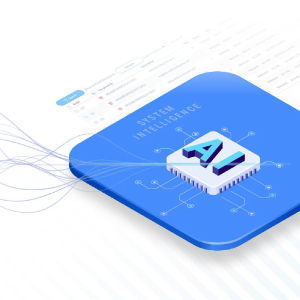
VisualVault, AI-Powered Records Management blog, embedded image, 2025

Duplicate data is a productivity drain and a compliance risk. Redundant documents accumulate quickly across forwarded emails, multiple repositories and inconsistent processes. This creates unnecessary work, consumes storage and complicates compliance with data retention requirements.

Legacy deduplication relied on hash matching, but this fails to detect most real-world duplicates. AI-based deduplication analyzes document classifications and extracted metadata to determine true duplicates based on agency-defined rules. If the elements match according to customer rules, the system flags the items as duplicates regardless of differences in headers or formatting.

This content-based deduplication reduces storage costs, simplifies retention compliance and minimizes cybersecurity exposure. Retaining unnecessary data increases legal risk during litigation and discovery and expands the attack surface for cyber threats. AI allows agencies to retain only necessary data, reducing operational and security liabilities.

Enhanced Workflow Automation with Predictive Analytics

High-quality, classified and extracted data unlocks the full value of predictive analytics, enabling Government agencies to shift from reactive problem-solving to proactive planning. This capability uses historical data to predict outcomes, such as numeric values, binary decisions or multiclass classifications.

Platforms like VisualVault allow agencies to train predictive models without data science expertise. Professional services teams configure the models, demonstrate how they work and train agency employees to manage them.

Public sector agencies already use predictive analytics to forecast safety incidents at licensed facilities. Historical inspection data comprised of conditions, violations and corrective actions allows models to identify facilities with a high probability of future serious events. When inspections reveal patterns associated with increased risk, inspectors and licensing officials are automatically alerted, enabling early intervention.

Predictive analytics also strengthens performance management. Agencies can compare their metrics against industry norms, seeing where they stand within their sector. This supports investment decisions and enables precise tracking of improvement outcomes.

Agencies should focus on automating controls that meaningfully reduce, not simply increasing the percentage of automated controls. High-impact controls should be prioritized for automation and predictive monitoring to maximize security and operational benefits.

For decision makers, predictive analytics delivers the context and accuracy needed to make fast, informed decisions across claims, vendor management, resource allocation and strategic planning.

Digital Transformation as Organizational Necessity

Despite rapid technological advancement, human expertise remains essential. AI systems are designed to operate behind the scenes and do not require users to understand machine learning (ML) concepts. Small teams define the required outcomes, what must be classified, what data must be extracted and what predictions will improve decisions, while professional services configure the system accordingly.

AI adoption does not inherently reduce headcount. Historically, technology shifts transform jobs rather than eliminate them. Workflows move from manual tasks like sorting documents to higher-value work such as analysis, decision making and innovation. Employees focus on defining requirements, reviewing AI outputs and applying human judgement where it adds value.

The Measurable Value of AI Implementation

Agencies can begin their journey by identifying their key performance indicators and the business outcomes they want to improve:

  • What pain points cause the most friction?
  • Where do backlogs accumulate?
  • Which processes create the most risk?

This ensures implementation is tied to measurable outcomes. AI success depends on clear requirements, proper process, staff training and strong governance. Agencies should adopt AI incrementally, starting with high-value use cases that deliver quick wins, then expanding into more complex workflows and predictive models as confidence grows.

Digitization mandates and the rise of generative AI have accelerated content creation beyond expectations, driving significant growth for platforms like VisualVault. The agencies that succeed will be those that embrace this shift and modernize now.

Watch VisualVault’s webinar “Employing AI to Bring Order and Value to Enterprise Records Management” to explore detailed demonstrations of AI-powered classification, extraction and predictive analytics capabilities that can transform your agency’s records management operations.

Carahsoft Technology Corp. is The Trusted Government IT Solutions Provider, supporting Public Sector organizations across Federal, State and Local Government agencies and Education and Healthcare markets. As the Master Government Aggregator for our vendor partners, including VisualVault, we deliver solutions for Geospatial, Cybersecurity, MultiCloud, DevSecOps, Artificial Intelligence, Customer Experience and Engagement, Open Source and more. Working with resellers, systems integrators and consultants, our sales and marketing teams provide industry leading IT products, services and training through hundreds of contract vehicles. Explore the Carahsoft Blog to learn more about the latest trends in Government technology markets and solutions, as well as Carahsoft’s ecosystem of partner thought-leaders.

From Data Silos to Life-Saving Decisions: How Technology is Transforming Healthcare Delivery

Healthcare organizations continuously navigate complex challenges as patient demand grows. Imaging volumes are rising faster than radiology capacity can scale. Public health agencies manage vast amounts of data across disconnected systems. Administrative tasks consume time that healthcare staff would rather spend on patient care.

These operational realities create opportunities for technology to make a meaningful difference. Leading healthcare organizations are already transforming these challenges into improved outcomes through strategic technology deployments enabled by streamlined procurement.

As The Trusted IT Solutions Provider for the Healthcare Industry™, Carahsoft offers a robust portfolio of healthcare technology solutions that make positive changes in the quality, safety and effectiveness of healthcare delivery systems. Streamlined procurement is available through Carahsoft’s reseller partners and numerous contract vehicles including GSA Schedule, NASPO ValuePoint, E&I Cooperative Services and The Quilt.

Key Takeaways:

  • AI diagnostics improve radiology efficiently by up to 40% addressing the looming shortage of 42,000 radiologists by 2033.
  • Unified data platforms enable more than 80% of emergency departments to share real-time data with the CDC.
  • Automated workflows cut processing times by 50%, freeing staff for patient care.
  • Zero Trust security protects patient data while enabling hybrid cloud operations.
  • Streamlined procurement accelerates deployment from months to weeks.

AI-Powered Diagnostics: Addressing the Radiology Crisis

By 2023 the U.S. faces a shortage of up to 42,000 radiologists as imaging volumes rise 5% annually while residency positions increase just 2%.

At Northwestern Medicine, Dr. Mozziyar Etemadi, Clinical Director of Advanced Technologies, deployed a generative AI solution with Dell Technologies and NVIDIA that analyzes chest X-rays and generates draft reports instantaneously. Results: radiology efficiency improved by up to 40% without compromising diagnostic accuracy. The system flagged unexpected pneumothorax cases with 72.7% sensitivity and 99.9% specificity – lifesaving in emergency settings.

The technology runs on Dell PowerEdge XE9680 servers with NVIDIA H100 GPUs, deployed on premises to maintain HIPAA compliance. Northwestern is now developing predictive models for entire electronic records.

Public Health Surveillance: Rapid Outbreak Response

The CDC faced a critical challenge: essential health data trapped in disconnected silos across thousands of facilities.

The CDC’s partnership with Cloudera created a unified platform consolidating data from hospitals, laboratories and wastewater testing sites. More than 80% of non-federal emergency departments now send data to CDC, enabling comprehensive threat monitoring. When measles spiked across 15 states in 2025, officials had integrated visualizations within days.

The CDC’s One CDC Data Platform (1CDP), established in 2024, provides state, tribal, local and territorial agencies with streamlined access to core datasets and analytics, enabling faster disease trend detection and proactive strategies.

Accelerating Cancer Research Collaboration

The National Cancer Institute partnered with Google Cloud and Barnacle AI to introduce NanCI – a platform leveraging AI-driven recommendations to connect researchers with collaboration opportunities, literature and events. The solution demonstrates how AI extends beyond clinical care to accelerate scientific discovery across Government, Education and Healthcare sectors.

Operational Excellence: Freeing Caregivers to Care

Workforce coordination: Healthcare organizations use BlackBerry AtHoc, available through Carahsoft’s reseller network and contract vehicles, to streamline staffing and scheduling processes. The event management platform helps ensure personnel are coordinated efficiently across departments which is essential for maintaining high standards of patient care.

Financial automation: Community Health Centers of Florida implemented Laserfiche’s enterprise content management system, cutting processing time by 50% and eliminating manual data entry. “I cannot fathom processing the current volume of invoices ‘the old way,’” said Dee Bradshaw, director of purchasing. “Laserfiche has cut our processing time in half.”

Every hour freed from administrative burdens is an hour caregivers get back to spend with their patients.

Modern, Secure Infrastructure

California Department of State Hospitals deployed Rubrik’s data management platform to integrate legacy systems with modern hybrid cloud environments. Rubrik’s Zero Trust Data Security framework minimized ransomware vulnerability while ensuring Federal compliance.  

St. Luke’s University Healthcare Network used Rubrik for faster backups, near-instant recovery and seamless hybrid IT integration, strengthening cyber defenses while freeing IT staff to support clinical teams.

Federal agencies, State and Local Governments and Education institutions face similar Zero Trust security and hybrid cloud integration requirements.

Explore Carahsoft’s cybersecurity solutions at www.carahsoft.com/solve/cybersecurity.

Meeting Demand at Scale

NYC Health + Hospitals deployed Snowflake’s Data Cloud which consolidated separate data sources into a unified platform. This integration eradicated silos, provided real-time visibility and enabled data-driven decisions at the point of care for vulnerable populations.

The Carahsoft Advantage

For Healthcare Organizations: Faster access to solutions, simplified procurement through pre-negotiated contracts, integrated solutions across technology verticals, dedicated healthcare technology expertise. Simplify your organization’s procurement journey with Carahsoft.

For Reseller Partners: Opportunities to deliver comprehensive solutions, access to leading vendors through established contract vehicles, sales enablement and marketing support. Become a Carahsoft reseller partner.

For Technology Vendors: Expanded reach across Federal, State and Local Government, Education and Healthcare markets, simplified Healthcare sales through hundreds of contract vehicles. Join our partner ecosystem.

Ready to explore healthcare technology solutions?

Artificial Intelligence and Cybersecurity: A Federal Perspective

As artificial intelligence (AI) continues to expand across Government operations, Federal agencies must integrate advanced AI technology to strengthen cybersecurity while staying ahead of new cyber threats. This is especially crucial in environments where critical systems, personally identifiable information (PII), and critical infrastructure are constantly targeted by sophisticated adversaries.

AI is a double-edged sword. Malicious actors now use machine learning techniques, deep learning and generative AI to scale cyberattacks at unprecedented speed. At the same time, security teams are successfully deploying advanced AI algorithms, security tools and threat intelligence to detect, defend and respond faster. Striking the right balance is essential for Federal leaders responsible for safeguarding national interests.

In this article, we’ll talk about how to find the right balance between exploiting AI’s capabilities and guarding against the risks. We’ll also explore the specific threats agencies face today, and discuss how AI can help by automating risk management.

The Growing Cybersecurity Challenge

Ransomware, large-scale phishing campaigns and deepfake social engineering attacks are accelerating due to advancements in AI systems and large language models (LLMs). Cybercriminals can cast a wider net than ever before, with little effort and at a low cost to themselves, especially when targeting critical infrastructure and Federal systems.

Increased Threats

It’s worth noting that even benign AI applications are paving the way for more cyber events. When Government agencies adopt AI tools, they automatically expand their networks and their “attack surfaces,” requiring new security measures and stronger vulnerability assessment practices.

AI’s automation and speed enable large-scale attacks. AI can rapidly scan and scrape online databases and analyze network traffic, looking for potential targets to attack. Hackers can use AI’s no-code automation capabilities to create the code for malware at high speed, and to send out phishing emails at a larger scale than ever before. AI’s natural language processing (NLP) capabilities allow it to create credible “deepfake” video and audio at high speed, as well.

The vast majority of these attacks are unsuccessful, but it only takes one careless end user to click a bad link to a malicious website, or to click a link that triggers a domain blocking failure. That’s why it’s so important for security teams to be on their guard. Fortunately, AI tools can also help. Just as no-code automation helps hackers, it also helps agencies protect themselves against threats.

Leveraging AI Tools To Fight Cyberattacks

The same capabilities that can make AI useful for hackers also make it a great tool in fighting cyber threats. Automation, speed and the ability to identify patterns are all invaluable for countering online threats.

Using AI to Identify Phishing Attacks

AI excels at assisting with phishing detection. AI and Machine Learning (ML) tools can quickly “read” incoming emails and texts and scan them for telltale signs of danger, like unusual sender addresses. AI’s natural language processing capabilities also help. NLP tools scan incoming messages for unusual phrasing or a strange tone, which might indicate a phishing attack.

Most spam folders are powered by AI and ML tools. These tools are constantly learning on the job, too. Whenever you mark an incoming email “spam,” your software learns a little more about what you consider to be spam. Going forward, it incorporates that information into its workflow.

Using AI To Scan for Malware

AI-powered antivirus tools scan for malware more effectively than older antivirus detection systems. The AI software scans and analyzes huge quantities of data in network traffic and system logs to identify patterns that could indicate a virus. Because deep learning models are so good at identifying patterns and spotting anomalies, it can often spot new viruses early on.

Older antivirus software relies on known viral signatures. While useful, these tools can’t keep up with new threats evolving through AI algorithms. That’s the AI difference: predictive pattern detection supports proactive cybersecurity solutions and strengthens incident response.

Using AI To Identify Threats From Within

AI can help to spot attacks from within. The software establishes a baseline of user behavior, like normal login hours and normal patterns of data access. When there’s a change in that baseline, the AI tool flags it for further investigation.

AI looks for changes like unusual activity outside of a team member’s normal working hours or location-based aberrations. For example, if a member of your team normally logs in at 9 a.m. and out at 5 p.m., the AI tool will notice if they start logging in again at midnight to download files. Even if they have authorization to view that information, it’s worth asking why they suddenly need to access it at an unusual time. In the same vein, further review may be warranted if an employee views a record from an atypical IP address.

Using AI To Actively Fight Threats

Beyond identifying cyber threats, AI tools can proactively defend systems. They block or isolate compromised devices, enforce malicious domain blocking, apply system patches and notify security teams of attempted attacks.

AI-backed incident response workflows reduce the spread of malware and help protect the network even when one endpoint is compromised.

Exercising Precaution: Building Guardrails for AI

AI is a valuable tool for fighting cyber threats. However, it’s important to protect your network and end users against AI’s natural pitfalls. Federal agencies have a special responsibility to install guardrails in accordance with the relevant regulations and guidelines.

AI guardrails ensure that the technology behaves according to ethical standards, avoiding bias and making appropriate use of sensitive data. To some extent, AI itself can create guidelines. Generative AI tools can routinely scan for ethical problems and alert managers to any new issues.

However, human oversight remains crucial, and agencies should appoint managers to be directly accountable for AI supervision. The NIST AI Risk Management Framework provides detailed guidance for managers and anyone else involved in managing AI guardrails.

Making the Best Use of AI

Government agencies can’t turn their backs on AI. The technology offers too many benefits to stop using it. However, leaders must be aware that expanding AI also opens them up to greater threats. It’s also critical to be alert to the many dangers posed by AI-enabled cyberattacks.

The first step? Inform yourself about how AI can impact your agency. To get started, learn about AI integration into GRC today.

Building the Future of Higher Education Through Strategic Partnerships

After more than 20 years of simplifying and facilitating technology procurement for higher education institutions, Carahsoft has developed a unique perspective: the greatest opportunities for innovation emerge when technology providers and campus leaders work together strategically, not just transactionally. Today’s most successful higher education IT initiatives share a common thread — they’re built on partnerships that align institutional needs with provider capabilities from the start.

This collaborative approach is transforming how campuses modernize infrastructure, strengthen cybersecurity and enable research excellence. Here’s what we’ve learned about building partnerships that deliver measurable results.

Understanding the Higher Education Technology Landscape

Campus CIOs are leading one of the most exciting periods of transformation in higher education history. The integration of Artificial Intelligence, machine learning and advanced analytics is opening new possibilities for research, student success and operational efficiency. At the same time, institutions are successfully navigating budget optimization, evolving institutional priorities and the ongoing need to strengthen cybersecurity posture.

From our vantage point as a Public Sector distributor working with hundreds of technology providers, resellers, implementation partners and thousands of institutions, we see tremendous momentum. Campuses are successfully deploying innovative solutions. Providers are developing platforms specifically designed for the unique needs of higher education. The opportunity now is to accelerate this progress through stronger collaboration and shared service.

What Campus Leaders Need to Succeed:

The most effective technology investments share common characteristics. They align with institutional strategy while delivering quick return on investment. They address current staffing realities rather than requiring extensive internal expertise. They integrate seamlessly with existing systems and workflows. Most importantly, they come with implementation support that helps institutions realize value quickly.

What Technology Providers Understand:

Leading providers recognize that higher education is a diverse marketplace with unique needs across institutions. A comprehensive research university has different needs than a liberal arts college or community college system. Successful vendors tailor their offerings to match institutional capacity which provides modular implementations that can scale over time as budgets and expertise grow.

Carahsoft’s Unique Position in Higher Education Technology

Our role as The Trusted Education IT Solutions Provider® and a Public Sector distributor gives us a distinctive perspective that benefits both institutions and providers. We facilitate numerous higher education technology transactions annually through cooperative contracts like OMNIA Partners, NASPO ValuePoint, The Quilt, E&I Cooperative Services and Internet2. This position allows us to see patterns and opportunities that emerge across the entire ecosystem.

View Carahsoft’s comprehensive suite of EdTech Contracts.

Operational Intelligence That Drives Better Outcomes:

Through more than two decades of higher education partnerships, we’ve developed deep knowledge of what drives successful technology adoption. We understand which contract vehicles institutions prefer and why. We know which implementation approaches deliver the fastest time-to-value. We’ve seen which vendor partnerships create the most sustainable long-term relationships.

This intelligence allows us to facilitate introductions and partnerships with a high probability of success. When a campus CIO describes their modernization goals, we can connect them with providers who have delivered similar outcomes for comparable institutions or state systems. When a technology provider wants to expand in higher education, we can share insights about institutional priorities, procurement preferences and implementation best practices.

Portfolio Breadth Enables Better Solutions:

Carahsoft’s portfolio spans Cybersecurity, Artificial Intelligence, MultiCloud, DevSecOps, analytics, identity management and more. This breadth enables us to help institutions build integrated solutions rather than purchasing point products. We can facilitate “Better Together” approaches where complementary technologies from multiple vendors create more comprehensive capabilities.

Accelerating Success Through Strategic Collaboration

Streamlined Procurement Accelerates Deployment:

Higher education institutions can access pre-negotiated pricing and state specific terms through cooperative contracts, satisfying lengthy RFP requirements and negotiations with vendors. This allows IT teams to focus resources on implementation and adoption rather than procurement administration.

Learn more about Carahsoft’s education contract vehicles and how they simplify procurement for your institution.

Implementation Support Addresses Resource Constraints:

Through Carahsoft’s reseller network, institutions can access partners who specialize in higher education deployments. These partners offer managed services, implementation support and ongoing optimization that address staffing challenges. This allows campuses to deploy more sophisticated solutions than internal resources alone would permit.

The Path Forward: Partnership as Strategy

As the higher education technology landscape continues to evolve, the institutions and providers that thrive will be those who embrace strategic partnership as a core operating principle. For campus leaders, this means viewing technology procurement not as a transaction but as relationship-building. For technology providers, this means investing in deep understanding of higher education operations, budget cycles and institutional priorities.

Carahsoft and our reseller partner are committed to facilitating these strategic partnerships. Our team of higher education specialists brings decades of combined experience in both campus IT operations and technology provider relationships. Together, we can ensure that every institution has access to innovative solutions that enable research excellence, student success and operational efficiency.

Ready to explore strategic technology partnerships for your institution? Contact Carahsoft’s higher education team to discuss your modernization goals and discover solutions tailored to your needs.

Technology providers seeking to expand in higher education? Connect with our team to learn how Carahsoft can accelerate your growth through strategic partnerships and streamlined procurement.

The Practical Applications of Artificial Intelligence in Government Programs

A Government’s ability to lead, protect and serve is tied to how boldly it embraces technology. Artificial intelligence (AI) is no longer a distant concept. It’s a force already redefining the way agencies operate, safeguard resources and deliver services. In an era where global competitors are racing ahead with automation and advanced analytics, standing still is not an option. Agencies that adopt AI strategically will not only keep pace but set new standards for effectiveness, transparency and citizen trust.

Key Use Cases for Artificial Intelligence in Government

Across the Public Sector, AI is moving beyond pilot projects into critical programs. Government agencies are weaving AI into their daily operations. They are detecting fraud before it drains budgets, automating compliance that once accounted for many staff hours and analyzing risks too complicated for manual review. The practical applications are real, measurable and growing. What once seemed like gradual innovation is quickly becoming a foundation for modern governance.

Common AI use cases in Government include:

Fraud detection and prevention

The U.S. Government loses between $233 billion and $521 billion a year to fraud. While no agency is immune to fraud, AI is helping the Government fight back. For example:

  • The Treasury Departmentuses machine learning to detect fraud in real time, enabling it to recover over $4 billion in fraudulent funds during fiscal year 2024.
  • The Centers for Medicare & Medicaid Services (CMS)has integrated AI in its fraud prevention system to review claims before payment. Between January and August 2025 alone, it denied over 800,000 fraudulent claims, saving more than $141 million.
  • The IRS uses AI-powered tools, such as the Risk-Based Collection Model, to improve fraud detection and reduce the tax gap.

Compliance reporting

Compliance is time-consuming for agencies, but AI is now automating much of the process. Agencies use AI to monitor real-time data and flag inconsistencies to simplify reporting. With these capabilities, AI enables greater transparency and faster responses to regulatory requirements.

While AI doesn’t replace human oversight, it frees staff to focus on higher-value analysis, cutting the time and costs of compliance. A good example is the Securities and Exchange Commission’s (SEC) use of natural language processing to automate reporting for financial markets. It processes millions of filings and generates compliance reports to improve enforcement efficiency.

Risk management

Government programs face constant risks:

  • Operational
  • Financial
  • Security
  • Environmental
  • Third-party exposure

AI in Government is already helping agencies with minimum risk management practices. For instance, automating third-party risk management with AI-enabled Governance, Risk and Compliance (GRC) platforms helps agencies assess vendor reliability and track compliance to reduce exposure.

Supply chain monitoring

The COVID-19 pandemic revealed the vulnerability of the public supply chain. AI is now helping the Government strengthen resilience with real-time monitoring.

Machine learning models predict bottlenecks to help agencies optimize their logistics. Additionally, enhanced visibility allows policymakers to proactively mitigate third-party risks in the supply chain, as they can monitor vendors and flag vulnerabilities before they escalate.

Policy cycle integration

Public policies move through cycles: setting the agenda, designing solutions, implementing programs and evaluating results. AI has a role at each stage.

Policy cycle stageAI’s roles
Agenda-settingAnalyzes citizen feedback and emerging trends to identify priorities
Solution development Models the likely impact of different policy options
ImplementationAutomates program operations
EvaluationMeasures outcomes against goals

Used thoughtfully, AI makes the policy cycle more evidence-driven and adaptive.

Citizen services

According to a 2024 Salesforce report, 75% of Americans expect Government digital technologies to match the quality of the best private sector organizations. To meet these expectations, U.S. and State Government agencies are using:

  • Chatbots to answer common questions and improve the availability of Government services
  • Digital assistants to provide personalized help and handle more complex inquiries
  • Self-service portals to let citizens complete tasks like renewing licenses on their own

Benefits of Artificial Intelligence in Government

Beyond mere modernization, embracing AI in Government delivers measurable value:

Increased efficiency and productivity

According to a 2023 McKinsey report, generative AI can automate 60%–70% of tasks and add $2.6–4.4 trillion annually to global productivity. Federal and State agencies are using AI to reduce repetitive tasks such as data entry and document reviews to free Government employees’ time for more strategic efforts. This shift in focus raises productivity without adding headcount.

Improved strategy

Insights from AI help policymakers see the bigger picture. Agencies use predictive analytics to forecast outcomes and test scenarios so they can design public policies to prevent undesirable outcomes to begin with, instead of just reacting to them.

Greater responsiveness

AI makes public services more responsive. Examples include agencies using chatbots to answer citizens’ questions and sentiment analysis tools to better listen to community concerns.

Implementation Challenges that Hinder the Strategic Use of AI in Government

While AI is already delivering results in Government agencies, several obstacles hinder its broader adoption.

Skill gaps and training

A 2024 Salesforce survey found that 60% of Public Sector IT professionals say limited AI skill is their top challenge in implementing AI.

Data biases and ethics

AI learns from data that often reflects existing societal inequities, which can perpetuate or even amplify bias.

Data management

Many agencies rely on siloed or outdated systems. In fact, the Federal Government faces a $100 billion legacy IT challenge, making it difficult to integrate and secure data effectively.

Public trust

Government agencies are expected to operate with a high degree of accountability and transparency. Public skepticism, shaped with legitimate concerns about bias and privacy, may stall or derail AI initiatives.

The Way Forward: Building Smarter, Trustworthy Public Programs

The potential of AI in Government is huge, but so are the risks. To enjoy the benefits while protecting public trust, it’s important to follow best practices for managing AI risks:

  • Treat AI as a strategic asset that drives smart, citizen-focused outcomes, rather than just a technical tool.
  • Pair AI with human oversight to address biases and provide context in decision-making, so the outcomes remain fair and ethical.
  • Invest in responsible governance frameworks to guide the development and deployment of AI within your agency.
  • Monitor AI continuously after deployment to address any unintended consequences.

Managing AI in GRC Solutions

Building Sustainable Automation: How Government Agencies Can Scale IT Operations for the AI Era

Despite investing in numerous automation tools, Government agencies still struggle to achieve true operational efficiency. The issue is not a lack of technology, but the need to better align organizational processes with automation strategies. Agencies often find that automation scattered across teams does not equate to automation at scale.

For State and Local Government agencies navigating budget constraints, workforce transitions and mounting pressure to adopt artificial intelligence (AI), understanding how to make automation sustainable is now mission critical.

Understanding the Foundation

The most effective automation transformations begin not with technology selection but with process evaluation. Agencies that achieve lasting results recognize that automation amplifies existing workflows, accelerating efficient processes while exposing areas in need of standardization. The key lies in establishing organizational readiness before scaling solutions.

Experience shows that technical excellence alone does not guarantee adoption. Many organizations implement advanced automation tools only to see them underutilized because processes were not standardized first. This pattern repeats across ticketing, project management and AI initiatives when solutions are deployed before process design. Sustainable change requires equal focus on culture, workflow and collaboration.

The distinction between organizational and technical capability becomes clear during initiatives like enterprise-wide patching. While patching might appear technically simple, it requires coordination across teams, standardized processes and consistent execution. When approached strategically, patching strengthens structures and communication across departments.

Moving Beyond Linear Scaling

Traditional methods for managing IT complexity have centered on workforce expansion, but modern infrastructure requires new thinking. As organizations add personnel to manage new systems, coordination overhead grows, reducing visibility and collaboration, which then drives additional staffing needs. This challenge extends beyond budgets. Larger teams face higher coordination demands, and IT professionals often overlook their time as an organizational resource until capacity constraints emerge. The question is not just about staffing; it is about designing systems that scale efficiently.

For Government agencies, this issue is especially pressing. Retirements and limited hiring flexibility leave positions unfilled, putting institutional knowledge at risk and resulting in expanding workloads for current employees. In this environment, automation becomes a strategic enabler for maintaining service levels and mission delivery. Manual processes scale linearly, while infrastructure complexity grows exponentially. Centralized automation helps break this cycle by handling routine operations, freeing staff to focus on work that demands human expertise.

Creating Connected Workflows

Sustainable automation strategies move beyond isolated, team-specific implementations toward centralized platforms that enable consistent workflows across the organization. Many agencies have distributed automation capabilities, where infrastructure teams automate provisioning, security teams automate compliance validation and network teams automate configuration, but these workflows often lack seamless integration.

Red Hat, Building Sustainable Automation blog, embedded image, 2025

A single application deployment spans multiple domains, such as provisioning, networking, security scanning, compliance validation and monitoring. When automation operates independently, staff must still coordinate manual handoffs between automated steps. According to Conway’s Law, organizations design systems that reflect their communication structures; fragmented communication results in fragmented architecture.

Centralized platforms address this by establishing shared, standardized automation for common tasks. Instead of multiple teams maintaining separate scripts, one validated and documented process can serve all. This approach enhances auditability, improves consistency, enables scalable growth and eliminates redundant development. Updates to shared workflows require modifying a single authoritative source rather than tracking changes across multiple implementations.

Importantly, centralization is as much about culture and process as technology. Success depends on clear communication of the value of standardization, demonstrating tangible benefits and building trust that centralized approaches will serve all teams effectively. When alignment is achieved, automation platforms reach their full potential, transforming disconnected efforts into unified, scalable operations.

Building the Foundation for Advanced Technologies

The growing interest in AI has created momentum for agencies to explore new solutions, but success requires careful groundwork. Agencies realize the greatest benefits from AI when they first established stable, standardized automation foundations. MIT research shows that 95% of enterprise AI solutions encounter challenges not because of model quality but due to integration difficulties and organizational readiness. Effective AI deployment depends on how well technology integrates within existing workflows.

Many agencies have expanded infrastructure incrementally, developing complex architectures held together by manual processes and specialized expertise. Deploying AI on such foundations is difficult. AI cannot effectively optimize systems when the underlying processes lack consistent automation. In practice, agencies deploying AI to optimize Customer Relationship Management (CRM) operations or automate incident response achieve better results when data and workflows are standardized. This consistency enables organizations to act confidently on AI-driven insights.

Building AI readiness involves working backward from AI’s requirements: integrated systems that share data reliably, standardized processes that AI can learn from and consistent execution that produces trustworthy patterns. Agencies that mature their automation capabilities create the foundation AI needs to succeed, significantly improving the likelihood of achieving meaningful results from AI investments.

Partnering for Success

Achieving sustainable automation is a progressive journey best supported by experienced partners. Leading strategies emphasize a “crawl, walk, run” approach:

  1. Start with a manageable scope
  2. Expand systematically
  3. Build organizational capability over time

This measured progression ensures transformation occurs sustainably for the teams implementing and maintaining these systems.

Many agencies are undertaking comprehensive automation for the first time, making guidance from experienced organizations like Red Hat particularly valuable. Effective partnerships emphasize knowledge transfer over dependency, helping agencies build autonomous, capable teams rather than relying on long-term external support.

The results of this approach are measurable. Red Hat customers have achieved 50% faster networking provisioning, 65% reductions in certain provisioning activities and 67% improvements in other operational areas, freeing staff for innovation and strategic initiatives. These gains also reduce unplanned downtime and improve the overall quality of life for IT teams.

This journey addresses multiple organizational objectives simultaneously. Leadership achieves cost optimization and stronger security, while practitioners gain time, efficiency and better work-life balance. Sustainable automation delivers across these dimensions because the same standardization that drives efficiency also enhances security and empowers staff to focus on meaningful challenges.


Government agencies have reached a pivotal moment where growing infrastructure complexity demands a more evolved approach to IT operations. The path forward lies in fundamentally integrating automation into organizational processes and culture. By prioritizing standardization, embracing centralization and partnering for sustainable transformation, agencies can develop scalable automation strategies that prepare the organizations to leverage emerging technologies like AI.To discover proven strategies for building sustainable automation foundations that prepare your agency for advanced technology adoption, watch Red Hat’s webinar, “The Backbone of Modern Government: Sustainable Automation at Scale.”

Carahsoft Technology Corp. is The Trusted Government IT Solutions Provider, supporting Public Sector organizations across Federal, State and Local Government agencies and Education and Healthcare markets. As the Master Government Aggregator for our vendor partners, including Red Hat, we deliver solutions for Geospatial, Cybersecurity, MultiCloud, DevSecOps, Artificial Intelligence, Customer Experience and Engagement, Open Source and more. Working with resellers, systems integrators and consultants, our sales and marketing teams provide industry leading IT products, services and training through hundreds of contract vehicles. Explore the Carahsoft Blog to learn more about the latest trends in Government technology markets and solutions, as well as Carahsoft’s ecosystem of partner thought-leaders.

Billington CyberSecurity Summit: AI Takes Center Stage

Premier U.S. Government cyber conference previews AI on offense, on defense and as a target

  • While adversaries can boost the quality and volume of attacks with artificial intelligence (AI), defenders will apply AI to counter attacks with predictive and proactive defenses.
  • The advent of Agentic AIs will accelerate this trend and provide more avenues for attack, but defenders will always have the advantage by being able to train AIs with proprietary information and use them to identify vulnerabilities before attackers do.
  • The transition to post-quantum cryptography will be an industry-wide heavy lift, with extensive rewriting of code to meet post-quantum standards.

Recently, I had the opportunity to share some of my experience and insights at the Billington CyberSecurity Summit in Washington, D.C. Moderated by Chris Townsend, Global Vice President of Public Sector at Elastic, our panel session, “The Future of Cyber Threat: Anticipating Threat Actors’ Next Steps,” explored how threat actors are evolving and what organizations can do now to prepare. Not surprisingly, AI was a hot topic. We also discussed quantum computing, emerging threats and the cybersecurity staffing shortage.

How Attackers Will Leverage AI

Attackers are already using AI to power their attacks, but it is important not to over-sensationalize the impact that AI is having because the proportion of AI-driven attacks is still quite small relative to the overall amount of malicious activity we are seeing. However, we expect that proportion to grow quickly.

One of the main ways attackers are using it now is to create phishing materials, because it addresses what is a weak point for many threat actors, who often are not native English speakers. Attacks that are technically sophisticated can fail because they begin with a spear phishing email whose spelling or grammar is wrong. Large Language Models (LLMs) solve that problem brilliantly because if there is one thing they are good at, it is creating plausible narratives in perfect English.

The other area we see attackers using it is to automate their work. We have already documented examples of code that appears to have been written by an AI.

In the short term, AI will not enable adversaries to do anything new, but we expect it to enhance the quality and volume of their attacks. AI is lowering the entry bar for threat actors. They do not even need to know how to code anymore. Naturally, the number of attacks will begin to go up.

In the medium term, the arrival of Agentic AI is likely to accelerate malicious activity levels, since agents can act autonomously, further minimizing the level of input needed from attackers.

We have already done some research on how agents could be abused and proven that they can already be used to carry out a basic spear phishing attack and deliver malicious code to a target. Agents are still in their infancy, and it is only a matter of time before they become capable of carrying out more sophisticated attacks with minimal instruction.

Preparing For the Quantum Era

The advent of quantum computing presents another significant challenge for cybersecurity. Quantum computers have the potential to break current encryption standards, making it imperative for organizations to transition to post-quantum encryption algorithms.

Adversaries are already preparing for this shift. The “harvest now, decrypt later” strategy involves stealing encrypted data today with the intention of decrypting it once quantum computing becomes viable.

This process of transitioning to post-quantum encryption is not without its challenges. Decades of work have gone into refining and protecting the implementation of existing encryption methods, and we now face the task of revising and rewriting code using new, post-quantum standards. This will inevitably introduce a new generation of bugs, but we will have the benefit of AI to mitigate them.

It Does Not Stop Here

Conferences such as Billington are essential as we navigate this complex landscape. It embodies the Public and Private Sector collaboration that will be key to realizing better cyber defense outcomes moving forward. Together, with partners like Carahsoft delivering mission-critical industry expertise to U.S. Federal and Public Sector agencies, we can anticipate and counter the next generation of cyber threats, ensuring the safety and resilience of our digital ecosystems.

Learn more about how industry icons like Symantec and Carbon Black are putting AI on the front lines of cybersecurity.

Want to learn how Symantec, Carbon Black and Carahsoft can strengthen your cybersecurity posture? Contact us at Broadcom@Carahsoft.com for more information.

Carahsoft Technology Corp. is The Trusted Government IT Solutions Provider, supporting Public Sector organizations across Federal, State and Local Government agencies and Education and Healthcare markets. As the Master Government Aggregator for our vendor partners, including Broadcom, we deliver solutions for Geospatial, Cybersecurity, MultiCloud, DevSecOps, Artificial Intelligence, Customer Experience and Engagement, Open Source and more. Working with resellers, systems integrators and consultants, our sales and marketing teams provide industry leading IT products, services and training through hundreds of contract vehicles. Explore the Carahsoft Blog to learn more about the latest trends in Government technology markets and solutions, as well as Carahsoft’s ecosystem of partner thought-leaders.

This post originally appeared on security.com, and is re-published with permission.

Securing Government AI: Why Federal Agencies Need a Trust Layer for Accountable, Compliant Deployment

Federal agencies must deploy AI fast – but safely. The White House’s Executive Order, new OMB guidance requiring Chief AI Officers, and citizen expectations are driving rapid adoption. More than 1,700 AI use cases are already live across Government, doubling in just one year.

The challenge? Traditional security can’t keep up with AI systems operating at machine speed and scale. Federal agencies need Zero Trust architecture built specifically for AI agents, not retrofitted legacy systems. The recent addition of Nuggets’ Trust Layer solutions to the GSA Schedule provides exactly that foundation.

The Zero Trust Imperative for Government AI

Here’s the reality: AI agents make thousands of decisions per second across multiple systems. Without Zero Trust verification, agencies can’t prove who authorized what action, when or with which data.

The core challenges are clear:

  • Speed vs oversight: AI operates faster than current security can verify
  • Scale: Thousands of simultaneous agent interactions with no unified oversight
  • Accountability gaps: No audit trails for autonomous decisions in black-box systems
  • Compliance blind spots: NIST IAL2/IAL3 standards weren’t designed for autonomous AI
  • Sophisticated threats: AI-powered spoofing attacks that overwhelm legacy defenses

Federal agencies face intense pressure to adopt AI, but risks around bias, privacy, accountability and public trust threaten safe deployment. The gap between what agencies must deliver–secure, transparent, compliant services—and what legacy systems can support continues to widen.

Why Legacy Solutions Can’t Keep Up

Traditional identity systems were built for humans, not AI agents. While protocols like Agent-to-Agent (A2A) and Model Context Protocol (MCP) enable coordination between agents and tools, they don’t verify trust, intent or authorization, especially when handling sensitive Government data.

Point solutions create security silos and compliance blind spots. Legacy frameworks simply don’t account for autonomous decision-making, leaving agencies without proof of who or what acted, when and with proper authorization. Without this foundation, compliance and accountability are left to chance.

The Trust Layer Solution: Zero Trust for AI

Nuggets provides purpose-built Zero Trust architecture for agentic AI. Recognized by Gartner as a leader in decentralized identity, our trust layer embeds verification into every AI interaction, no matter the agent, system or data involved.

The comprehensive architecture creates compliance by design through three core capabilities:

Verifiable Identity: Cryptographically verified identity for every human, organization and AI agent that works across all platforms, contexts, devices and systems.

Complete Audit Trails: Every AI decision creates tamper-proof records with consent receipts and authorization proofs that meet Federal accountability requirements.

Standards Compliance: Built-in adherence to NIST IAL2/IAL3, AAL2 and UK Digital Identity Trust Framework requirements, ensuring agencies can deploy AI while meeting stringent security standards.

The result: a Zero Trust foundation on which agencies can deploy autonomous AI systems with confidence that every action is verified, compliant and auditable. This will enable both rapid innovation and Government accountability.

Real Impact: Government AI That Works

For Government IT leaders, the practical outcomes are substantial and measurable. Agencies using Nuggets’ trust layer achieve:

Operational Confidence: AI agents operate autonomously while maintaining security standards, delivering efficiency without sacrificing oversight.

Compliance Assurance: Built-in adherence to Federal identity verification requirements eliminates compliance guesswork.

Mission Success: Complete audit trails for all AI interactions and decisions ensure accountability while preventing unauthorized actions that could compromise sensitive operations.

Real-world use cases demonstrate the impact: automated document processing across agencies with complete audit trails, AI-driven eligibility checks and fraud detection that withstand regulatory scrutiny, secure inter-agency data sharing with verified agent identities and AI-powered citizen services that maintain privacy while delivering efficiency.

Each deployment proves that agencies can achieve both AI innovation and Government accountability, systems that are trusted by regulators, citizens and the mission itself.

The GSA Schedule Advantage

Procurement complexity often slows Government adoption of new technologies, but Nuggets eliminates these barriers. The solution is available through multiple pre-vetted contract vehicles, including GSA Schedule No. 47QSWA18D008F, SEWP V contracts, ITES-SW2, NASPO ValuePoint, OMNIA Partners and E&I Contract.

This means agencies can move from evaluation to deployment quickly, leveraging Carahsoft’s established Government relationships and support infrastructure. No lengthy procurement delays, no security gaps, no compliance questions.

Ready for Trusted AI Deployment?

As agencies expand AI capabilities, traditional security cannot keep pace with the speed, scale and complexity of autonomous systems. Purpose-built Zero Trust infrastructure is essential for agencies that must balance innovation mandates with compliance requirements and public accountability.

See how Federal agencies are deploying AI that’s secure, compliant, transparent and trusted. Schedule a personalized demo to explore how Nuggets’ Trust Layer can secure your agency’s AI deployment with the accountability that Government operations require.

Deploy AI that’s trusted by regulators, citizens and your mission. Contact Carahsoft at (844) 214-4790 or Nuggets@carahsoft.com. Learn more at www.carahsoft.com/nuggets.

Carahsoft Technology Corp. is The Trusted Government IT Solutions Provider, supporting Public Sector organizations across Federal, State and Local Government agencies and Education and Healthcare markets. As the Master Government Aggregator for our vendor partners, including Nuggets, we deliver solutions for Geospatial, Cybersecurity, MultiCloud, DevSecOps, Artificial Intelligence, Customer Experience and Engagement, Open Source and more. Working with resellers, systems integrators and consultants, our sales and marketing teams provide industry leading IT products, services and training through hundreds of contract vehicles. Explore the Carahsoft Blog to learn more about the latest trends in Government technology markets and solutions, as well as Carahsoft’s ecosystem of partner thought-leaders.

Enabling Rapid Compliance with Sysfleet’s RPA Tools

As technology evolves, Government agencies seek to modernize effectively, securely and efficiently. By utilizing Sysfleet’s RPA tools, agencies can reach compliance, automate workflows, embed data loss prevention and promote solution-based, application life-cycle models.

The Power of RPA

Robotic Process Automation (RPA) tools refer to automation software that performs repetitive, rule-based tasks. In Government agencies, increasing efficiency is a primary concern, as it enables agencies to deliver solutions in a timely fashion.

There are three main benefits to RPA tools. RPA tools:

  1. Shorten the life cycle of requests
  2. Eradicate human error by automating menial tasks
  3. Improve security by detecting anomalies

Traditionally, Government struggles with high-risk projects; projects require an investment of time to gain approvals, and market monopolies result in high premiums. RPA enables Government to shorten the life cycle of projects, which reduces costs and expedites delivery time.

With the added capabilities of artificial intelligence (AI) and machine learning (ML), RPA tools can replace old-school application program interfaces (APIs) development, which can be draining and slow. Through hyper-automation, RPA enables users to carry out operations swiftly.

Meeting Government Needs with RPA

Before onboarding new technology like RPA tools, the Government expects certain inherited features, such as web content, accessibility controls, guidelines and FedRAMP certification. Sysfleet Consulting LLC, a technology solutions company that simplifies business processes, automates workflows and improves efficiency through system integration, is equipped to address the unique needs of Government agencies and enterprises.

Sysfleet helps Government agencies and enterprises gain compliance and audit readiness with its RPA solutions. Sysfleet’s RPA solutions have a unique focus on compliance automation. By transforming manual workflows into controlled, automated processes, Sysfleet embeds audit readiness and data security directly into agency workflow. Additionally, Sysfleet’s RPA tools can modernize with existing legacy systems without disrupting ongoing operations, cutting down on modernization costs. Sysfleet has delivered measurable results, enabling agencies to cut down on processing time by 30-70%, saving hundreds of labor hours quarterly.

Products to Enable Rapid Compliance

As an official Microsoft partner, Sysfleet utilizes applications such as Power Automate, UiPath and Blue Prism Automation to help customers automate repetitive tasks. Through the Power Platform’s  Center of Excellence (CoE), a Microsoft product that enables data loss prevention, Sysfleet automatically captures data, enabling users to follow and trace data trails. Additionally, Power Platform maps to National Institute of Standards and Technology (NIST) and  Federal Regulation section 508, and can operate within existing Government cloud boundaries and other external systems.

Benefits of the RPA-Enabled Automation

Sysfleet improves operational performance through automation. Traditionally, State Government approvals take years, draining time and resources. With Sysfleet’s RPA tools, agencies can shorten internal approval time by 55%, gaining a return of investment within just six months. The tools automate safely and are easy to scale to existing applications. Additionally, Sysfleet’s RPA tool can expedite long manual processes that traditionally contain human errors due to their complexity.

Carahsoft and Sysfleet

Through strategic partnerships, Sysfleet ensures secure, scalable, future-ready solutions. Sysfleet has proven leadership in Government automation projects, delivering measurable results in mission-critical workflows. By partnering with Carahsoft, Sysfleet is further empowered to support the Public Sector. Carahsoft enables Sysfleet to reach Government customers nation-wide, to help agencies expedite the procurement process, scale and reach marketing and offer solution bundling.

Learn how agencies can accelerate modernization and embed security into every workflow.

Carahsoft Technology Corp. is The Trusted Government IT Solutions Provider, supporting Public Sector organizations across Federal, State and Local Government agencies and Education and Healthcare markets. As the Master Government Aggregator for our vendor partners, including Sysfleet, we deliver solutions for Geospatial, Cybersecurity, MultiCloud, DevSecOps, Artificial Intelligence, Customer Experience and Engagement, Open Source and more. Working with resellers, systems integrators and consultants, our sales and marketing teams provide industry leading IT products, services and training through hundreds of contract vehicles. Explore the Carahsoft Blog to learn more about the latest trends in Government technology markets and solutions, as well as Carahsoft’s ecosystem of partner thought-leaders.
Embracing Human Intelligence into Digital Learning

Artificial intelligence (AI) delivers scale and efficiency, but human intelligence adds empathy, creativity and critical thinking to create a balanced, impactful learning environment. Adding human interaction into digital learning offers advantages that AI alone cannot provide.  First and foremost, humans are consuming the information, and humans learn in a variety of ways, so training is often not a one-size-fits-all endeavor. There is also contextual judgement and nuance that might be missed by AI. Training should include an emotional connection to help drive learner engagement. Finally, the social learning aspect of open-ended discussions, engaging in the hive mind, mentorship and creating an ecosystem of peers delivers a more human experience. Let’s look at how Adobe Captivate, Adobe Learning Manager and Adobe Connect can help you deliver training that embodies human-driven content with AI efficiency.

Course Creation – The Perfect Combination of AI and the Human Touch

Creating courses from scratch can be a daunting task, and scaling them as your need for more training grows can be even more overwhelming. What topics to cover, which training methods should be used and how to deliver the courses is only the tip of the iceberg. The latest version of Adobe Captivate incorporates AI to help you create tailored training through simplified workflows that include content presets, slide templates and text to speech generation. For added interactivity, Captivate includes the capability to add interactive videos, choose from a built-in multimedia asset library and dynamic widgets. Once the core content is created, the information can be massaged to create story driven training based on real world experiences that span from soft skills to software simulation and everywhere in-between. Lastly, information retention can be supported through graded or knowledge check-type assessments to create quizzes with varied criteria to provide a fully polished training course. In short, let AI automate the more tedious tasks and keep the human touch as a core to add relatability to the final deliverable.

When to Leverage AI for Training Scalability

When your organization is growing and the need for high-volume repetitive training arises, AI can allow you to scale by helping you manage data-driven improvements and efficiencies. Adobe Learning Manager is a learning management system that can help you automate course assignments, track learner progress and generate a multitude of reports to measure the effectiveness of your training program. AI can be used to help create logical learning paths to help team members navigate organizations that have hundreds or thousands of course offerings with blended content types, such as self-paced, virtual training, in person or submission-based. Through Adobe Learning Manager, individual courses can be grouped into learning paths spanning a longer period, covering related topics and increasing the learner’s expertise in associated skills levels. Such learning paths can be configured with automated enrollment triggered by specified events, such as a learner’s registration to the LMS, their onboarding, promotion, re-location, upskilling and more. Carahsoft recently completed a case study* on Adobe Learning Manager that cited a 96% increase in growth over the last four years. It was a huge turning point in how training was delivered company-wide, and the number of courses and modules exploded to over 5600. Whether you are delivering on-demand, instructor-led or hybrid-style training, Adobe Learning Manager serves as a centralized hub where team members can complete compliance courses, engage in continuing education, develop new skills or renew their yearly certifications.

*Please click here if you would like to read more about how Carahsoft leverages Adobe Learning Manager to deliver over 5600 learning modules, 952 courses and 35 learning paths.

Virtual Classrooms – Where AI and Human Interactivity Join Forces to Provide Deep Learning Experiences

The key to any great virtual classroom experience is interactivity. Get your audience to the keyboard and the screen and keep them there. Adobe Connect provides numerous ways to achieve this, including breakout rooms, webcams, quizzes, multiple simultaneous screenshares, whiteboarding and persistent virtual environments. Humans tend to learn better when they feel seen, and are engaged in the training, this is the human element at work. Turn on webcams to create empathy, break into smaller groups to promote the sharing of ideas, leverage creativity by drawing on the whiteboard and start building an environment that is enhanced by AI but not solely driven by it. Once the human element is operating in full force, you can engage the power of AI to offer live support during a training session or to create post-training blogs to keep the conversation going after the course has ended.

When you learn to combine the power of AI with the relatability of the human touch, your training programs will scale, engage, educate and drive results in ways that were unimaginable a few short years ago. The future of training will incorporate hyper-personalized learning paths that include bite-sized microlearning modules, adaptive assessments, immersive learning experiences and AI assistance throughout the entire process.

To learn more about digital learning and AI, watch the webinar series, “Embracing Human Intelligence into Digital Learning.” To take a deeper dive into Adobe’s eLearning products contact us to schedule a complimentary demo today!

Carahsoft Technology Corp. is The Trusted Government IT Solutions Provider, supporting Public Sector organizations across Federal, State and Local Government agencies and Education and Healthcare markets. As the Master Government Aggregator for our vendor partners, including Adobe we deliver solutions for Geospatial, Cybersecurity, MultiCloud, DevSecOps, Artificial Intelligence, Customer Experience and Engagement, Open Source and more. Working with resellers, systems integrators and consultants, our sales and marketing teams provide industry leading IT products, services and training through hundreds of contract vehicles. Explore the Carahsoft Blog to learn more about the latest trends in Government technology markets and solutions, as well as Carahsoft’s ecosystem of partner thought-leaders.