The Role of AI Infrastructure in Government  

To maintain its place as a leader in AI advancements, and to comply with the latest White House guidance, Government agencies must harness AI capabilities, such as secure cloud computing platforms, high-performance data processing systems and scalable machine learning frameworks, for critical functions such as cybersecurity, predictive analytics and economic competitiveness. As with any new technology, AI requires updated infrastructure to power these advanced capabilities. 

The Capabilities of AI Infrastructure 

AI infrastructure refers to the hardware and software needed to create and deploy AI-powered applications and solutions. It enables both AI, the technology that simulates the way people think, and machine learning (ML), a focus area of AI that utilizes data and algorithms to imitate the way humans learn, increasing the accuracy of its results the more data you input. AI infrastructure enables users to create and deploy AI and ML apps, such as chatbots, facial and speech recognition and computer vision. 

Building the infrastructure for AI requires data storage and processing, compute resources, ML frameworks and MLOps platforms to acquire the processing capabilities needed for AI, and also to train ML models.  

AI Infrastructure Deep Dive 

Below are the six pillars that define a strong AI foundation, each continuously evolving to keep pace with the next generation of AI capabilities. 
Specialized Compute 
In 2025, AI solutions rely on more than GPUs, they use a mix of processors designed for different types of AI tasks. This makes it faster and more cost-effective to train, update and run today’s complex models. As AI systems are becoming more advanced, many models are becoming larger and require HPC solutions. On the other hand, smaller models can run on cloud-based architecture for lower compute needs. 

Data Preparation 

The success of an AI solution can tie back to how well the data is prepared before it’s used. Modern AI infrastructure now includes built-in tools to clean, label and organize data at scale, sometimes using AI itself to automate the work. This ensures models are trained on accurate, relevant information, while also tagging and tracking data to meet security, compliance and transparency requirements. 

Data Storage 
Because today’s AI solutions are becoming more and more advanced, additional data is required to train the models. AI now depends on lightning-fast data storage that can easily grow alongside datasets. New tools also make it possible to keep sensitive data in specific locations or environments, meeting strict privacy and Government requirements without slowing down AI workflows. 

Networking 
As AI models get bigger, the speed of moving information between systems is critical. New high-speed networks reduce delays so AI can process and deliver results in near real-time, even across large environments. 

Software & Orchestration 
Managing AI today requires controlling the entire process from development to deployment. Modern platforms help teams easily update models, track their history and ensure they run efficiently whether in the cloud, on-premises, or in secure Government networks. 

Security & Governance 
AI infrastructure in 2025 is built with security at its core. It goes through rigorous testing to ensure it meets Government compliance standards and protects sensitive information. It is important to choose solutions from providers that continuously monitor their models, ensuring they’re safe, reliable and ready to be audited at any time. 

All these AI Infrastructure features will be utilized by Government agencies to enable AI solutions that improve workflows and maintain global competitiveness. 

AI Infrastructure: A National Priority 

Executive Order 14141 names AI infrastructure, including data centers and compute clusters that are powered by clean energy, as a national priority to upholding U.S. leadership, national security and competition.  

The order encourages Government agencies to secure supply chains, integrate clean energy and collaborate with the private sector. It also directs Federal agencies to make Federal lands and sites available for clean power generation and gigawatt-scale AI data centers 

In alignment with the Executive Order, the Department of Energy (DOE) has released a Request for Information (RFI) to use its territories to build AI infrastructure datacenters, citing that they would enable AI training and inference, scientific research and other essential services.  

Most recently, the AI Action Plan outlines recommended policy actions regarding building AI infrastructure such as data centers, semiconductor manufacturing facilities and energy infrastructure. The goal of the AI Action Plan is to streamline AI adoption and, in turn, speed up and scale the development of AI infrastructure on the federal level. National Security, AI incident response, cybersecurity and secure-by-design systems are highlighted as vital pillars of the AI Action Plan’s infrastructure guidance. By sharing specific steps to achieve safe and secure AI infrastructure, such as identifying available federal land, training our workforce, building data centers and keeping security at the backbone, the AI Action Plan outlines clear next steps that agencies need to take in order to push AI adoption forward.  

In an increasingly technology-driven landscape, AI infrastructure allows Government agencies to modernize their operations and deliver more efficient, responsive services. Strategic investment in AI infrastructure enables agencies to enhance decision-making processes, reduce operational costs, protect national security interest and fulfill their core mandate of serving citizens. Once this foundation is in place, agencies can begin to build and deploy solutions that directly support their missions. The next blog in our series will explore how this infrastructure enables Generative AI and its potential for transforming Government workflows. 

Carahsoft’s ecosystem of hardware and software vendors are equipped to connect agencies with the latest technology for AI, including the infrastructure needed to run it. To learn more about AI infrastructure solutions that are tailored for the Public Sector, visit Carahsoft’s Page on AI Solutions. 
Excellence at Scale: Transforming AI Infrastructure with F5 and MinIO’s Secure Data Delivery

Today’s enterprises face both a challenge and an opportunity to transform vast amounts of data from AI, autonomous systems and emerging workloads into meaningful business outcomes. Secure, optimized data delivery and high-performance object storage are essential to accelerate insights, optimize business performance and maintain a competitive edge.

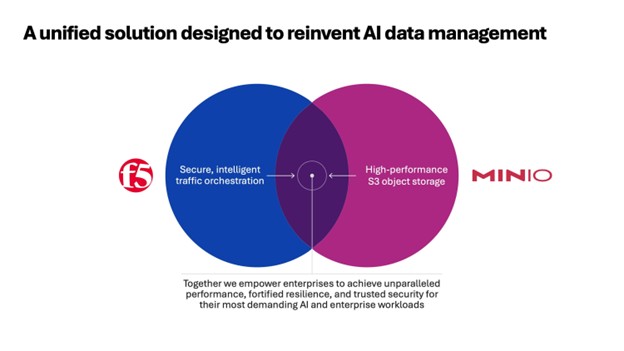
The expanded F5 and MinIO partnership brings together MinIO AIStor’s high-performance, highly-scalable, S3-compatible object storage with the secure, intelligent traffic management of the F5 Application Delivery and Security Platform (ADSP). This joint solution delivers a comprehensive, secure and scalable foundation for AI workloads, enabling businesses to achieve optimized data management, strengthened security and flexible migration across cloud, on-premises and hybrid environments.

F5 and MinIO offer a joint solution designed to enhance performance, resilience and security for customers’ most demanding AI and enterprise workloads.

Understanding S3 and its importance for scalable data management

Simple Storage Service (S3) is the standard protocol for modern object storage, fully supported by AIStor and a key component of today’s data architectures. Unlike traditional storage, S3 stores data as discrete objects in logical containers called buckets, paired with metadata for efficient organization and retrieval, which is critical for AI workloads.

Operating over HTTP/S, S3 is ideal for scalability, distributed deployments and seamless cloud integration. It’s widely used in data lakes, archives, media repositories, static websites, backups and especially AI and machine learning pipelines, making S3-compatible storage a strategic business investment. Because S3 leverages HTTP/S as its transport protocol, businesses can directly benefit from F5’s deep expertise and apply its industry-leading Layer 4-7 capabilities to S3 storage traffic.

Optimizing storage traffic with F5 BIG-IP for MinIO AIStor

As organizations utilize real-time and large-scale data for AI and enterprise workloads, efficient traffic management is critical. Powered by F5 ADSP, F5 BIG-IP’s intelligent load balancing technologies (e.g., LTM and DNS) prevent storage bottlenecks by distributing queries and traffic evenly, reducing latency, eliminating hotspots and enabling consistent scalability.

BIG-IP also provides robust delivery and security for S3 storage traffic:

  • Protect against HTTP/S-based threats with an advanced web application firewall (WAF) to safeguard critical business data and minimize risks.
  • Defend against DDoS attacks to maximize availability and ensure continuous uptime.
  • Offload SSL/TLS encryption to optimize security without impacting MinIO performance.

Across cloud, on-premises or hybrid deployments, F5 and MinIO’s unified approach simplifies management, ensuring consistent performance and security.

Simplifying cloud-to-on-premises migration: The repatriation advantage

Businesses are increasingly moving workloads from public clouds back on-premises due to rising costs, compliance demands, data sovereignty and performance predictability. This cloud-to-on-prem repatriation often requires significant application refactoring and architectural changes.

F5 BIG-IP and MinIO AIStor simplify this transition: AIStor’s consistent S3-compatible API enables applications to migrate smoothly, while BIG-IP intelligently orchestrates incremental traffic shifts through DNS routing, allowing for phased, disruption-free migrations with minimal adjustments.

Extending strategic advantage across industries

From managing autonomous vehicle training data to powering healthcare analytics and financial compliance, the flexibility of the F5 and MinIO solution translates into a clear competitive advantage for organizations across industries.

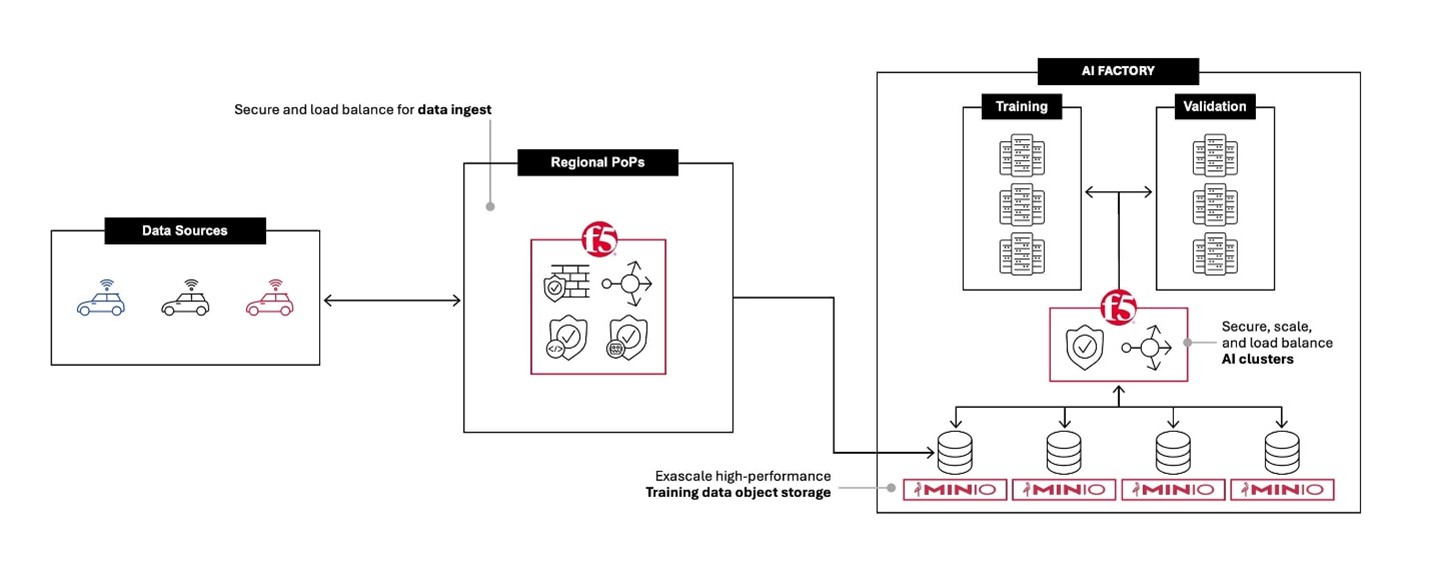
For example, a major global automotive manufacturer is using the joint solution provided by F5 and MinIO to securely and reliably deliver and manage proprietary data from its vehicle fleets worldwide to AI factories. This enables continuous improvements to their AI models, providing significant business advantages. This powerful solution has enabled the manufacturer to save millions of dollars annually by repatriating the data from the public cloud. It has also reduced downtime, enhanced reliability, maximized ROI on AI infrastructure and ensured secure management of exascale data. These benefits have empowered the automotive manufacturer to boost innovation and maintain a strong competitive edge.

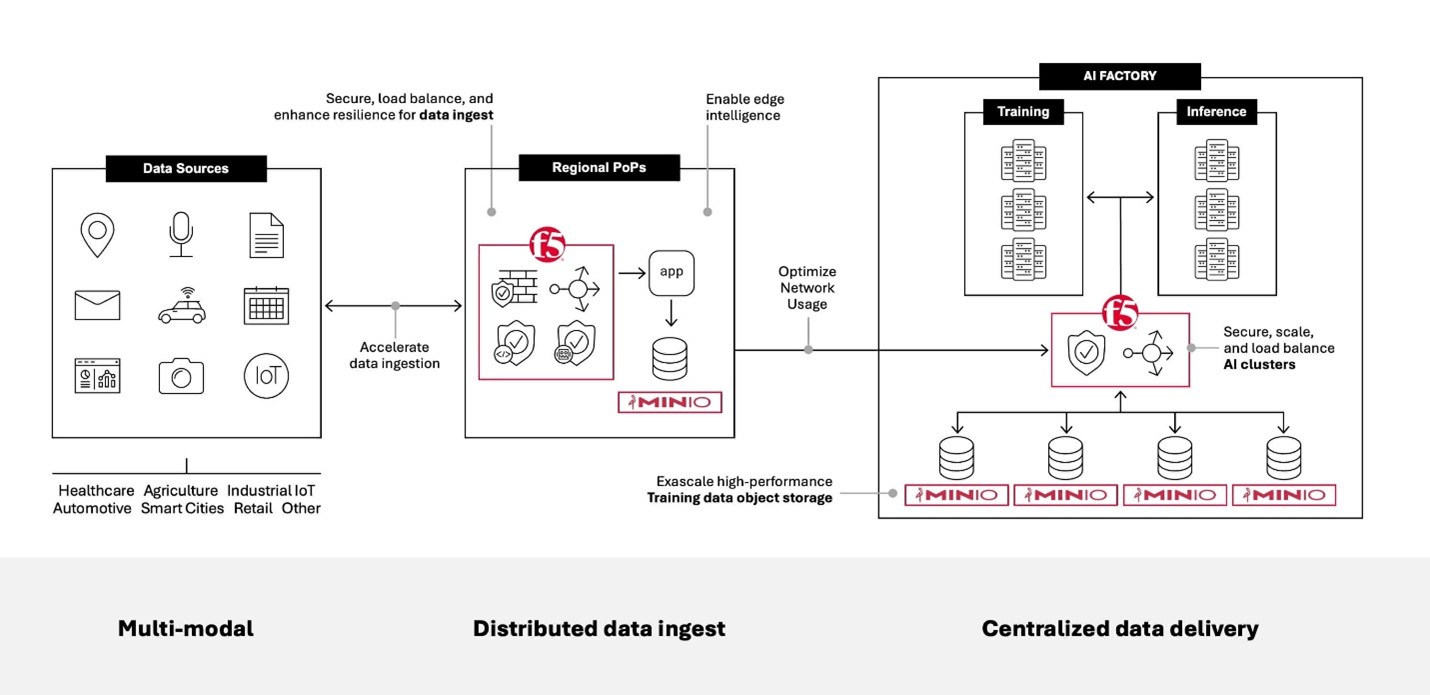
F5’s secure traffic management capabilities collect and route vehicle-generated data through F5-powered regional points of presence (PoPs), delivering it seamlessly into a centralized data lake powered by MinIO AIStor. MinIO’s high-performance object storage solution forms the essential foundation for training AI models. Once models are trained and validated, they are delivered securely back to vehicle systems, with every step of the cycle delivered and protected by F5 infrastructure.

A global automotive manufacturer is using the joint solution from F5 and MinIO to securely route AI data across its systems, ensuring rapid processing and uninterrupted availability.

This large-scale deployment illustrates the significant advantage organizations in other industries can gain when adopting the joint approach of F5 and MinIO. For example, healthcare providers use secure, high-performance storage to enhance predictive analytics and medical imaging, improving patient outcomes through rapid, reliable data access. Financial institutions leverage BIG-IP’s security and MinIO’s security and scalability for compliant storage of large amounts of sensitive data, enabling AI-driven fraud detection and risk management. And companies with edge computing deployments count on F5 and MinIO for secure, low-latency data processing and storage—critical for IoT and smart industry use cases.

In short, F5 and MinIO together bring exceptional security, scalability and straightforward repatriation capabilities to virtually any industry looking for transformative data management strategies.

F5 and MinIO provide resilient, secure and scalable Al data delivery for any industry.

Next steps: Unlocking strategic agility with F5 and MinIO

In today’s dynamic business environments, gaining a strategic advantage means confidently navigating the digital transformation landscape. Together, F5 and MinIO provide high-performance, resilient, secure object storage and intelligent traffic orchestration optimized for today’s most ambitious AI projects and mission-critical data workloads across many industries.

Carahsoft Technology Corp. is The Trusted Government IT Solutions Provider, supporting Public Sector organizations across Federal, State and Local Government agencies and Education and Healthcare markets. As the Master Government Aggregator for our vendor partners, including F5 we deliver solutions for Geospatial, Cybersecurity, MultiCloud, DevSecOps, Artificial Intelligence, Customer Experience and Engagement, Open Source and more. Working with resellers, systems integrators and consultants, our sales and marketing teams provide industry leading IT products, services and training through hundreds of contract vehicles. Explore the Carahsoft Blog to learn more about the latest trends in Government technology markets and solutions, as well as Carahsoft’s ecosystem of partner thought-leaders.

This post originally appeared on F5.com, and is re-published with permission.

Transforming Federal AI Adoption: How Google’s OneGov Agreement Delivers Enterprise-Grade Intelligence

The General Services Administration’s (GSA) OneGov strategy represents a fundamental shift in Federal procurement, moving from fragmented, agency-by-agency purchasing to a unified enterprise approach that leverages the Government’s collective buying power. Google’s new Gemini for Government agreement provides Federal agencies with access to cutting-edge artificial intelligence (AI) capabilities at an unprecedented $0.47 per agency price point. This strategic partnership builds upon Google’s previous Workspace agreement with GSA, establishing a procurement framework that treats the Federal government as a single unified customer.

Breaking Down Silos with Purpose-Built AI Infrastructure

Gemini for Government addresses one of the most persistent challenges in Federal operations: the need for sophisticated automation tools that can operate securely across diverse Government environments. The platform serves as a developer-focused suite specifically designed for Federal agencies, enabling the building, deployment and management of advanced automated AI agents that perform complex, multi-step workflows across an organization’s internal data. Unlike commercial solutions that require extensive customization for Government use, Gemini for Government comes purpose-built with integrated security features and compliance standards that meet Federal requirements from day one.

The platform’s comprehensive approach eliminates the traditional barriers that have prevented agencies from adopting enterprise-grade AI solutions. By providing both prepackaged AI agents and the capability to create custom solutions, agencies can immediately begin automating business processes while maintaining the flexibility to develop specialized applications as their needs evolve.

Democratizing AI Development Across Federal Agencies

One of the most significant advantages of the Gemini for Government offer lies in its accessibility to agencies with varying levels of technical resources. The solution incorporates no-code capabilities through products like Agentspace, enabling Government users to leverage sophisticated AI tools without requiring extensive programming expertise. This democratization of AI development ensures that smaller agencies or those with limited technical staff can participate in digital transformation initiatives.

The platform includes Google’s best-of-breed commercial AI tools, including Agentspace and NotebookLM, all engineered specifically for Federal use. These tools provide agencies with immediate access to advanced AI capabilities while maintaining the security and compliance standards required for Government operations.

Security and Compliance Built into the Foundation

Federal agencies operate under stringent security requirements that often create barriers to adopting innovative technologies. Gemini for Government addresses these concerns through built-in security features, including identity and access management, threat detection, data privacy protections and advanced compliance standards such as SOC2 Type 2. Google Cloud’s extensive portfolio of FedRAMP High-authorized products provides the underlying infrastructure, ensuring that agencies can confidently deploy AI solutions without compromising their security posture.

This comprehensive security framework eliminates the lengthy and expensive process of retrofitting commercial solutions to meet Federal requirements. Instead of spending months or years on compliance validation, agencies can immediately begin leveraging AI capabilities while maintaining full compliance with Federal security standards.

Streamlined Procurement Through Strategic Partnerships

The GSA OneGov Gemini for Government promotional agreement demonstrates how strategic partnerships can dramatically simplify federal procurement processes. Available through Carahsoft’s GSA MAS contract, the deal provides standardized pricing and terms that eliminate the need for individual agency negotiations. The $0.47 per agency pricing includes a standard provisioning of 1,000 users, with the ability to add additional users at no cost during the promotional period.

Google has also provided flexibility to match promotional discounts on other Government contract vehicles based on specific agency procurement requirements. This approach ensures that agencies can access the technology through their preferred contracting mechanisms while still benefiting from the OneGov pricing structure. The promotional agreement runs through September 30th, 2026, providing agencies with ample time to evaluate and implement the solution.

The Path Forward for Federal AI Transformation

The Gemini for Government OneGov agreement represents more than just a procurement vehicle—it is a blueprint for how Federal agencies can access and implement cutting-edge technologies while maintaining security, compliance and cost-effectiveness. As agencies continue to face increasing demands for efficiency and innovation, solutions like Gemini for Government provide the foundation for meeting these challenges while maintaining the highest standards of security and compliance.

Ready to leverage this agreement to access best-of-breed AI tools that can transform your agency’s operations? Contact our Google team at Carahsoft today or call us at (888) 662-2724 to learn more and take advantage of this limited-time promotional offer.

Carahsoft Technology Corp. is The Trusted Government IT Solutions Provider, supporting Public Sector organizations across Federal, State and Local Government agencies and Education and Healthcare markets. As the Master Government Aggregator for our vendor partners, including Google we deliver solutions for Geospatial, Cybersecurity, MultiCloud, DevSecOps, Artificial Intelligence, Customer Experience and Engagement, Open Source and more. Working with resellers, systems integrators and consultants, our sales and marketing teams provide industry leading IT products, services and training through hundreds of contract vehicles. Explore the Carahsoft Blog to learn more about the latest trends in Government technology markets and solutions, as well as Carahsoft’s ecosystem of partner thought-leaders.

AI Excellence for Economic and Diplomatic Leadership 

In today’s technological landscape, breakthroughs in innovation, specifically AI, are essential to maintaining balance of power – sparking new industries and revolutionizing the workspace. Excellence in AI represents more than a policy goal; it is the basis for maintaining American leadership across economic, military and diplomatic spheres. 

The White House recently released America’s AI Action Plan – the US’s new guide to ensure American excellence in AI. The Action Plan outlines a national strategy – prioritizing private-sector innovation, infrastructure expansion, and global AI leadership with over 90 Federal policies. 

The plan rests on three foundational pillars: 

  • Pillar I calls to accelerate AI innovation. The federal government is cutting unnecessary red tape and empowering agencies to prioritize mission-first, secure AI solutions for defense, law enforcement, border protection, and citizen services.  
  • Pillar II is to prioritize building the infrastructure (data centers, semiconductor manufacturing, and energy) needed to power these AI solutions on a national level.  
  • Pillar III focuses on ensuring that America is the global leader in international AI diplomacy and security – mitigating cybersecurity and national security risks caused by externally produced AI systems. 

The AI Action Plan is the latest in a series of targeted memos, executive orders, resolutions, and policies aiming to support AI adoption across America.  Understanding the AI Action Plan requires a review of the current State of AI in American politics.  

Minimizing Roadblocks for Innovation

In alignment with the recent Action Plan, there has been a Government-wide push to overcome Federal hurdles and regulatory constraints to AI adoption. The recently passed H.R. 1 is a major milestone – removing outdated legislative barriers while allocating funding for AI in defense and AI infrastructure at the Department of Energy (DOE). The bill encourages centralized, Federal legislation, rather than having AI laws be passed state-by-state, enabling consistent, nation-wide progress 

In April, the Office of Management and Budget (OMB) directed agencies to prepare for widespread AI deployment by appointing AI officers and publishing practical AI adoption strategies. In Memo-25-21, “Accelerating Federal Use of AI through Innovation, Governance, and Public Trust,” OMB set forth a number of AI-related recommendations for agencies, such as removing barriers to innovation, accelerating AI adoption, and ensuring AI delivers real benefits to the American people. The companion memo, M-25-22, encourages agencies to source American made AI solutions, simplifying procurement and increasing interoperability. When viewed as a whole, these Federal guidelines emphasize deregulation, support open-source models, and highlight leadership from the Private sector as the key to rapid AI advancement and adoption across industries.  

Building AI Infrastructure at Scale 

In addition to removing legislative roadblocks to AI adoption, recent Federal guidance lays the physical foundation for AI expansion. The National Science Foundation (NSF) requested information to support Federal development in AI infrastructure, receiving over 10,000 responses.  Within the NSF, the National AI Research Resource (NAIRR) are working to utilize Federal lands to construct data centers and power infrastructure. The combination of new data centers, a modernized electric grid, and specialized workforce training for AI will make AI more accessible to the government as well as the American citizens. In addition to the nation’s continued advancement in AI Infrastructure, the General Service Administration (GSA) aims to launch an “AI procurement toolbox,” which would help agencies develop and test new technology, including Generative AI (GenAI) to improve Government operations.  

The private sector remains dedicated to AI advancement. Recent initiatives underscore the market’s effort to scale AI. One such effort is OpenAI, SoftBank, Oracle and MGX’s $500 billion initiative Stargate, which aims to expand U.S. AI capacity. Another is the $90 billion in pledges for data centers and power infrastructure at the Pennsylvania Energy and Innovation Summit. 

AI leadership is simultaneously an economic imperative and national security necessity. As global competitors advance their own AI capabilities, America’s usage will determine its ability to maintain technological dominance in the broader, geopolitical competition. 

Carahsoft and its partners are able to connect agencies with the latest compliant technology for AI. To learn more about AI solutions in accordance with Federal standards, visit Carahsoft’s Page on AI Solutions. 

More Coverage, Less Overhead: Rethinking Road Inspection Costs with AI-Driven Insights

Trying to make your maintenance dollars go further without cutting corners on insight, safety or service?

If so, you’re not alone. With budgets often stretched and infrastructure demands growing, many agencies are reexamining how to get the most value out of every maintenance dollar. That’s why many are rethinking expensive, labor-intensive field inspections and turning to smarter, more cost-effective alternatives.

AI-analyzed dashcam imagery from commercial and fleet vehicles gives teams near real-time, visual insights into road conditions without the typical overhead. By using what’s already on the road, agencies can cut spending while getting even better data on pavement conditions, signage, lane markings and hazards.

Smarter Inspections. Real Savings.

Manual inspections can cost anywhere from $100 to $200 per mile, depending on the method and crew required. When you factor in vehicle costs, staffing, scheduling and delays, those expenses scale fast, especially for agencies managing thousands of miles.

AI-powered visual intelligence can reduce up to 90% of the manual inspections traditionally required for roadway condition assessment. That’s a considerable savings in time and money. In Hawaii, automated analysis of guardrails, striping and debris saved the state DOT over $900,000 by eliminating unnecessary field visits and allowing more strategic deployment of maintenance dollars.

With continuous AI-driven assessments, inspections shift from rigid schedules to condition-based decision-making. This allows agencies to focus their limited resources where the data shows they’re actually needed, maximizing impact while minimizing waste.

Lower Operational Strain, Lower Spend

Reducing fieldwork doesn’t just save time, it cuts expenses across the board. Fewer field deployments mean lower fuel costs, less vehicle wear and fewer overtime hours.

Instead of organizing additional field inspections, agencies can rely on regularly updated insights coming from existing vehicle networks. This reduces the need to expand teams or invest in specialized equipment to keep up with inspections. It also supports a safer inspection process by reducing risk exposure for field crews.

Better visibility leads to more accurate budgeting. Instead of flying blind—or relying on complaints—you can plan maintenance with precision, stretch your resources and avoid surprise repairs that blow up budgets.

Faster Recovery, Lower Emergency Costs

Storms, floods, and other disruptions can incur urgent, unexpected expenses. But quick, AI-enabled visual assessments can help reduce emergency costs.

Agencies can assess road damage without dispatching field teams immediately, saving time and protecting crews. Infrastructure inspections are evolving to include tools like Google Street View, providing a reliable “before” snapshot. Combined with dashcam imagery for the “after,” agencies can clearly analyze damage and document changes over time. That early insight supports faster funding requests and avoids the cost of blanket response measures that may not be necessary.

With centralized, visual data that’s easy to share, teams can streamline contractor coordination, skip redundant inspections and focus their limited funds where they’ll have the most impact.

Rewriting the Cost Equation

Road inspections don’t have to drain your budget. With AI-analyzed dashcam data, agencies are expanding visibility across their networks while significantly cutting costs.

The real value lies in shifting from reactive to efficient, insight-driven decision-making. From daily maintenance to emergency recovery, this model is helping public teams rethink how, and how much, they spend on inspections.

For any agency trying to do more with the same—or even less—budget, it’s time to rethink how inspections are conducted.

Watch the on-demand webinar to see how agencies are using AI-driven insights to reduce inspection costs while improving road safety.

From Noise to Impact: How Agencies Can Build Real AI Use Cases

Insights from Federal data, legal and technology leaders on turning AI potential into mission-driven action

Everyone’s talking about AI. But in Government, where budgets are tight, oversight is strict and the stakes are high, talk isn’t enough. Agencies need AI use cases that solve real problems, not just generate headlines.

At a recent panel discussion in D.C. hosted by ZL Tech and Carahsoft, experts from data, legal and tech roles shared their insights on how Federal agencies can move from experimentation to impact. Their message was clear: success with AI starts with governance, strategy and the right people at the table.


1. Want Real AI? Start at the Top

The biggest challenge agencies face? Starting small and remaining siloed.

“Start at the highest, most strategic level of the organization,” said Matthew Versaggi, a White House Presidential Innovation Fellow for AI. “Don’t begin in your own department, by then it’s too narrow. Instead, ask: what’s the most impactful agency-wide use case we can build toward?”

The panelists emphasized that departmental pain points might improve workflows, but agency-wide pain points tied to the mission are where AI can truly move the needle.

“Without a structured process, you’re just chasing your tail,” added Kon Leong, CEO of ZL Tech. “Start small, but make sure your experiment is scalable and aligned to long-term strategy.”


2. Governance Isn’t a Roadblock. It’s the Roadmap.

AI can’t succeed without trust in the data. And trust depends on governance.

“Governance is accountability,” said Leong. “It’s what separates scalable, sustainable innovation from science experiments.”

Jason Baron, a professor and former senior Government attorney, described governance as a mesh, not a silo: “True governance links your CISO, CIO, records officers, FOIA leads, legal teams—all under shared policy and ownership. We used to work in silos. That has to end.”

And as Matthew pointed out, AI governance isn’t a blocker, it’s an enabler: “AI governance becomes the mechanism for sustaining innovation. If we’re going to compete globally, we have to embrace it.”


3. Talk to Your CDO—Yes, You Have One

One of the most actionable takeaways: if you’re not already talking to your Chief Data Officer, you’re behind.

“Every agency has a CDO,” said Jason. “Go find them. Hopefully you like them. Have a conversation.”

CDOs are uniquely positioned to bridge mission needs with data access and policy. As one attendee noted during the session, “Awareness is the first step. Records and governance leaders are finally getting a seat at the table.”

It’s no longer enough for legal, records and privacy teams to operate in isolation. Building AI responsibly requires alignment—and that starts with the CDO.


4. Unstructured Data Is the Game-Changer

Structured data, like spreadsheets and databases, has been the traditional foundation for reporting and analytics. But that’s not where the majority of Government data lives.

“Unstructured data is radioactive,” said Leong. “That’s where every crisis lives. And now, it’s center stage in AI.”

Unstructured data includes everything from emails and PDFs to file shares, chat logs and documents. It makes up more than 80% of enterprise data, yet many agencies lack visibility or control over it.

Jason gave a real-world Federal perspective: “As a records guy, I’d take out my watch and wait to see how long it took vendors to say ‘FOIA’ or ‘FedRAMP.’ If they don’t understand the challenges around Federal unstructured data, they’re not serious.”


5. Use the Impact vs. Effort Matrix to Prioritize Wisely

With hundreds of possible AI use cases, how can agencies filter out distractions and find the ones worth pursuing?

Panelists recommended the Impact vs. Effort Matrix—a simple yet powerful tool to map use cases by how much effort they require and how much impact they’ll deliver.

What Is the Impact vs. Effort Matrix?

This tool helps agencies focus on what’s worth doing, especially when time, talent and resources are limited. Each AI idea gets placed into one of four categories:

  • Quick Wins (High Impact, Low Effort): Prioritize these immediately.
  • Major Projects (High Impact, High Effort): Worth the investment—plan carefully.
  • Fill-Ins (Low Impact, Low Effort): Do when time permits.
  • Thankless Tasks (Low Impact, High Effort): Avoid or minimize these.

“We see hundreds of AI ideas across agencies,” one panelist said. “But when you apply the matrix, only a handful have real traction. The juice has to be worth the squeeze.”

The matrix helps filter noise and ensure teams are spending time on the projects most likely to scale, succeed and support the mission.


6. Build with Scale in Mind, Even If You Start Small

AI is experimental. Not every idea will pan out. But successful projects need a path to grow from day one.

“Do a small test with an enterprise mindset,” said Matthew. “Security, governance and scale should be built in from the start.”

Leong agreed: “Get your data ducks in a row, and everything else will follow. You don’t want to make long-term bets on projects that were never designed to scale.”


7. Custom or Off-the-Shelf? Choose Based on Complexity

Should agencies build custom platforms or adapt off-the-shelf tools? It depends.

“Don’t overpay for generic tools,” said Matthew. “But for deep, high-end capabilities, you may need in-house builds—just know the tradeoffs.”

The more specialized the use case, the more likely a tailored solution is required. But whether buying or building, the panel emphasized the importance of involving records officers, legal teams and SMEs early—not just the CIO chasing the next shiny object.


Final Thought: The Data Is There. The Champions Are Too.

The core message of the session? Agencies already have the data—and they have the people who care about getting it right.

What’s missing is coordination, prioritization and a strong governance foundation.

Start with strategy. Talk to your CDO. Use the matrix. Build with intent.

Carahsoft Technology Corp. is The Trusted Government IT Solutions Provider, supporting Public Sector organizations across Federal, State and Local Government agencies and Education and Healthcare markets. As the Master Government Aggregator for our vendor partners, including ZL Tech, we deliver solutions for Geospatial, Cybersecurity, MultiCloud, DevSecOps, Artificial Intelligence, Customer Experience and Engagement, Open Source and more. Working with resellers, systems integrators and consultants, our sales and marketing teams provide industry leading IT products, services and training through hundreds of contract vehicles. Explore the Carahsoft Blog to learn more about the latest trends in Government technology markets and solutions, as well as Carahsoft’s ecosystem of partner thought-leaders.

How AI-Powered Compliance Solutions Are Transforming Regulatory Management for Government Agencies

Government agencies manage between 12,000 and 40,000 regulatory obligations, with approximately 200 to 250 new regulatory alerts issued globally every day across the financial services sector alone. This escalating complexity is driving agencies to rethink their approach to compliance management, moving away from manual, reactive processes toward intelligent, proactive solutions.

The Overwhelming Scale of Modern Regulatory Compliance

Traditional compliance methods cannot keep up with today’s regulatory demands. In the U.S., the Securities and Exchange Commission (SEC) and the Financial Industry Regulatory Authority (FINRA) account for over 5,000 of those obligations. In the future, 74% of organizations anticipate even more regulatory activity, highlighting the rise and complexity of compliance requirements.

The challenge extends beyond just volume to the speed at which regulations evolve and their divergence across jurisdictions. Traditional methods—spreadsheets, siloed systems and manual tracking—leave agencies vulnerable to gaps and inconsistencies that can result in significant penalties and reputational damage.

For Government agencies, the stakes are even higher. They must demonstrate complete adherence to regulatory standards while maintaining public trust through transparency and accountability. This creates additional pressure on compliance teams to meet regulatory requirements in a way that can withstand public scrutiny and audits.

The Hidden Costs of Manual Compliance Operations

Manual compliance processes are costly and inefficient. A 10-person compliance team loses approximately $500,000 annually to manual tasks like monitoring, tagging, mapping and documentation—excluding the costs of fines and remediation. That time could instead be spent on strategic analysis and risk prevention.

A high employee turnover rate of 23% further inflates costs, as onboarding new analysts takes months. By the time they are fully trained, they are often ready to move on from routine tasks, creating a cycle of constant training, development and replacement.

Manual processes also introduce risks such as compliance gaps, failed audits and regulatory penalties. Organizations using manual processes experience 3.2 times more violations than those with automation. These inefficiencies contribute to the expectation that compliance costs will rise 6-9% annually through 2030, making automation a financial necessity.

AI as a Force Multiplier for Compliance Teams

Archer, AI-Powered Compliance Solutions Are Transforming Regulatory Management, blog, embedded image, 2025

Artificial intelligence (AI) serves as a force multiplier that can put the expertise of a 15- or 20-year analyst into the hands of an amateur. By delivering institutional knowledge and step-by-step guidance through complex processes, AI significantly reduces onboarding time for new team members.

Its impact is both immediate and measurable. AI-powered horizon scanning reduces the time analysts spend reviewing regulatory updates from hours to minutes, filtering out up to 95% of irrelevant alerts so teams can focus on the 5% that truly matter. Natural language further enhances efficiency by breaking down complex regulatory text into digestible summaries, helping teams quickly understand and act on new requirements.

Most notably, AI automates obligation extraction from dense regulatory text—a process that manually takes 5.3 hours per obligation and has a 14.6% error rate. AI identifies obligation statements, provides rationale and tags content for routing to the appropriate business units. In doing so, AI not only streamlines workflows but also ensures greater quality and accuracy over time through expert-in-the-loop validation.

End-to-End Lifecycle Management for Regulatory Changes

Modern compliance requires a holistic approach, from identifying regulatory updates to operational implementation and audit readiness. The true value comes from operationalizing these insights into frameworks, policies, controls and measurable testing programs. Yet only 38% of organizations successfully map regulatory changes through to updated controls and audit trails.

Lifecycle management starts with comprehensive horizon scanning and extends through policy governance, control alignment and continuous monitoring. When updates—such as tighter insider trading language—triggers changes, AI flags policy conflicts, creates change requests and ties them directly to relevant citations. This creates a clear audit trail, ensuring that modifications are documented, defensible and properly embedded back into the compliance framework.

AI also strengthens control management by flagging gaps between obligations and controls, identifying conflicts with evolving regulations and static policies—such as a privacy policy’s opt-in age that conflicts with new jurisdictional requirements—and recommending changes before violations occur. This creates a responsive system where regulatory changes automatically drive updates across policies, controls and audits.

Proactive Risk Management Through Intelligent Automation

Shifting from reactive to proactive compliance enables smarter risk management. Intelligent automation identifies potential issues before they become violations and informs decisions about expanding products and services or entering new markets. Instead of months-long manual assessments, agencies can use AI to instantly identify control gaps and readiness. This can speed up service expansion or help agencies determine not to proceed.

Automated insights also enhance leadership decision-making. By combining real-time monitoring with impact analysis, agencies can prepare for regulatory changes instead of responding after implementation deadlines. These capabilities yield real results: organizations leveraging AI-driven compliance systems report a 79% reduction in audit cycle times—from 42 days to nine—and 90% fewer evidence requests from business units.

The future of Government compliance lies in embracing intelligent automation that enhances human expertise rather than replacing it. By implementing AI-powered solutions that can manage the velocity and complexity of modern regulatory requirements, agencies can transform their compliance programs from reactive cost centers into proactive strategic assets.

To learn more about how AI-powered compliance solutions can transform your agency’s regulatory management approach, watch the full webinar “Archer Evolv Compliance” and view the solution brief for a deeper dive into the platform’s capabilities.

* All statistics referenced in this blog are sourced directly from the webinar on which this content is based.

Carahsoft Technology Corp. is The Trusted Government IT Solutions Provider, supporting Public Sector organizations across Federal, State and Local Government agencies and Education and Healthcare markets. As the Master Government Aggregator for our vendor partners, including Archer, we deliver solutions for Geospatial, Cybersecurity, MultiCloud, DevSecOps, Artificial Intelligence, Customer Experience and Engagement, Open Source and more. Working with resellers, systems integrators and consultants, our sales and marketing teams provide industry leading IT products, services and training through hundreds of contract vehicles. Explore the Carahsoft Blog to learn more about the latest trends in Government technology markets and solutions, as well as Carahsoft’s ecosystem of partner thought-leaders.

Meeting the AI Mandates with Confidence: Why Federal Teams Trust Snyk

Federal agencies are moving fast to unlock the potential of AI—from improving citizen services to driving mission outcomes. But with all that innovation comes a new wave of complexity and risk.  Security, trust, and transparency can’t be afterthoughts. They need to be part of the build process from day one.  That’s where Snyk for Government comes in—now FedRAMP authorized, we’ve taken it even further with the launch of the Snyk AI Trust Platform May 2025. 

AI isn’t magic. It’s built on code, containers, infrastructure templates, and APIs—and increasingly, it’s generating code on its own, generating 40% more vulnerabilities than human developers. Agencies need to track, fix, and manage continuously.  With Snyk, you can shift left and Secure-by-Design:

  • Spot and fix risks early—automatically and at scale
  • Keep developers moving fast while staying compliant
  • Build AI systems that are secure from the ground up

Meet the Snyk AI Trust Platform

Launched in May 2025, the Snyk AI Trust Platform is the first of its kind: an AI-native, agentic security platform designed for how modern teams build today. It gives agencies the tools to move quickly without compromising trust.

This isn’t just DevSecOps—it’s security built for the era of AI-driven, autonomous software development.


How Snyk is supporting new federal AI mandates

Trusted, Transparent AI Development

As agencies embrace AI, expectations around objectivity and transparency are front and center. Snyk helps teams meet those expectations with tools that focus on real technical risks—not subjective filters.

  • Credible vulnerability intelligence: Sourced from standards-based orgs like CVE, CWE, and NIST
  • Customizable policy enforcement: Agencies stay in full control with Snyk Guard’s real-time, no-bias policy engine
  • Integrated into your pipeline: From GitHub to Terraform to container registries—Snyk fits your workflow, not the other way around

 Scaling Secure AI Infrastructure

New funding and fast-tracked initiatives mean federal developers need security tools that keep up.

  • FedRAMP authorized: Snyk is cleared for use across federal cloud environments
  • Automation where it counts: Agentic tools like Snyk Assist and Snyk Agent surface issues and fix them before they ship

 Building Export-Ready, Trusted AI Systems

As global collaboration increases, secure supply chains are more important than ever. Snyk helps you ship software that’s secure, auditable, and globally trusted.

  • Standards-aligned: Support for SBOMs, AIBOMS, international compliance, and NIST-aligned policies
  • Agentic AI security: Governance that scales to GenAI assistants and LLMs—wherever and however they run
  • Broad ecosystem support: Integrates with the open tools your dev teams already use

Whether you’re modernizing legacy systems, launching new GenAI services, or strengthening cross-agency pipelines, Snyk helps federal teams move fast, stay secure, and build trust into every line of code.

? Ready for a tailored AI readiness assessment?
 Let’s talk: federal@snyk.io

Carahsoft Technology Corp. is The Trusted Government IT Solutions Provider, supporting Public Sector organizations across Federal, State and Local Government agencies and Education and Healthcare markets. As the Master Government Aggregator for our vendor partners, including Snyk, we deliver solutions for Geospatial, Cybersecurity, MultiCloud, DevSecOps, Artificial Intelligence, Customer Experience and Engagement, Open Source and more. Working with resellers, systems integrators and consultants, our sales and marketing teams provide industry leading IT products, services and training through hundreds of contract vehicles. Explore the Carahsoft Blog to learn more about the latest trends in Government technology markets and solutions, as well as Carahsoft’s ecosystem of partner thought-leaders.

How AI-Powered Contract Writing is Transforming Federal Acquisition Operations

Federal agencies are facing growing pressure to deliver acquisition solutions faster, more efficiently and with deeper commercial market engagement; however, traditional manual contract processes are proving insufficient for meeting mission-critical timelines. The union of artificial intelligence (AI) and enterprise resource planning systems now offers a transformative solution that automates contract creation, ensures compliance and maintains the real-time visibility essential for modern Federal operations.

AI-Driven Contract Automation and Efficiency

Integrating AI into contract writing shifts Federal contracting professionals’ focus from administrative burden to strategic work. Modern AI-powered platforms automatically select and populate appropriate Federal Acquisition Regulation (FAR) and Defense Federal Acquisition Regulation Supplement (DFARS) clauses based on acquisition parameters such as contract type, commodity classification and procurement method. This automation eliminates time-consuming manual clause selection and reduces the risk of human error in compliance requirements.

Beyond simple clause insertion, the technology supports form generation and contract assembly. When contracting officers define basic parameters—whether procuring supplies or services, acquisition type and contract structure—the AI system cascades these selections to generate comprehensive solicitation packages. What once required weeks of manual preparation becomes a streamlined process completed in hours. The system maintains full version control and audit trails to document every modification and decision point for future reference and compliance reviews.

This automation enables teams to prioritize higher-value strategic tasks such as developing innovative procurement strategies, refining requirements and engaging with industry to identify cutting-edge solutions that advance mission objectives.

Seamless ERP Integration and Data Flow

Modern contract management lies in seamless integration across the procurement ecosystem. Enterprise resource planning (ERP) integration eliminates data silos, creating a unified environment where contract information flows automatically between sourcing, execution and financial systems. Vendor master data, pricing information and contract line-item details populate without requiring duplicate data entry across platforms, establishing a single version of truth for contract data.

When sourcing events transition into contract execution, all relevant information transfers seamlessly, maintaining continuity throughout the lifecycle. Execution activities automatically update contract status and performance metrics, providing real-time visibility into utilization, budget consumption and milestones.

This integrated environment proves valuable for complex Federal acquisitions involving multiple stakeholders and extended timelines. Project command centers automatically populate with relevant documents, team members and milestone tracking based on acquisition type and requirements. Comprehensive audit trails and proactive management of contract modifications, amendments and closeout procedures support effective oversight and decision-making across large contract portfolios.

Federal Compliance and Risk Mitigation

Icertis, AI Powered Contract Writing, blog, embedded image, 2025

Compliance with Federal acquisition regulations has grown increasingly complex as oversight requirements intensify and regulatory frameworks evolve. AI-powered contract systems address these challenges through automated compliance checking that ensures appropriate clauses, terms and conditions are consistently applied across all contract types. Clause libraries remain current by syncing with acquisition.gov, incorporating regulatory updates and agency-specific supplements automatically.

The system recognizes compliance requirements based on contract characteristics and dollar thresholds. For example, small business set-asides trigger inclusion of socioeconomic clauses and certification requirements, while construction contracts incorporate relevant safety and environmental provisions. This automation reduces the risk of protests and disputes while ensuring consistent compliance across an agency’s entire contract portfolio.

Risk mitigation capabilities include proactive monitoring and automated alerts for critical milestones. The system identifies potential supply chain vulnerabilities, flag contracts approaching funding limits and recommends amendments or modifications before performance is impacted. This approach helps agencies address issues early to maintain operational continuity and comply with Federal oversight.

Mission Readiness and Supply Chain Resilience

Modern Federal operations demand the ability to respond rapidly to evolving mission requirements and supply chain disruptions. AI-powered contract intelligence equips acquisition professionals with dashboards offering both macro and micro perspectives on contract portfolios. This visibility enables rapid identification of alternative sources when primary suppliers face disruptions or surge contracting requirements emerge.

During crisis response, contracting officers can quickly assess contracts offering similar solutions or services, explore modification options and evaluate supply chain pivots. The system also highlights relevant clauses affected by changing requirements and what alternative sourcing strategies are available within existing vehicles. Instead of relying on institutional knowledge or manual searches, acquisition professionals can access real-time analytics on contract performance, vendor capabilities and available vehicles. This capability is essential when scaling operations or pivoting to address emerging threats while maintaining compliance.

End-to-End Contract Lifecycle Management

Comprehensive contract lifecycle management spans every phase, from requisition through closeout, maintaining continuity and institutional knowledge. Modern platforms support the full Federal contract framework, including all sections of the Uniform Contract Format (UCF) and management of complex parent-child relationships between base contracts and amendments. This ensures modifications maintain proper documentation and approval workflows while preserving historical context essential for audit and oversight.

Amendment processing is a particular strength: Standard Form (SF)-30 modifications can be generated automatically while retaining all original contract information and maintaining version control. Contracting officers can modify delivery schedules, quantities or performance requirements as needed—essential for managing long-term contracts that evolve over time.

AI capabilities also extend to contract analysis and summarization, enabling rapid comprehension of complex documents. Contracting officers can query contracts in natural language to locate specific clauses, assess risk or understand approval workflows. This proves valuable during reviews, protest responses or when new team members need to quickly understand contract structures and requirements.

Federal acquisition operations continue evolving as agencies balance increasing mission demands with the need for transparency, efficiency and compliance. AI-powered contract writing offers a transformative opportunity to modernize acquisition processes while maintaining the rigor and oversight Federal operations require. The convergence of AI, enterprise integration and comprehensive lifecycle management equips acquisition professionals with the tools to meet today’s challenges and prepare for future success.

Discover how AI-powered contract writing can transform your agency’s acquisition operations by watching the full webinar, “Advancing Mission Readiness with AI-Powered Contract Writing.”

Carahsoft Technology Corp. is The Trusted Government IT Solutions Provider, supporting Public Sector organizations across Federal, State and Local Government agencies and Education and Healthcare markets. As the Master Government Aggregator for our vendor partners, including Icertis, we deliver solutions for Geospatial, Cybersecurity, MultiCloud, DevSecOps, Artificial Intelligence, Customer Experience and Engagement, Open Source and more. Working with resellers, systems integrators and consultants, our sales and marketing teams provide industry leading IT products, services and training through hundreds of contract vehicles. Explore the Carahsoft Blog to learn more about the latest trends in Government technology markets and solutions, as well as Carahsoft’s ecosystem of partner thought-leaders.

The End of Manual Inspections? How AI and Dashcam Imagery Are Redefining Roadway Management

Years ago, as I waited at a traffic light, I wondered why infrastructure maintenance still leaned so heavily on manual inspections and reporting. That question sparked an idea: What if roads could tell us when something was wrong?

Today, that vision has become a reality. Dashcam imagery—passively captured from vehicles already on the road—is now powering automated AI models that detect issues like fading lane paint, damaged signs, and debris. Looking ahead, the integration of expansive imagery sources, such as Google Street View, promises to further enhance this capability, offering broader and more detailed coverage. It’s a shift from scheduled inspections to constant awareness, from sending crews out to bringing insight in.

Automation with Real Impact

Traditional inspections are resource intensive. They usually involve deploying extra staff and specialized equipment, and scheduling work during off-hours to avoid disrupting traffic. AI-driven visual intelligence of dashcam footage can reduce the number of manual surveys required by more than 90%, saving considerable time and money.

Take Fort Worth. Dashcam imagery gave the city a fresh look at lane striping and sign visibility, but from the driver’s perspective, not an aerial map. It’s how people experience the road daily, and it’s the same view automated vehicles rely on to safely navigate.

Instead of waiting months for a full inspection cycle, cities can spot and act on issues within days. Enabling faster response and more strategic use of limited resources.

Smarter Operations. Less Fieldwork.

While field checks are still common for most agencies, the model is shifting. With dashcam footage collected by vehicles already in motion and analyzed automatically, teams can now monitor more of the network without constantly dispatching field crews.

In Alaska, for example, dashcam data is used to monitor remote routes that are difficult and sometimes dangerous for crews to inspect in person. This kind of visibility can be a game changer for regions with tough geography or tight budgets.

Instead of following a fixed schedule or responding to complaints, agencies can now rely on AI-driven alerts to flag when conditions change. It’s a shift from routine patrols to focused action, and it means fewer trips to the field, less fuel, and better outcomes with the same (or smaller) team.

Compliance without the Complexity

Staying compliant with FHWA, MUTCD, and other federal standards typically requires a lot of paperwork. However, with AI-based monitoring, those checks can happen automatically in the background. Retroreflectivity, sign placement, and line clarity are continuously reviewed and documented.

Each data point is visual, time-stamped, and ready for audits, grant applications, or internal reviews. Even better, it’s easy to share. Operations, maintenance, and planning teams can stay aligned without sifting through emails or outdated spreadsheets.

A New Model for Infrastructure

The future of road operations isn’t about more inspections. It’s about smarter ones. Or, in many cases, none at all. When roads can essentially report their condition using dashcam footage and AI, agencies don’t have to guess or wait. They already know what’s happening.

And this is only the beginning. As capabilities such as historical imagery access and visual change detection over time emerge with Google Street View and become integrated, transportation teams will gain even deeper insight into how their infrastructure evolves. These images will empower agencies to identify long-term patterns, track degradation over time, and intervene before minor issues escalate into costly repairs.

For public teams expected to cover more ground with fewer resources, this isn’t just about saving time. It’s about working in a more intelligent, sustainable way, built for the demands of today’s infrastructure and ready for tomorrow’s.

Ready to stop checking and start knowing?