Enhancing Federal Customer Experience with Digital Transformation

In the world of digital transformation within Government agencies, the collaboration between industry partners and Federal entities is critical for driving progress in enhancing the Federal digital experience. Recently, the General Services Administration (GSA) and the Office of Management and Budget (OMB) held The Federal Digital Experience Virtual Summit to shed light on the pivotal role that industry plays in supporting Government agencies on their journey towards digital innovation. By emphasizing the need for collaboration, innovation and skill development, these conversations underscored the importance of industry expertise in guiding Government agencies towards effective digital solutions. Key takeaways from the summit are summarized throughout this blog post to provide insights into the evolving landscape of Government digital services. As agencies strive to modernize their digital services and platforms, industry partners, like Carahsoft and our partners, technology vendors, resellers, system integrators, and MSPs, are instrumental in providing the necessary resources, knowledge and solutions to help agencies meet the evolving demands of their users and improve the Customer Experience (CX).

The Importance of Inclusive and Compliant Digital Solutions

A people-first approach is paramount in Government digital services, focusing on the needs of both customers and the Federal workforce. Industry partners engaging with Government agencies must align their technological solutions with this people-centric mindset. Prioritizing user experience (UX) and ensuring that technology serves the needs of all stakeholders is essential for fostering effective digital interactions within the Government ecosystem.
While adopting a mobile-first approach is crucial in today’s digital landscape, accessibility remains a fundamental consideration. Government agencies recognize the importance of catering to individuals who may not have access to mobile devices or prefer alternative communication channels, such as in-person interactions or call centers. Ensuring that digital services are inclusive and accessible to all individuals, regardless of their preferred mode of interaction, is key to promoting equitable access to Government resources and information, as well as providing a means of service outside of digital for those who do not have access.

Federal agencies expect industry partners to demonstrate a deep understanding of the regulatory landscape and Government policies, such as the 21st Century Integrated Digital Experiences Act (IDEA), Executive Order 14058, Transforming Federal Customer Experience and Service Delivery to Rebuild Trust in Government, and specific mandates like M-2322. Industry proposals should reflect a clear alignment with these guidelines and address the unique needs outlined by Government directives. Collaboration between Government agencies and industry partners are linked by a shared commitment to compliance and a mutual understanding of the regulatory framework governing digital initiatives. By proactively incorporating policy requirements into their proposals, industry partners can demonstrate their readiness to support Government agencies in achieving their digital transformation goals.

Enhancing the Federal Digital Experience

Implementing best practices is essential in the realm of Federal digital experience for enhancing user engagement and optimizing service delivery. The following best practices were identified by the speakers that all agencies should be working towards and where the industry should support by supplying guidance and tactical solutions, helping them meet Federal initiatives. One key practice is the importance of the US Web Design System, which promotes a mobile-first approach for Government websites. By prioritizing mobile responsiveness and user-friendly design elements, agencies can ensure that their digital platforms are accessible and intuitive for all users. Leveraging the design system not only fosters consistency across Government websites but also enhances the overall UX, making it easier for individuals to navigate and interact with online Government services.

Another crucial best practice is the enhancement of search functionality for Government websites. By implementing Search Engine Optimization (SEO) methods, agencies can improve search results and make relevant information more easily discoverable for users. Looking ahead, planning for future technologies like artificial intelligence (AI) in content delivery can further enhance the search experience, enabling more personalized and efficient access to Government resources. By staying informed of evolving search technologies and incorporating AI-driven solutions, agencies can streamline information retrieval processes and provide users with tailored and relevant content.

Digitization serves as a foundational element for transformation within Federal agencies. Moving towards digital and self-service options for common tasks not only enhances efficiency but also empowers users to access services conveniently. By focusing on structured data and digital interactions, agencies can transform UX, making interactions more intuitive and seamless. Embracing digitization as a bedrock for innovation enables agencies to modernize their service delivery models, reduce operational burdens and adapt to the evolving digital landscape effectively.

Collaboration and Alignment Across Government and Industry

Establishing a dialogue and fostering partnerships between agencies and industry partners can lead to the co-creation of solutions that address the evolving needs of the digital landscape. By working together, stakeholders can leverage their respective expertise and insights to develop innovative strategies and technologies that improve service delivery and user satisfaction. This collaborative approach not only fosters knowledge sharing and best practice exchange but also promotes a culture of continuous improvement and innovation within the Government ecosystem. As a call to action, stakeholders are encouraged to join forces and collaborate towards a shared goal of creating a better digital experience for customers and Government employees alike. Stakeholders can collectively drive positive change and shape the future of digital interactions within the Government sector by aligning efforts and working together. Leveraging the federal digital experience guidance provides a clear path forward, offering a roadmap for stakeholders to navigate the complexities of digital transformation and align their initiatives with Government priorities and policies. By adhering to the guidance and embracing a collaborative mindset, Government agencies and industry partners can collectively advance the digital experience landscape, ensuring that services are accessible, user-centric and future-ready.

As agencies like GSA and OMB advocate for a mobile-first strategy, organizations can explore Carahsoft’s portfolio of website modernization and mobile enhancement solutions to align with these initiatives. Carahsoft also features leading solutions from our vendor partners in the digitization of services, such as fortifying public outreach, electronic signatures and accessibility technology, aiding in the modernization journey for agencies to make services simpler and more accessible for users. Customer services are improved through understanding the voice of the customer with analytics and human-centered design. Public outreach is imperative for transparency, gathering and implementing feedback and ultimately building trust between constituents and Government. CX plays a pivotal role in shaping how constituents perceive and interact with civic services, fostering trust and transparency in Government operations.

Carahsoft’s Customer Experience and Engagement portfolio offers a range of industry-leading solutions that enable agencies to analyze and disseminate information securely, improve service efficiency, build trust with constituents and bolster agency reputability. By embracing trusted software solutions from our technology providers, agencies can advance their digital Government services to meet the evolving needs of the public and deliver exceptional experiences that drive positive outcomes for all stakeholders. Carahsoft’s expertise in digitization also extends to social media integration, call center optimization and the implementation of adaptive technology, aligning with diverse needs of Government agencies and their constituents.

GSA and OMB are calling for a people-first approach and Carahsoft has the CX solutions to help your organization meet this initiative. Check out Carahsoft’s portfolio of solutions providers who can support your needs in website modernization and mobile enhancement, digitization of services, customer services, public outreach, social media, electronic signatures, call center, accessibility technology and other CX solutions.

The 10 Cybersecurity Events for Government in 2024

In the fast-paced world of Cybersecurity, staying ahead of evolving threats and industry trends is paramount for Government agencies and the ecosystem that supports them. From in-depth discussions on certification processes to cutting-edge solutions for modern cyber threats, Carahsoft and our partners’ cybersecurity events promise to provide valuable insights, networking opportunities and practical strategies for enhancing Government cybersecurity posture.  
 
Join us as we delve into cybersecurity excellence and empower Government entities to navigate the digital landscape with confidence and resilience. 

Public Sector Day at RSA Conference 

May 6 | San Francisco, CA 

Attendees joined us for our 11th Annual Public Sector Day event at RSA Conference. They heard from pioneering figures in Government as they shared their perspectives on the forefront cybersecurity challenges facing the Public Sector. As cyber threats continue to challenge all levels of Government, attendees learned how Government and industry are working together to protect communities at all levels from ransomware, thefts of data, election security challenges and attacks on critical infrastructure. Carahsoft was proud to host this event for our 11th year. We will be back in 2025 in San Francisco and hope to see you there! Access our podcast series for a recap of the sessions and discover how to protect your organization’s sensitive information by leveraging compliant cloud authentication services.  

AFCEA TechNet Cyber 2024 

June 25-27 | Baltimore, MD 

A flagship event, AFCEA’s TechNet Cyber serves as a center of gravity for a whole-of-government effort to bring together the policy, strategic architecture, operations and C2 – along with the joint capabilities – needed to meet the global security challenges and successfully operate in a digital environment. Join us in Baltimore and be part of the conversation led by U.S. Cyber Command, DISA, the DoD CIO and numerous industry and academia partners to deliver solutions for this enduring, no-fail mission. Carahsoft will host a pavilion on the exhibit floor that features more than 50 of our technology partners showcasing a range of cybersecurity solutions. Visit our website for more information! 

2024 SANS Government Solutions Forum  

July 25 | Online 

Government agencies face a continuing stream of legislative, executive and oversight recommendations, constantly keeping teams and technologies on their toes. This SANS Government Security Forum equips Public Sector cybersecurity teams with the essential knowledge to address these challenges and modern threats head-on. Carahsoft has partnered with SANS to host this event for our third year in a row. Hear from Government and industry leaders on the latest in cybersecurity. 

DOE Cybersecurity and Innovation Conference 

July 29 – August 1 | Dallas, TX 

Carahsoft is proud to be a sponsor of the DOE Cybersecurity and Innovation Conference. This event will explore the developments and challenges in cybersecurity, technology innovation, workforce development, and critical infrastructure protection. Speakers and attendees will include top thought leaders from across the DOE enterprise, the federal interagency, academia, international partners, and private industry leaders for thoughtful conversations about cybersecurity, modernizing IT and OT environments and solutions, sharing tools, data management, technology, and best practices with the energy industry, and developing technical solutions to meet national challenges. 

Carahsoft will have a booth on the exhibit floor that features and handful of our technology partners showcasing a range of cybersecurity solutions. We will also host a networking happy hour on July 30th from 7:30 – 9:30 pm CST. Stay tuned for more information! 

Black Hat USA 2024 

August 3-8 | Las Vegas, NV 

Now in its 27th year, Black Hat USA returns to the Mandalay Bay Convention Center in Las Vegas with a six-day program. The event will open with four days of specialized cybersecurity trainings with courses for all skill levels. The two-day main conference (August 7-8) will feature more than 100 selected briefings, dozens of open source tool demos in Arsenal, a robust Business Hall, networking and social events and much more.  
 
Carahsoft is pleased to host a networking reception for our vendor partners and their customers. Join us for food, drinks and networking!  

Billington CyberSecurity Summit 2024 

September 3-6 | Washington, D.C. 

Join over 2,500 attendees and 200+ top speakers participating in more than 40 sessions and breakouts at the leading Government cybersecurity summit. Hear from speakers with years of experience in mitigating cyber threats, offering valuable insights. Government, military, nonprofit, academia and industry thought leaders will present major cyber trends and discuss solutions for current field issues. Carahsoft and more than 50 partners will showcase a full range of cybersecurity solutions in our partner pavilion on the show floor. Register Now

The National Cyber Summit 

September 24-26 | Huntsville, AL 

National Cyber Summit is the nation’s most innovative cybersecurity technology event, offering unique educational, collaborative and workforce development opportunities for industry visionaries and rising leaders. NCS offers a cyber conference with diverse focus-areas, premier speakers and unmatched accessibility focused on education, collaboration and innovation.  
 
Visit Carahsoft at our booth on the show floor and explore our CMMC Solutions Showcase. 

Carahsoft Cyber Leaders Exchange 

October 1-2 | Online 

Discover how agencies are leading the way as the Government “fundamentally re-imagines America’s cyber social construct”. During this exclusive two-day virtual event, Federal News Network and Carahsoft will sit down with cyber leaders and experts to dive deep into efforts across Government to bring the White House vision to life and strengthen Federal cyber capabilities. Tune in for multiple sessions featuring some of our leading technology partners.   

Innovate Cybersecurity Summit 

October 6-8 | Scottsdale, AZ 

Powered by the collective knowledge of cybersecurity executives, practitioners and cutting-edge solution providers, Innovate Cybersecurity Summit is the premier resource for CISO education and collaboration. The Reverse Expo, a featured session, is a highly interactive engagement model and a refreshing way for technology vendors to meet with attendees. Carahsoft is a premier sponsor of the event and will have a partner pavilion featuring some of our leading cybersecurity partners as well as networking events throughout the summit. 

Carahsoft Cybersmart Series: State and Local Government 

November 7 | Austin, TX  

Carahsoft has partnered with FedInsider for a series highlighting and discussing topics on cyber in Government. Join us to hear cyber experts in State and Local organizations discuss the latest cybersecurity threats to the Public Sector and what steps State and Local agencies are taking to protect against them. This year’s half-day event focuses on how the release of AI into the broader computing environment is affecting cybersecurity strategies across the Public Sector. Collaborate with peers, thought leaders and key partners in Austin or watch the panel discussions online in a follow-up webinar!  

Do not miss out on the opportunity to engage with industry experts, explore innovative solutions and network with like-minded professionals at our 2024 events. Secure your spot today and take proactive steps towards safeguarding your organization’s critical assets in an ever-evolving cyber landscape. Together, let us strengthen our cybersecurity defenses and pave the way for a more resilient Government cybersecurity ecosystem.  

To learn more or get involved in any of the above events please contact us at CyberSecurity@carahsoft.com. For more information on Carahsoft and our industry leading Cybersecurity technology partners’ events, visit our Cybersecurity Solutions Portfolio and Cyber Events page

FedRAMP Roadmap 2024-25: Modernization Strategy and its Impact on the Program

Carahsoft represents a wide range of FedRAMP offerings and supports many emerging SaaS ISVs as they create Government mission focused solutions. Our Government customers have leveraged thousands of reuse authorizations across the hundreds of FedRAMP authorized cloud services that Carahsoft sells and supports. With such a substantial record of reuses, FedRAMP could be considered the most cost-effective, time-efficient, and security enhancing program in the history of Government IT.

Carahsoft FedRAMP Roadmap Blog Embedded Image 2024

We are excited by the new FedRAMP roadmap, released by GSA on March 28, 2024. This roadmap introduces strategic initiatives designed to modernize the program. FedRAMP allows agencies to leverage previously completed work and reuse cloud authorizations, offering significant time and cost savings for government and industry alike.

Building on the OMB FedRAMP Draft memo released in October 2023, the FedRAMP Roadmap underscores GSA’s commitment to make the program faster and less expensive for Federal Agencies and Cloud Service Providers (CSPs). This blog post aims to analyze the roadmap’s key initiatives and outline its primary objectives. FedRAMP lays out four clear goals to drive the program forward:

  1. Orienting around the customer experience
  2. Cybersecurity leadership
  3. Scaling a trusted marketplace
  4. Smarter, technology-forward operations

Accelerating FedRAMP Authorization and Deployment

Several initiatives introduced by the PMO are designed to significantly speed up the authorization process for CSPs and enable agencies to deploy advanced technology more rapidly:

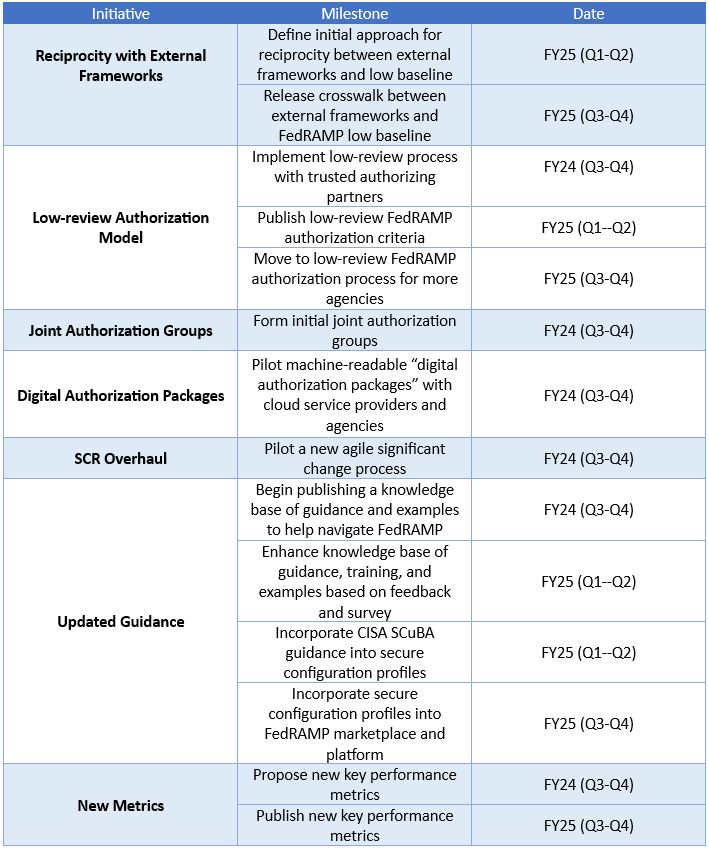
  1. Reciprocity with External Frameworks: Starting with Low-impact SaaS, the roadmap outlines a plan to enhance interoperability across different frameworks. This allows CSPs to reuse previously completed work, reducing the time to achieve FedRAMP authorization.
  2. Low-review Authorization Model: In partnership with DISA, the roadmap pilots a model where trusted agencies undergo a less extensive review process. This approach aims to make the authorization process faster and more efficient for agencies with mature review processes.
  3. Joint Authorization Groups: The FedRAMP PMO, OMB, and the FedRAMP Board are establishing joint authorization groups to promote a unified approach to risk management. This collaboration is expected to reduce the overall risk profile and workload, thereby increasing the chances for a CSP to secure agency sponsorship.
  4. Digital Authorization Packages: The PMO plans to pilot machine-readable packages using OSCAL. These digital packages are designed to speed up the review process by eliminating many of the manual tasks currently required of PMO staff.

These steps are part of a broader effort to make FedRAMP more agile and responsive to the needs to both CSPs and government agencies, ensuring quicker access to secure and industry-leading cloud solutions.

Maintaining a Cutting-Edge Program

Other initiatives laid out in FedRAMP’s 2024-25 roadmap addresses an effort to continuously update and enhance the program:

  1. SCR Overhaul: Replacing the extensive Significant Change Request (SCR) process with a more agile change management system. This adjustment allows for quicker delivery of security updates, better aligning FedRAMP with the rapid iteration cycles typical of commercial tech products. By allowing CSPs to implement iterative product updates, FedRAMP is not only improving its own operational efficiency but also enhancing the security posture of cloud services used throughout the federal government.
  2. Updated Guidance: Refreshing guidelines in critical security areas, including FIPS 140, DNSSEC, and external service integrations. These updates ensure that the program keeps pace with the latest developments in cybersecurity.
  3. New Metrics: To better meet the evolving needs to agencies and CSPs, FedRAMP is introducing new, customer-oriented key performance metrics.

Through these initiatives, FedRAMP is not just maintaining its standards but also enhancing its adaptability, ensuring it continues to set the standard in government cloud security.  

Timeline

Looking Forward

The roadmap marks a clear commitment to modernization. The PMO is confident that this strategic overhaul will alleviate the current review backlog, streamline processes, and optimize service delivery. As we look towards a transformative period for FedRAMP, Carahsoft remains committed to supporting our partners through these changes. Together, we anticipate a future where Government cloud technology is not only secure and compliant but also at the cutting edge of innovation.

To learn more about Carahsoft’s partner marketplace for FedRAMP certified cloud solutions visit our FedRAMP portfolio and speak to a member of our team today.  

Join us for GovForward’s 6th Annual ATO and Cloud Security Summit on Thursday, July 11, 2024 from 8:00 am-4:45 pm in Waldorf Astoria, Washington D.C. Learn more about the event here.

Improving Government CX Services to Build Trust Amongst Customers

In the Private Sector, customer experience (CX) is characterized by applications that serve as a single-stop service for customers. These expectations have trickled from the commercial digital world into the Public Sector, with the exception that co-designing services that keep up with the public’s needs and priorities is non-negotiable to rebuilding trust. High Impact Service Providers (HISPs), Federal agencies that the Government has deemed as having critical value due to their public-facing services, aim to mimic the single-stop layout by creating an all-encompassing CX in the Public Sector. This way, the public sees the Government as seamless and unified, and different Government agencies as parallel to each other.

Customer Experience Built on Trust

Unifying services can reduce challenges the public faces when accessing them. Time is lost due to slow modernization that would otherwise improve interactions with customers. In the past, to access services, individuals may need to take off work, which may lose them income. They may need to travel to a far location, may forget vital documents at home or may have to account for child care. These considerations which come at the expense of the public can be attributed to a “time tax” that burdens Government customers. However, with the shift to online services, customers can update their information quickly and easily on their own time. It is important to note that HISPs are moving to a digital-first, but not digital-only strategy. This means that although all services will be provided online, there will still be in-person options for those who do not have access to a dependable connection or for services that can require in-person help. By providing a variety of reliable, time and cost-effective services, Government agencies can ease usability and build trust with customers.

Okta HISP Customer Experience Series Blog Embedded Image 2024

Agencies with new, modernized websites can build trust in the Government. Conversely, a rushed website with too much downtime can lead to a user’s inability to access essential capabilities. Not every agency has a Customer Experience Officer to help roll out improved CX strategies. Various agencies may be set up differently regarding reporting structure, which complicates counsel. A driver of HISP and other government-wide CX initiatives, the Office of Management Budget (OMB), has released digital experience guidance related to Memorandum M-23-22. With this initiative, the OMB will help agencies choose which public-facing items to invest in and which digital services to optimize for prime CX.  

A fundamental part of CX is the people who provide services. To truly improve customer service, agencies must first improve their employee experience. This means providing secure access to a variety of work models: virtual or in-person, temporary, seasonal or full-time, contractor or agency related. Once agencies understand how to provide a uniform experience across a diverse portfolio of workforces, agencies can train employees to provide uniform CX across a diverse array of customers. 

Technology also plays a key role in the Government’s hope of a trust-filled relationship with those they serve. Consistent branding is one powerful way to unite HISPs across the Government. This can look like each agency placing its logo in the same area of its website. Another way is one authentication mechanism for members of the public to access both their Government account and servicer website. 

A Unified Login

A cornerstone of the Federal Government’s idea around modernizing CX is that there is a simple way for people to access Government services across multiple devices. Login.gov is putting that idea into practice. To shift online, the Government must provide a secure access method for every customer with a goal to move past the need for passwords. The modern generation of customers expect technological services to be available on multiple devices. They also prefer the ability to take a break and pick up where they left off, which requires behavioral analytics to protect users. Each agency will also be required to offer phishing resistant multi factor authentication (MFA) as an option for public users. With proper Identity and Access Management (IAM), whether in the form of single sign on (SSO) or biometric methods to log in, an app can verify that the user accessing sensitive information is the desired recipient. This way, users can gain easy, secure access to their services and information and agencies gain relevant context at the application level that follows Zero Trust principles. 

Empowering CX with IAM

Okta, the leading independent Identity partner, understands that IAM is an integral part of ensuring services are simple, seamless and secure. Furthermore, IAM services can still center CX. Okta has created human-centered design challenge cards to help agencies redesign experiences based on user needs and CX metrics. By synthesizing CX, secure and proper IAM and modern capabilities, the Federal Government can help build trust with the new era of customers. 

To learn more about how Okta’s IAM capabilities aid CX in the Federal Government, watch my interview with Federal News Network to gain insight on building trust with customers. To learn more about how Government agencies can build trust with their customers and improve customer services, view content from Carahsoft’s Government Customer Experience & Engagement Summit.

Securing Operational Technology with Cyber-Informed Engineering

Cyber-Informed Engineering (CIE) is an initiative by Idaho National Laboratory with funding from the Department of Energy (DOE). The goal of CIE is to secure physical operations through the combination of cybersecurity and engineering approaches. Today, engineering mitigations are used from time to time to address cyber risks but are used neither universally nor systematically. CIE recognizes the importance and necessity of using both engineering tools and conventional cybersecurity designs to secure operational technology (OT) networks.

Protecting Critical Infrastructure

Access to OT information in IT networks, very often through PI servers, is essential to many kinds of business automation, such as automatically ordering spare parts or scheduling maintenance crews. However, because all modern automation involves computers, as businesses continue to automate processes more targets for cyberattacks are created. In addition, data in motion is the lifeblood of modern automation, but all cyber-sabotage attacks on OT systems are information, and every connection between systems and IT/OT networks is an opportunity for attacks to spread. Thus, the more automation is deployed, the more opportunities are created to attack the ever-increasing number of targets. Cybersecurity is an issue that becomes steadily more pressing as businesses automate.

The IT/OT boundary, where PI servers tend to be deployed, is very often a consequence boundary. Worst-case consequences on the OT network are very often dramatically different and more severe than consequences on IT networks. Worst-case business consequences often include expensive incident response costs, such as businesses having to buy identity fraud insurance for customers whose information was leaked into the Internet. On the other hand, worst-case consequences for OT networks in a power plant or a high-speed passenger rail switching system often include threats to worker and public safety, or to the availability of critical infrastructure services to the nation. When worst-case OT consequences are unacceptable, engineering-grade protections must be deployed at the IT/OT interface to prevent worst-case scenarios from being realized.

Waterfall Security OT and Cyber-Informed Engineering Blog Embedded Image 2024

Conventional OT Security Programs

Using exclusively IT style mitigations to protect critical OT networks is often not enough—when public safety or critical infrastructures are at risk, it is not enough to hope that cyberattacks can be detected before they compromise critical infrastructure. It is not enough to hope that if detected in time, an incident response team can be assembled fast enough to prevent consequences. Engineering-grade designs are expected to reliably perform critical physical operations within a specified threat environment until the next scheduled opportunity to upgrade defenses, with a large margin for error.

The Threat Landscape

Remote-controlled attacks are the modern attack pattern used by hacktivists, ransomware criminals and nation-states. Modern remote-controlled attacks use social media research and clever phishing emails to trick potential victims into revealing passwords or opening malicious attachments. Once remote attackers gain a foothold in their target network, they control the compromised machine remotely, using it to attack other machines through layers of firewalls, including the IT/OT firewalls deployed to send OT data into PI servers to enable IT/OT integration. Attackers then repeat, spreading further until they reach essential OT systems or valuable information that a business would be willing to pay to recover.

‘Living off the land’ is another type of remote-controlled attack seen recently. After gaining a foothold in an IT network, attackers erase all hint of their presence, including any malware that was used to gain their foothold. Eventually compromising the IT domain controller, attackers create their own remote access and credentials. These new accounts look like a normal employee logging in; no alarms are raised as the attackers use normal operating system tools in their attacks, making them extremely difficult to detect.

Unbreachable Protection with Unidirectional Gateways

In the face of sophisticated remote-control attacks, safe integration of critical OT networks with PI servers and other business automations must involve network engineering. The most common approach to network engineering is to protect the IT/OT consequence boundary with a Unidirectional Gateway. The gateways are a combination of hardware and software; the software makes copies of PI and other OT servers from OT networks, while the hardware allows information to travel in only one direction, from the OT network out to the IT network. The gateways move OT data out to where the enterprise can use it while preventing any remote-control attacks or attack information getting back through into the OT network. Even if a deceived insider carries a piece of malware into an OT network and inadvertently activates it, that malware cannot connect out to the Internet through the gateway, much less receive any attack commands from the Internet.

Increasingly, critical infrastructures are expected to have OT networks that operate reliably and independently of the IT network, even when the IT network is compromised. A Unidirectional Gateway provides OT data to PI servers and other business automation, with no ability for malware, remote-control commands or other attack information to penetrate the gateway into operations. By eliminating the risks associated with firewalls at the IT/OT consequence boundary, industrial enterprises can be confident of the integrity of their OT systems, even in the face of the most sophisticated of modern, network-based attacks.

As Cyber-Informed Engineering emerges as the most important change in OT security in a decade, Waterfall Security’s Unidirectional Security Gateways, certified to be truly unidirectional, are leading the world in safe IT/OT and OT/cloud integration, even in the face of the most sophisticated of cyber threats. Watch our webinar “Cyber-Informed Engineering for OT Security and AVEVA PI Users” to see how Waterfall’s solutions enable safe IT/OT integration and protect safe and reliable physical operations, especially for AVEVA PI installations.

Patching in Federal Government Networks

Ivanti is committed to our customers who uphold the Nation’s highest commitments. To this end Ivanti believes that the mission our customers fulfill should not be impeded or constrained by the security stance they take. In these security conscious situations, it’s considered both mandatory and best practice for nodes within these networks to be either disconnected or entirely air-gapped.

(Context: A disconnected network can traverse its own internal network/intranet but is disconnected from the broader internet. Conversely – an air gapped environment is even further isolated – being entirely independent with no connectivity to either a larger intranet or internet.)

Despite these efforts – the risk of exploitation is not absolved simply by disconnecting or placing nodes into an air-gapped state. Network isolation of these servers & endpoints is only one aspect within a zero-trust security paradigm that these Sys-Admins have to contend with.

Technical administrators of these environments are still responsible for maintaining their systems against on-going vulnerabilities. The patching of these systems acts as a counter measure against insider threats within these systems. These vulnerabilities are more than the standard Patch Tuesday Windows OS vulnerabilities. A significant majority of these vulnerabilities exist in the 3rd party Application Eco-System. According to The U.S. National Vulnerability Database – Microsoft exploits only account for 15% of total vulnerabilities today.

Ivanti Patching in Federal Gov Networks Blog Embedded Image 2024

Patching these systems can be extremely tedious and time-consuming, but also manually intensive. This time could be better spent performing strategic security measures, or not spent at all. As a result of this lengthy process critical systems can be impacted and left open to vulnerabilities. A report from the GAO (As detailed in Pg. 46 of the GAO Report 16-501: Agencies Need to Improve Controls over Selected High-Impact Systems) shows that this has historically left even critical vulnerabilities unpatched after a significant time period (In the report – several years). To address these issues, Ivanti assists our customers by automating the remediation of the vulnerabilities found within their system, while also providing a record of truth, and reporting to these workflows.

Ivanti’s Disconnected Patching Capability

Ivanti’s product portfolio not only includes its flagship cloud-based Product Suite, and also a strong array of On-Premise based products. Two products worth highlighting for this are Ivanti Security Controls (ISEC), and Ivanti Endpoint Manager (EPM). Both products have On-Premise deployment options which extend into Disconnected and Air-Gapped Use-Cases.

At a high-level, Ivanti services disconnected / airgapped environments via the use of servers placed within those environments. Those servers then act as a repository for OS patches (Incl. Windows, Linux, and Mac), along with 3rd Party Application Patches. Reference this example diagram of a disconnected instance of Ivanti ISEC. In this example, a central environment is used to download and prepare patches for the environment. Then, one-to-many disconnected environment can then be stood up with patches and management provided via a ‘File Transfer Service’. This service can mean two things: either an approved Media Devices to enable transfers when no connectivity can exist, or a staged approach in which connectivity for a Centralized console is alternated between the Internet and a Disconnected Environment. Where approved, this prevents a direct link between the internet and the disconnected environment.

One additional note with this diagram is that both the Central Rollup Console and Connected Environment can also be connected on temporarily, even if only to update definitions in support the disconnected portions of the deployment.

Ivanti Endpoint Manager (EPM)

On the flipside, we can take the disconnected / connected philosophy we mentioned in ISEC and apply it to our EPM product. Like with ISEC an admin can create multiple EPM consoles, or cores without any additional charges. Those cores can be deployed as disconnected or ‘dark’ cores. Vulnerability Definitions and Patches can then be copied from a connected environment into the disconnected environment via the same preferred ‘File Transfer Client’ of choice. This methodology has been proven amongst our customer base who have effectively deployed this into disconnected and airgapped instances for both ISEC and EPM.

Modernized & Automated Patching Workflows

Modernizing the patching process means reducing the Mean Time to Patch, and strategically securing against vulnerabilities. To that end, Ivanti provides Neurons for Risk Based Vulnerability Management – a Vulnerability Management system that provides contextualization around threats (Ex. ‘Trending’ Vulnerabilities or Vulnerabilities could be executed without physical access to the target).

RBVM also provides the necessary patches and remediation for those vulnerabilities. By integrating our Patching and RBVM we modernize patching into a strategic and automated process. Files containing the vulnerabilities deemed most risky can be loaded into solutions like EPM to determine and provide patches. This workflow can still apply even in disconnected and airgapped use cases. RBVM could connect to the Rollup Core while disseminating patches via the process mentioned above.

How Ivanti can Help

Between Ivanti’s EPM & ISEC products, a System Administrator would have full range to patch the Windows, MacOS, and Linux Servers and Workstations within their environments. Patches also extend to 3rd Party Applications in which a significant portion of vulnerabilities originate. Ivanti also has a team of QA testers that validate the patches within its 3rd Party Patch Catalog to ensure no patches will cause a crash to the system. This patching can apply to both connected, and disconnected environments without any additional charges for scaling your Console Server Deployments.

In the case of ISEC – ISEC can discover and patch endpoints both with an agent and agentlessly. ISEC can also integrate with On-Premise VMware ESXi environments and patch ESXi hosts, as well as images and offline VM’s, thus further centralizing and reducing time to patch across the environment. Conversely – EPM provides users with a full suite of Endpoint Management capabilities in addition to patching including Discovery and Data Normalization, OS Provisioning, Software Distribution, User Profile Management, Remote Control, and Integrated Patching and Endpoint Security.

Additional Resources

For further reading, please consider Ivanti’s Product documentation around this subject. These references can provide additional documentation around how to establish:

About Ivanti

Ivanti was created in 2017 with the merger of Landesk and HEAT software. We are a powerhouse IT solution with over 30 years of combined experience. Ivanti finds, heals and protects every device, everywhere – automatically. Whether your team is down the hall or spread around the globe, Ivanti makes it easy and secure for them to do what they do best.

Ivanti is committed to supporting our customers requiring either Cloud or On-Premise deployment requirements. In both of those deployment paths Ivanti’s Portfolio contains accredited solutions including the following certifications: DoD ATO, Army CoN, Common Criteria, DoDIN APL, DISA STIG, DoD IL2 & IL5 Private Cloud, DoD ATO, NIAP MDM PP v4, NIAP Common Criteria, NSA CSFC, FIPS 140-2, FedRAMP Moderate, & SOC 2 Compliances.

Connect with an Ivanti representative today and learn more about how Ivanti can support your MultiCloud initiatives.

The 12 Artificial Intelligence Events for Government in 2024

Carahsoft 10 Artificial Intelligence Events for the New Year Blog Embedded Image 2024Last year set a landmark standard for innovation in artificial intelligence (AI). Federal, State, and Local Governments and Federal Systems Integrators are eager to learn how they can implement AI technology within their agencies. With the recent Presidential Executive Order for AI, many Public Sector-focused events in 2024 will explore AI modernizations, from accelerated computing in cloud to the data center, secure generative AI, cybersecurity, workforce planning and more.
We have compiled the top AI events for Government for 2024 that you will not want to miss.

1. AI for Government Summit

May 2, 2024, Reston, VA | In-Person Event

The AI for Government Summit is a half-day event designed to bring together Government officials, AI experts and industry leaders to explore the transformative potential of AI in the public sector. As Governments worldwide increasingly adopt AI technologies to enhance efficiency, improve services and address complex challenges, this summit will serve as a platform for collaboration, discussion and sharing knowledge on the latest advancements and best practices in AI deployment within Government organizations.

Sessions to look out for: Cybersecurity & AI – Safeguarding the Government and Generative AI Government Use Case Panel 

Carahsoft is proud to host this inaugural event alongside FedInsider. Join us and over 100 of our AI & machine learning technology and solution providers as they speak towards AI adoption in our Public Sector and how they are using AI to solve our government’s most critical challenges. Attendees will also hear from top government decision-makers as they share unique insights into their current AI projects. 

2. NVIDIA GTC 

March 18 – 21, 2024, San Jose, CA | Hybrid Event

Come connect with a dream team of industry luminaries, developers, researchers, and business strategists helping shape what’s next in AI and accelerated computing. From the highly anticipated keynote by NVIDIA CEO Jensen Huang to over 600 inspiring sessions, 200+ exhibits, and tons of unique networking events, GTC delivers something for every technical level and interest area. Whether you join us in person or virtually, you are in for an incredible experience at the conference for the era of AI.

Sessions to look out for: What’s Next in Generative AI and Robotics in the Age of Generative AI 

Carahsoft serves as NVIDIA’s Master Aggregator working with resellers, systems integrators, and consultants. Our team provides NVIDIA products, services, and training through hundreds of contract vehicles.

Carahsoft is proud to be the host of the GTC Public Sector Reception on Tuesday, March 19th.  

Please visit Carahsoft and our partners at the following booths:

  • Government IT Solutions: Carahsoft (#1726), Government Acquisitions (#1820), World Wide Technology (#929)
  • AI/ML & Data Analytics: Anaconda (#1701), Dataiku (#1704), Datadog (#1033), DataRobot (#1603), Deepgram (#1719), Domino Data Labs (#1612), Gretel.AI (G130), H2O.AI (G124), HEAVY.AI (#1803), Kinetica (I132), Lilt (I123), Primer.AI (I126), Red Hat (#1605), Run:AI (#1408), Snowflake (#930), Weights & Biases (#1505 & G115)
  • AI Infrastructure: Dell (#1216), DDN (#1521), Edge Impulse (#434), Lambda Data Lab (#616), Lenovo (#1740), Liqid (#1525), Pure Storage (#1529), Rescale (#1804), Rendered.AI (#330), Supermicro (#1016), Weka (#1517)
  • Industry Leaders: AWS (#708), Google Cloud (#808), HPE (#408), Hitachi Vantara (#308), IBM (#1324), Microsoft (#1108), VAST Data (#1424), VMware (#1604)

3. 5th Annual Artificial Intelligence Summit  

March 21, 2024, Falls Church, VA | In-Person Event  

Join the Potomac Officers Club’s 5th Annual AI Summit, where federal leaders and industry experts converge to explore the transformative power of artificial intelligence. Discover innovative AI advancements, engage in dynamic discussions, and forge strategic collaborations with key partners at this annual gathering of the movers and shakers in the AI field. Hosted by Executive Mosaic, this summit will be held in Falls Church, Virginia.  

Sessions to look out for: Leveraging Collaboration to Accelerate AI Adoption in the DoD and Operationalizing AI in Government: Getting Things Done with Automation  

Carahsoft is the master aggregator for Percipient AI, a Silver Sponsor, and Primer AI, the Platinum Sponsor. Mark Brunner, President of Federal at Primer AI, will also be speaking at the event. 

4. INSA Spring Symposium: How AI is Transforming the IC

April, 4, 2024, Arlington, VA | In-Person Event

Join 300+ intelligence and national security professionals at INSA’s Spring Symposium, How Artificial Intelligence is Transforming the IC, on Thursday, April 4, from 8:00 am-4:30 pm at the INSA/NRECA Conference Center in Arlington, VA. Key leaders from government, academia, and industry will discuss cutting-edge AI innovations transforming intelligence analysis, top priorities and concerns from government stakeholders, developments in ethics and oversight, challenges and opportunities facing the public and private sector and more!

Session to look out for: AI Ready? Challenges from a Data-Centric Viewpoint

Meet with Carahsoft partners AWS, Google Cloud, Intel, and Primer.

5. Google Next ‘24  

April 9 – 11, Las Vegas, NV | In-Person Event  

Explore new horizons in AI at Google Cloud Next ’24 in Las Vegas, April 9–11 at Mandalay Bay Convention Center. Dive into AI use cases, learn how to stay ahead of cyberthreats with frontline intelligence and AI powered security and boost data and thrive in a new era of AI. Plus, see our latest in AI, productivity and collaboration, and security from Google Public Sector.  

Carahsoft will be a sponsor of Google Next ‘24 with a significant public sector presence and plans to host a reception as well. 

6. SC24  

November 17 – 22, 2024, Atlanta, GA | Hybrid Event  

Supercomputing (SC) is the longest running and largest high performance computing conference. SC is an unparalleled mix of thousands of scientists, engineers, researchers, educators, programmers, and developers. Hosted by The Association for Computing Machinery & IEEE Computer Society, SC24 is hosted in Atlanta, Georgia.   

Carahsoft is proud to attend SC24 for a fourth year as the master aggregator serving the public sector. Carahsoft will be hosting an extensive partner pavilion showcasing daily demos of our technology and solution partners, demonstrating use-cases in AI and HPC intended for higher-ed organizations, research institutions, government agencies, and more.  

Join us at our public sector reception for a night of networking with leading decision-makers and solution experts on November 20. 

7. Elastic Public Sector Summit ‘24  

March 13, 2024, Pentagon City, VA | In-Person Event  

Join top Federal program executives and IT leaders to learn firsthand how advances in data management, search and analytics capabilities are helping agencies turn data into mission value faster and more productively for citizens and Government employees. Learn how agencies are leveraging these capabilities for cybersecurity, operational resilience, and preparing for the new era of generative AI. FedScoop, Elastic and Carahsoft will co-host this summit in Pentagon City, Virginia.   

As a top-level sponsor of Elastic’s Public Sector Summit, Carahsoft will host a pavilion on the exhibit floor that features Elastic’s foremost technology partners for the hundreds of projected government attendees.

8. CDAO Government

September 17 – 19, 2024, Washington DC | In-Person Event  

This event brings together the latest technological advancements and practical examples to apply key data-driven strategies to solve challenges in Government and greater society. Join a unique mix of academia, industry and Government thought leaders at the forefront of research and explore real-world case studies to discover the value of data and analytics. Located in Washington, D.C., CDAO Government will be hosted by Corinium Intelligence.   

Carahsoft was proud to be a Premier Sponsor at the 2023 CDAO Government, involving numerous of our vendor partners, Cloudera, and HP, Alation, Informatica, Progress|MarkLogic, Snowflake, and Tyler Technologies, Alteryx, Coursera, DataRobot, Databricks, Elastic, Immuta, Primer AI, and Qlik. 

Carahsoft looks forward to participating as a leading sponsor again at the 2024 CDAO Government.  

9. OODACON

November 5 – 6, Reston, VA | In-Person Event 

The world is at a transition point where technology is enabling rapid changes that can drive both positive and negative outcomes for humanity. It is also empowering many bad actors and poses new threats. The essence of OODAcon lies in its capacity to forge a robust community of leaders, experts, and practitioners that serve as a collective force that can propel us towards a brighter future.  

Join us at the Carahsoft Conference and Collaboration Center to discuss how disruptive technology can solve the most pressing issues of today. 

10. AWS Public Sector Summit 

June 26-27, 2024, Washington DC | In-Person Event 

Join Carahsoft and our partners for two days on innovation, collaboration and global representation. Designed to unite the global cloud computing community, AWS Summits are designed to educate customers about AWS products and services, providing them with the skills they’ll need in order to build, deploy, and operate their infrastructure and applications. 

As a top-level sponsor of AWS’ Public Sector Summit, Carahsoft will host a pavilion on the exhibit floor that features AWS’ foremost technology partners for the thousands of projected government attendees. 

Learn More About Previously Held Events

11. CDAO Advantage DoD24 Defense Data & AI Symposium  

Carahsoft was at CDAO’s inaugural Advantage DoD 2024: Defense Data & AI Symposium from February 20th to 22nd at the Washington Hilton in Washington, DC. The symposium provided a platform for over 1000 government officials, industry leaders, academia, and partners to converge and explore the latest advancements in data, analytics, and artificial intelligence in support of the U.S. Department of Defense mission. Carahsoft had a small tabletop partner pavilion, featuring our vendor partners Alteryx, DataRobot, Collibra, Elastic, Databricks, PTFS, EDB, Weights & Biases, and Clarifai.

Throughout the symposium, attendees from diverse backgrounds, including technical programmers, policymakers, and human resources professionals, gained valuable insights into emerging technologies and best practices for integrating data-driven strategies into organizational frameworks. Attendees also enjoyed two networking receptions hosted by Booz Allen Hamilton and C3.ai.

The agenda featured compelling speaking sessions including topics such as:

  1. Task Force Lima – The Way Forward (Goals and Progress)
  2. LLMs and Cybersecurity: Practical Examples and a Look Ahead
  3. DoD GenAI Use Cases and Acceptability Criterias

12. Using Generative AI & Machine Learning in the Enterprise  

This intimate one-day 500-person conference curated data science sessions to bring industry leaders and specialists face-to-face to educate one another on innovative solutions in generative AI, machine learning, predictive analytics, and best practices. Attendees saw a mix of use-cases, technical talks, and workshops, and walked away with actionable insights from those working on the frontlines of machine learning in the enterprise. Hosted by Data Science Salon, the event was held in Austin, Texas.

Carahsoft partners NVIDIA and John Snow Labs were in attendance; two leading AI and Machine Learning solution providers. Carahsoft serves as the master aggregator for both NVIDIA and John Snow Labs to provide government agencies with solutions that fulfill mission needs from trustworthy technology and industry partners.

While the landscape of government events has always been in flux, the pace of change in 2024 feels downright dizzying. From navigating hybrid gatherings to crafting data-driven experiences, the pressure is on to connect, inform, and engage. This is where the power of AI steps in, not as a silver bullet, but as a toolbox brimming with innovative solutions. Carahsoft’s curated list of Top 12 AI for Government Events is just the starting point. So, do not let the future intimidate you; embrace it. Dive into the possibilities, explore these AI tools, and get ready to redefine what a government event can be. Your citizens—and your data—will thank you.  

To learn more or get involved in any of the above events please contact us at AITeam@carahsoft.com. For more information on Carahsoft and our industry leading AI technology partners’ events, visit our AI solutions portfolio and events page. 

Revitalizing FedRAMP: Navigating the Shift to a Modernized Cloud Security Framework

The Federal Risk and Authorization Management Program (FedRAMP) was created over a decade ago to provide a standardized approach to security assessment, authorization and continuous monitoring for cloud products and service used by Federal agencies. Embracing the dynamic advancements in cloud technology, FedRAMP has recognized the importance of modernizing to keep pace with the rapid developments in the cloud landscape. The Office of Management and Budget (OMB) released a draft memorandum in October 2023 that outlined a comprehensive FedRAMP framework, emphasizing adaptability, automation and cooperation to address evolving cloud service requirements. 

An Opportunity for Modernization 

As technology continues to evolve, so do the advancement opportunities in the realm of cloud security for Federal agencies. With the expansion of cloud offerings and the increasing demand for cloud-based services, FedRAMP is undergoing a significant overhaul to meet the changing landscape. The new OMB FedRAMP guidance will replace the original guidance published in 2011, a year in which the cloud security climate looked drastically different and less complex than today. Changes to address the evolving threat landscape include tools for enterprise collaboration, product development and improving an enterprise’s own cybersecurity. Having already authorized more than 300 authorized services in the FedRAMP Marketplace, FedRAMP recognizes the need to add more solutions for agencies to have all the required capabilities to deliver on their missions.[1]

OMB aims to address these challenges by establishing a plan to scale the program, bolster security reviews of cloud solutions and accelerate Federal adoption. Drew Myklegard, the Deputy Federal CIO, said during CyberTalks, a gathering of the most influential leaders in cybersecurity and digital privacy, “There’s a lot of room in the FedRAMP process with friction and [manual] steps that are causing too long of times from when people identify a product that they need until they can employ it.” [2] 

The New FedRAMP Guidance 

Carahsoft FedRAMP General Overview Blog Embedded Image 2024Automation and Continuous Monitoring (ConMon) stand at the forefront of FedRAMP modernization as the memo underscores the significance of automation and the use of machine-readable formats for authorization and ConMon artifacts. The new guidance will create a system for automating security assessments and reviews, as well as expand on the initiative to obtain FedRAMP security artifacts solely through automated, machine-readable processes. The General Services Administration (GSA) also plans to update ConMon processes within 180 days and exclusively accepting machine-readable artifacts within 18 months.  
By automating security assessments and reviews, FedRAMP is looking to streamline the authorization process, reduce the time and cost of compliance, and improve the accuracy and consistency of security assessments. An added benefit is that automation will help identify and mitigate security risks more quickly and effectively, improving the overall security posture of cloud-based services used by the Federal Government.  

The key changes proposed in the new guidance will: 

  • Reaffirm the presumption of adequacy established in the FedRAMP Authorization Act. This provision establishes that once a CSO achieves FedRAMP Authorization, Federal agencies must presume the offering has adequate security measures for a streamlined reauthorization.  
  • Recognize the transformation of the cloud marketplace and the need for FedRAMP to adjust its processes, originally tailored to a limited number of Infrastructure as a Service (IaaS) solutions, to now accommodate a vast and growing amount of Software as a Service (SaaS) solutions. 
  • Introduce a fast-track authorization program for agencies that have demonstrated mature authorization processes and frequently provide the PMO with high-quality authorization packages. 
  • Propose new authorization types: Joint-Agency and Program authorizations. The Joint Authorization Board (JAB) authorization option is evolving, with all existing JAB authorizations automatically transitioning to Joint-Agency authorizations upon the memorandum’s issuance. Joint-Agency authorizations can pool the resources of any Federal agency to review an authorization package, expanding beyond the DoD, DHS and GSA to include all relevant agencies. 
  • Define the roles and responsibilities of the newly established FedRAMP Board. The FedRAMP Authorization Act empowered OMB to assume a more active and leading role in FedRAMP, and this memo serves as a notable illustration of that increased involvement. 
  • Establish a preliminary “pilot” authorization category allowing agencies to test new cloud services for up to twelve months. This authorization pathway would provide agencies and CSPs with an expedited route to market, accelerating the availability of CSOs. 
  • Streamline authorizations for products that leverage FedRAMP-authorized Infrastructure as a Service (IaaS) and Platform as a Service (PaaS) solutions and for products which have obtained external security frameworks that evaluate relevant risks.  
  • Establish the Technical Advisory Group (TAG) to act as an independent source of Federal Government employees for best practices to enhance the efficiency of FedRAMP’s operations.  

Benefits for Federal Agencies 

By scaling the program, more cloud service providers will be able to obtain FedRAMP authorization, increasing the availability of authorized cloud services for Federal agencies to use. This will enable agencies to more easily and quickly adopt cloud-based services that meet their specific needs. 

Through enhanced security reviews of cloud service offerings, Federal agencies can gain increased confidence in the adherence of the cloud services they utilize to rigorous security standards. Therefore, improving the overall security posture of Federal agencies and reducing the risk of data breaches. 

Streamlining the authorization process and offering a broader range of authorized cloud services can help Federal agencies alleviate the costs and administrative burden linked to duplicative security assessments. Overall, agencies will be able to more efficiently and effectively leverage cloud-based services to support their mission and better serve its citizens.  

The Future of FedRAMP 

Stakeholders are optimistic the new OMB guidance will pave a future for the program that will be more comprehensive, efficient and tailored to the current security environment. As more commercial providers become incentivized to pursue FedRAMP authorization, Federal agencies will have more options when it comes to cloud, and technology vendors will be more suited to achieve FedRAMP authorization success. 

To explore more in-depth insights into the OMB Memo view the Carahsoft Guide to Modernizing the Federal Risk Authorization Management Program (FedRAMP). To learn more about Carahsoft’s partner marketplace for FedRAMP certified cloud solutions visit our FedRAMP portfolio and speak to a member of our team today.  


Resources: 

[1] “Office of Management and Budget Releases Draft Memorandum for Modernizing the Federal Risk and Authorization Management Program (FedRAMP).” The White House, https://www.whitehouse.gov/omb/briefing-room/2023/10/27/office-of-management-and-budget-releases-draft-memorandum-for-modernizing-the-federal-risk-and-authorization-management-program-fedramp/. 

[2] “OMB extends comment period for new FedRAMP guidance.” FedScoop, https://fedscoop.com/omb-extends-comment-period-for-new-fedramp-guidance/ 

5G: Powering the Government’s Digital Transformation

5G technology has the capacity to speed data transfers and connect billions of devices at a time when mission success hinges on fast, secure access to data and people. 5G’s potential to enhance all government activities makes it an indispensable component of efforts to modernize IT systems and service delivery. Because of its low latency and capacity to carry vast amounts of data quickly and efficiently, 5G enables real-time access to information. As a result, it is facilitating the growth of smart cities, the use of artificial intelligence to improve government operations and the adoption of edge computing. The implications are profound for activities as varied as battlefield communications, military logistics and preparedness, and emergency response in situations where critical infrastructure is unavailable. Learn how government agencies can leverage all the resources in play to achieve the goal of open, interoperable and secure 5G networks Carahsoft’s Innovation in Government® report.


The Unifying Nature of 5G Technology 

“5G technology is the first telecommunications standard that is cloud-native, making it critical for the government’s digital transformation. We now have a transport medium that aligns with and supports the flexibility, scalability and efficiency of cloud operating models and containerized functions and services. In addition, all aspects of a digital transformation strategy — including edge computing, artificial intelligence, cloud migration and application rationalization — center on data. With everything level-set architecturally to be cloud-native and containerized, 5G networks enable a common approach to managing data, and they also bring in a new capability for data sovereignty.”

Read more insights from Chris D. Thomas, technical strategist at Dell Technologies. 


Why 5G Is Indispensable for Frontline Agencies 

Carahsoft IIG FCW 5G Digital Transformation Blog Embedded Image 2023“Private 5G networks have distinct benefits for government, which is why DOD has stated that it is a strategic direction for the department. At Federated Wireless, we custom-build networks for high performance, scale and unlimited capacity using best-of-breed technology from a large ecosystem of suppliers. Private wireless networks provide strong security and control over where the data resides. Unlike a traditional cellular carrier that sends data through an off-site central core, private 5G networks are secure enclaves that are governed by zero trust architectures.”
Read more insights from Paul Battaglia, vice president of public sector at Federated Wireless. 


The Key to Creating More Flexible 5G Networks 

“JMA Wireless embarked on a project a couple of years ago to help bring 5G to the Marine Corps Logistics Base in Albany, GA. We were part of a team that deployed a 5G network and added applications to enable officials to modernize warehousing and logistics at the base. As a result of those improvements, the base has reduced labor costs by 61%. Additionally, it used to take three to five days for items to move from the dock to the shelf. That timeline has been slashed to about 36 minutes as the combination of the 5G network and updated application environment drives major efficiencies in logistics operations.”

Read more insights from Rishi Bhaskar, senior vice president and general manager at JMA Wireless.


Sharing Critical Information in Real Time 

“The deployment of 5G for government agencies requires a security approach that is independent from the underlying transport network. For our public safety and defense customers, we offer a security architecture based on Blackned’s TacticalCORE, which provides an over-the-top multidomain security layer, enabling authentication in contested environments and separate classified information spaces across the same infrastructure. All transport is considered untrusted with the ability to implement agency-specific encryption on the 5G network. This state-of-the-art security approach has already been accredited by the German BSI as NATO-restricted and enhanced security classifications are planned.” 

Read more insights from Richie Obermayer, VP of technical sales at GuardSTACK Technologies. 


How Agencies Can Reap the Benefits of 5G

“5G’s reliability and availability make it possible to build dedicated wireless networks that can be sliced so mission-critical applications run in separate areas while the government maintains full control over that network. Last but certainly not least, 5G networks have carrier-grade, built-in security standards, including SIM cards that are provisioned and activated for a specific network. Users cannot connect to the network without inserting a highly secure SIM into their devices.” 

Read more insights from Derrick Frost, senior vice president of operations and general manager of private wireless at Kajeet. 


Private Networks and the Evolving 5G Ecosystem

“Private networks are well-suited to agency use cases for a number of reasons. First and foremost is security, which is the bedrock of every cellular network. Beyond the built-in security private 5G networks bring, they also have the capacity to add extra layers of security. The other components of a robust network include radio frequency technology and the latest 5G devices and radios. Once that foundation is in place, agencies can explore the wide range of use cases that a private 5G network can address. Deployments include standalone networks for first responders, border patrol agents and tactical response units, as well as secure, reliable networks for telemedicine providers.”

Read more insights from Derek Gallagher, CTO at Druid Software. 


Download the full Innovation in Government® report for more insights from 5G thought leaders and additional industry research from FCW. 

Building a Foundation for an AI Future

It might seem like agencies are hesitant to adopt artificial intelligence. But really, it is quite the opposite. As Lori Wade, the Intelligence Community’s chief data officer, put it: “It is no longer just about the volume of data, it is about who can collect, access, exploit and gain actionable insight the fastest.” The realization is clear: Humans alone cannot keep pace. They need AI so they can make decisions based on the most relevant and most current information — and make those decisions in a timely manner. It is really as simple as that. Download the guide, “Building the Foundation for Your AI Future,” to pick up pointers on data management and AI, plus take a glimpse at the latest technology developments, tips for best practices and an explanation of the early value that AI is delivering to agencies across government. 


How to Revolutionize Government Translation with Generative AI

“In situations where accurate and timely translations are crucial, the shortage of qualified and vetted linguists poses significant challenges. Equally, non-linguist analysts are not equipped with secure, at-desk tools to translate foreign language material at the speed of relevance. For example, during the ongoing war in Ukraine, there has been a scarcity of linguists available to provide real-time updates on the ground. This shortage not only has affected the ability to gather vital intelligence but also hindered the timely dissemination of information to national security and defense agencies in the U.S. and abroad.”

Read more insights from Jesse Rosenbaum, Vice President of Business Development and National Security at Lilt. 


How Graph Databases Drive a Paradigm Shift in Data Platform Technology  

Carahsoft IIG FNN Future AI Blog Embedded Image 2023“Federal agencies are awash in data. With recent modernization efforts, including the wide-scale adoption of cloud platforms and applications, it is easier than ever for agencies to receive streaming data on everything from logistics to finances to cybersecurity. But that volume of data requires new solutions to process and analyze it. Older methods like SQL and NoSQL simply are not up to the task of analyzing all of the connections between the government’s many massive databases. That is where the new graph paradigm of data platform technology comes in.”

Read more insights from Michael Moore, Principal for Partner Solutions and Technology at Neo4j. 


How Agencies Can Upskill in AI to Achieve a Data Mesh Model  

“Data mesh behavior actually goes a step further. AI has become so easy to use, business owners can actually join in the development alongside the data scientists. Therein lies the challenge: Upskilling subject matter experts across an entire organization is a big lift. The way it works best is to start with a center of excellence, a small group of people who begin working with business owners across the enterprise, office by office. They can then prove the value and evangelize it, and then the agency can move to a hub-and-spoke model, where the data scientists are co-developing alongside business owners. As successes pile up, the data scientists can take a step back and allow frontline workers to do the development, governing the new data products on their own.”

Read more insights from Doug Bryan, Field Chief Data Officer at Dataiku. 


How Agencies Can Build a Data Foundation for Generative AI  

“Generative artificial intelligence tools are making waves in the technology world, most famously ChatGPT. Although the code of these tools is significant, their real power stems from the data they are trained on. Gathering and correctly formatting the data, then transforming it to yield accurate predictions, often represents the most challenging aspect of developing these tools. Federal agencies that want to start leveraging generative AI already have massive amounts of data on which to train the technology. But to successfully implement these tools, they need to ensure the quality of their data before trusting any decisions they might make.”

Read more insights from Nasheb Ismaily, Principal Solutions Engineer at Cloudera. 


How to Democratize Data as a Catalyst for Effective Decision-Making  

“One of the key best practices in the Office of Management and Budget’s Federal Data Strategy calls for using data to guide decision-making. But that is easier said than done when the ability to analyze the data, much less access it, is limited to an agency’s often overworked and understaffed data science specialists. But now that every line of federal business has their own data silo and a mandate to use that data to guide decisions, agencies need a way to democratize access to that data and empower every federal employee to become an analyst.”

Read more insights from Kevin Woo, Director of Federal Sales at Alteryx. 


Download the full Expert Edition for more insights from these artificial intelligence leaders, additional government interviews, historical perspectives and industry research.