Efficient, Continuous Identity Verification with 1Kosmos’s Enterprise Identity Wallet

In the age of digital technology, digital identity wallets offer users a transportable, secure way of verifying their identity and certifications. Having a reliable, up-to-date method of verifying identity enables enterprises to swiftly and securely manage procedures.

Switching to Digital Wallets 

Digital wallets provide a flexible, streamlined experience for enterprises, employees, third-party contractors and business-to-business transactions. In spaces where transactions are high-risk, having a secure, verifiable identity to cross-reference is vital to security. Digital wallets can verify end users for active attorney license statuses, active medical licenses or to prove cybersecurity certifications, such as Certified Information Systems Security Professional (CISSP). These can follow employees throughout their employment. 

Utilizing digital wallets in decision-making spaces can help verify end users in addition to their every-day authenticators, similar to step-up authentication. Digital wallets verify identities, eliminating the need for social engineering. If credentials are needed to gain privileged user access, digital wallets help enterprises verify that the end user is who they say they are. For example, during emergencies, such as natural disasters, wallets can help verify that volunteers have active licenses in a timely manner. 

1Kosmos’s Enterprise Identity Wallets 

1Kosmos Identity Blog image

1Kosmos enterprise identity wallets deliver centralized, scalable identity management that enable organizations to securely provision and govern employee digital identities, credentials and access privileges across their entire technology ecosystem.

First, 1Kosmos verifies the end user by validating and verifying their provided documentation. Once verified, 1Kosmos creates a digital wallet by collecting, encrypting and storing an end user’s identification information in a private and permissioned ledger, allowing only the end user to access and share their personal data on their own initiative. This information cannot be accessed by 1Kosmos, as it goes through several layers of encryption. 

These wallets are built with World Wide Web Consortium (W3C) standards, providing an interoperable experience and enables users to reuse wallets and access their identification as often as needed.

1Kosmos’s Digital enterprise identity wallets are classified through a decentralized management system. 1Kosmos’s private, distributed ledger breaks up end users’ identification wallets, updating new certifications and licenses in its own personalized block, utilizing blockchain in the back end to provide a layer of security to encrypt information. Permissions are access based, providing a layer of security through segmentation. 1Kosmos’s wallets utilize attribute-based access control (ABAC) security, granting permissions based on matching data tags. With the proper credentials, end users can access files instantly.  

Protection for High-Risk Transactions

1Kosmos’s enterprise identity wallets have an array of features that make them perfect for high-risk transactions. The wallets have a private and permissioned ledger, offering a distributed identity experience over a centralized one. With Presentation Attack Detection (PAD) Level 1 and Level 2 certifications, 1Kosmos offers protection against deep fake attacks. 1Kosmos offers continuous vulnerability management, FedRAMP high authorization, Kantara certification and Federal Information Processing Standards (FIPS)-140-3 encryption. Perfect for enterprise use and a diverse set of end users, 1Kosmos’s wallets can verify identity, ensuring that all processes are efficient and secure.  

Visit 1Kosmos’s page to learn more about their full service, privacy preserving enterprise identity wallets.

Carahsoft Technology Corp. is The Trusted Government IT Solutions Provider, supporting Public Sector organizations across Federal, State and Local Government agencies and Education and Healthcare markets. As the Master Government Aggregator for our vendor partners, including 1Kosmos we deliver solutions for Geospatial, Cybersecurity, MultiCloud, DevSecOps, Artificial Intelligence, Customer Experience and Engagement, Open Source and more. Working with resellers, systems integrators and consultants, our sales and marketing teams provide industry leading IT products, services and training through hundreds of contract vehicles. Explore the Carahsoft Blog to learn more about the latest trends in Government technology markets and solutions, as well as Carahsoft’s ecosystem of partner thought-leaders.


From Insights to Intervention: Building Safer Roads with Smarter Data

Safety threats do not always wait for the next inspection or make themselves obvious. A missing stop sign, a tilted guardrail or debris from a recent storm can pose real dangers long before a complaint is filed or a crash occurs. Near real-time visual data from crowd-sourced dashcam imagery allows agencies to detect these issues earlier, reducing the risk of collisions, confusion and liability.

This is not just about reacting to problems. It is about gaining continuous visibility across your road network. When you can see more, sooner, you prevent more and protect everyone who uses your roads.

Enable a Proactive Maintenance Culture

Proactive maintenance reduces risk by keeping infrastructure from reaching a failure point. It starts with awareness. With timely insights into pavement wear, fading striping or damaged safety features, you can fix problems before they become safety hazards.

Using this approach minimizes emergencies and reduces the need to send crews into high-risk, high-traffic situations. Over time, it is not just about saving money, it is about making safer and more intelligent decisions every day.

Do Not Let Blind Spots Become Risk Zones

Not every mile of the roadway gets equal attention. Areas that are not high-traffic or complaint-heavy can still hide dangerous issues, especially if they go uninspected for long periods.

Imagery from vehicles already on the road helps reveal what is often missed. It fills in the gaps between formal inspections, surfacing problems in places crews do not regularly visit.

Safety should not depend on luck or public reports. Every segment of your road network deserves consistent visibility.

Speed Recovery After Disasters

When a storm or crisis hits, minutes matter. Near real-time, image-based insights give agencies a fast way to assess damage and identify dangerous conditions, often before crews can access the scene.

Improved visibility enables quicker, more targeted responses. Agencies can clear routes, mark danger zones and stabilize infrastructure faster, protecting both the public and their crews.

The sooner you know what you are facing, the sooner you can act.

Awareness That Improves Safety Outcomes—Not Just Oversight

Effective safety programs do not rely on complaints, scheduled inspections or guesswork. They rely on data that reflects what is happening on the ground—frequently, consistently and with the scale to match the entire network.

Whether identifying early signs of pavement failure or responding to extreme weather events, increased awareness drives better outcomes: fewer emergencies, smarter spending and safer roads for all.

To learn how better information leads to safer roads, view Blyncsy’s portfolio.

Secrets to Public Sector Sales Success: Insights from Marion Square’s Harvey Morrison

The Federal Government needs more solutions, not more software. That is the message we at Marion Square get every day from our agency contacts. They do not want lists of product features or emails about why one technology is better than another. They want to know how that technology will meet their very specific needs, how it will fit into their unique IT architecture and, most importantly, how it will help them solve their challenges.

As such, successfully selling to agencies today looks a lot different from what it did a few years ago. It is not about getting 50 meetings with 50 different agencies; that scattershot approach is a waste of time. Instead, it is about ensuring that the right meetings are held and that each one matters.

That is where Marion Square comes in. We help technology vendors align their products with mission impact and operational fit. Our advisory approach blends deep market intelligence with tailored go-to-market strategies that position technology not as a product, but as an answer to an agency’s most pressing needs.

Based on our conversations with agency contacts, here are the key trends shaping Federal buying behavior, and how we recommend vendors respond.

The Three Pricing Archetypes Driving Public Sector Purchasing

The Government is still under immense pressure to bring costs down and increase efficiencies. Over the past few months, we have heard from many clients whose customers have called for price reductions. We advise them on three ways to respond:

Vendors must choose their approach carefully. A bold discount can open doors but risks setting unsustainable expectations. Value bundling requires clear articulation of how those added features meet specific mission needs. And while price cuts may help win deals in the short term, they should be anchored in a broader licensing or adoption strategy to avoid devaluation.

Partnering With Services Companies Is a Winning Strategy

Agencies need help navigating integration, implementation, training and sustainment. That is why partnering with services companies is essential. These firms bring institutional knowledge, procurement relationships and hands-on delivery capacity that agencies trust. When a vendor brings a product plus a credible partner to help stand it up, it reduces perceived risk and increases purchase confidence.

At Marion Square, we help clients align with the right service partners early in their go-to-market process. Doing so allows them to frame their offerings not as standalone tools, but as parts of larger, operationally relevant solutions.

Indeed, we have seen a lot of success when vendors position themselves alongside integrators or mission-focused contractors who already have traction within an agency. The collaboration strengthens the overall value proposition and gives agencies greater confidence that the solution can be deployed effectively and deliver measurable outcomes.

Agencies Look to Vendors For Education, Not Just Products

Many Federal stakeholders are overwhelmed by emerging technologies and new mandates. They value a partner who can help them unpack directives like the Cybersecurity and Infrastructure Security Agency (CISA) Binding Operational Directive (BOD) 23-02, for instance, or understand how artificial intelligence (AI) tools can improve workflows, cybersecurity initiatives and so forth. Vendors who show up with insight, rather than just information, become trusted advisors and separate themselves from the pack.

We also see a significant knowledge gap around the innovation programs already available to agencies. Beyond well-known pathways like Small Business Innovation Research Programs (SBIRs), many Government stakeholders are unaware of other funding mechanisms and pilot opportunities that could support emerging technologies. So, we work with clients to help them think of new ways to present their technology and receive funding for their solutions.

For example, we worked with a client focused on AI data processing who was using a traditional hardware approach. We identified an opportunity to reposition their architecture to align with a lesser-known innovation program, helped craft a targeted proposal and they secured funding. It is proof that vendors can add value by not only educating agencies on their capabilities but also guiding them toward untapped opportunities to fund and implement them.

Join Us This Fall

In October, we will be co-hosting a strategy session with our partner Carahsoft to discuss these and other issues. We will discuss current market trends and provide attendees with insights into crafting winning sales strategies that drive traction. We will cover what it takes to get agency attention, how to build messaging that resonates and how to position each solution as the one that helps Government teams deliver on their mission.

We hope you will join us!

Carahsoft Technology Corp. is The Trusted Government IT Solutions Provider, supporting Public Sector organizations across Federal, State and Local Government agencies and Education and Healthcare markets. As the Master Government Aggregator for our vendor partners, including Marion Square we deliver solutions for Geospatial, Cybersecurity, MultiCloud, DevSecOps, Artificial Intelligence, Customer Experience and Engagement, Open Source and more. Working with resellers, systems integrators and consultants, our sales and marketing teams provide industry leading IT products, services and training through hundreds of contract vehicles. Explore the Carahsoft Blog to learn more about the latest trends in Government technology markets and solutions, as well as Carahsoft’s ecosystem of partner thought-leaders.



Streamlining Productivity with Document Solutions: A Modern Approach to Digital Workflows

The Digitalization of Day-to-Day Experiences in the Modern World

Looking around at our society today, at how we interact with the world—whether it be with our shopping, art, schooling, or the internet—there is no denying that our experiences have become increasingly digitized. Nearly every aspect of life, from a personal, individual lens to a global one, now incorporates a digital component, and as a collective, we have come to expect a certain level of facility from digital services, tools, or devices. Technological advancements are constant. While their impact may vary and generate differing public opinions, there is no doubt that technology will continue to advance exponentially, offering countless opportunities to enhance nearly every aspect of daily life.

Adopting Digital Tools and Services for Automating Administrative Tasks

One major technological advancement is the rise of digital tools and services for document workflows, which have become widely adopted across commercial, personal, and particularly government settings. Digital solutions, including those used extensively for documents, are considered essential now, as they provide many benefits across workflows that streamline administrative efforts in document creation and management. An ideal digital solution for document processes includes the capabilities to create, edit, redact, digitize, and organize documents of varying sizes, plus additional services, which may provide the ability for sending, signing, and sharing for real-time collaboration. When organizations leverage modern tools across initiatives, they save time and money while automating previously manual tasks to make them more convenient for employees to accomplish. Furthermore, the lasting benefits of modernization through the implementation of such solutions apply internally and externally, allowing organizations to deliver better experiences to the public.

Using the Digital Toolbox to Work on PDFs

In today’s fast-paced, digital-first workplace, the ability to effortlessly build, edit, and digitize documents is essential for operational efficiency. Modern PDF solutions, such as Adobe Acrobat, eliminate the need for paper-based processes by offering intuitive solutions that support document creation, conversion, editing, and e-signing. Whether converting scanned documents into editable text using Optical Character Recognition (OCR) or merging multiple files into a single, structured PDF, these tools empower professionals to maintain a smooth, fully digital workflow. This transformation not only saves time but also reduces errors and administrative overhead.

Speeding up and Securing Signature Processes by eSigning Documents

One of the most impactful advancements in digital document management is the integration of e-signature technology. In the year 2000, the passage of the Electronic Signatures in Global and National Commerce Act (E-Sign Act) made electronic signatures legally equivalent to traditional paper signatures, provided specific consumer consent and record retention requirements were met. Now there are various solutions across vendors that meet these standards for official use, such as those from Adobe. Adobe Acrobat Sign’s e-signature features enable users to collect legally binding signatures in minutes—without printing, scanning, or mailing. This accelerates approval cycles, reduces turnaround times, and eliminates workflow bottlenecks, making it useful across departments for any organization. Acrobat Sign improves efficiency by streamlining signature requests and enabling sending and signing directly within various apps, online, or across devices. Teams can manage the signing process from a centralized platform that allows for seamless and professional user experiences.

Working Together While Working Remotely

Collaboration is another key component of an effective digital document strategy. With optional cloud services, such as those available through Adobe’s Document Cloud solutions, teams can provide real-time comments, annotations, and feedback without necessarily needing to download or email different versions of the document one by one. Team members can work seamlessly within the same document, where their input is compiled and shared for review. This dynamic interaction improves communication, minimizes version control issues, and enables faster decision-making. Whether working on contracts, proposals, or technical documentation, these tools allow for more agile and synchronized teamwork—regardless of team members’ physical locations.

Stronger Solutions for Safeguarding Digital Documents

Security remains a priority, especially when handling confidential or sensitive information. To protect sensitive content, PDF tools included across Adobe Document Cloud solutions offer features such as password protection, permissions settings, and redaction, as well as adherence to various compliances or authorizations. These capabilities help organizations comply with data privacy standards and prevent unauthorized access or data leaks. Applying security best practices, such as encrypting and redacting documents or leveraging custom authentication options and audit trails for e-signing agreements ensures that your digital workflows not only stay efficient but also remain safe and compliant, whether in transit or at rest.

Modern Solutions Make for Better Results

As digital solutions become more widely adopted across public and private sectors, their benefits for document workflows—like creating, editing, signing and securing—can streamline operations, reduce costs and save employee time and effort. Using premier digital tools generates the best results as automation and AI-based features drive efficiency for administrative tasks, projects, or day-to-day objectives. During our recent four-part webinar series, Carahsoft’s team of Adobe experts shared applicable ways to replace outdated, paper workflows with secure, effective, comprehensive digital document processes. To learn more, please refer to the on-demand recordings.

Check out this on-demand webinar series for more information on how Adobe can support your organization’s digital transformation initiatives.

Carahsoft Technology Corp. is The Trusted Government IT Solutions Provider, supporting Public Sector organizations across Federal, State and Local Government agencies and Education and Healthcare markets. As the Master Government Aggregator for our vendor partners, including Adobe we deliver solutions for Geospatial, Cybersecurity, MultiCloud, DevSecOps, Artificial Intelligence, Customer Experience and Engagement, Open Source and more. Working with resellers, systems integrators and consultants, our sales and marketing teams provide industry leading IT products, services and training through hundreds of contract vehicles. Explore the Carahsoft Blog to learn more about the latest trends in Government technology markets and solutions, as well as Carahsoft’s ecosystem of partner thought-leaders.
Insights from MESC: Modernization, AI and the Cloud 

At this year’s Medicaid Enterprise Systems Conference (MESC), held August 11-14 in Milwaukee, Wisconsin, Federal officials, technology partners and thought leaders joined to share insights on modernization, artificial intelligence (AI), fraud prevention and cloud adoption. 

Carahsoft attended MESC alongside its partners to facilitate connections between healthcare systems and technology vendors. 

Here are the top five insights from MESC.

1. Unified Observability Enables Modernization

As agencies modernize, observability is becoming critical to success. In the session “You Can’t Modernize What You Can’t See: Observability for Medicaid Cloud Future,” Datadog speakers Greg Reeder, the Senior Director of the Public Sector Marketing, Ryan Gault, the Regional Sales Director for SLED East, and Abe Rosloff, the Enterprise Solution Engineer for SLED, discussed best practices for the cloud. Observability reduces the time it takes teams to find system bottlenecks. With Datadog’s unified observability SaaS platform, agencies can utilize real-time monitoring to oversee critical systems. The Centers for Medicare & Medicaid Services (CMS) has released new modules that run alongside 30 year old modular systems. Onboarding the cloud to legacy systems can be tricky, so Datadog’s unified platform provides a layer of visibility that empowers users with insight in the form of an easy-to-use dashboard. Working with a large Medicaid agency on both coasts under contracts with the National Association of State Procurement Officials (NASPO), the US General Services Administration (GSA) and OMNIA, Datadog helps pinpoint issues quickly through their SaaS platform.  

With Datadog’s unified monitoring, agencies gain real-time visibility into user interactions to proactively identify and address breaches before they arise. 

2. AI Use Cases for Medicaid 

In the session “Avoiding AI Landmines in Medicaid: What Worked, What Didn’t and What We’ve Learned,” speakers Eng Tan and Cynthia Afkhami from Automated Health Systems (AHS) discussed the pros and cons of various AI usages. AHS discussed its digital journey in AI adoption; it took three months for users to learn terminology, three months to build the model and six to nine months to test it. While building the AI was easy, the production stage was more challenging. Instead of traditional IT testing, AI requires strategic, human-centered testing. In one case study, AHS designed Infobot, a “digital butler” for customer support representatives that helped translate notes between Spanish and English. This resulted in reduced wait times, a 3% increase in scores and reduced attrition. AHS attributes this success to relevant management buy-ins, IT management support, staff participation, senior management support and focused training. Ultimately, AHS recommends having a solid foundation of data management, governance frameworks and team training before implementing AI. 

Learn how AI can help streamline processes to build stronger, more resilient healthcare systems with Carahsoft’s AI solutions. 

3. How GenAI Can Embolden Healthcare 

In the session “Unleashing the Power of Generative AI on Care Planning in Healthcare,” speakers Mason Tanaka, the Deputy Commissioner and CIO from Alabama Medicaid Agency, and Andy Pitman, the State and Local Government Health and Human Services (HHS) Strategy Director for Microsoft, showcased Alabama Medicaid’s  goals and guiding principles behind its new generative AI (genAI) platform, AI Continuum. In collaboration with Microsoft, Alabama Medicaid aims to bring genAI into healthcare planning by operationalizing various tools in testing and production to help teams reclaim ownership of the planning and design process. Through AI Continuum, nurses and social workers were able to support clinical decisions and use risk stratification predictive analytics to secure better patient outcomes. 

Leverage genAI insights and maximize your data’s potential through Databricks’s optimized data infrastructure and scalable, predictive machine learning models. 

4. Modernization, the Cloud and AI

In the session “CMS-5: MES State of States,” speakers from CMS Ed Dolly, the Deputy Director for Data Systems Group, and Eugene Gabriyelov, the Director Division of State Systems, reviewed the progress made in Medicaid Enterprise Systems (MES) and future goals.  

The top takeaways include: 

  • The time spent creating modular certifications has been reduced from two years to fourteen months 
  • With over 1,300 MES submissions received annually, timely operational reporting has become more significant 
  • Metric reporting is essential for continued funding 

Looking ahead to the upcoming fiscal year, goals include receiving operational metric reports from each state, standardizing interfaces, expanding AI usage and increasing collaboration across the nation. 

Modernize with confidence to improve efficiency, transparency and accountability. Visit Broadcom’s page to learn how their solutions support interoperability.  

5. Fighting Fraud with DNA Prevention

In the session “Fighting fraud: Insights from Illinois Health and Family Services (HFS) Office of Inspector General (OIG)’s internally developed Fraud, Waste and Misuse (FWM) early warning system,” speakers Wei-Shin Wang, the Bureau Chief at the Bureau of Fraud Science and Technology, Douglas Steinley, data analytics consultant at the University of Missouri, Ben Xu, the Sr. Developer at the Bureau of Fraud Science and Technology, and Jon DeShazo, the Senior Lead Consultant at Leads, discussed Dynamic Network Analysis (DNA)-powered fraud prevention. The FWM early warning system, which was built with NTT DATA and powered by DNA, saw successes in uncovering fraud patterns early on. Within the system, there are modules for profiles, reports and inquiries, advanced surveillance and risk detection, audit support and system usability. Early results from this training illustrate that automation and analytics can strengthen program integrity while reducing manual oversight.  

Leverage trusted data analytics and streamlined operations with Equifax’s trusted solutions in data analytics and fraud-resilient technology.  

——————– 

As medical systems evolve, the common theme is clear: innovation must balance modernization with accountability, human-centered design and measurable outcomes. 

Carahsoft’s healthcare portfolio equips agencies with cloud, genAI and analytics solutions that streamline operations and strengthen program integrity. By improving efficiency, reducing fraud and eradicating unnecessary costs, agencies can reinvest in sustainable healthcare that prioritizes improving patient outcomes.  

Looking to modernize with the latest in healthcare technology? Visit Carahsoft’s broad range of contract vehicles to access Government healthcare solutions quickly and confidently.  

Better Together: How Nutanix and Omnissa Are Transforming End-User Computing in the Public Sector

Budget cuts and the pressure to do more with less has pushed IT leaders in State, Local and Education (SLED) organizations to consolidate tools and resources to increase operational efficiency. Simultaneously, the dynamic of workflows are changing; modern-day students and Government workers need secure access to resources from anywhere, at any time.

Integrated solutions are helping SLED organizations eliminate the unnecessary complexity and costs associated with maintaining separate solutions for storage, compute and networking components. The recent partnership between Nutanix and Omnissa offers SLED organizations a platform for managing End-User Computing (EUC) across agencies, states, cities and school districts.

Vendor Choice and Pricing Flexibility

Faced with higher costs and more restrictions, many SLED organizations are seeking alternatives solutions that can provide similar functionality without the associated vendor lock-in risks. The Nutanix-Omnissa platform offers multiple licensing options, including per-user models that offer greater flexibility than traditional bundled approaches. Organizations can choose the licensing model that best fits their usage patterns and budget constraints.

The solution also works with a wide range of server vendors including Dell, HPE, Lenovo, Cisco and more, allowing organizations to leverage existing hardware investments or choose vendors based on their specific procurement requirements. This enables different agencies within the same Government entity to standardize on the same technology stack, eliminating disparate systems.

Hybrid Cloud Security, Compliance and Resilience

SLED organizations must be able to provide remote access to sensitive data while simultaneously meeting strict compliance mandates. The Nutanix-Omnissa Horizon platform supports certified Government cloud environments, including FedRAMP, GovRAMP and GovCloud, ensuring consistent enforcement of security policies across on-premises and hybrid deployments. Department of Defense (DoD) certifications validate the platform for regulated workloads, while unified access gateway appliances deliver secure, compliant remote access.

To strengthen resilience, Nutanix provides automated disaster recovery and replication across sites and clouds, maintaining workload availability even during outages. Agencies can extend their EUC environments across AWS, Azure and soon Google Cloud, balancing scalability with compliance while preserving consistent management and licensing. When paired with Omnissa Horizon Cloud-Pod technology, the platform can provide a true multi-cloud solution including on-premises hybridity.

How Nutanix and Omnissa Are Transforming EUC, blog, embedded image, 2025

Simplified Infrastructure Management

Outmoded infrastructure management often requires specialized expertise across hypervisors, storage, networking components and management tools, creating operational overhead and increasing the risk of configuration errors or security gaps. The Nutanix-Omnissa Horizon integration streamline operations through Prism Central, a unified management interface for multi-cluster and hybrid environments.

The platform includes built-in capabilities for replication, disaster recovery and automated maintenance that traditionally required separate tools and specialized expertise. Lifecycle management capabilities automatically update firmware, software and system components with zero downtime, allowing organizations to perform maintenance during business hours and reduce human error during update processes.

Technical Differentiators and Release Roadmap

Beyond EUC management, the Nutanix-Omnissa Horizon solution introduces technical advantages like Clone Prep technology that enables extremely fast, reboot-free provisioning, delivering near instant clone performance. Nutanix’s metadata-based cloning and data locality ensure low-latency performance for Virtual Desktop Infrastructure (VDI) workloads, while built-in deduplication and erasure coding optimize storage efficiency. Additional features further strengthen the platform’s ability to meet complex SLED requirements, including:

  • Nutanix Files – scalable file services that can be used for user profiles and Omnissa App Volumes
  • Nutanix Flow – microsegmentation and network security
  • Nutanix Data Lens – ransomware protection and data insights

The partnership is rolling out in phases to ensure stability and customer success. Limited Availability (LA) is currently offered, supporting Windows 10 and 11 automated pools, graphics processing unit (GPU) support and Unified Access Gateway (UAG) appliances. General Availability (GA) is expected between December and March, adding capabilities such as:

  • Automated remote desktop service (RDS) farms
  • Windows Server operating system (OS) support
  • Federal Information Processing Standards (FIPS) mode
  • Workspace ONE Access on-premises integration

Proven Partnership with Enhanced Capabilities

Thousands of organizations already run Omnissa Horizon on Nutanix infrastructure using vSphere, demonstrating the maturity and proven nature of the underlying technology platform. The addition of AHV hypervisor support represents an evolution of an existing partnership rather than an experimental new venture, validated real-world organizations that participated in the beta program.

The partnership brings together the complete technology stack and expertise from both organizations. Omnissa brings over 15 years of Horizon and Workspace expertise, while Nutanix contributes hyperconverged infrastructure capabilities. Together, they deliver mature, field-tested solutions that reduce operational complexity, consolidate infrastructure and enable future growth with confidence.

To learn more about how this partnership can transform your organization’s EUC strategy, watch the complete webinar, “Unlock the Future of EUC for Public Sector: Horizon 8 on Nutanix.”

Carahsoft Technology Corp. is The Trusted Government IT Solutions Provider, supporting Public Sector organizations across Federal, State and Local Government agencies and Education and Healthcare markets. As the Master Government Aggregator for our vendor partners, including Nutanix and Omnissa, we deliver solutions for Geospatial, Cybersecurity, MultiCloud, DevSecOps, Artificial Intelligence, Customer Experience and Engagement, Open Source and more. Working with resellers, systems integrators and consultants, our sales and marketing teams provide industry leading IT products, services and training through hundreds of contract vehicles. Explore the Carahsoft Blog to learn more about the latest trends in Government technology markets and solutions, as well as Carahsoft’s ecosystem of partner thought-leaders.

Embracing Human Intelligence into Digital Learning

Artificial intelligence (AI) delivers scale and efficiency, but human intelligence adds empathy, creativity and critical thinking to create a balanced, impactful learning environment. Adding human interaction into digital learning offers advantages that AI alone cannot provide.  First and foremost, humans are consuming the information, and humans learn in a variety of ways, so training is often not a one-size-fits-all endeavor. There is also contextual judgement and nuance that might be missed by AI. Training should include an emotional connection to help drive learner engagement. Finally, the social learning aspect of open-ended discussions, engaging in the hive mind, mentorship and creating an ecosystem of peers delivers a more human experience. Let’s look at how Adobe Captivate, Adobe Learning Manager and Adobe Connect can help you deliver training that embodies human-driven content with AI efficiency.

Course Creation – The Perfect Combination of AI and the Human Touch

Creating courses from scratch can be a daunting task, and scaling them as your need for more training grows can be even more overwhelming. What topics to cover, which training methods should be used and how to deliver the courses is only the tip of the iceberg. The latest version of Adobe Captivate incorporates AI to help you create tailored training through simplified workflows that include content presets, slide templates and text to speech generation. For added interactivity, Captivate includes the capability to add interactive videos, choose from a built-in multimedia asset library and dynamic widgets. Once the core content is created, the information can be massaged to create story driven training based on real world experiences that span from soft skills to software simulation and everywhere in-between. Lastly, information retention can be supported through graded or knowledge check-type assessments to create quizzes with varied criteria to provide a fully polished training course. In short, let AI automate the more tedious tasks and keep the human touch as a core to add relatability to the final deliverable.

When to Leverage AI for Training Scalability

When your organization is growing and the need for high-volume repetitive training arises, AI can allow you to scale by helping you manage data-driven improvements and efficiencies. Adobe Learning Manager is a learning management system that can help you automate course assignments, track learner progress and generate a multitude of reports to measure the effectiveness of your training program. AI can be used to help create logical learning paths to help team members navigate organizations that have hundreds or thousands of course offerings with blended content types, such as self-paced, virtual training, in person or submission-based. Through Adobe Learning Manager, individual courses can be grouped into learning paths spanning a longer period, covering related topics and increasing the learner’s expertise in associated skills levels. Such learning paths can be configured with automated enrollment triggered by specified events, such as a learner’s registration to the LMS, their onboarding, promotion, re-location, upskilling and more. Carahsoft recently completed a case study* on Adobe Learning Manager that cited a 96% increase in growth over the last four years. It was a huge turning point in how training was delivered company-wide, and the number of courses and modules exploded to over 5600. Whether you are delivering on-demand, instructor-led or hybrid-style training, Adobe Learning Manager serves as a centralized hub where team members can complete compliance courses, engage in continuing education, develop new skills or renew their yearly certifications.

*Please click here if you would like to read more about how Carahsoft leverages Adobe Learning Manager to deliver over 5600 learning modules, 952 courses and 35 learning paths.

Virtual Classrooms – Where AI and Human Interactivity Join Forces to Provide Deep Learning Experiences

The key to any great virtual classroom experience is interactivity. Get your audience to the keyboard and the screen and keep them there. Adobe Connect provides numerous ways to achieve this, including breakout rooms, webcams, quizzes, multiple simultaneous screenshares, whiteboarding and persistent virtual environments. Humans tend to learn better when they feel seen, and are engaged in the training, this is the human element at work. Turn on webcams to create empathy, break into smaller groups to promote the sharing of ideas, leverage creativity by drawing on the whiteboard and start building an environment that is enhanced by AI but not solely driven by it. Once the human element is operating in full force, you can engage the power of AI to offer live support during a training session or to create post-training blogs to keep the conversation going after the course has ended.

When you learn to combine the power of AI with the relatability of the human touch, your training programs will scale, engage, educate and drive results in ways that were unimaginable a few short years ago. The future of training will incorporate hyper-personalized learning paths that include bite-sized microlearning modules, adaptive assessments, immersive learning experiences and AI assistance throughout the entire process.

To learn more about digital learning and AI, watch the webinar series, “Embracing Human Intelligence into Digital Learning.” To take a deeper dive into Adobe’s eLearning products contact us to schedule a complimentary demo today!

Carahsoft Technology Corp. is The Trusted Government IT Solutions Provider, supporting Public Sector organizations across Federal, State and Local Government agencies and Education and Healthcare markets. As the Master Government Aggregator for our vendor partners, including Adobe we deliver solutions for Geospatial, Cybersecurity, MultiCloud, DevSecOps, Artificial Intelligence, Customer Experience and Engagement, Open Source and more. Working with resellers, systems integrators and consultants, our sales and marketing teams provide industry leading IT products, services and training through hundreds of contract vehicles. Explore the Carahsoft Blog to learn more about the latest trends in Government technology markets and solutions, as well as Carahsoft’s ecosystem of partner thought-leaders.

The Role of AI Infrastructure in Government  

To maintain its place as a leader in AI advancements, and to comply with the latest White House guidance, Government agencies must harness AI capabilities, such as secure cloud computing platforms, high-performance data processing systems and scalable machine learning frameworks, for critical functions such as cybersecurity, predictive analytics and economic competitiveness. As with any new technology, AI requires updated infrastructure to power these advanced capabilities. 

The Capabilities of AI Infrastructure 

AI infrastructure refers to the hardware and software needed to create and deploy AI-powered applications and solutions. It enables both AI, the technology that simulates the way people think, and machine learning (ML), a focus area of AI that utilizes data and algorithms to imitate the way humans learn, increasing the accuracy of its results the more data you input. AI infrastructure enables users to create and deploy AI and ML apps, such as chatbots, facial and speech recognition and computer vision. 

Building the infrastructure for AI requires data storage and processing, compute resources, ML frameworks and MLOps platforms to acquire the processing capabilities needed for AI, and also to train ML models.  

AI Infrastructure Deep Dive 

Below are the six pillars that define a strong AI foundation, each continuously evolving to keep pace with the next generation of AI capabilities. 

Specialized Compute 
In 2025, AI solutions rely on more than GPUs, they use a mix of processors designed for different types of AI tasks. This makes it faster and more cost-effective to train, update and run today’s complex models. As AI systems are becoming more advanced, many models are becoming larger and require HPC solutions. On the other hand, smaller models can run on cloud-based architecture for lower compute needs. 

Data Preparation 

The success of an AI solution can tie back to how well the data is prepared before it’s used. Modern AI infrastructure now includes built-in tools to clean, label and organize data at scale, sometimes using AI itself to automate the work. This ensures models are trained on accurate, relevant information, while also tagging and tracking data to meet security, compliance and transparency requirements. 

Data Storage 
Because today’s AI solutions are becoming more and more advanced, additional data is required to train the models. AI now depends on lightning-fast data storage that can easily grow alongside datasets. New tools also make it possible to keep sensitive data in specific locations or environments, meeting strict privacy and Government requirements without slowing down AI workflows. 

Networking 
As AI models get bigger, the speed of moving information between systems is critical. New high-speed networks reduce delays so AI can process and deliver results in near real-time, even across large environments. 

Software & Orchestration 
Managing AI today requires controlling the entire process from development to deployment. Modern platforms help teams easily update models, track their history and ensure they run efficiently whether in the cloud, on-premises, or in secure Government networks. 

Security & Governance 
AI infrastructure in 2025 is built with security at its core. It goes through rigorous testing to ensure it meets Government compliance standards and protects sensitive information. It is important to choose solutions from providers that continuously monitor their models, ensuring they’re safe, reliable and ready to be audited at any time. 

All these AI Infrastructure features will be utilized by Government agencies to enable AI solutions that improve workflows and maintain global competitiveness. 

AI Infrastructure: A National Priority 

Executive Order 14141 names AI infrastructure, including data centers and compute clusters that are powered by clean energy, as a national priority to upholding U.S. leadership, national security and competition.  

The order encourages Government agencies to secure supply chains, integrate clean energy and collaborate with the private sector. It also directs Federal agencies to make Federal lands and sites available for clean power generation and gigawatt-scale AI data centers 

In alignment with the Executive Order, the Department of Energy (DOE) has released a Request for Information (RFI) to use its territories to build AI infrastructure datacenters, citing that they would enable AI training and inference, scientific research and other essential services.  

Most recently, the AI Action Plan outlines recommended policy actions regarding building AI infrastructure such as data centers, semiconductor manufacturing facilities and energy infrastructure. The goal of the AI Action Plan is to streamline AI adoption and, in turn, speed up and scale the development of AI infrastructure on the federal level. National Security, AI incident response, cybersecurity and secure-by-design systems are highlighted as vital pillars of the AI Action Plan’s infrastructure guidance. By sharing specific steps to achieve safe and secure AI infrastructure, such as identifying available federal land, training our workforce, building data centers and keeping security at the backbone, the AI Action Plan outlines clear next steps that agencies need to take in order to push AI adoption forward.  

In an increasingly technology-driven landscape, AI infrastructure allows Government agencies to modernize their operations and deliver more efficient, responsive services. Strategic investment in AI infrastructure enables agencies to enhance decision-making processes, reduce operational costs, protect national security interest and fulfill their core mandate of serving citizens. Once this foundation is in place, agencies can begin to build and deploy solutions that directly support their missions. The next blog in our series will explore how this infrastructure enables Generative AI and its potential for transforming Government workflows. 

Carahsoft’s ecosystem of hardware and software vendors are equipped to connect agencies with the latest technology for AI, including the infrastructure needed to run it. To learn more about AI infrastructure solutions that are tailored for the Public Sector, visit Carahsoft’s Page on AI Solutions. 

How “America by Design” Will Transform Federal Services

Consistent, accessible design allows customers to easily access and navigate Federal services.

The recent executive order (EO), “Improving Our Nation Through Better Design,” aims to modernize and improve the visual presentation of digital and physical Federal Government services.

Facilitated by a new Chief Design Officer and National Design Studio (NDS), this initiative aims to reduce duplicative costs, utilize standardized designs to enhance trust in high-impact service providers (HISPs) and improve the quality of experiences across the nation.

A New Executive Order for Digital Excellence Across the Federal Government 

The EO establishes the initiative “America by Design,” which aims to modernize and improve the visual presentation and usability of Federal Government services. The initiative seeks to address the costly maintenance of legacy systems while dramatically enhancing the user experience (UX). This action plan will be facilitated through the new position of Chief Design Officer in the White House’s NDS. The Chief Design Officer will coordinate with thought leaders, researchers and design experts to implement standardized, aesthetically pleasing design solutions across both Federal websites and physical services. It is recommended that agency heads consult with the Chief Design Officer to implement the America by Design standards in their respective agency. Results must be delivered by July 4, 2026. While the NDS is a temporary creation that will terminate in three years, the design standards implemented will have an enduring impact.

Why Design Matters in CX 

The recent initiative ensures Government-wide compliance with Federal policies, such as the 21st Century Integrated Digital Experience Act (IDEA), which laid out requirements for digital services, and the U.S. Web Design System (USWDS) code, a visual style guide for Government websites. Together, these standards aim to reduce duplication, minimize customer support needs and improve the overall interoperability of systems. Standardized, accessible design improves customer experience (CX) and reduces costs.  

Customer-focused design promotes standardization across Federal websites, maintaining consistency and compliance with the USWDS code. Standardized web designs increase efficiency and trust, as users recognize and find confidence in navigating across Federal spaces. These design standards also aim to replace legacy systems, which are costly, bog down users and erode efficiency in Government services. Overall, improved design correlates to operational efficiency, cost savings and service effectiveness. 

The EO marks a pivotal modernization moment for CX. By creating standards for a seamless, customer-first experience, Improving Our Nation Through Better Design champions service excellence through design that is consistent, aesthetically pleasing and accessible.

Carahsoft and its partners are equipped to connect agencies with the latest compliant technology for CX and design. To learn more about the solutions that can help your agency achieve the requirements detailed in this recent EO, check out Carahsoft’s Website Modernization and Mobile Enhancement Solutions. To revisit the 21st Century IDEA and the US Web Design System initiatives, read our past blogs, Government Experience: Modernizing Websites and Enhancing Federal Customer Experience with Digital Transformation. Take our quiz to identify the CX technology solution area that can enhance your Government customer experience delivery.  

Excellence at Scale: Transforming AI Infrastructure with F5 and MinIO’s Secure Data Delivery

Today’s enterprises face both a challenge and an opportunity to transform vast amounts of data from AI, autonomous systems and emerging workloads into meaningful business outcomes. Secure, optimized data delivery and high-performance object storage are essential to accelerate insights, optimize business performance and maintain a competitive edge.

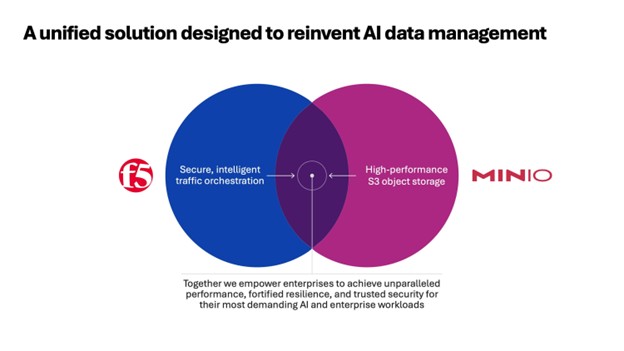
The expanded F5 and MinIO partnership brings together MinIO AIStor’s high-performance, highly-scalable, S3-compatible object storage with the secure, intelligent traffic management of the F5 Application Delivery and Security Platform (ADSP). This joint solution delivers a comprehensive, secure and scalable foundation for AI workloads, enabling businesses to achieve optimized data management, strengthened security and flexible migration across cloud, on-premises and hybrid environments.

F5 and MinIO offer a joint solution designed to enhance performance, resilience and security for customers’ most demanding AI and enterprise workloads.

Understanding S3 and its importance for scalable data management

Simple Storage Service (S3) is the standard protocol for modern object storage, fully supported by AIStor and a key component of today’s data architectures. Unlike traditional storage, S3 stores data as discrete objects in logical containers called buckets, paired with metadata for efficient organization and retrieval, which is critical for AI workloads.

Operating over HTTP/S, S3 is ideal for scalability, distributed deployments and seamless cloud integration. It’s widely used in data lakes, archives, media repositories, static websites, backups and especially AI and machine learning pipelines, making S3-compatible storage a strategic business investment. Because S3 leverages HTTP/S as its transport protocol, businesses can directly benefit from F5’s deep expertise and apply its industry-leading Layer 4-7 capabilities to S3 storage traffic.

Optimizing storage traffic with F5 BIG-IP for MinIO AIStor

As organizations utilize real-time and large-scale data for AI and enterprise workloads, efficient traffic management is critical. Powered by F5 ADSP, F5 BIG-IP’s intelligent load balancing technologies (e.g., LTM and DNS) prevent storage bottlenecks by distributing queries and traffic evenly, reducing latency, eliminating hotspots and enabling consistent scalability.

BIG-IP also provides robust delivery and security for S3 storage traffic:

  • Protect against HTTP/S-based threats with an advanced web application firewall (WAF) to safeguard critical business data and minimize risks.
  • Defend against DDoS attacks to maximize availability and ensure continuous uptime.
  • Offload SSL/TLS encryption to optimize security without impacting MinIO performance.

Across cloud, on-premises or hybrid deployments, F5 and MinIO’s unified approach simplifies management, ensuring consistent performance and security.

Simplifying cloud-to-on-premises migration: The repatriation advantage

Businesses are increasingly moving workloads from public clouds back on-premises due to rising costs, compliance demands, data sovereignty and performance predictability. This cloud-to-on-prem repatriation often requires significant application refactoring and architectural changes.

F5 BIG-IP and MinIO AIStor simplify this transition: AIStor’s consistent S3-compatible API enables applications to migrate smoothly, while BIG-IP intelligently orchestrates incremental traffic shifts through DNS routing, allowing for phased, disruption-free migrations with minimal adjustments.

Extending strategic advantage across industries

From managing autonomous vehicle training data to powering healthcare analytics and financial compliance, the flexibility of the F5 and MinIO solution translates into a clear competitive advantage for organizations across industries.

For example, a major global automotive manufacturer is using the joint solution provided by F5 and MinIO to securely and reliably deliver and manage proprietary data from its vehicle fleets worldwide to AI factories. This enables continuous improvements to their AI models, providing significant business advantages. This powerful solution has enabled the manufacturer to save millions of dollars annually by repatriating the data from the public cloud. It has also reduced downtime, enhanced reliability, maximized ROI on AI infrastructure and ensured secure management of exascale data. These benefits have empowered the automotive manufacturer to boost innovation and maintain a strong competitive edge.

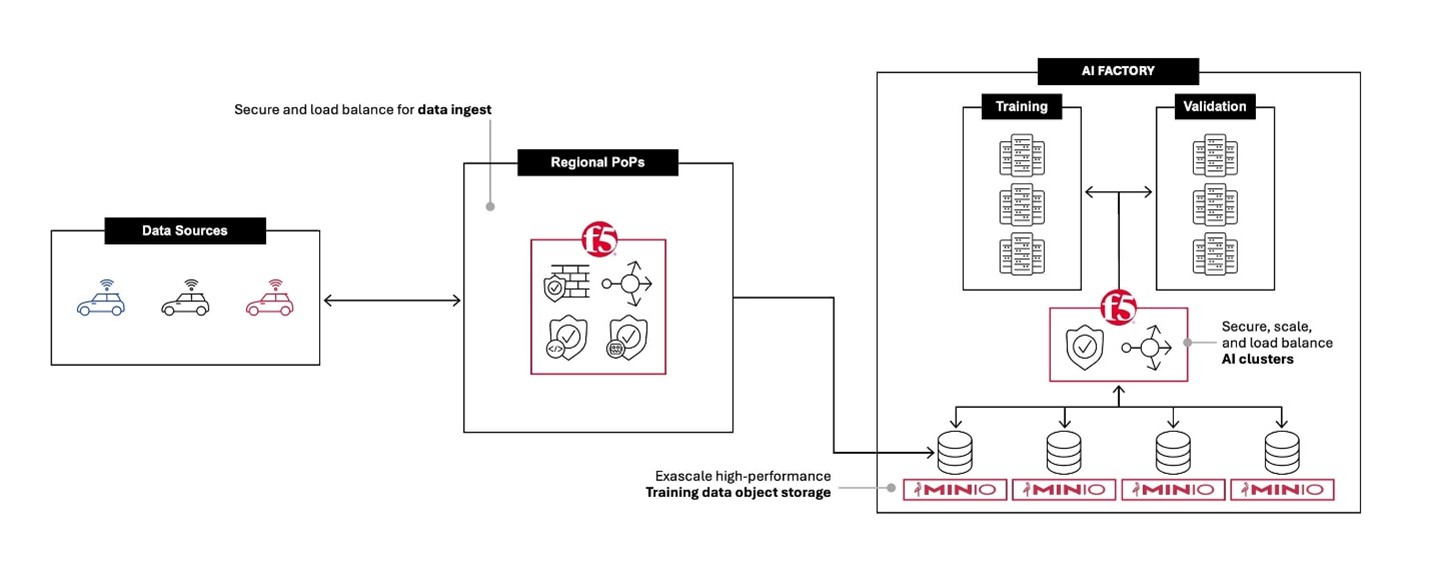
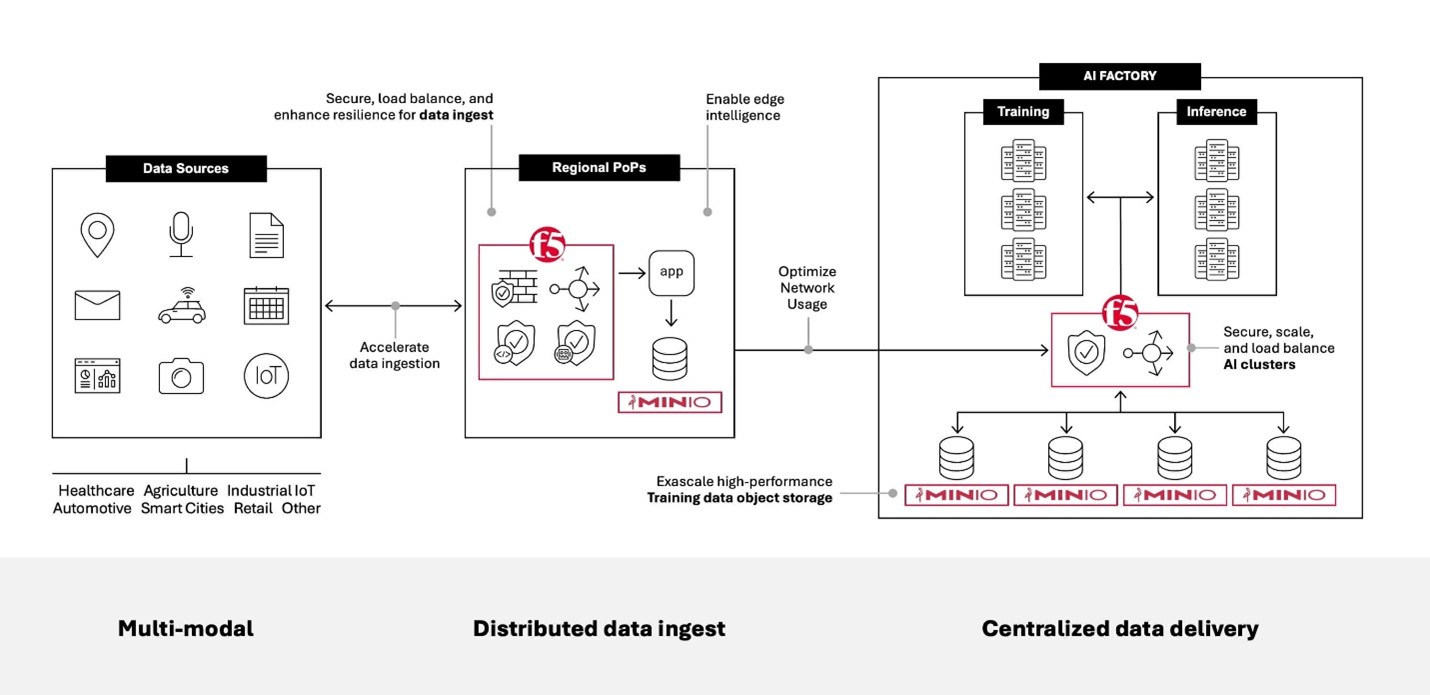
F5’s secure traffic management capabilities collect and route vehicle-generated data through F5-powered regional points of presence (PoPs), delivering it seamlessly into a centralized data lake powered by MinIO AIStor. MinIO’s high-performance object storage solution forms the essential foundation for training AI models. Once models are trained and validated, they are delivered securely back to vehicle systems, with every step of the cycle delivered and protected by F5 infrastructure.

A global automotive manufacturer is using the joint solution from F5 and MinIO to securely route AI data across its systems, ensuring rapid processing and uninterrupted availability.

This large-scale deployment illustrates the significant advantage organizations in other industries can gain when adopting the joint approach of F5 and MinIO. For example, healthcare providers use secure, high-performance storage to enhance predictive analytics and medical imaging, improving patient outcomes through rapid, reliable data access. Financial institutions leverage BIG-IP’s security and MinIO’s security and scalability for compliant storage of large amounts of sensitive data, enabling AI-driven fraud detection and risk management. And companies with edge computing deployments count on F5 and MinIO for secure, low-latency data processing and storage—critical for IoT and smart industry use cases.

In short, F5 and MinIO together bring exceptional security, scalability and straightforward repatriation capabilities to virtually any industry looking for transformative data management strategies.

F5 and MinIO provide resilient, secure and scalable Al data delivery for any industry.

Next steps: Unlocking strategic agility with F5 and MinIO

In today’s dynamic business environments, gaining a strategic advantage means confidently navigating the digital transformation landscape. Together, F5 and MinIO provide high-performance, resilient, secure object storage and intelligent traffic orchestration optimized for today’s most ambitious AI projects and mission-critical data workloads across many industries.

Carahsoft Technology Corp. is The Trusted Government IT Solutions Provider, supporting Public Sector organizations across Federal, State and Local Government agencies and Education and Healthcare markets. As the Master Government Aggregator for our vendor partners, including F5 we deliver solutions for Geospatial, Cybersecurity, MultiCloud, DevSecOps, Artificial Intelligence, Customer Experience and Engagement, Open Source and more. Working with resellers, systems integrators and consultants, our sales and marketing teams provide industry leading IT products, services and training through hundreds of contract vehicles. Explore the Carahsoft Blog to learn more about the latest trends in Government technology markets and solutions, as well as Carahsoft’s ecosystem of partner thought-leaders.
This post originally appeared on F5.com, and is re-published with permission.