Transitioning Towards a Sustainable Healthcare Mindset at DHITS 2023

Since the Defense Health Agency (DHA) oversees the entire military health system, it knows how important it is for members of the military and their doctors to be able to access medical records quickly and universally. In August 2023, the DHA hosted the Defense Health Information Technology Symposium (DHITS) where military health system (MHS) stakeholders discussed its newest asset– the Military Health System (MHS) Genesis. With the creation of this universal health record database, military members’ health records can easily be accessed, whether they are active-duty or not. Currently being rolled out in waves, the MHS Genesis plans to expand health records accessibility between different military branches.

Benefits from MHS Genesis

While still new, the MHS Genesis already shows improvements in several areas which include:

  • Enterprise and Cultural Interoperability: Some doctors may have different views or standards than others. This universal system makes patient files easily accessible to any doctor, regardless of military branch or practice. Now, the IT systems and Electronic Health Records (EHR) work together seamlessly. Different military branches will be able to use the same uniform system when it comes to accessing patient files and records, making the job easier for both patients and doctors.
  • Patient-Centric Care: With the MHS Genesis technology enhancements, it is now easier than ever to meet patients at their home on a Tuesday through telehealth. Telehealth is especially important within the military to give patients flexibility in choosing appointments as well as requesting information or gaining access to their medical records.
  • System and Process Automation: Medical professionals struggle with the global constraint of time. The MHS enables providers to automate tasks, saving time on things like paperwork and allowing for more one-on-one patient care.

Carahsoft Healthcare at DHITS Tradeshow Blog Embedded Image 2023Next Steps for the MHS

Currently, the entire DoD is at an 86% implementation rate for the MHS Genesis. It is actively being used in all DHA locations in the U.S. with plans to incorporate the universal health record system into the remaining treatment facilities outside of the United States by the end of 2023.

As leaders within the MHS continue their journey into modernization and sustainability, it is important that they equip people with the right knowledge and skills to be able to deliver their future vision of what military medicine should look like. The number one purpose of this emerging technology is to ensure the medical readiness of the military. The MHS Genesis will help guarantee that this stays a top priority, as it creates better access to information and helps deliver that information to the decision makers. Using Artificial Intelligence (AI) in medical settings is an exciting development that will help with diagnosing, personal assistants, risk analysis, forecasting and more. Through AI support, doctors will be able to spend more time on their patients and less time on large amounts of paperwork.

While the implementation of the MHS Genesis has been a success, all branches of the DoD must continue to communicate and collaborate openly and effectively. They must also involve other stakeholders by breaking down data silos and sharing freely what does and does not work in an enterprise setting. This will ultimately help with addressing public health challenges, ethically using AI in a medical setting, cybersecurity and more.

The MHS journey coincides with changing the deployment approach to a “sustainment” mentality. A sustainment mindset involves focusing on:

  • Optimization of user experience: Seeking feedback and continuing to adjust the technology to enhance user experience
  • Scalability: Scaling the success and implementing the changes across the enterprise if success is found with one configuration setup
  • Standardization: Creating a standard vocabulary and process for enterprise usage, so people communicate with the same terminology across the MHS

At the end of the day, the most important thing is that patients receive the care they need. Through the MHS Genesis and the IT solutions discussed at DHITS, the MHS hopes to greatly boost patient experiences, increase trust in the military health system, reduce healthcare provider burnout and give patients and clinicians access to data in real-time.


Visit Carahsoft’s Department of Defense and Healthcare solutions portfolios to learn more about DHITS 2023 and how Carahsoft can support your organization in these critical marketplaces.

*The information contained in this blog has been written based off the thought-leadership discussions presented by speakers at DHITS 2023.*

Make Invisible Talent Visible

With strengthening and empowering the Federal workforce as a key tenant of the President’s Management Agenda, the critical need for people with cybersecurity skills and an aging workforce, now is the time for government to re-evaluate how it looks at the skills of employees. Moving to a data-driven talent strategy allows agencies to match the right people to the right work at the right time which also enhances that employee’s experience and engagement with their work.

Progression not Promotion

The first step is realizing that skills are not a title. For too long, career success has meant moving up GS levels or in title. A change in title does not necessarily mean being exposed to new experiences, gaining new skills or even gaining responsibility. The growth that comes with new challenges is what keeps employees fulfilled. That can happen when employees move into positions across an organization. Sideways needs to be the new up – not just for the growth of employees but for the mission achievement of government.

ServiceNow Federal Workforce Talent Blog Embedded Image 2023Keep Talent in Government

People enter public service because they have a tie to the mission. They want to work for that organization with a line of sight toward that mission. They do not leave because they stopped believing in the mission, they leave because they have not been given an opportunity to grow and develop. Research shows that one third of millennials and Gen Z workers leave a job because they did not see an opportunity to grow their career.

Talent sharing across agencies is a concept whose time has come. Government employees need to see career path options outside of their current organization. Where can their skills make an impact in another office or agency? Seeing a growth path will keep the talent within the government ecosystem rather than losing them to good commercial companies.

Diversify the Workforce You Already Have

A data-driven approach can go a long way in driving out bias and growing equity. Across government there are many opportunities for people to get involved in steering committees, pop-up projects and short-term initiatives. However, getting involved requires employees to be informed. We assume that people will seek out these opportunities. Employees only network with people they know – this limits what they are exposed to. Employees miss opportunities every day that are tailor made for their skills and career goals.

A data-driven approach automates the ability to engage. Opportunities can be pushed to employees that meet specific skills and capability criteria. Those employees can then engage with the opportunity through a digital workflow allowing them to quickly and easily break into a new network within the organization. No longer are we dependent on who we know. Now technology becomes a proactive, enabling force in finding the best fit based on skills, not position or education.

Personalize the Journey

Studies show that 94% of employees will stay with an organization longer if they feel it is invested in them. Providing a dynamic career path backed by training and mentoring opportunities is a way to demonstrate commitment to an employee.

A one size fits all training program ends up fitting no one. Employees have come to expect a personalized experience from all of the brands they interact with – whether that is music or movie recommendations or reminders to order more toilet paper. Data-driven organizations can offer that same experience by feeding employees programs and trainings that people actually want to participate in and learn from.

For organizations, knowing the growth areas for employees allows for more targeted efforts in offering reskilling and upskilling opportunities to the people who will most quickly benefit from the training.


ServiceNow is proud to support organizations ready to make the leap to a data-driven skills-based model. Our recent webinar showed how to move away from spreadsheets and emails and begin managing skills in an automated way that works for everyone – HR, agency leaders, supervisors and employees. View the full session here to learn how to transform how you hire, reward and grow your team.  

Okta and ServiceNow: Modernizing Public Sector Operations

Federal, state, and local agencies and educational institutions are facing a surge in targeted cyberattacks. With increasing return-to-office mandates, they face further challenges balancing security with the need to deliver frictionless experiences for users and systems, both within and beyond the premises of agencies and campuses. Public sector organizations can lean further on industry partners to help them modernize operations to improve cybersecurity, support distributed workforces and users, remain compliant with audit and policy mandates, and, ultimately, better serve the public.

Roadblocks to Modernization

To modernize operations, agencies and institutions need to transition from legacy systems to cloud-based tools. Creating collaborative, seamless, and secure work environments that not only attract and retain top talent but also comply with key audit and policy mandates is necessary.

But building this kind of robust environment that can securely support mission-critical work isn’t easy.

Okta ServiceNow Modernizing Public Sector Operations Blog Embedded Image 2023

For one, as the public sector implements cloud-based tools that deliver modern, continuous digital services, they must also ensure the new technology works seamlessly alongside existing processes. And securing work environments both in-office and remotely has never been more challenging, with a 40% increase in cyberattacks against government and public service organizations from Q2 2023 to Q3 2023. Unfortunately, busy IT teams’ resources are too often spent completing manual work instead of implementing changes needed to focus on the high-value work that propels their missions.

How Okta and ServiceNow Solutions Help With Modernization and Automation

Okta and ServiceNow solutions enable agencies and institutions to overcome these obstacles by providing tools that enhance security, modernize operations, comply with strategic policies, and improve service delivery to meet critical mission goals.

Together, Okta and ServiceNow help with:

  • Identity and access management: A centralized Identity solution offers a complete view of users and phishing-resistant authentication to protect accounts from cyberattacks and least-privilege access. This gives users just the right access at the right time for the right purposes.
  • User lifecycle and workflow automation: Advanced algorithms and customizable templates streamline onboarding and offboarding for IT teams, reducing time-consuming work, eliminating manual, repetitive tasks, and increasing productivity.
  • Compliance and policy oversight: Detailed logs and refined reporting capabilities perform automated compliance checks, and policy enforcement mechanisms help reduce the risk of non-compliance.
  • No-code automation: No-code/low-code automation enables IT teams to quickly launch modern services while still adhering to Zero Trust integrations.
  • Risk management and monitoring: Advanced analytics and real-time reporting enable continuous visibility of all systems, improving service availability and accelerating incident response that can better protect the sensitive information of public sector organizations.
  • System integration: API management and middleware tools enable seamless integration with automated data exchange to improve communication and reduce errors.

Why Okta and ServiceNow are Better Together

These solutions combine ServiceNow’s expertise in policy and compliance management and internal and vendor risk management with Okta’s expertise in Identity and access management, such as single sign-on (SSO) and multi-factor authentication (MFA).

More specifically, with a rich, bidirectional integration, Okta and ServiceNow work seamlessly together, empowering public sector organizations to modernize and automate their services to support their evolving missions with:

  • Okta Integration Network (OIN)
  • ServiceNow Security Incident Module
  • StateRAMP Ready authorization
  • FedRAMP High authorization
  • Department of Defense Impact Level (IL) 4 and IL5 workloads

Contact our team today to learn more about about how, together, Okta and ServiceNow provide the public sector with an open, future-ready platform to automate, secure, orchestrate, and simplify their workflows.

People Plus Technology: Building a Resilient Federal Cyber Workforce

Filling cyber jobs in Federal agencies is complicated – it requires competing with industry salaries, retaining existing talent and navigating the Federal hiring process. It’s a far-reaching challenge that affects every agency – the administration knows that, the Office of Personnel Management knows that, and agency technology and human resources leaders know that. And federal C suite leaders realize how the government recruits, hires and retains people for cyber jobs has to change. In partnership with FNN, our Federal Cyber Workforce guide takes a look at what the government is doing to tackle this problem on a sweeping federal level and also on a more agency-specific level. We also get industry perspective on the technologies that affect cyber workforce resiliency. We hope it provides some guidance and help as your agency works to beef up its cybersecurity, both through investments in people and technology.


Carahsoft IIG FNN July Cyber Workforce Blog Embedded Image 20233 Key Rallying Points for a Resilient Cybersecurity Team
“Agencies are currently operating in a high-threat environment, but that doesn’t mean they can’t implement a reasonable amount of information assurance. It may not be perfect, but it doesn’t have to be. The idea is to make it so that adversaries have to work extremely hard to penetrate the infrastructure. The adversaries are good, but agencies can be better with a resilient cybersecurity team, said Mark Bowling, chief risk, security and information security officer for ExtraHop. The key to achieving this is to have a risk reduction perspective.”

Read more insights from Mark Bowling, Chief Risk, Security and Information Security Officer at ExtraHop.


Do not Wait for a Breach: Why to Adopt Proactive Approach to Cyber Resilience

“When most people talk about cyber resilience, they’re referring to post-breach recovery — the means, methods and speed with which an organization can get its systems and services back online after a cyber incident. But Felipe Fernandez, federal chief technology officer at Fortinet, views resiliency more holistically. His advice? Agencies need to take a proactive stance on cyber resilience and include not only recovery from breaches but also when their planning for non-malicious threats and other operational disruptions, including those associated with cloud-based services.”

Read more insights from Felipe Fernandez, Federal Chief Technology Officer at Fortinet.


Proactively Improve Digital Employee Experience Though Automation

“Digital modernization and the adoption of collaboration tools is supposed to make work easier, especially in a hybrid environment. Employees want the flexibility to be productive in whatever manner best suits them. Unresolved technology issues can impede productivity. In its latest survey of industry employees and IT professionals, Ivanti found that 49% of employees are frustrated with the tools they use and 26% are considering leaving their jobs because of that. Employee experience is a top priority in government right now, and employees are internal customers of an agency’s IT services. By improving their experience your agency can realize gains in productivity and retention.”

Read more insights from Mareike Fondufe, Product Marketing Director at Ivanti.


Download the full Expert Edition for more insights from these cyber workforce leaders and additional government interviews, historical perspectives and industry research.

5 Essential Applications of AI Technology in Education

When growing up and sitting through math class, students often heard teachers say that students should not rely on a calculator to do their math for them. After all, they would never have a calculator in their pockets. Today, that statement could not be farther from the truth. Now, many students have an entire computer in their pockets with a calculator just a click of a button away. The growth of artificial intelligence (AI) has increased exponentially within the last few decades, and students and educators alike must embrace the latest in AI and education technology to keep up with the pace.

Carahsoft AI in EdTech Blog Embedded Image 2023In all learning environments, students and teachers rely on modern technologies to enhance their experiences to be as informational, productive and efficient as possible. In recent years, hybrid learning and collaborative digital spaces became essential components of education for both K-12 and higher education organizations. With this development, education technology has evolved and expanded to include new and more advanced AI systems inside and outside the classroom.
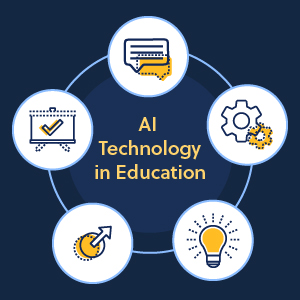
The needs of students are always changing, and educators must constantly adapt to progressive ways of teaching and learn different technologies or platforms that can assist with their daily lessons. With the implementation of AI and numerous benefits of digital learning, all students and instructors can achieve a more wholistic and innovative education. These five topics demonstrate how AI is an essential tool in the learning process for various types of learners across K-12 and higher education.

  • Communication

Carahsoft AI in EdTech Blog Icon 5 Image 2023Innovative trends in education technology have made it possible for students and staff to stay connected, whether through remote online learning or collaborative learning in the classroom. AI tools like SMS bots, predictive technology and ChatGPT can assist students in tasks such as navigating their school’s learning platforms, researching and preparing information for assignments and getting real-time answers to their questions. AI can also help teachers and professors orchestrate discussion points between students and guide next steps within small group collaborative projects.[1]
  • Automation

Carahsoft AI in EdTech Blog Icon 4 Image 2023For teachers, implementing AI can help automate repetitive daily tasks like grading tests and quizzes, and catching minor mistakes within written essays. This way they have more freedom and time to focus on in-depth feedback, creating comprehensive lesson plans and spending one-on-one time with their students. Additionally, AI tools can give students instant feedback on their work, allowing them to be more independent in identifying inaccuracies and recognizing successful projects.[2]

  • Immersive Learning

Carahsoft AI in EdTech Blog Icon 3 Image 2023Augmented reality (AR) and virtual reality (VR) are becoming increasingly more popular in students’ everyday lives, so using these technologies as a learning tool is familiar and compelling for them to gain valuable experiences in the classroom. Immersive technologies can simulate real-world scenarios for students to gain hands-on experience with low risk, like medical simulations and technical experiments. It also can allow students to break the barrier between their physical space and complex concepts like observing the planets up close or enlarging and examining something microscopic.[3] Not only do AR and VR create expansive opportunities for students to view and understand concepts in new and captivating ways, but they also create an additional, interactive and collaborative avenue of learning for students who may not be as responsive to traditional tools like textbooks and study guides.[4]
  • Data-Driven Results

Carahsoft AI in EdTech Blog Icon 1 Image 2023Throughout a student’s education, data is continually collected to better understand and predict their developing needs and most effective learning strategies. AI technologies can quickly and automatically analyze and report on this data, allowing teachers and professors to evaluate trends in an individual student’s or an entire class’s performance. Empowered with this knowledge, educators can tailor their lesson plans and take a more proactive approach to supporting students’ needs, ultimately increasing academic improvement for all.[5]

  • Personalized Learning

Carahsoft AI in EdTech Blog Icon 2 Image 2023Student’s learning styles can vary depending on many factors. For example, some students learn best through more visual and interactive experiences, while others may learn best through memorization and flashcards. Analyzing data collected by AI can help teachers be more informed and prepared educators for different kinds of learners. By applying the insights gathered from AI algorithms, educators can create personalized tracks for individual students, including aspects like adjusting the types of content, working with their comfortability, tailoring to their pace of learning and understanding their comprehension of learning objectives.[6] Additionally, AI technologies can help teachers plan, schedule and produce suggested lesson ideas more efficiently so they can target instruction and reduce the time it takes to create activities that best support each student.[5]

As AI becomes more common in education, maintaining academic integrity and validity within assignments of any kind will remain top of mind for educators. While earlier AI systems are designed to help students achieve academic success, newer AI systems are intended to empower teachers to optimize the use of artificial intelligence for students and encourage positive, ethical engagement with AI technologies.[7] Fostering trust among educators to cultivate the most prosperous learning environment through the implementation of AI can further personal, social and educational growth for all students.

Explore Carahsoft’s education technology solutions to learn how your organization can work together with our top innovative EdTech vendors to bridge the digital divide and meet the demands of modern education.


Resources:

[1] Office of Ed Tech. “AI and the Future of Teaching and Learning: New Interactions, New Choices.” Medium, https://medium.com/ai-and-the-future-of-teaching-and-learning/ai-and-the-future-of-teaching-and-learning-new-interactions-new-choices-c726bcf03012

[2] Shonubi, Olufemi. “Council Post: AI in the Classroom: Pros, Cons and the Role of Edtech Companies.” https://www.forbes.com/sites/theyec/2023/02/21/ai-in-the-classroom-pros-cons-and-the-role-of-edtech-companies/?sh=2cb4a227feb4

[3] Dick, Ellysse. “The Promise of Immersive Learning: Augmented and Virtual Reality’s Potential in Education.” Information Technology and Innovation Foundation. https://itif.org/publications/2021/08/30/promise-immersive-learning-augmented-and-virtual-reality-potential/

[4] Dani, Vishal. “How Augmented Reality Creates Interactive and Engaging Classrooms.” Kitaboo, https://kitaboo.com/augmented-reality-creates-interactive-and-engaging-classrooms/

[5] Gururaj, Tejasri. “10 Examples of Artificial Intelligence Improving Education.” Interesting Engineering, https://interestingengineering.com/innovation/examples-how-artificial-intelligence-improving-education

[6] Dani, Vishal. “9 Trends in Education Technology That Will Have a Major Impact.” Kitaboo, https://kitaboo.com/trends-in-education-technology/

[7] Office of Ed Tech. “AI and the Future of Teaching and Learning: Engaging Educators.” Medium, https://medium.com/ai-and-the-future-of-teaching-and-learning/ai-and-the-future-of-teaching-and-learning-engaging-educators-141e90c5e29f

Why AppExchange Use Offers Agencies Untapped Opportunity

In our first Insider’s Guide, we’re pulling back the curtain on the world’s largest cloud app marketplace, the Salesforce AppExchange, to offer a look at what it is, how it works and how it can provide value to agencies in extending their investment in the Salesforce platform. With the government’s increased focus on improving service delivery — particularly public-facing services per the presidential administration executive order on customer service — taking advantage of possible software-as-a-service integrations with the Salesforce customer relationship management platform makes logical sense. Download the guide to learn how AppExchange helps organizations increase productivity, eliminate risk and save time.


Nintex DocGen for Document Creation, Automation and Management

“A great example would be voter registration cards. Every year, you need to update it. We make it really easy to go out and maintain it with our solution and not have to go into code to make updates. It becomes easy to create, easy to maintain going forward and not having to spend budget on development cycles or development resources to build these solutions. The alternative is to write and maintain custom Apex code, which requires an advanced skill set and takes more time. This is a faster way to develop it and an easier way to maintain it.”

Read more insights from Steve Witt, Director of Public Sector at Nintex.


IIG FNN AppExchange Blog Embedded Image 2023FormAssembly for Secure Online Forms

“Specifically, we’re the most secure and compliant platform in the entire marketplace. That is how we go to market, that’s what we pride ourselves on: being good stewards of our data, being thought leaders in that space. Government organizations should use us because, doubling down on the security and compliancy, we’re tailored for highly sensitive data. We’re built for that. We hold the distinction of being the only FedRAMP-ready platform on the marketplace in this category. We also hold SOC 2, ISO 27001, PCI DSS and GDPR compliance. And really, what that means for our customers and partners is that we’re experts in this space, and that will mitigate any risk and collecting data for your organization, whether it’s here in the United States or abroad.”

Read more insights from Paul Lazatin, Director of Partnerships at FormAssembly.


WalkMe for No-Code Digital Adoption

“What makes us unique is that we have the ability to overlay on any enterprise application in the tech stack, commercial off-the-shelf (COTS), government off-the-shelf (GOTS) or custom-built. By doing so, we’re able to create better user experiences, drive employee productivity and monitor digital adoption on any enterprise application that’s being deployed out to the federal government, whether those applications are internal to employees or externally facing for taxpayers and constituents.”

Read more insights from Carl Wright, Director of Public Sector of Federal Sales at WalkMe.


Odaseva for Enterprise Data Protection

“Many federal and state organizations have questions that need answers when it comes to managing their Salesforce data. How do Salesforce users archive data that is no longer needed? How do they comply with regulations such as those from the National Institute of Standards and Technology or in the California Consumer Privacy Act? That’s why we at Odaseva consider the data management lifecycle. Odaseva helps organizations comply with the strictest data regulations and guard against data failure — all with precise control on a field-tested platform to scale with ease. And we deliver this with the strongest data security features that exceed the requirements of even the most complex, highly regulated businesses in the world.”

Read more insights from Matt Carstensen, Senior Solutions Engineer at Odaseva.


Conga Apps for Contract and Workflow Management

“Conga offers a flexible platform and set of solutions built natively on top of Salesforce that address a broad set of needs for federal, state and local government entities. Our products include Composer, the number one downloaded application on Salesforce’s AppExchange. Conga Composer allows public sector customers to automate document generation to get work done faster and easier in Salesforce. Users can create documents with dynamic data from Salesforce in the correct template, then send it, store it and trigger the next business process. Conga Sign is a modern and highly secure e-signature solution. We now offer a FedRAMP-certified version of our e-signature solution, which is getting quite a bit of attention.”

Read more insights from Eric Daggett, Vice President of Sales for Public Sector at Conga.


Download the full Insider’s Guide for more insights from these AppExchange leaders and additional interviews, research and infographics.


AvePoint Adds Governance, Management, Data Protection and Migration Support for Microsoft Power Platform

Carahsoft partner AvePoint Public Sector recently announced its support for the governance, management, migration and data protection of Microsoft Power Platform environments. As more organizations adopt Power Platform to automate processes, build digital solutions, analyze data and create virtual agents, IT leaders need strategies that support their unique governance, security and compliance requirements.

AvePoint’s support for Power Platform helps organizations:

  • Provide scalable management and governance: Access management and risk assessments allow organizations to quickly drive impactful collaboration and sustainable Power Platform adoption. Best practices and productivity can be achieved through automated governance and policies, enforcing proper control of data access and functionality.
  • Protect critical workspaces, apps and flows: AvePoint’s automated backup for Power BI workspaces, Power Apps and flows makes it seamless to avoid accidental data deletion, user error or ransomware. This way, organizations can ensure they’re protected, compliant and prepared for business continuity when using Power Platform.
  • Seamlessly migrate data: Building on AvePoint’s award-winning migration capabilities, organizations can now migrate apps from an environment within the same tenant or between tenants – giving organizations more opportunities to successfully use Power Platform.
AvePoint and Microsoft Integration Blog Embedded Image 2023

Some organizations are already taking advantage of the AvePoint’s Power Platform support. “AvePoint’s support for Power Platform has helped us empower employees to safely build solutions that will enhance their work,” Mike Fettner, Principal Office 365 Engineering at Regeneron, said. “As an organization, this allows us to continue taking smart risks because we know robust governance solutions will put the right guardrails in place, and data protection will ensure none of our data or workflows are lost.”

Register today to join AvePoint and Microsoft for Power Platform Workshop: A Framework to Manage and Govern Power Platform at Scale, coming to a city near you later this Spring.

Connecting Customers with AvePoint and Industry Solutions

It has never been easier to count on Carahsoft and AvePoint. We can help your agency with:

  • Quick quote turnaround and smart spending
  • Industry-expert cloud computing product recommendations
  • 24/7 live assistance to get you up and running faster

Contact a member of the Carahsoft and AvePoint Public Sector team today and discover how we can support your organization.

3 Ways to Address Developers’ Productivity Concerns

From modernizing software development to creating Zero Trust cybersecurity architectures, the federal government has ambitious plans for 2023. But those plans will only reach fruition by removing the barriers that get in the way of developer productivity.

Government agencies have made great strides to bring IT teams, including developers, closer together over the past few years. For example, they’ve made significant investments in software development factories that are rooted in DevOps cultures. And the Department of Defense clearly recognizes the benefits of collaboration between cybersecurity and development teams, making it a core facet of the agency’s software modernization strategy.

But as a recent Mattermost survey discovered, more must be done to break down communication and collaboration barriers that inhibit developer productivity.

Mattermost Developer Productivity Concerns Blog Embedded Image 2023For Unblocking Workflows: The 2023 Guide to Developer Productivity, 300 software developers were surveyed to find out what’s keeping them from being as productive as possible, and what can be done to accelerate productivity. Their responses showed that although organizations have tried to build more collaborative development cultures, there’s still some work to be done in certain areas.

Let’s dig into some of the challenges—and what you, as a government IT professional, can do to address them.

“Poor communication across teams” is a big productivity challenge

Poor communication practices are the biggest obstacles to productivity and collaboration, with 29% of survey respondents citing “poor communication across teams” as an inhibitor. Their biggest issues are around “lack of process and documentation” (27%) and “lack of clarity around project prioritization” (25%).

General-purpose collaboration platforms that other teams use aren’t helping. Thirty-seven percent of respondents said there are “too many distractions from non-developers” using those tools while 25% said they “don’t fit their workflows well.”

“Information spread across too many tools” (46%) and lack of integration with other tools” (45%) are making it tough to collaborate and find information

Having to work with different tools is also making it difficult for developers to collaborate. Indeed, the developers surveyed said that information silos were among their biggest concerns.

These silos are making it frustrating for developers to find what they need when they need it. Thirty-two percent of respondents said they spend 3 to 5 hours per week hunting down information while 18% spent 6 to 8 hours.

Remote work “somewhat improves collaboration” but continues to be a source of tension among some developers

Remote work might be the norm, but developers aren’t entirely taken with it. Forty-three percent of respondents stated that remote work “somewhat improves collaboration” while 33% believe it makes collaboration worse.

That number is down from our 2021 survey, where more than half of respondents said that remote work was a net gain. The fact that the number has fallen is likely a reflection of the deterioration of communications practices and lack of integration, both of which contribute to poor project clarity.

What government agencies can do to improve developer productivity

Our survey respondents sent a clear message: Give us tools and processes that allow us to collaborate more effectively, break up information silos, and share knowledge easily. There are three things you can do to satisfy these needs.

  1. Invest in software built for developer workflows.

Since open source is easily customizable, it’s simple to integrate different development tools. This will make it easier for developers to share code and resources, manage workflows, and communicate with each other without interference from other teams.

  1. Create a central repository for knowledge sharing.

Having a “single source of truth” that developers can refer to when looking for information can save enormous time. Invest in a repository that pulls information from different teams and tools. Provide developers with greater visibility and access to the information they need to do their jobs more efficiently.

  1. Automate information sharing and workflow management.

Automatically input new information into the repository once it’s received so developers don’t have to look for it. Automate workflow processes, too, by using a system that automatically checks off tasks when they’re done, alerts developers when it’s their time to work on a project, and more. Help your developers spend less time focusing on these tasks and more time building applications.

The success of accelerated investments in software factories and modernization initiatives in 2023 will depend in large part on developers’ abilities to be productive. Right now, there are obstacles getting in the way of that productivity. But you can eliminate those obstacles by improving collaboration and information sharing.


Want to learn more about developers’ productivity concerns and what you can do to address them? Check out Unblocking Workflows: The 2023 Guide to Developer Productivity.