Why Cloud, Why Now? Modernizing federal IT: Why the cloud is becoming the new standard

The shift to Atlassian Government Cloud unlocks new potential for federal agencies

Modernization has been a Federal priority for over a decade, but the realities of legacy systems, compliance mandates and limited resources have forced IT leaders to make hard tradeoffs. The pandemic accelerated digital transformation, proving just how critical resilient, cloud-based systems are to mission continuity and citizen services.

Yet many agencies have remained tethered to on-premises tools not by choice, but by compliance constraints.

Now that Atlassian Government Cloud is FedRAMP Moderate authorized, agencies can confidently shift core collaboration and service delivery workloads to the cloud with security and compliance in place.

The opportunity to modernize is clearer than ever. With compliance barriers removed, cloud adoption becomes not just feasible, but foundational to moving missions forward.

FedRAMP Moderate removes the guesswork

Atlassian Government Cloud is a dedicated environment built specifically for public sector teams and limited to U.S. Government agency and contractor usage. It delivers the performance Federal agencies need, with the security and compliance they require.

This includes:

  • FedRAMP Moderate Authorization for Jira, Confluence and Jira Service Management
  • Dual-region hosting on AWS commercial US East/West regions
  • Continuous monitoring aligned to FedRAMP Moderate standards

Atlassian’s Government cloud platform is built on the same architecture that powers Cloud Enterprise, offering the scale, reliability and control public sector teams need. It’s designed to reduce friction and deliver continuous innovation while maintaining trust and transparency.

From patching systems to powering missions

Agencies that remain on legacy infrastructure are fighting a battle on two fronts: maintaining outdated systems while trying to meet new mission demands. That approach is no longer sustainable.

Modernizing with Atlassian Government Cloud eliminates the distractions of infrastructure maintenance and opens the door to high-impact work. Instead of managing update cycles or responding to fire drills, IT teams can shift their focus to scaling digital services, working with disparate teams and improving citizen-facing outcomes.

For IT administrators, this shift is transformational. Cloud offloads the operational burden they’ve carried for years—manual upgrades, weekend patching, surprise outages. With that weight lifted, teams can focus on enabling smarter service delivery across the agency.

As Jeff Garrett, Technical Product Manager at the California Department of Health Care Services shared, “I’ve had to maintain server infrastructure in the past. It’s not pleasant. Being on Atlassian Cloud Enterprise means we don’t have to do that anymore. Plus, we can add and remove applications quickly.”

This is how mission work moves forward with greater speed, clarity and alignment.

Built-in collaboration, automation, and insight

Atlassian Government Cloud offers more than security and compliance. It enables new ways of working across teams and departments, aligning your entire agency and harnessing your data.

Consider this scenario: A Federal program team launches a new initiative to expand community outreach. Rather than waiting weeks for a custom workflow, they spin up a new Jira project using a pre-built template with no administrator required. HR and legal teams contribute to project planning in Confluence, while real-time insights track progress across departments. No tickets. No silos. Just forward momentum.

The scenario above shows how teams can move faster using features like team-managed projects and templates in Jira, along with native incident management in Jira Service Management.

In addition to streamlining work, Atlassian Government Cloud will soon include Atlassian Analytics, bringing cross-product visibility and supporting data-driven decision-making across teams.

Beyond what’s available in Atlassian Government Cloud today, we’re also committed to delivering the same innovative features you’ll find in our commercial products, like Confluence Whiteboards and Goals. We’re actively developing our roadmap for Atlassian Government Cloud and will share more information soon.

Migration isn’t a barrier. It’s a supported journey

Atlassian has helped thousands of organizations transition to the cloud, including some of the world’s largest enterprises and Government agencies. We have reliable tooling for migrating data from Data Center to Atlassian Government Cloud that has been hardened through years of supporting migrations to commercial cloud. And for those migrating from commercial cloud to AGC, we’re releasing tooling for this soon.

Federal teams benefit from specialized migration support designed to streamline the process and minimize risk. That includes:

  • A Cloud Migration Manager assigned to each Atlassian Government Cloud project
  • Migration guides, training resources and toolkits to support end-user adoption
  • The choice to engage with a network of experienced solution partners if your agency wants even more support.

Agencies already using Atlassian Cloud are seeing measurable results that support faster delivery, smarter governance and stronger collaboration:

  • Utah Department of Technology Services cut Jira project setup time by 90%, enabling faster response to internal and citizen needs
  • California Department of Health Care Services standardized on Atlassian Cloud and reduced one project’s delivery time from 18 months to 6 months, cutting costs from $2.8M to $600K

With Atlassian, cloud migration becomes a guided path to modernization — not an obstacle.

The results are measurable

The shift to Atlassian Government Cloud delivers tangible results. Early adopters, including public sector agencies and private sector enterprises, are already seeing gains in performance, collaboration, and insight.

In a recent customer impact survey, organizations migrating to Atlassian Cloud reported:

  • Up to a 53% increase in productivity
  • 47% improvement in cross-functional collaboration
  • 44% gain in insight-driven decision-making

These outcomes directly support the goals of Federal agencies: improved cross-team collaboration, greater agility and faster progress on mission priorities. In a time when agencies are under pressure to do more with less, results like these make a big impact.

Take the next step

With FedRAMP Moderate authorization in place, Federal agencies can now adopt Atlassian Government Cloud with confidence. It’s time to move from maintaining systems to empowering missions.

Curious about your agency’s migration path to Atlassian Government Cloud? You can become a part of our Early Access Program. Join the waitlist here!

Carahsoft Technology Corp. is The Trusted Government IT Solutions Provider, supporting Public Sector organizations across Federal, State and Local Government agencies and Education and Healthcare markets. As the Master Government Aggregator for our vendor partners, including Atlassian we deliver solutions for Geospatial, Cybersecurity, MultiCloud, DevSecOps, Artificial Intelligence, Customer Experience and Engagement, Open Source and more. Working with resellers, systems integrators and consultants, our sales and marketing teams provide industry leading IT products, services and training through hundreds of contract vehicles. Explore the Carahsoft Blog to learn more about the latest trends in Government technology markets and solutions, as well as Carahsoft’s ecosystem of partner thought-leaders.


Vice President for StateRAMP Solutions, Carahsoft: StateRAMP: Recognizing the Importance of Framework Harmonization

StateRAMP builds on the National Institute of Standards and Technology (NIST) Special Publication 800-53 standard, which underpins FedRAMP’s approach to cloud security for Federal agencies by offering a consistent framework for security assessment, authorization and continuous monitoring. Recognizing the need for a similar framework at the State and Local levels, StateRAMP has been developed to tailor these Federal standards to the unique needs of State and Local Governments.  

Key to StateRAMP’s initiative is the focus on framework harmonization, which aligns State and Local regulations with broader Federal and industry standards. This harmonization includes efforts like FedRAMP/TX-RAMP reciprocity and the CJIS task force, making compliance more streamlined. By mapping more compliance frameworks to one another, StateRAMP helps Government agencies and industry players leverage existing work, avoid redundancy and facilitate smoother procurement of secure technologies. Carahsoft supports this mission by partnering with StateRAMP Authorized vendors and engaging in initiatives that promote these harmonization efforts, such as the StateRAMP Cyber Summit and Federal News Networks’ StateRAMP Exchange.  

Developing Framework Harmonization 

CSPs often operate across multiple sectors and industries, each regulated by distinct frameworks such as FedRAMP CJIS, IRS Publication 1075, PCI DSS, FISMA, and HIPPA. Managing compliance across multiple frameworks can lead to redundant processes, inefficiencies and complexity. These challenges have emphasized the need for framework harmonization—aligning various cybersecurity frameworks to create a more cohesive and streamlined process.  

Carahsoft StateRAMP Framework Harmonization Blog Embedded Image 2024

With the FedRAMP transition to the NIST SP 800-53 Rev. 5 requirements in 2023, StateRAMP began working towards harmonization with FedRAMP across all impact levels. Through the StateRAMP Fast Track Program, CSPs pursuing FedRAMP authorization can leverage the same compliance documentation, including Plans of Actions and Milestones (POA&M), System Security Plans (SSP), security controls matrix and Third Party Assessment Organization (3PAO) audits, to achieve StateRAMP authorization.  

Reciprocity between StateRAMP and TX-RAMP has been established to streamline cybersecurity compliance for CSPs working with Texas state agencies, higher education institutions and public community colleges. CSPs that achieve a StateRAMP Ready or Authorized status are eligible to attain TX-RAMP certification at the same impact level through an established process. Additionally, StateRAMP’s Progressing Security Snapshot Program offers a pathway to provisional TX-RAMP certification, enabling CSPs to engage with Texas agencies while working towards StateRAMP compliance. Once CSPs have enrolled in the Snapshot Program or have engaged with a 3PAO to conduct an audit, they are added to the Progressing Product List, a public directory of products and their cybersecurity maturity status. This reciprocity eases the burden of navigating multiple compliance frameworks and certifications.  

Harmonized frameworks enable CSPs to align with the cybersecurity objectives of various organizations while simultaneously addressing a broader range of threats and vulnerabilities, improving overall security. StateRAMP’s focus is to align requirements across the Federal, State, Local and Educational sectors to reduce the cost of development and deployment through a unified set of standards. To ensure the Public and Private Sectors work in alignment, StateRAMP members have access to the same guidance, tools and resources necessary for implementing a harmonized framework. This initiative will streamline the compliance process through a unified approach to cybersecurity that ensures adherence to industry and regulatory requirements. 

The Future of StateRAMP  

StateRAMP has rolled out an overlay to its Moderate Impact Level baseline that maps to Criminal Justice Information Services (CJIS) Security Policy. This overlay is designed to strengthen cloud security in the law enforcement sector, helping assess a product’s potential for CJIS compliance in safeguarding critical information.  

At the 2024 StateRAMP Cyber Summit, Deputy Information Security Officer Jeffrey Campbell from the FBI CJIS addressed the challenges state and local entities face when adopting cloud technologies. He explained that while state constituents frequently asked if they could use FedRAMP for cloud initiatives, the answer was often complicated because FedRAMP alone does not fully meet CJIS requirements. “You can use vendors vetted through FedRAMP, that is going to get you maybe 80% of these requirements. There’s still 20% you’re going to have to do on your own” Campbell noted. He emphasized that, through framework harmonization, StateRAMP can bridge this compliance gap, offering states a viable solution to achieve several parallel security standards.  

Another initiative is the NASPO/StateRAMP Task Force, which was formed to unite procurement officials, cybersecurity experts, Government officials and industry experts together with IT professionals. The task force aims to produce tools and resources for procurement officials nationwide to make the StateRAMP adoption process more streamlined and consistent. 

Though still relatively new, StateRAMP is gaining traction, with 28 participating states as of October 2024. As cyberattacks become more sophisticated, cybersecurity compliance has become a larger point of emphasis at every level of Government to protect sensitive data. StateRAMP is working to bring all stakeholders together to drive toward a common understanding and acceptance of a standardized security standard. StateRAMP’s proactive steps to embrace framework harmonization are helping CSPs and State and Local Governments move towards a more secure digital future. 

To learn more about the advantages the StateRAMP program offers State Governments and technology suppliers watch the Federal News Network’s StateRAMP Exchange, presented by Carahsoft.  

To learn more about framework harmonization and gain valuable insights into others, such as cloud security, risk management and procurement best practices, watch the StateRAMP Cyber Summit, presented by Carahsoft. 

FedRAMP Roadmap 2024-25: Modernization Strategy and its Impact on the Program

Carahsoft represents a wide range of FedRAMP offerings and supports many emerging SaaS ISVs as they create Government mission focused solutions. Our Government customers have leveraged thousands of reuse authorizations across the hundreds of FedRAMP authorized cloud services that Carahsoft sells and supports. With such a substantial record of reuses, FedRAMP could be considered the most cost-effective, time-efficient, and security enhancing program in the history of Government IT.

Carahsoft FedRAMP Roadmap Blog Embedded Image 2024

We are excited by the new FedRAMP roadmap, released by GSA on March 28, 2024. This roadmap introduces strategic initiatives designed to modernize the program. FedRAMP allows agencies to leverage previously completed work and reuse cloud authorizations, offering significant time and cost savings for government and industry alike.

Building on the OMB FedRAMP Draft memo released in October 2023, the FedRAMP Roadmap underscores GSA’s commitment to make the program faster and less expensive for Federal Agencies and Cloud Service Providers (CSPs). This blog post aims to analyze the roadmap’s key initiatives and outline its primary objectives. FedRAMP lays out four clear goals to drive the program forward:

  1. Orienting around the customer experience
  2. Cybersecurity leadership
  3. Scaling a trusted marketplace
  4. Smarter, technology-forward operations

Accelerating FedRAMP Authorization and Deployment

Several initiatives introduced by the PMO are designed to significantly speed up the authorization process for CSPs and enable agencies to deploy advanced technology more rapidly:

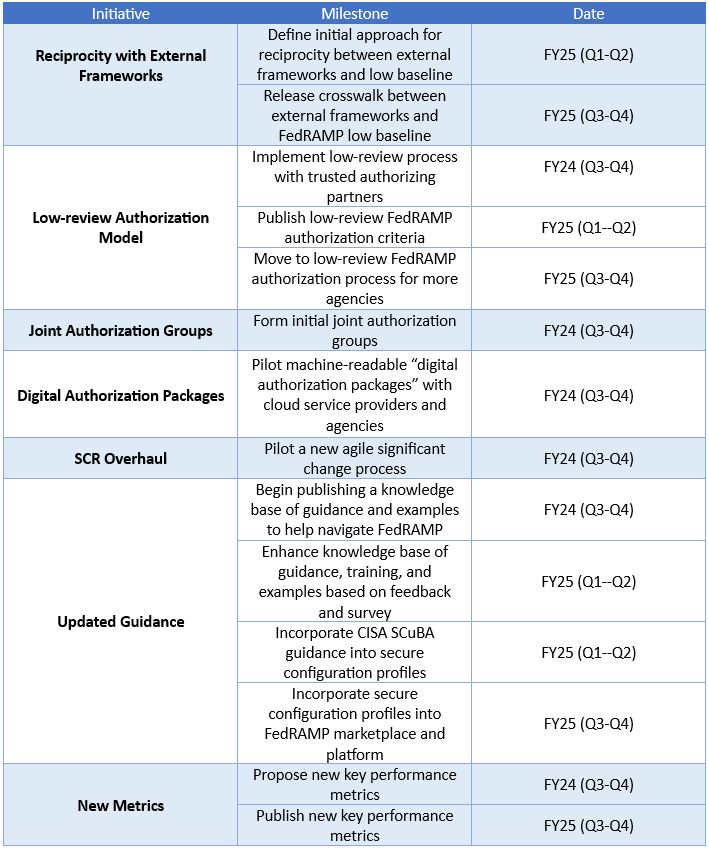
  1. Reciprocity with External Frameworks: Starting with Low-impact SaaS, the roadmap outlines a plan to enhance interoperability across different frameworks. This allows CSPs to reuse previously completed work, reducing the time to achieve FedRAMP authorization.
  2. Low-review Authorization Model: In partnership with DISA, the roadmap pilots a model where trusted agencies undergo a less extensive review process. This approach aims to make the authorization process faster and more efficient for agencies with mature review processes.
  3. Joint Authorization Groups: The FedRAMP PMO, OMB, and the FedRAMP Board are establishing joint authorization groups to promote a unified approach to risk management. This collaboration is expected to reduce the overall risk profile and workload, thereby increasing the chances for a CSP to secure agency sponsorship.
  4. Digital Authorization Packages: The PMO plans to pilot machine-readable packages using OSCAL. These digital packages are designed to speed up the review process by eliminating many of the manual tasks currently required of PMO staff.

These steps are part of a broader effort to make FedRAMP more agile and responsive to the needs to both CSPs and government agencies, ensuring quicker access to secure and industry-leading cloud solutions.

Maintaining a Cutting-Edge Program

Other initiatives laid out in FedRAMP’s 2024-25 roadmap addresses an effort to continuously update and enhance the program:

  1. SCR Overhaul: Replacing the extensive Significant Change Request (SCR) process with a more agile change management system. This adjustment allows for quicker delivery of security updates, better aligning FedRAMP with the rapid iteration cycles typical of commercial tech products. By allowing CSPs to implement iterative product updates, FedRAMP is not only improving its own operational efficiency but also enhancing the security posture of cloud services used throughout the federal government.
  2. Updated Guidance: Refreshing guidelines in critical security areas, including FIPS 140, DNSSEC, and external service integrations. These updates ensure that the program keeps pace with the latest developments in cybersecurity.
  3. New Metrics: To better meet the evolving needs to agencies and CSPs, FedRAMP is introducing new, customer-oriented key performance metrics.

Through these initiatives, FedRAMP is not just maintaining its standards but also enhancing its adaptability, ensuring it continues to set the standard in government cloud security.  

Timeline

Looking Forward

The roadmap marks a clear commitment to modernization. The PMO is confident that this strategic overhaul will alleviate the current review backlog, streamline processes, and optimize service delivery. As we look towards a transformative period for FedRAMP, Carahsoft remains committed to supporting our partners through these changes. Together, we anticipate a future where Government cloud technology is not only secure and compliant but also at the cutting edge of innovation.

To learn more about Carahsoft’s partner marketplace for FedRAMP certified cloud solutions visit our FedRAMP portfolio and speak to a member of our team today.  

Join us for GovForward’s 6th Annual ATO and Cloud Security Summit on Thursday, July 11, 2024 from 8:00 am-4:45 pm in Waldorf Astoria, Washington D.C. Learn more about the event here.

Revitalizing FedRAMP: Navigating the Shift to a Modernized Cloud Security Framework

The Federal Risk and Authorization Management Program (FedRAMP) was created over a decade ago to provide a standardized approach to security assessment, authorization and continuous monitoring for cloud products and service used by Federal agencies. Embracing the dynamic advancements in cloud technology, FedRAMP has recognized the importance of modernizing to keep pace with the rapid developments in the cloud landscape. The Office of Management and Budget (OMB) released a draft memorandum in October 2023 that outlined a comprehensive FedRAMP framework, emphasizing adaptability, automation and cooperation to address evolving cloud service requirements. 

An Opportunity for Modernization 

As technology continues to evolve, so do the advancement opportunities in the realm of cloud security for Federal agencies. With the expansion of cloud offerings and the increasing demand for cloud-based services, FedRAMP is undergoing a significant overhaul to meet the changing landscape. The new OMB FedRAMP guidance will replace the original guidance published in 2011, a year in which the cloud security climate looked drastically different and less complex than today. Changes to address the evolving threat landscape include tools for enterprise collaboration, product development and improving an enterprise’s own cybersecurity. Having already authorized more than 300 authorized services in the FedRAMP Marketplace, FedRAMP recognizes the need to add more solutions for agencies to have all the required capabilities to deliver on their missions.[1]

OMB aims to address these challenges by establishing a plan to scale the program, bolster security reviews of cloud solutions and accelerate Federal adoption. Drew Myklegard, the Deputy Federal CIO, said during CyberTalks, a gathering of the most influential leaders in cybersecurity and digital privacy, “There’s a lot of room in the FedRAMP process with friction and [manual] steps that are causing too long of times from when people identify a product that they need until they can employ it.” [2] 

The New FedRAMP Guidance 

Carahsoft FedRAMP General Overview Blog Embedded Image 2024Automation and Continuous Monitoring (ConMon) stand at the forefront of FedRAMP modernization as the memo underscores the significance of automation and the use of machine-readable formats for authorization and ConMon artifacts. The new guidance will create a system for automating security assessments and reviews, as well as expand on the initiative to obtain FedRAMP security artifacts solely through automated, machine-readable processes. The General Services Administration (GSA) also plans to update ConMon processes within 180 days and exclusively accepting machine-readable artifacts within 18 months.  

By automating security assessments and reviews, FedRAMP is looking to streamline the authorization process, reduce the time and cost of compliance, and improve the accuracy and consistency of security assessments. An added benefit is that automation will help identify and mitigate security risks more quickly and effectively, improving the overall security posture of cloud-based services used by the Federal Government.  

The key changes proposed in the new guidance will: 

  • Reaffirm the presumption of adequacy established in the FedRAMP Authorization Act. This provision establishes that once a CSO achieves FedRAMP Authorization, Federal agencies must presume the offering has adequate security measures for a streamlined reauthorization.  
  • Recognize the transformation of the cloud marketplace and the need for FedRAMP to adjust its processes, originally tailored to a limited number of Infrastructure as a Service (IaaS) solutions, to now accommodate a vast and growing amount of Software as a Service (SaaS) solutions. 
  • Introduce a fast-track authorization program for agencies that have demonstrated mature authorization processes and frequently provide the PMO with high-quality authorization packages. 
  • Propose new authorization types: Joint-Agency and Program authorizations. The Joint Authorization Board (JAB) authorization option is evolving, with all existing JAB authorizations automatically transitioning to Joint-Agency authorizations upon the memorandum’s issuance. Joint-Agency authorizations can pool the resources of any Federal agency to review an authorization package, expanding beyond the DoD, DHS and GSA to include all relevant agencies. 
  • Define the roles and responsibilities of the newly established FedRAMP Board. The FedRAMP Authorization Act empowered OMB to assume a more active and leading role in FedRAMP, and this memo serves as a notable illustration of that increased involvement. 
  • Establish a preliminary “pilot” authorization category allowing agencies to test new cloud services for up to twelve months. This authorization pathway would provide agencies and CSPs with an expedited route to market, accelerating the availability of CSOs. 
  • Streamline authorizations for products that leverage FedRAMP-authorized Infrastructure as a Service (IaaS) and Platform as a Service (PaaS) solutions and for products which have obtained external security frameworks that evaluate relevant risks.  
  • Establish the Technical Advisory Group (TAG) to act as an independent source of Federal Government employees for best practices to enhance the efficiency of FedRAMP’s operations.  

Benefits for Federal Agencies 

By scaling the program, more cloud service providers will be able to obtain FedRAMP authorization, increasing the availability of authorized cloud services for Federal agencies to use. This will enable agencies to more easily and quickly adopt cloud-based services that meet their specific needs. 

Through enhanced security reviews of cloud service offerings, Federal agencies can gain increased confidence in the adherence of the cloud services they utilize to rigorous security standards. Therefore, improving the overall security posture of Federal agencies and reducing the risk of data breaches. 

Streamlining the authorization process and offering a broader range of authorized cloud services can help Federal agencies alleviate the costs and administrative burden linked to duplicative security assessments. Overall, agencies will be able to more efficiently and effectively leverage cloud-based services to support their mission and better serve its citizens.  

The Future of FedRAMP 

Stakeholders are optimistic the new OMB guidance will pave a future for the program that will be more comprehensive, efficient and tailored to the current security environment. As more commercial providers become incentivized to pursue FedRAMP authorization, Federal agencies will have more options when it comes to cloud, and technology vendors will be more suited to achieve FedRAMP authorization success. 

To explore more in-depth insights into the OMB Memo view the Carahsoft Guide to Modernizing the Federal Risk Authorization Management Program (FedRAMP). To learn more about Carahsoft’s partner marketplace for FedRAMP certified cloud solutions visit our FedRAMP portfolio and speak to a member of our team today.  


Resources: 

[1] “Office of Management and Budget Releases Draft Memorandum for Modernizing the Federal Risk and Authorization Management Program (FedRAMP).” The White House, https://www.whitehouse.gov/omb/briefing-room/2023/10/27/office-of-management-and-budget-releases-draft-memorandum-for-modernizing-the-federal-risk-and-authorization-management-program-fedramp/. 

[2] “OMB extends comment period for new FedRAMP guidance.” FedScoop, https://fedscoop.com/omb-extends-comment-period-for-new-fedramp-guidance/ 

Why AppExchange Use Offers Agencies Untapped Opportunity

In our first Insider’s Guide, we’re pulling back the curtain on the world’s largest cloud app marketplace, the Salesforce AppExchange, to offer a look at what it is, how it works and how it can provide value to agencies in extending their investment in the Salesforce platform. With the government’s increased focus on improving service delivery — particularly public-facing services per the presidential administration executive order on customer service — taking advantage of possible software-as-a-service integrations with the Salesforce customer relationship management platform makes logical sense. Download the guide to learn how AppExchange helps organizations increase productivity, eliminate risk and save time.


Nintex DocGen for Document Creation, Automation and Management

“A great example would be voter registration cards. Every year, you need to update it. We make it really easy to go out and maintain it with our solution and not have to go into code to make updates. It becomes easy to create, easy to maintain going forward and not having to spend budget on development cycles or development resources to build these solutions. The alternative is to write and maintain custom Apex code, which requires an advanced skill set and takes more time. This is a faster way to develop it and an easier way to maintain it.”

Read more insights from Steve Witt, Director of Public Sector at Nintex.


IIG FNN AppExchange Blog Embedded Image 2023FormAssembly for Secure Online Forms

“Specifically, we’re the most secure and compliant platform in the entire marketplace. That is how we go to market, that’s what we pride ourselves on: being good stewards of our data, being thought leaders in that space. Government organizations should use us because, doubling down on the security and compliancy, we’re tailored for highly sensitive data. We’re built for that. We hold the distinction of being the only FedRAMP-ready platform on the marketplace in this category. We also hold SOC 2, ISO 27001, PCI DSS and GDPR compliance. And really, what that means for our customers and partners is that we’re experts in this space, and that will mitigate any risk and collecting data for your organization, whether it’s here in the United States or abroad.”

Read more insights from Paul Lazatin, Director of Partnerships at FormAssembly.


WalkMe for No-Code Digital Adoption

“What makes us unique is that we have the ability to overlay on any enterprise application in the tech stack, commercial off-the-shelf (COTS), government off-the-shelf (GOTS) or custom-built. By doing so, we’re able to create better user experiences, drive employee productivity and monitor digital adoption on any enterprise application that’s being deployed out to the federal government, whether those applications are internal to employees or externally facing for taxpayers and constituents.”

Read more insights from Carl Wright, Director of Public Sector of Federal Sales at WalkMe.


Odaseva for Enterprise Data Protection

“Many federal and state organizations have questions that need answers when it comes to managing their Salesforce data. How do Salesforce users archive data that is no longer needed? How do they comply with regulations such as those from the National Institute of Standards and Technology or in the California Consumer Privacy Act? That’s why we at Odaseva consider the data management lifecycle. Odaseva helps organizations comply with the strictest data regulations and guard against data failure — all with precise control on a field-tested platform to scale with ease. And we deliver this with the strongest data security features that exceed the requirements of even the most complex, highly regulated businesses in the world.”

Read more insights from Matt Carstensen, Senior Solutions Engineer at Odaseva.


Conga Apps for Contract and Workflow Management

“Conga offers a flexible platform and set of solutions built natively on top of Salesforce that address a broad set of needs for federal, state and local government entities. Our products include Composer, the number one downloaded application on Salesforce’s AppExchange. Conga Composer allows public sector customers to automate document generation to get work done faster and easier in Salesforce. Users can create documents with dynamic data from Salesforce in the correct template, then send it, store it and trigger the next business process. Conga Sign is a modern and highly secure e-signature solution. We now offer a FedRAMP-certified version of our e-signature solution, which is getting quite a bit of attention.”

Read more insights from Eric Daggett, Vice President of Sales for Public Sector at Conga.


Download the full Insider’s Guide for more insights from these AppExchange leaders and additional interviews, research and infographics.