7 Reasons Why Trustwave’s FedRAMP Status is Key for U.S. Vendors

While selling technology or services to the U.S. Federal Government offers a tremendous opportunity, it also involves navigating complex requirements—especially in the area of cybersecurity.

Federal agencies handle sensitive data and demand the highest levels of security assurance.

This is where the Federal Risk and Authorization Management Program (FedRAMP) comes in, acting as the crucial gatekeeper for cloud services used by the Government.

For vendors looking to succeed in the Federal marketplace, partnering with or building upon services from a FedRAMP-authorized provider isn’t just helpful—it’s often essential.

Trustwave has achieved FedRAMP Authorization for its Government Fusion platform (delivering Managed Detection and Response (MDR) and Co-Managed SIEM/SOC services) which makes Trustwave an ideal partner for any U.S. Government vendor, and here’s why:

1. Instant Credibility: The FedRAMP Stamp of Approval

FedRAMP is the standardized, rigorous security framework mandatory for Federal agency cloud deployments. Achieving FedRAMP Authorization is a lengthy, complex and resource-intensive process, demonstrating an exceptional commitment to security.

  • Leveraging Trustwave’s FedRAMP-authorized platform instantly elevates your offering’s credibility. It signals to agencies that the underlying security meets the Government’s stringent standards and is vetted through an exhaustive process. Trustwave is notably the first pure-play MDR provider to achieve this status, adding further weight to its credentials.

2. Enhanced Trust and Credibility

Achieving FedRAMP authorization is no small feat. It involves a rigorous evaluation process that includes detailed security assessments and continuous monitoring. Trustwave’s compliance with these standards enhances its credibility and trustworthiness, making it a reliable partner for Government vendors who must adhere to strict security protocols.

Trustwave, 7 Reasons Why Trustwave's FedRAMP Status is Key for US Vendors, blog, embedded image, 2025

3. Meeting Rigorous Federal Security Mandates

FedRAMP isn’t just a checkbox; it ensures robust, ongoing security. Authorization requires continuous monitoring, regular assessments and adherence to strict controls based on NIST standards.

  • Partnering with Trustwave assures agencies that your solution’s security components adhere to these high standards. Furthermore, Trustwave’s authorization, operating within AWS GovCloud and meeting “U.S. eyes only” requirements, directly supports vendors needing to comply with other critical mandates like the Cybersecurity Maturity Model Certification (CMMC) required for the Defense Industrial Base (DIB).

4. Access to a Wider Government Market

Simply put, FedRAMP authorization is often a non-negotiable requirement for Federal cloud contracts. Without it, market access is severely limited.

  • By partnering with Trustwave, you align your solution with a provider that has already unlocked the door to Federal agencies requiring FedRAMP compliance. This accomplishment expands your potential customer base significantly. Trustwave also holds GovRAMP authorization, potentially easing access to State and Local Government markets as well.

5. Leveraging Proven Cybersecurity Expertise

Trustwave’s FedRAMP authorization covers its Government Fusion platform, delivering critical Managed Detection and Response and Co-Managed SOC services operated by cleared U.S. personnel.

  • This means you’re not just getting compliance; you’re gaining the backing of a recognized leader in threat detection, response and managed security. Access to Trustwave’s expertise, including insights from their elite SpiderLabs team, strengthens your overall security posture and value proposition.

6. Continuous Monitoring and Improvement

FedRAMP requires continuous monitoring of security controls and regular updates to address emerging threats. Trustwave’s commitment to ongoing security improvements ensures that Government vendors benefit from the latest advancements in cybersecurity. This proactive approach helps mitigate risks and enhances the overall security posture of Government operations.

7. Support for Cloud Adoption

As Government agencies increasingly adopt cloud technologies, having a FedRAMP-authorized partner like Trustwave is invaluable. Trustwave’s expertise in cloud security helps Government vendors transition to the cloud securely, ensuring compliance with Federal regulations while leveraging the benefits of cloud computing.

In the competitive and security-conscious Federal marketplace, alignment with FedRAMP is critical. Trustwave’s FedRAMP Authorization achievement provides U.S. Government vendors with a powerful advantage.

Partnering with Trustwave offers enhanced credibility, accelerates procurement cycles, ensures compliance with stringent security mandates like FedRAMP and CMMC, broadens market access and leverages world-class cybersecurity services.

For vendors serious about succeeding in the U.S. Public Sector, Trustwave’s FedRAMP status makes them a perfect fit.

To learn more about why partnering with a FedRAMP authorized vendor like Trustwave Government Solutions can help your organization succeed in the Federal marketplace, please visit TGS.

Carahsoft Technology Corp. is The Trusted Government IT Solutions Provider, supporting Public Sector organizations across Federal, State and Local Government agencies and Education and Healthcare markets. As the Master Government Aggregator for our vendor partners, including Trustwave we deliver solutions for Geospatial, Cybersecurity, MultiCloud, DevSecOps, Artificial Intelligence, Customer Experience and Engagement, Open Source and more. Working with resellers, systems integrators and consultants, our sales and marketing teams provide industry leading IT products, services and training through hundreds of contract vehicles. Explore the Carahsoft Blog to learn more about the latest trends in Government technology markets and solutions, as well as Carahsoft’s ecosystem of partner thought-leaders.


Key Insights from Global Cyber Innovation Forum 2025 

The 2025 Global Cyber Innovation Forum served as a premier gathering where cybersecurity’s most pressing challenges meet collaborative solutions.  

Hosted by  Forgepoint Capital, Snowflake, Forescout, Google Cloud and Carahsoft at the Embassy of Canada in Washington, D.C., the Forum brought together a curated audience of influential cyber leaders from across the globe, including industry executives, Government officials, policy leaders, venture capitalists and thought leaders from academia and the non-profit sector.  

This annual event provided a platform for critical discussions on emerging threats, technological innovation and strategic partnerships essential for securing our digital infrastructure. Five key themes stood out throughout the sessions: 

  • National Security Threats with Supply Chain Vulnerabilities 
  • The Rise and Race to AI Dominance 
  • The Edge of Quantum Transformation 
  • Typhoon of Attacks on Critical Infrastructure 
  • Streamlining Cybersecurity Compliance 

National Security Threats with Supply Chain Vulnerabilities 

The digital supply chain, specifically software and applications civilians use, have increasingly become a source of critical national security vulnerabilities. Government officials and industry leaders warn that software and digital platforms sourced from foreign adversaries have reshaped the threat landscape by implanting foreign influence in the U.S. technology ecosystem.  

Technology serves as a funding mechanism for adversaries and comes with a hidden price of mass data collection, making it easier for threat actors to access sensitive information and transform traditional cyberattacks. The lack of transparency in certain nation-states raises concerns on regulatory consequences, potentially giving adversaries a strategic edge in information warfare and creating a blind spot in the global tech supply chain.  

U.S. leaders emphasize the necessity for regulated technology supply chains and accelerated Federal certifications, specifically FedRAMP, to ensure innovation does not come at the cost of national security. 

Rise and Race to AI Dominance 

With the rise of artificial intelligence (AI), data has become the modern form of power. Foreign adversaries are striving to build or gain access to data pipelines to fuel their AI models, bypassing privacy in a way that allows them to train AI models much faster than has been possible in America. The U.S. must counter this by accelerating our own AI model training and innovation, while safeguarding privacy and data integrity.  

Government and industry experts state that AI is being underutilized across U.S. operations. The current administration has streamlined AI usage through Executive Order 14179: Removing Barriers to American Leadership in Artificial Intelligence and Executive Order 14277: Advancing Artificial Intelligence Education for American Youth. Additionally, AI should be deployed when combating advanced cyberattacks and automating routine cybersecurity efforts such as threat detection, incident response and vulnerability identification. 

The Edge of Quantum Transformation 

Emerging technologies such as quantum computing are rapidly approaching mainstream adoption. The massive amount of encrypted data currently stored in secret could be vulnerable to decryption within the next 5 to 10 years. This hovering threat has made the development and deployment of post-quantum cryptography a top priority for the U.S. Government. The race to post-quantum cryptography and quantum computers has not just been an urgency for the U.S. and its allies, but also for adversarial nation-states. 

Typhoon of Attacks on Critical Infrastructure 

Advanced persistent threat (APT) groups such as Salt Typhoon, Volt Typhoon and Flax Typhoon have already infiltrated critical infrastructure systems, often using “living off the land” techniques. These public and well documented attacks are considered digital terrorism, disrupting U.S. critical infrastructure operations and stealing intellectual property.  

In response, the U.S. Government is prioritizing cyber hygiene, secure-by-design and the development of an integrated and robust defense system. Agencies, technology providers and critical infrastructure operators are heavily encouraged to collaborate through information sharing, adoption of emerging technologies and routine threat assessments. The severity of these cyberattacks have increased substantially, highlighting the urgency for a more proactive and coordinated national response from the U.S. Government. 

Streamlining Cybersecurity Compliance 

The current cybersecurity regulatory landscape presents a fragmented maze of overlapping requirements that hinder both innovation and effective security implementation. Government and industry security teams are overwhelmed by conflicting standards across Federal, State and agency-specific frameworks. Organizations must navigate multiple compliance frameworks—FedRAMP, National Institute of Standards and technology (NIST) requirements, Cybersecurity Maturity Model Certification (CMMC) and various state requirements—creating redundant processes that drain resources without enhancing security. 

To address this, industry leaders are advocating for regulatory harmonization initiatives. Federal agencies are working to align various compliance frameworks while updating modernization strategies to build interoperability. By aligning around core standards like NIST 800-53 and implementing automated compliance tools, agencies can reduce complexity while maintaining robust cybersecurity postures. Forum participants agreed: harmonized regulations are essential to enabling secure innovation without compromising oversight. 

The Global Cyber Innovation Forum demonstrated that securing America’s digital future requires unprecedented coordination between Government agencies, private industry and international allies. As adversaries continue exploit emerging technologies, the U.S. must respond with unified strategies that streamline regulations, accelerate innovation and sustain global cyber leadership. The insights shared offer a critical roadmap for defending against tomorrow’s threats in a rapidly evolving digital landscape. 

Visit Carahsoft’s Resource Hub to dive deeper into the key takeaways, expert perspectives and resources from the 2025 Global Cyber Innovation Forum. 

Snyk for Government Achieves FedRAMP Moderate Authorization: A Milestone for Secure Government Software

Today marks a significant milestone for Snyk and, more importantly, for the security posture of the U.S. Government. I’m thrilled to introduce Snyk for Government, our FedRAMP Moderate authorized solution for the Public Sector.  

This authorization underscores our unwavering commitment to providing secure development solutions that meet the rigorous standards of the Federal Risk and Authorization Management Program (FedRAMP). It means that U.S. Government agencies can now confidently leverage Snyk’s comprehensive platform to identify and remediate vulnerabilities throughout their software development lifecycle, knowing it meets the stringent security and compliance requirements mandated by the Federal Government.

This achievement is not just a certification; it’s a testament to our dedication to building trust and ensuring the integrity of the software that powers critical Government functions. It allows agencies to embrace modern development practices, including the use of open source software and cloud-native technologies, with the assurance that security is baked in from the start.

The Power of Proactive Security

At Snyk, we believe that security shouldn’t be an afterthought. It needs to be an integral part of the development process. Our platform empowers developers to find and fix vulnerabilities in their code, dependencies, containers and infrastructure as code – early and often. This proactive approach not only reduces risk but also accelerates development cycles by preventing security issues from becoming costly roadblocks later on.

Snyk for Government offers the same powerful capabilities that our enterprise customers rely on, tailored to the specific needs and compliance requirements of Government agencies based on NIST 800-53v5 security controls. This includes:

  • Comprehensive Vulnerability Detection: Identifying security flaws in open source libraries, proprietary code, containers and infrastructure configurations.
  • Actionable Remediation Advice: Providing clear guidance and automated fixes to address vulnerabilities quickly and efficiently.
  • Policy Enforcement: Enabling organizations to define and enforce security policies across their development teams.
  • Integration with Developer Tools: Seamlessly integrating with popular IDEs, build tools and CI/CD pipelines.
  • Detailed Reporting and Compliance Features: Providing the visibility and documentation needed to meet FedRAMP requirements.

Investing in the Future of Security: The Snyk AI Advantage

At Snyk we recognize the transformative potential of AI in cybersecurity. By leveraging machine learning and advanced algorithms, we are building intelligent capabilities into our platform that will provide even more accurate vulnerability detection, smarter remediation recommendations and enhanced threat intelligence.

AI is accelerating development faster than ever with Snyk you can ensure the code flooding your systems is secure and, beyond development, verify AI-powered apps aren’t creating unmanaged security risks. Ensure your organization stays secure our AI enabled agentic solution:

  • Keep Pace with Development: Learn how to scale security to match AI-generated code’s unprecedented speed and volume.
  • Staying Ahead of New Threat Vectors: Tackle emerging AI threats as apps increasingly leverage LLMs.
  • Adapting Developer Workflows: Explore the evolving role of developers and the skills needed for a new era of AI-assisted coding and building AI-powered apps.
  • Build Upon ApSec Governance: Leverage AppSec governance towards secure AI adoption and risk management.

For U.S. Government agencies, these AI-driven advancements will translate into a more resilient and secure digital infrastructure. For the enterprises that service the Government, integrating Snyk’s AI-powered platform into their development processes will not only help them meet stringent security requirements but also provide a competitive edge by building more secure and reliable solutions.

The FedRAMP Moderate authorization for Snyk for Government is a significant step forward in our mission to empower organizations to build securely. Combined with our ongoing investment in cutting-edge technologies like AI, we are confident that Snyk will continue to be a trusted partner for the U.S. Government and its partners in navigating the evolving landscape of software security.

We are excited about this milestone and look forward to helping Government agencies and their partners build a more secure digital future, together.

Carahsoft Technology Corp. is The Trusted Government IT Solutions Provider, supporting Public Sector organizations across Federal, State and Local Government agencies and Education and Healthcare markets. As the Master Government Aggregator for our vendor partners, including Torq we deliver solutions for Geospatial, Cybersecurity, MultiCloud, DevSecOps, Artificial Intelligence, Customer Experience and Engagement, Open Source and more. Working with resellers, systems integrators and consultants, our sales and marketing teams provide industry leading IT products, services and training through hundreds of contract vehicles. Explore the Carahsoft Blog to learn more about the latest trends in Government technology markets and solutions, as well as Carahsoft’s ecosystem of partner thought-leaders.

Why Cloud, Why Now? Modernizing federal IT: Why the cloud is becoming the new standard

The shift to Atlassian Government Cloud unlocks new potential for federal agencies

Modernization has been a Federal priority for over a decade, but the realities of legacy systems, compliance mandates and limited resources have forced IT leaders to make hard tradeoffs. The pandemic accelerated digital transformation, proving just how critical resilient, cloud-based systems are to mission continuity and citizen services.

Yet many agencies have remained tethered to on-premises tools not by choice, but by compliance constraints.

Now that Atlassian Government Cloud is FedRAMP Moderate authorized, agencies can confidently shift core collaboration and service delivery workloads to the cloud with security and compliance in place.

The opportunity to modernize is clearer than ever. With compliance barriers removed, cloud adoption becomes not just feasible, but foundational to moving missions forward.

FedRAMP Moderate removes the guesswork

Atlassian Government Cloud is a dedicated environment built specifically for public sector teams and limited to U.S. Government agency and contractor usage. It delivers the performance Federal agencies need, with the security and compliance they require.

This includes:

  • FedRAMP Moderate Authorization for Jira, Confluence and Jira Service Management
  • Dual-region hosting on AWS commercial US East/West regions
  • Continuous monitoring aligned to FedRAMP Moderate standards

Atlassian’s Government cloud platform is built on the same architecture that powers Cloud Enterprise, offering the scale, reliability and control public sector teams need. It’s designed to reduce friction and deliver continuous innovation while maintaining trust and transparency.

From patching systems to powering missions

Agencies that remain on legacy infrastructure are fighting a battle on two fronts: maintaining outdated systems while trying to meet new mission demands. That approach is no longer sustainable.

Modernizing with Atlassian Government Cloud eliminates the distractions of infrastructure maintenance and opens the door to high-impact work. Instead of managing update cycles or responding to fire drills, IT teams can shift their focus to scaling digital services, working with disparate teams and improving citizen-facing outcomes.

For IT administrators, this shift is transformational. Cloud offloads the operational burden they’ve carried for years—manual upgrades, weekend patching, surprise outages. With that weight lifted, teams can focus on enabling smarter service delivery across the agency.

As Jeff Garrett, Technical Product Manager at the California Department of Health Care Services shared, “I’ve had to maintain server infrastructure in the past. It’s not pleasant. Being on Atlassian Cloud Enterprise means we don’t have to do that anymore. Plus, we can add and remove applications quickly.”

This is how mission work moves forward with greater speed, clarity and alignment.

Built-in collaboration, automation, and insight

Atlassian Government Cloud offers more than security and compliance. It enables new ways of working across teams and departments, aligning your entire agency and harnessing your data.

Consider this scenario: A Federal program team launches a new initiative to expand community outreach. Rather than waiting weeks for a custom workflow, they spin up a new Jira project using a pre-built template with no administrator required. HR and legal teams contribute to project planning in Confluence, while real-time insights track progress across departments. No tickets. No silos. Just forward momentum.

The scenario above shows how teams can move faster using features like team-managed projects and templates in Jira, along with native incident management in Jira Service Management.

In addition to streamlining work, Atlassian Government Cloud will soon include Atlassian Analytics, bringing cross-product visibility and supporting data-driven decision-making across teams.

Beyond what’s available in Atlassian Government Cloud today, we’re also committed to delivering the same innovative features you’ll find in our commercial products, like Confluence Whiteboards and Goals. We’re actively developing our roadmap for Atlassian Government Cloud and will share more information soon.

Migration isn’t a barrier. It’s a supported journey

Atlassian has helped thousands of organizations transition to the cloud, including some of the world’s largest enterprises and Government agencies. We have reliable tooling for migrating data from Data Center to Atlassian Government Cloud that has been hardened through years of supporting migrations to commercial cloud. And for those migrating from commercial cloud to AGC, we’re releasing tooling for this soon.

Federal teams benefit from specialized migration support designed to streamline the process and minimize risk. That includes:

  • A Cloud Migration Manager assigned to each Atlassian Government Cloud project
  • Migration guides, training resources and toolkits to support end-user adoption
  • The choice to engage with a network of experienced solution partners if your agency wants even more support.

Agencies already using Atlassian Cloud are seeing measurable results that support faster delivery, smarter governance and stronger collaboration:

  • Utah Department of Technology Services cut Jira project setup time by 90%, enabling faster response to internal and citizen needs
  • California Department of Health Care Services standardized on Atlassian Cloud and reduced one project’s delivery time from 18 months to 6 months, cutting costs from $2.8M to $600K

With Atlassian, cloud migration becomes a guided path to modernization — not an obstacle.

The results are measurable

The shift to Atlassian Government Cloud delivers tangible results. Early adopters, including public sector agencies and private sector enterprises, are already seeing gains in performance, collaboration, and insight.

In a recent customer impact survey, organizations migrating to Atlassian Cloud reported:

  • Up to a 53% increase in productivity
  • 47% improvement in cross-functional collaboration
  • 44% gain in insight-driven decision-making

These outcomes directly support the goals of Federal agencies: improved cross-team collaboration, greater agility and faster progress on mission priorities. In a time when agencies are under pressure to do more with less, results like these make a big impact.

Take the next step

With FedRAMP Moderate authorization in place, Federal agencies can now adopt Atlassian Government Cloud with confidence. It’s time to move from maintaining systems to empowering missions.

Curious about your agency’s migration path to Atlassian Government Cloud? You can become a part of our Early Access Program. Join the waitlist here!

Carahsoft Technology Corp. is The Trusted Government IT Solutions Provider, supporting Public Sector organizations across Federal, State and Local Government agencies and Education and Healthcare markets. As the Master Government Aggregator for our vendor partners, including Atlassian we deliver solutions for Geospatial, Cybersecurity, MultiCloud, DevSecOps, Artificial Intelligence, Customer Experience and Engagement, Open Source and more. Working with resellers, systems integrators and consultants, our sales and marketing teams provide industry leading IT products, services and training through hundreds of contract vehicles. Explore the Carahsoft Blog to learn more about the latest trends in Government technology markets and solutions, as well as Carahsoft’s ecosystem of partner thought-leaders.

Vice President for StateRAMP Solutions, Carahsoft: StateRAMP: Recognizing the Importance of Framework Harmonization

StateRAMP builds on the National Institute of Standards and Technology (NIST) Special Publication 800-53 standard, which underpins FedRAMP’s approach to cloud security for Federal agencies by offering a consistent framework for security assessment, authorization and continuous monitoring. Recognizing the need for a similar framework at the State and Local levels, StateRAMP has been developed to tailor these Federal standards to the unique needs of State and Local Governments.  

Key to StateRAMP’s initiative is the focus on framework harmonization, which aligns State and Local regulations with broader Federal and industry standards. This harmonization includes efforts like FedRAMP/TX-RAMP reciprocity and the CJIS task force, making compliance more streamlined. By mapping more compliance frameworks to one another, StateRAMP helps Government agencies and industry players leverage existing work, avoid redundancy and facilitate smoother procurement of secure technologies. Carahsoft supports this mission by partnering with StateRAMP Authorized vendors and engaging in initiatives that promote these harmonization efforts, such as the StateRAMP Cyber Summit and Federal News Networks’ StateRAMP Exchange.  

Developing Framework Harmonization 

CSPs often operate across multiple sectors and industries, each regulated by distinct frameworks such as FedRAMP CJIS, IRS Publication 1075, PCI DSS, FISMA, and HIPPA. Managing compliance across multiple frameworks can lead to redundant processes, inefficiencies and complexity. These challenges have emphasized the need for framework harmonization—aligning various cybersecurity frameworks to create a more cohesive and streamlined process.  

Carahsoft StateRAMP Framework Harmonization Blog Embedded Image 2024

With the FedRAMP transition to the NIST SP 800-53 Rev. 5 requirements in 2023, StateRAMP began working towards harmonization with FedRAMP across all impact levels. Through the StateRAMP Fast Track Program, CSPs pursuing FedRAMP authorization can leverage the same compliance documentation, including Plans of Actions and Milestones (POA&M), System Security Plans (SSP), security controls matrix and Third Party Assessment Organization (3PAO) audits, to achieve StateRAMP authorization.  

Reciprocity between StateRAMP and TX-RAMP has been established to streamline cybersecurity compliance for CSPs working with Texas state agencies, higher education institutions and public community colleges. CSPs that achieve a StateRAMP Ready or Authorized status are eligible to attain TX-RAMP certification at the same impact level through an established process. Additionally, StateRAMP’s Progressing Security Snapshot Program offers a pathway to provisional TX-RAMP certification, enabling CSPs to engage with Texas agencies while working towards StateRAMP compliance. Once CSPs have enrolled in the Snapshot Program or have engaged with a 3PAO to conduct an audit, they are added to the Progressing Product List, a public directory of products and their cybersecurity maturity status. This reciprocity eases the burden of navigating multiple compliance frameworks and certifications.  

Harmonized frameworks enable CSPs to align with the cybersecurity objectives of various organizations while simultaneously addressing a broader range of threats and vulnerabilities, improving overall security. StateRAMP’s focus is to align requirements across the Federal, State, Local and Educational sectors to reduce the cost of development and deployment through a unified set of standards. To ensure the Public and Private Sectors work in alignment, StateRAMP members have access to the same guidance, tools and resources necessary for implementing a harmonized framework. This initiative will streamline the compliance process through a unified approach to cybersecurity that ensures adherence to industry and regulatory requirements. 

The Future of StateRAMP  

StateRAMP has rolled out an overlay to its Moderate Impact Level baseline that maps to Criminal Justice Information Services (CJIS) Security Policy. This overlay is designed to strengthen cloud security in the law enforcement sector, helping assess a product’s potential for CJIS compliance in safeguarding critical information.  

At the 2024 StateRAMP Cyber Summit, Deputy Information Security Officer Jeffrey Campbell from the FBI CJIS addressed the challenges state and local entities face when adopting cloud technologies. He explained that while state constituents frequently asked if they could use FedRAMP for cloud initiatives, the answer was often complicated because FedRAMP alone does not fully meet CJIS requirements. “You can use vendors vetted through FedRAMP, that is going to get you maybe 80% of these requirements. There’s still 20% you’re going to have to do on your own” Campbell noted. He emphasized that, through framework harmonization, StateRAMP can bridge this compliance gap, offering states a viable solution to achieve several parallel security standards.  

Another initiative is the NASPO/StateRAMP Task Force, which was formed to unite procurement officials, cybersecurity experts, Government officials and industry experts together with IT professionals. The task force aims to produce tools and resources for procurement officials nationwide to make the StateRAMP adoption process more streamlined and consistent. 

Though still relatively new, StateRAMP is gaining traction, with 28 participating states as of October 2024. As cyberattacks become more sophisticated, cybersecurity compliance has become a larger point of emphasis at every level of Government to protect sensitive data. StateRAMP is working to bring all stakeholders together to drive toward a common understanding and acceptance of a standardized security standard. StateRAMP’s proactive steps to embrace framework harmonization are helping CSPs and State and Local Governments move towards a more secure digital future. 

To learn more about the advantages the StateRAMP program offers State Governments and technology suppliers watch the Federal News Network’s StateRAMP Exchange, presented by Carahsoft.  

To learn more about framework harmonization and gain valuable insights into others, such as cloud security, risk management and procurement best practices, watch the StateRAMP Cyber Summit, presented by Carahsoft. 

FedRAMP Roadmap 2024-25: Modernization Strategy and its Impact on the Program

Carahsoft represents a wide range of FedRAMP offerings and supports many emerging SaaS ISVs as they create Government mission focused solutions. Our Government customers have leveraged thousands of reuse authorizations across the hundreds of FedRAMP authorized cloud services that Carahsoft sells and supports. With such a substantial record of reuses, FedRAMP could be considered the most cost-effective, time-efficient, and security enhancing program in the history of Government IT.

Carahsoft FedRAMP Roadmap Blog Embedded Image 2024

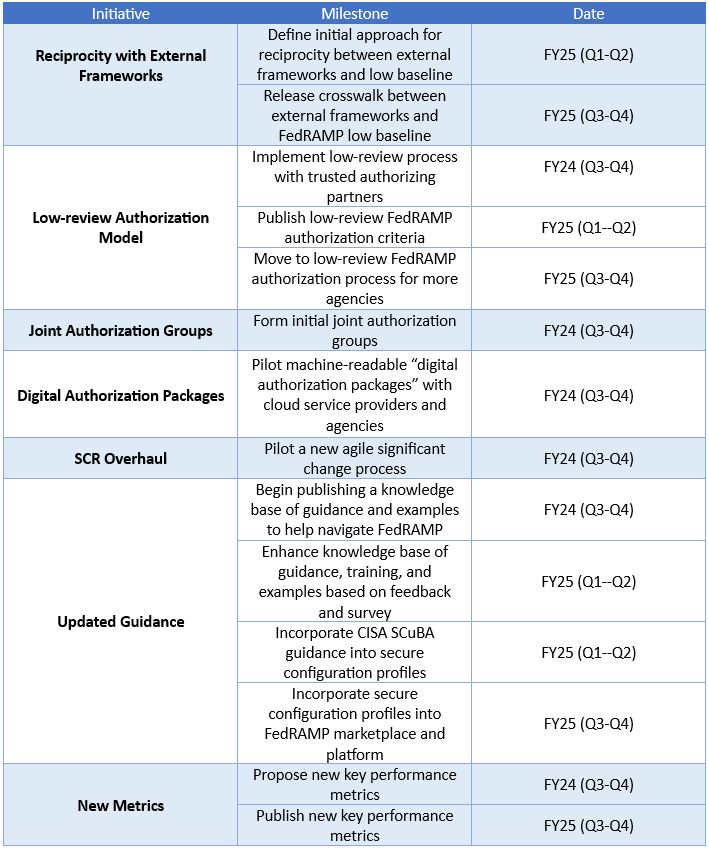
We are excited by the new FedRAMP roadmap, released by GSA on March 28, 2024. This roadmap introduces strategic initiatives designed to modernize the program. FedRAMP allows agencies to leverage previously completed work and reuse cloud authorizations, offering significant time and cost savings for government and industry alike.

Building on the OMB FedRAMP Draft memo released in October 2023, the FedRAMP Roadmap underscores GSA’s commitment to make the program faster and less expensive for Federal Agencies and Cloud Service Providers (CSPs). This blog post aims to analyze the roadmap’s key initiatives and outline its primary objectives. FedRAMP lays out four clear goals to drive the program forward:

  1. Orienting around the customer experience
  2. Cybersecurity leadership
  3. Scaling a trusted marketplace
  4. Smarter, technology-forward operations

Accelerating FedRAMP Authorization and Deployment

Several initiatives introduced by the PMO are designed to significantly speed up the authorization process for CSPs and enable agencies to deploy advanced technology more rapidly:

  1. Reciprocity with External Frameworks: Starting with Low-impact SaaS, the roadmap outlines a plan to enhance interoperability across different frameworks. This allows CSPs to reuse previously completed work, reducing the time to achieve FedRAMP authorization.
  2. Low-review Authorization Model: In partnership with DISA, the roadmap pilots a model where trusted agencies undergo a less extensive review process. This approach aims to make the authorization process faster and more efficient for agencies with mature review processes.
  3. Joint Authorization Groups: The FedRAMP PMO, OMB, and the FedRAMP Board are establishing joint authorization groups to promote a unified approach to risk management. This collaboration is expected to reduce the overall risk profile and workload, thereby increasing the chances for a CSP to secure agency sponsorship.
  4. Digital Authorization Packages: The PMO plans to pilot machine-readable packages using OSCAL. These digital packages are designed to speed up the review process by eliminating many of the manual tasks currently required of PMO staff.

These steps are part of a broader effort to make FedRAMP more agile and responsive to the needs to both CSPs and government agencies, ensuring quicker access to secure and industry-leading cloud solutions.

Maintaining a Cutting-Edge Program

Other initiatives laid out in FedRAMP’s 2024-25 roadmap addresses an effort to continuously update and enhance the program:

  1. SCR Overhaul: Replacing the extensive Significant Change Request (SCR) process with a more agile change management system. This adjustment allows for quicker delivery of security updates, better aligning FedRAMP with the rapid iteration cycles typical of commercial tech products. By allowing CSPs to implement iterative product updates, FedRAMP is not only improving its own operational efficiency but also enhancing the security posture of cloud services used throughout the federal government.
  2. Updated Guidance: Refreshing guidelines in critical security areas, including FIPS 140, DNSSEC, and external service integrations. These updates ensure that the program keeps pace with the latest developments in cybersecurity.
  3. New Metrics: To better meet the evolving needs to agencies and CSPs, FedRAMP is introducing new, customer-oriented key performance metrics.

Through these initiatives, FedRAMP is not just maintaining its standards but also enhancing its adaptability, ensuring it continues to set the standard in government cloud security.  

Timeline

Looking Forward

The roadmap marks a clear commitment to modernization. The PMO is confident that this strategic overhaul will alleviate the current review backlog, streamline processes, and optimize service delivery. As we look towards a transformative period for FedRAMP, Carahsoft remains committed to supporting our partners through these changes. Together, we anticipate a future where Government cloud technology is not only secure and compliant but also at the cutting edge of innovation.

To learn more about Carahsoft’s partner marketplace for FedRAMP certified cloud solutions visit our FedRAMP portfolio and speak to a member of our team today.  

Join us for GovForward’s 6th Annual ATO and Cloud Security Summit on Thursday, July 11, 2024 from 8:00 am-4:45 pm in Waldorf Astoria, Washington D.C. Learn more about the event here.

Revitalizing FedRAMP: Navigating the Shift to a Modernized Cloud Security Framework

The Federal Risk and Authorization Management Program (FedRAMP) was created over a decade ago to provide a standardized approach to security assessment, authorization and continuous monitoring for cloud products and service used by Federal agencies. Embracing the dynamic advancements in cloud technology, FedRAMP has recognized the importance of modernizing to keep pace with the rapid developments in the cloud landscape. The Office of Management and Budget (OMB) released a draft memorandum in October 2023 that outlined a comprehensive FedRAMP framework, emphasizing adaptability, automation and cooperation to address evolving cloud service requirements. 

An Opportunity for Modernization 

As technology continues to evolve, so do the advancement opportunities in the realm of cloud security for Federal agencies. With the expansion of cloud offerings and the increasing demand for cloud-based services, FedRAMP is undergoing a significant overhaul to meet the changing landscape. The new OMB FedRAMP guidance will replace the original guidance published in 2011, a year in which the cloud security climate looked drastically different and less complex than today. Changes to address the evolving threat landscape include tools for enterprise collaboration, product development and improving an enterprise’s own cybersecurity. Having already authorized more than 300 authorized services in the FedRAMP Marketplace, FedRAMP recognizes the need to add more solutions for agencies to have all the required capabilities to deliver on their missions.[1]

OMB aims to address these challenges by establishing a plan to scale the program, bolster security reviews of cloud solutions and accelerate Federal adoption. Drew Myklegard, the Deputy Federal CIO, said during CyberTalks, a gathering of the most influential leaders in cybersecurity and digital privacy, “There’s a lot of room in the FedRAMP process with friction and [manual] steps that are causing too long of times from when people identify a product that they need until they can employ it.” [2] 

The New FedRAMP Guidance 

Carahsoft FedRAMP General Overview Blog Embedded Image 2024Automation and Continuous Monitoring (ConMon) stand at the forefront of FedRAMP modernization as the memo underscores the significance of automation and the use of machine-readable formats for authorization and ConMon artifacts. The new guidance will create a system for automating security assessments and reviews, as well as expand on the initiative to obtain FedRAMP security artifacts solely through automated, machine-readable processes. The General Services Administration (GSA) also plans to update ConMon processes within 180 days and exclusively accepting machine-readable artifacts within 18 months.  

By automating security assessments and reviews, FedRAMP is looking to streamline the authorization process, reduce the time and cost of compliance, and improve the accuracy and consistency of security assessments. An added benefit is that automation will help identify and mitigate security risks more quickly and effectively, improving the overall security posture of cloud-based services used by the Federal Government.  

The key changes proposed in the new guidance will: 

  • Reaffirm the presumption of adequacy established in the FedRAMP Authorization Act. This provision establishes that once a CSO achieves FedRAMP Authorization, Federal agencies must presume the offering has adequate security measures for a streamlined reauthorization.  
  • Recognize the transformation of the cloud marketplace and the need for FedRAMP to adjust its processes, originally tailored to a limited number of Infrastructure as a Service (IaaS) solutions, to now accommodate a vast and growing amount of Software as a Service (SaaS) solutions. 
  • Introduce a fast-track authorization program for agencies that have demonstrated mature authorization processes and frequently provide the PMO with high-quality authorization packages. 
  • Propose new authorization types: Joint-Agency and Program authorizations. The Joint Authorization Board (JAB) authorization option is evolving, with all existing JAB authorizations automatically transitioning to Joint-Agency authorizations upon the memorandum’s issuance. Joint-Agency authorizations can pool the resources of any Federal agency to review an authorization package, expanding beyond the DoD, DHS and GSA to include all relevant agencies. 
  • Define the roles and responsibilities of the newly established FedRAMP Board. The FedRAMP Authorization Act empowered OMB to assume a more active and leading role in FedRAMP, and this memo serves as a notable illustration of that increased involvement. 
  • Establish a preliminary “pilot” authorization category allowing agencies to test new cloud services for up to twelve months. This authorization pathway would provide agencies and CSPs with an expedited route to market, accelerating the availability of CSOs. 
  • Streamline authorizations for products that leverage FedRAMP-authorized Infrastructure as a Service (IaaS) and Platform as a Service (PaaS) solutions and for products which have obtained external security frameworks that evaluate relevant risks.  
  • Establish the Technical Advisory Group (TAG) to act as an independent source of Federal Government employees for best practices to enhance the efficiency of FedRAMP’s operations.  

Benefits for Federal Agencies 

By scaling the program, more cloud service providers will be able to obtain FedRAMP authorization, increasing the availability of authorized cloud services for Federal agencies to use. This will enable agencies to more easily and quickly adopt cloud-based services that meet their specific needs. 

Through enhanced security reviews of cloud service offerings, Federal agencies can gain increased confidence in the adherence of the cloud services they utilize to rigorous security standards. Therefore, improving the overall security posture of Federal agencies and reducing the risk of data breaches. 

Streamlining the authorization process and offering a broader range of authorized cloud services can help Federal agencies alleviate the costs and administrative burden linked to duplicative security assessments. Overall, agencies will be able to more efficiently and effectively leverage cloud-based services to support their mission and better serve its citizens.  

The Future of FedRAMP 

Stakeholders are optimistic the new OMB guidance will pave a future for the program that will be more comprehensive, efficient and tailored to the current security environment. As more commercial providers become incentivized to pursue FedRAMP authorization, Federal agencies will have more options when it comes to cloud, and technology vendors will be more suited to achieve FedRAMP authorization success. 

To explore more in-depth insights into the OMB Memo view the Carahsoft Guide to Modernizing the Federal Risk Authorization Management Program (FedRAMP). To learn more about Carahsoft’s partner marketplace for FedRAMP certified cloud solutions visit our FedRAMP portfolio and speak to a member of our team today.  


Resources: 

[1] “Office of Management and Budget Releases Draft Memorandum for Modernizing the Federal Risk and Authorization Management Program (FedRAMP).” The White House, https://www.whitehouse.gov/omb/briefing-room/2023/10/27/office-of-management-and-budget-releases-draft-memorandum-for-modernizing-the-federal-risk-and-authorization-management-program-fedramp/. 

[2] “OMB extends comment period for new FedRAMP guidance.” FedScoop, https://fedscoop.com/omb-extends-comment-period-for-new-fedramp-guidance/ 

Okta and ServiceNow: Modernizing Public Sector Operations

Federal, state, and local agencies and educational institutions are facing a surge in targeted cyberattacks. With increasing return-to-office mandates, they face further challenges balancing security with the need to deliver frictionless experiences for users and systems, both within and beyond the premises of agencies and campuses. Public sector organizations can lean further on industry partners to help them modernize operations to improve cybersecurity, support distributed workforces and users, remain compliant with audit and policy mandates, and, ultimately, better serve the public.

Roadblocks to Modernization

To modernize operations, agencies and institutions need to transition from legacy systems to cloud-based tools. Creating collaborative, seamless, and secure work environments that not only attract and retain top talent but also comply with key audit and policy mandates is necessary.

But building this kind of robust environment that can securely support mission-critical work isn’t easy.

Okta ServiceNow Modernizing Public Sector Operations Blog Embedded Image 2023

For one, as the public sector implements cloud-based tools that deliver modern, continuous digital services, they must also ensure the new technology works seamlessly alongside existing processes. And securing work environments both in-office and remotely has never been more challenging, with a 40% increase in cyberattacks against government and public service organizations from Q2 2023 to Q3 2023. Unfortunately, busy IT teams’ resources are too often spent completing manual work instead of implementing changes needed to focus on the high-value work that propels their missions.

How Okta and ServiceNow Solutions Help With Modernization and Automation

Okta and ServiceNow solutions enable agencies and institutions to overcome these obstacles by providing tools that enhance security, modernize operations, comply with strategic policies, and improve service delivery to meet critical mission goals.

Together, Okta and ServiceNow help with:

  • Identity and access management: A centralized Identity solution offers a complete view of users and phishing-resistant authentication to protect accounts from cyberattacks and least-privilege access. This gives users just the right access at the right time for the right purposes.
  • User lifecycle and workflow automation: Advanced algorithms and customizable templates streamline onboarding and offboarding for IT teams, reducing time-consuming work, eliminating manual, repetitive tasks, and increasing productivity.
  • Compliance and policy oversight: Detailed logs and refined reporting capabilities perform automated compliance checks, and policy enforcement mechanisms help reduce the risk of non-compliance.
  • No-code automation: No-code/low-code automation enables IT teams to quickly launch modern services while still adhering to Zero Trust integrations.
  • Risk management and monitoring: Advanced analytics and real-time reporting enable continuous visibility of all systems, improving service availability and accelerating incident response that can better protect the sensitive information of public sector organizations.
  • System integration: API management and middleware tools enable seamless integration with automated data exchange to improve communication and reduce errors.

Why Okta and ServiceNow are Better Together

These solutions combine ServiceNow’s expertise in policy and compliance management and internal and vendor risk management with Okta’s expertise in Identity and access management, such as single sign-on (SSO) and multi-factor authentication (MFA).

More specifically, with a rich, bidirectional integration, Okta and ServiceNow work seamlessly together, empowering public sector organizations to modernize and automate their services to support their evolving missions with:

  • Okta Integration Network (OIN)
  • ServiceNow Security Incident Module
  • StateRAMP Ready authorization
  • FedRAMP High authorization
  • Department of Defense Impact Level (IL) 4 and IL5 workloads

Contact our team today to learn more about about how, together, Okta and ServiceNow provide the public sector with an open, future-ready platform to automate, secure, orchestrate, and simplify their workflows.

FedRAMP Rev. 5 Baselines are Here, Now What?

The FedRAMP Joint Authorization Board (JAB) has given the green light to update to FedRAMP Rev. 5. With this revision, FedRAMP baselines are now updated in line with the National Institute of Standards and Technology’s (NIST) SP 800-53 Rev. 5 Catalog of Security and Privacy Controls for Information Systems and Organizations and SP 800-53B Control Baselines for Information Systems and Organizations. This transformation brings opportunities and challenges for all stakeholders involved, including Cloud Service Providers (CSP), Third Party Assessment Organizations (3PAOs), and Federal Agencies. But worry not – with RegScale, we have your back! Let’s dive in and understand the impact and how to prepare for the coming changes.

Decoding the Transition

The transition has been in the works for a very long time, and FedRAMP has updated many of their controls to accurately reflect updates in technology since Rev. 4 was published in 2015. FedRAMP Rev. 5 brings with it significant updates to the security controls to meet emerging threats, including new families such as supply chain risk management, and places a greater emphasis on privacy controls. FedRAMP continues to strongly encourage package submission in NIST Open Security Controls Assessment Language (OSCAL) format to accelerate review and approval processes. To aid with a clear comprehension of the updates, FedRAMP has also released a Rev. 4 to Rev. 5 Baseline Comparison Summary. There are more than 250 controls with significant changes, including several whole new families of controls.

In the coming weeks, FedRAMP plans to release a series of updated OSCAL baseline profiles, resolved profile catalogs, System Security Plan (SSP), Security Assessment Plan (SAP), Security Assessment Report (SAR), and Plans of Action and Milestones (POA&;ampM) templates as well as supporting guides for each of these.

What is OSCAL, You Ask?

RegScale FedRAMP Rev. 5 Baselines Blog Embedded Image 2023

OSCAL is a set of standards for digitizing the authorization package through common machine-readable formats developed by NIST in conjunction with the FedRAMP PMO and industry. NIST defines it as a “set of hierarchical, formatted, XML- JSON- and YAML-based formats that provide a standardized representation for different categories of security information pertaining to the publication, implementation, and assessment of security controls.” OSCAL makes it easier to validate the quality of your FedRAMP packages and expedites the review of those packages.

The Impact on CSPs

FedRAMP has published the CSP Transition Plan, providing a comprehensive roadmap and tool for CSPs to identify the scope of the Rev. 5 controls that require testing and offering support for everyone based on their stage in the FedRAMP authorization process. Timelines for the full transition range from immediate to 12-18 months. You should find a technology partner to assist you regardless of your FedRAMP stage so that you can quickly and completely adapt from Rev. 4 to Rev. 5 baselines as well as update, review, and submit your packages in both human-readable (Word, Excel) and machine-readable (OSCAL) formats.

If you are a CSP just getting started with your FedRAMP journey…

As of May 30, 2023, CSPs in the “planning” stage of FedRAMP authorization must adopt the new Rev. 5 baseline in their controls documentation and testing and submit their packages in the updated FedRAMP templates as they become available. You are in the planning phase if you are:

  • Applying for FedRAMP or are in the readiness review process
  • Have not partnered with a federal agency prior to May 30, 2023
  • Have not contracted with a 3PAO for a Rev. 4 assessment prior to May 30, 2023
  • Have a JAB prioritization but have not begun an assessment after the release of the Rev. 5 baselines and templates

If you are a CSP in the “Initiation” phase

CSPs in the initiation phase will complete an Authority to Operate (ATO) using the Rev. 4 baseline and templates. By the latest of the issuance of your ATO or September 1, 2023, you will identify the delta between your Rev. 4 implementation and the Rev. 5 requirements, develop plans to address the differences, and document those plans in the SSP and POA&;ampM. You are in the initiation phase if any of the following apply prior to May 30, 2023:

  • Prioritized for the JAB and are under contract with a 3PAO or in 3PAO assessment
  • Have been assessed and are working toward P-ATO package submission
  • Kicked off the JAB P-ATO review process
  • Partnered with a federal agency and are:
    • Currently under contract with a 3PAO
    • Undergoing a 3PAO assessment
    • Have been assessed and have submitted the package for Agency ATO review

If you are a Fully Authorized CSP

You are in the “continuous monitoring” phase if you are a CSP with a current FedRAMP authorization. By September 1, 2023, you need to identify the delta between your current Rev. 4 implementation and the Rev. 5 requirement, develop plans to address the differences and document those plans in the SSP and POA&;ampM. By October 2, 2023; you should update plans based on any shared controls.

If your latest assessment was completed between January 2 and July 3, 2023, you have a maximum of one year from the date of the last assessment to complete all implementation and testing activities for Rev. 5. If your annual assessment is scheduled between July 3 and December 15, 2023, you will need to complete all implementation and testing activities no later than your next, scheduled annual assessment in 2023/2024.

A Complete Technology and Transition Partner

The transition to FedRAMP Rev. 5 is not just about meeting the new requirements but doing so in the most efficient and seamless manner. You should focus on your core business while technology like RegScale handles the intricacies of the compliance transition.

Beyond compliance documentation, RegScale serves as a comprehensive FedRAMP compliance technology and transition partner. Our platform assists with mapping your security controls against FedRAMP and NIST SP 800-53 baselines for Rev. 4 and Rev. 5, supports gap analysis, provides remediation support, and enables continuous monitoring and improvement. The platform currently includes FedRAMP support and tools to develop human-readable and OSCAL-formatted content for Catalogs, Profiles, SSPs, Components, SAPs, SARs, POAMs and Asset Inventory. To help eliminate the friction and confusion of where to begin with OSCAL, RegScale provides an intuitive Graphical User Interface (GUI) to build artifacts using our wizards and then easily export them as valid OSCAL. By automating the creation of audit-ready documentation and allowing direct submission to the FedRAMP Project Management Office (PMO) through OSCAL and/or Word/Excel templates, RegScale provides a seamless transition experience to Rev. 5, reducing complexities and saving you valuable time and resources.

In closing, it is crucial for all CSPs and stakeholders to review the new mandates and the CSP Transition Plan and begin planning to address the updated templates. Let RegScale help make the shift to FedRAMP Rev. 5 a streamlined, efficient, and effective process with minimum costs and business disruptions.

This post originally appeared on Regscale.com and is re-published with permission.

View our webinar to learn more about the low-cost approaches for handling the transition to Rev 5.

How Palantir Meets IL6 Security Requirements with Apollo

Building secure software requires robust delivery and management processes, with the ability to quickly detect and fix issues, discover new vulnerabilities, and deploy patches. This is especially difficult when services are run in restricted, air-gapped environments or remote locations, and was the main reason we built Palantir Apollo.

With Apollo, we are able to patch, update, or make changes to a service in 3.5 minutes on average and have significantly reduced the time required to remediate production issues, from hours to under 5 minutes.

For 20 years, Palantir has worked alongside partners in the defense and intelligence spaces. We have encoded our learnings for managing software in national security contexts. In October 2022, Palantir received an Impact Level 6 (IL6) provisional authorization (PA) from the Defense Information Systems Agency (DISA) for our federal cloud service offering.

IL6 accreditation is a powerful endorsement, recognizing that Palantir has met DISA’s rigorous security and compliance standards and making it easier for U.S. Government entities to use Palantir products for some of their most sensitive work.

The road to IL6 accreditation can be challenging and costly. In this blog post, we share how we designed a consistent, cross-network deployment model using Palantir Apollo’s built-in features and controls in order to satisfy the requirements for operating in IL6 environments.

What are FedRAMP, IL5, and IL6?

With the rise of cloud computing in the government, DISA defined the operating standards for software providers seeking to offer their services in government cloud environments. These standards are meant to ensure that providers demonstrate best practices when securing the sensitive work happening in their products.

DISA’s standards are based on a framework that measures risk in a provider’s holistic cloud offering. Providers must demonstrate both their products and their operating strategy are deployed with safety controls aligned to various levels of data sensitivity. In general, more controls mean less risk in a provider’s offering, making it eligible to handle data at higher sensitivity levels.

Palantir IL6 Security Requirements with Apollo Blog Embedded Image 2023

Impact Levels (ILs) are defined in DISA’s Cloud Computing SRG as Department of Defense (DoD)-developed categories for leveraging cloud computing based on the “potential impact should the confidentiality or the integrity of the information be compromised.” There are currently four defined ILs (2, 4, 5, and 6), with IL6 being the highest and the only IL covering potentially classified data that “could be expected to have a serious adverse effect on organizational operations” (the SRG is available for download as a .zip from here).

Defining these standards allows DISA to enable a “Do Once, Use Many” approach to software accreditation that was pioneered with the FedRAMP program. For commercial providers, IL6 authorization means government agencies can fast track use of their services in place of having to run lengthy and bespoke audit and accreditation processes. The DoD maintains a Cloud Service Catalog that lists offerings that have already been granted PAs, making it easy for potential user groups to pick vetted products.

NIST and the Risk Management Framework

The DoD bases its security evaluations on the National Institute of Standards and Technology’s (NIST) Risk Management Framework (RMF), which outlines a generic process used widely across the U.S. Government to evaluate IT systems.

The RMF provides guidance for identifying which security controls exist in a system so that the RMF user can assess the system and determine if it meets the users’ needs, like the set of requirements DISA established for IL6.

Controls are descriptive and focus on whole system characteristics, including those of the organization that created and operates the system. For example, the Remote Access (AC-17) control is defined as:

The organization:

  • Establishes and documents usage restrictions, configuration/connection requirements, and implementation guidance for each type of remote access allowed;
  • Authorizes remote access to the information system prior to allowing such connections.

Because of how controls are defined, a primary aspect of the IL6 authorization process is demonstrating how a system behaves to match control descriptions.

Demonstrating NIST Controls with Apollo

Apollo was designed with many of the NIST controls in mind, which made it easier for us to assemble and demonstrate an IL6-eligible offering using Apollo’s out-of-the box features.

Below we share how Apollo allows us to address six of the twenty NIST Control Families (categories of risk management controls) that are major themes in the hundreds of controls adopted as IL6 requirements.

System and Services Acquisition (SA) and Supply Chain Risk Management (SR)

The System and Services Acquisition (SA) family and related Supply Chain Risk Management (SR) family (created in Revision 5 of the RMF guidelines) cover the controls and processes that verify the integrity of the components of a system. These measures ensure that component parts have been vetted and evaluated, and that the system has safeguards in place as it inevitably evolves, including if a new component is added or a version is upgraded.

In a software context, modern applications are now composed of hundreds of individual software libraries, many of which come from the open source community. Securing a system’s software supply chain requires knowing when new vulnerabilities are found in code that’s running in the system, which happens nearly every day.

Apollo helped us address SA and SR controls because it has container vulnerability scanning built directly into it.

Figure 1: The security scan status appears for each Release on the Product page for an open-source distribution of Redis

When a new Product Release becomes available, Apollo automatically scans the Release to see if it’s subject to any of the vulnerabilities in public security catalogs, like MITRE’s Common Vulnerabilities and Exposure’s (CVE) List.

If Apollo finds that a Release has known vulnerabilities, it alerts the team at Palantir responsible for developing the Product in order to make sure a team member updates the code to patch the issue. Additionally, our information security teams use vulnerability severity to define criteria for what can be deployed while still keeping our system within IL6 requirements.

Figure 2: An Apollo scan of an open-source distribution of Redi shows active CVEs

Scanning for these weak spots in our system is now an automatic part of Apollo and a crucial element in making sure our IL6 services remain secure. Without it, mapping newly discovered security findings to where they’re used in a software platform is an arduous, manual process that’s intractable as the complexity of a platform grows, and would make it difficult or impossible to accurately estimate the security of a system’s components.

Configuration Management (CM)

The Configuration Management (CM) group covers the safety controls that exist in the system for validating and applying changes to production environments.

CM controls include the existence of review and approval steps when changing configuration, as well as the ability within the system for administrators to assign approval authority to different users based on what kind of change is proposed.

Apollo maintains a YML-based configuration file for each individual microservice within its configuration management service. Any proposed configuration change creates a Change Request (CR), which then has to be reviewed by the owner of the product or environment.

Changes within our IL6 environments are sent to Palantir’s centralized team of operations personnel, Baseline, which verifies that the Change won’t cause disruptions and approves the new configuration to be applied by Apollo. In development and testing environments, Product teams are responsible for approving changes. Because each service has its own configuration, it’s possible to fine-tune an approval flow for whatever’s most appropriate for an individual product or environment.

Figure 3: An example Change Request to remove a Product from an Environment

A history of changes is saved and made available for each service, where you can see who approved a CR and when, which also addresses Audit and Accountability (AU) controls.

When a change is made, Apollo first validates it and then applies it during configured maintenance windows, which helps to avoid the human error that’s common in managing service configuration, like introducing an untested typo that interrupts production services. This added stability has made our systems easier to manage and, consequentially, easier to keep secure.

Incident Response (IR)

The Incident Response (IR) control family pertains to how effectively an organization can respond to incidents in their software, including when its system comes under attack from bad actors.

A crucial aspect to meeting IR goals is being able to quickly patch a system, quarantine only the affected parts of the system, and restore services as quickly as is safely possible.

A major feature that Apollo brings to our response process is the ability to quickly ship code updates across network lines. If a product owner needs to patch a service, they simply need to make a code change. From there, a release is generated, and Apollo prepares an export for IL6 that is applied automatically once it’s transferred by our Network Operations Center (NOC) team according to IL6 security protocols. Apollo performs the upgrade without intervention, which removes expensive coordination steps between the product owner and the NOC.

Figure 4: How Apollo works across network lines to an air-gapped deployment

Additionally, Apollo allows us to save Templates of our Environments that contain configuration that is separate from the infrastructure itself. This has made it easy for us to take a “cattle, not pets” approach to underlying infrastructure. With secrets and other configuration decoupled from the Kubernetes cluster or VMs that run the services, we can easily reapply them onto new infrastructure should an incident ever pop up, making it simple to isolate and replace nodes of a service.

Figure 5: Templates make it easy to manage Environments that all use the same baseline

Contingency Planning (CP)

Contingency Planning (CP) controls demonstrate preparedness should service instability arise that would otherwise interrupt services. This includes the human component of training personnel to respond appropriately, as well as automatic controls that kick in when problems are detected.

We address the CP family by using Apollo’s in-platform monitoring and alerting, which allows product or environment owners to define alerting thresholds based on an open standard metric types, including Prometheus’s metrics format.

Figure 6: Monitors configured for all of the Products in an Environment make it easy to track the health of software components

Apollo monitors our IL6 services and routes alerts to members of our NOC team through an embedded alert inbox. Alerts are automatically linked to relevant service logging and any associated Apollo activity, which has drastically sped up the remediation process when services or infrastructure experience unexpected issues. The NOC is able to address alerts by following runbooks prepared for and linked to within alerts. When needed, alerts are triaged to teams that own the product for more input.

Because we’ve standardized our monitors in Apollo, we’ve been able to create straightforward protocols and processes for responding to incidents, which means we are able to action contingency plans quicker and ensure our systems remain secure.

Access Control (AC)

The Access Control (AC) control family describes the measures in a system for managing accounts and ensuring accounts are only given the appropriate levels of permissions to perform actions in the system.

Robustly addressing AC controls includes having a flexible system where individual actions can be granted based on what a user needs to be able to do within a specific context.

In Apollo, every action and API has an associated role, which can be assigned to individual users or Apollo Teams, which are managed within Apollo and can be mirrored from an SSO provider.

Roles necessary to operating environments (e.g. approving the installation of a new component) are granted to our Baseline team, and are restricted as needed to a smaller group of environment owners based on an environment’s compliance requirements. Team management is reserved for administrators, and roles that include product lifecycle actions (e.g. recalling a product release) are given to development teams.

Figure 7: Products and Environments have configurable ownership that ensures the right team is monitoring their resources

Having a single system to divide responsibilities by functional areas means that our access control system is consistent and easy to understand. Further, being able to be granularly assign roles to perform different actions makes it possible to meet the principle of least privilege system access that underpins AC controls.

Conclusion

The bar to operate with IL6 information is rightfully a high one. We know obtaining IL6 authorization can feel like a long process — however, we believe this should not prevent the best technology from being available to the U.S. Government. It’s with that belief that we built Apollo, which became the foundation for how we deploy to all of our highly secure and regulated environments, including FedRAMP, IL5, and IL6.

Additionally, we recently started a new program, FedStart, where we partner with organizations just starting their accreditation journey to bring their technology to these environments. If you’re interested in working together, reach out to us at fedstart@palantir.com for more information.

Get in touch if you want to learn more about how Apollo can help you deploy to any kind of air-gapped environment, and check out the Apollo Content Hub for white papers and other case studies.

This post originally appeared on Palantir.com and is re-published with permission.

Download our Resource, “Solution Overview: Palantir—Apollo” to learn more about how Palantir Technologies can support your organization.