Naval leaders gathered at Armed Forces Communications and Electronics Association (AFCEA) West Conference delivered a clear message: the sea services are undergoing their most significant transformation in decades to meet an increasingly complex threat environment. Admiral Daryl Caudle, Chief of Naval Operations’ (CNO) emphasis on achieving 80% combat surge readiness to the Marine Corps’ accelerated force design modernization, the discussions revealed the Navy and Marine Corps are fundamentally rethinking how they train, equip and fight as an integrated force.
The conversations that unfolded across multiple panel sessions painted a comprehensive picture of both the challenges facing the sea services and the innovative solutions being implemented to address them, from generating readiness across all domains to resourcing maritime dominance and integrating emerging technologies.
Here are the five key insights that will guide the future of maritime superiority.
1. Achieving 80% Combat Surge Readiness Requires Foundational Investment in People and Platforms
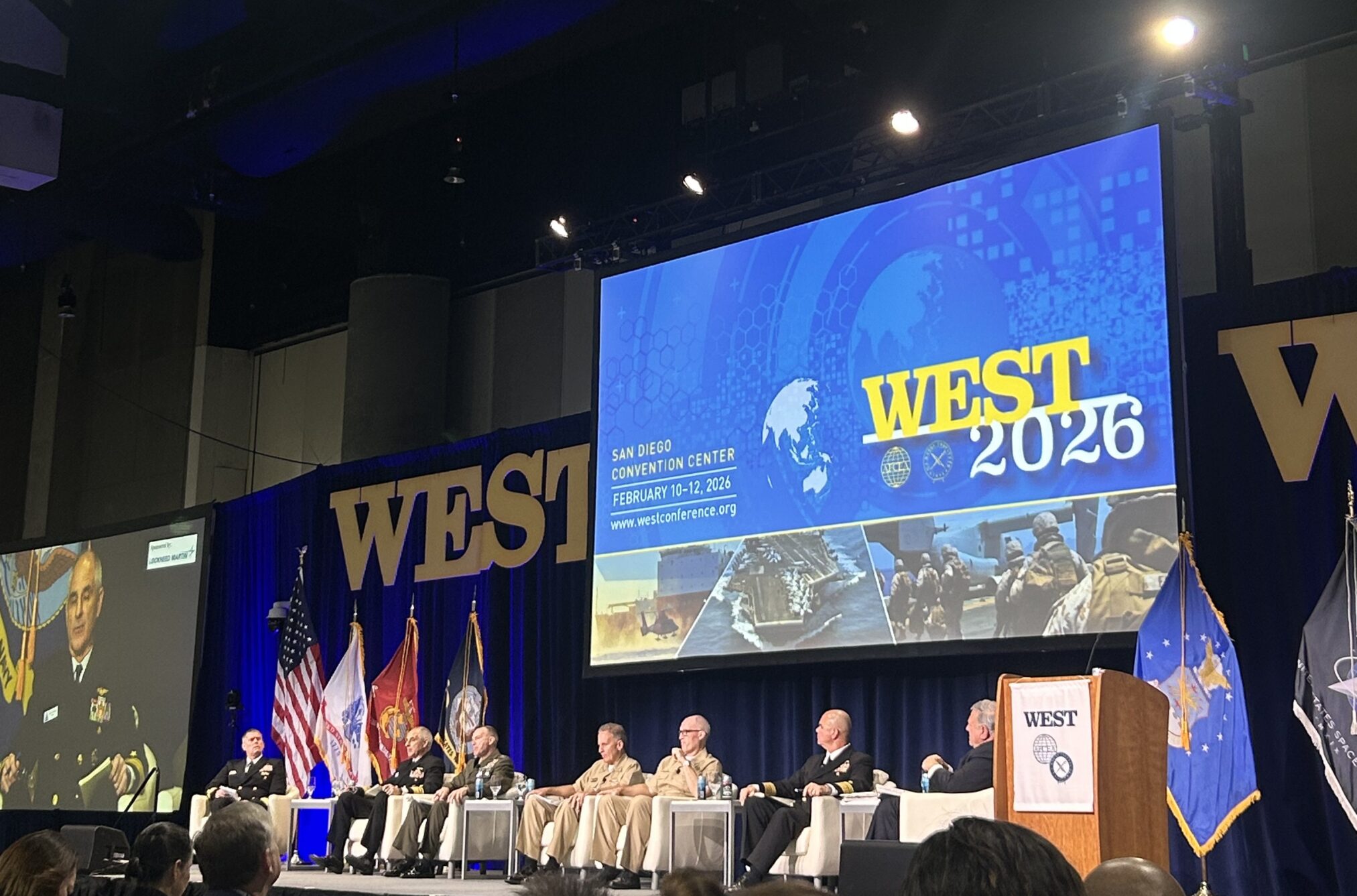
The CNO established “80% combat surge ready” as the target resiliency metric. This threshold is designed to ensure the Navy can execute and provide desired outcomes during relative peace while maintaining capacity to surge when needed. In the panel titled “Generating Readiness Across All Domains,” Commander Naval Surface Forces Vice Admiral Brendan McLean spoke with several naval leaders and emphasized that if the fleet struggles now during peacetime operations, the challenges will become insurmountable when conflict begins.
This combat surge readiness target represents more than a numerical goal; it reflects a fundamental shift in how the Navy approaches fleet generation. The foundry concept places Sailors first, recognizing that the most important weapon system remains the individual Sailor or Marine and their ingenuity, toughness and capabilities. Training must focus on developing mastery and self-sustainment rather than simply checking qualification boxes – we must train like we’re going to fight.
Achieving this readiness level demands addressing critical infrastructure challenges, particularly in maintenance and sustainment. Supply chain effectiveness emerged as another critical factor. Submarine forces, for example, have driven gross effectiveness and net effectiveness metrics up 40% in two years by improving configuration change processes, conducting enhanced audits and working with Naval Supply Systems Command (NAVSUP) to overcome bureaucratic barriers.
2. Force Design Modernization Accelerates Lethal Capabilities to the Tactical Edge

Force design represents a fundamental rethinking of Marine formations and employment concepts. The Marine Littoral Regiments (MLR) and Marine Expeditionary Units (MEU) are designed as inherently dispersed, mobile units with lower signatures that complicate adversary targeting. These formations create hard-to-hit postures that enable forces to persist in contested environments, strengthening the entire naval force.
Force design remains a journey rather than a destination, characterized by continuous learning and adaptation. Marine Corps leaders described how early force design decisions around infantry battalions have evolved through experimentation and wargaming, building resiliency back into formations while incorporating small unmanned aerial systems and other emerging technologies. The ability to operate from austere locations ashore through Expeditionary Advanced Base Operations (EABO) supports Distributed Maritime Operations (DMO) by creating multiple dilemmas for adversaries unsure of where the next threat will emerge.
3. Information Dominance Powers Decision Advantage in Contested Environments
Information warfare capabilities and the ability to make decisions faster than adversaries define success in contested maritime operations. As information warfare leaders emphasized, the side that wins is the side able to decide and act fastest, and the commander who generates and maintains tempo puts the adversary on the defensive. The Maritime Operations Center (MOC) emerged as a critical node for generating this decision advantage. With responsibility for battlespace awareness, integrated fires and assured Command and Control (C2), MOCs are evolving beyond traditional command centers to become dynamic fusion centers that leverage multiple sensors, shooters and C2 nodes across all domains.
Artificial intelligence (AI) is transforming how information flows into operational decisions. Leaders described AI not as a replacement for human judgment, but as a battle partner that curates vast amounts of data and presents options to decision makers. Technology experts such as Alteryx, CrowdStrike, Quantum and RegScale understand that the most valuable contribution of AI to defense will be to help human beings make better, faster and more precise decisions, especially in combat, where decision makers often face overwhelming volumes of conflicting data.
Building information dominance requires cultural transformation around information sharing. Leaders acknowledged the tension between traditional need-to-know restrictions and the imperative to create truly data-centric environments where information flows seamlessly to support distributed operations. The challenge extends beyond technology to include standards, governance and trust frameworks that enable sharing intelligence and operations synchronization in real time across services, combatant commands and coalition partners.
4. Distributed Maritime Operations Demands Seamless Blue-Green Integration

The integration of Navy and Marine Corps forces for DMOs represents the operational approach designed to counter adversary anti-access and area denial strategies in contested environments. As fleet commanders emphasized, this integration creates exponential expansion in capability rather than simple force multiplication.
One Marine Expeditionary Force’s (MEF) integration with Third Fleet demonstrates how this concept translates to operational reality. The ability to operate small, dispersed and mobile formations from austere locations ashore forces adversaries into complex dilemmas. Additionally, Marine aviation provides critical enabling functions that tie distributed operations together, such as Intelligence, Surveillance and Reconnaissance (ISR), electronic warfare, aviation ground support and more.
Training infrastructure must evolve to support this level of integration. The Surface and Mine Warfighting Development Center (SMWDC) now conducts Information Warfare Advanced Team Training integrated with Surface Warfare Advanced Tactical Training (SWAT) events, bringing Warfare Tactics Instructors (WTI) together with Strike Warfare teams to refine tactics, techniques and procedures based on operational lessons learned.
5. Industry Partnership at Speed Accelerates Innovation to Operational Forces
The Red Sea operations demonstrated how Government, industry and laboratory partnerships operating at unprecedented speed can deliver operational advantage. What previously required a month to analyze engagement data, develop software updates and deploy improvements to ships was compressed to two days.
Naval leaders issued clear guidance to industry on critical capability gaps. Obsolescence management emerged as a priority challenge, and industry partners who must maintain expertise will be critical. Open architecture and intellectual property access would enable faster adaptation to provide products when and where needed without waiting for single suppliers.
The newly established Naval Rapid Capabilities Office (NRCO) demonstrates institutional commitment to accelerating innovation. Within three months of establishment, the office has inducted six to seven systems. The process emphasizes demoing and testing rather than lengthy development cycles and getting capabilities into operator hands for evaluation before scaling production.
Carahsoft, The Trusted Government IT Solutions Provider™ excels at achieving rapid delivery through our partner vendors. We connect naval commands with industry partners specializing in open architecture systems, AI-driven analytics, cybersecurity solutions and emerging technologies that address critical capability gaps. Our established contract vehicles streamline procurement timelines, enabling defense organizations to move from requirement identification to deployment at the speed operations demand to support mission-critical modernization efforts.
Charting the Course for Maritime Dominance
AFCEA West 2026 reinforced that sustained maritime dominance requires synchronized progress across people, platforms, concepts and partnerships. The Navy and Marine Corps are not simply acquiring new technologies; they are fundamentally transforming how they organize, train and fight as an integrated naval force prepared for high-end conflict.
The 80% combat surge readiness target, accelerated force design fielding, information warfare integration, distributed maritime operations and industry collaboration at speed represent interconnected elements of a comprehensive modernization strategy. Success depends on maintaining focus on foundational capabilities, such as trained Sailors and Marines, maintained platforms, resilient networks and proven tactics, while rapidly integrating emerging technologies that provide decision advantage.
As Carahsoft, The Trusted Government IT Solutions Provider™, continues supporting defense modernization, the insights from AFCEA West 2026 inform how industry can best partner with the sea services to deliver the capabilities required for maritime superiority in an era of great power competition.
Explore Carahsoft’s Defense Technology portfolio of leading solutions that support naval modernization priorities including AI, cybersecurity, cloud infrastructure and advanced analytics.
Contact us at (888) 662-2724 or NavyInc@carahsoft.com to discuss how Carahsoft’s technology partners can support your mission requirements.