Open-source intelligence is not a recent concept. Governments and individuals have used public information to gain a strategic advantage for centuries, especially during wars. The International Spy Museum’s website states that many people trace OSINT’s origins to ancient Rome and notes that “in the U.S. Civil War, Generals Lee and Grant read enemy newspapers to monitor each side’s activity and inform military strategy.” Similarly, in World War II, the Allies monitored adversaries’ propaganda broadcasts and foreign media.
Through OSINT, agencies gain insight into human behavior, the emotional tone of social media posts, geopolitical signals, threat actors and supply chain risks. In addition to military strategies, OSINT can be used to inform activities as varied as public services, cybersecurity and law enforcement.
Many organizations struggle to combine OSINT platforms with legacy systems and standardize data formats across multiple sources. But if agencies don’t succeed, they are left with fragmented ecosystems that make it difficult, if not impossible, to consolidate and correlate data. As a result, analysts cannot see and understand the whole picture, or make timely and accurate decisions.
Data reliability is another concern given the widespread impact of disinformation and manipulated content. Furthermore, the exploding volume of open-source information can quickly lead to data overload, especially for organizations that lack trained OSINT practitioners and automated tools.
Fortunately, new OSINT solutions take advantage of artificial intelligence to help reduce the signal-to-noise ratio so analysts can focus on the information that matters and produce actionable intelligence. AI can play a vital role at nearly every stage of OSINT—from data discovery to analysis—and can uncover insights more quickly and efficiently than humans. However, experts underscore the importance of leaving the final evaluation and decision-making to expert analysts, for a multitude of reasons.
Ultimately, the linkage of AI systems with OSINT should provide a reliable bedrock, able to withstand the pressures of adversarial attacks and contested informational environments. The same might be said of the robust intelligence systems that embed PAI with other data sources so that agencies can reap the game-changing power of OSINT.
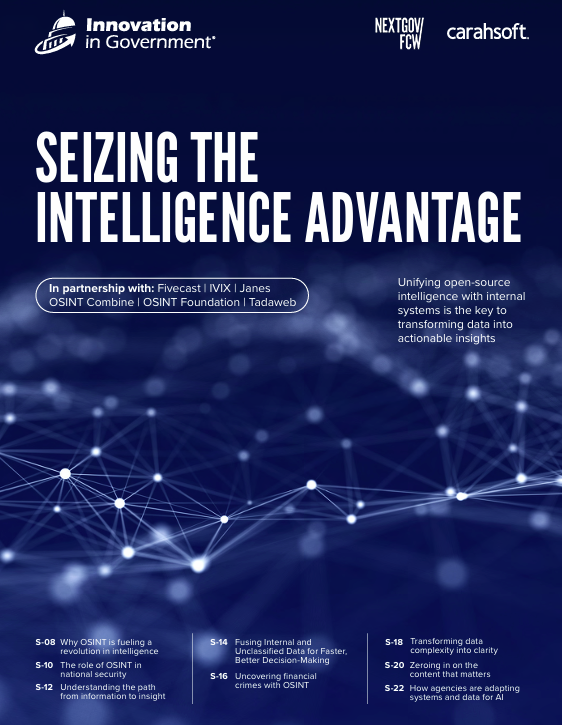
Read the latest OSINT insights from industry thought leaders, including:
· Chris Poulter, Founder and CEO of OSINT Combine, explains how A robust OSINT platform enables decision-makers to trace the chain of intelligence and trust the integrity of the results.
· Randy Nixon, U.S. President and Chief Customer Officer at Janes, details how organizations that successfully integrate external information with internal data can create a more complete understanding of the operational environment.
· Don Fort, Former Chief of IRS’ Criminal Investigation Division and Chief Business Officer at IVIX, notes how modern investigation tools transform fragmented public data into structured intelligence that reveals hidden economic activities.
· Brittany Mason, Pre-Sales Engineer Lead at Fivecast, breaks down how a secure, automated data fusion platform boosts the effectiveness of investigations while streamlining workflows.
· Erik Noren, Vice President of Product at Tadaweb, speaks on how unclassified information can speed the time to insight, but avoiding data overload requires the ability to focus on what’s relevant.
Read more insights from Carahsoft and their OSINT partners when you download the full report.