Although threat actors have a variety of motivations—money, espionage, disruption—they typically have the same goal: to find a way into government networks and, once inside, move around until they find the information or access they’re after. By stealing credentials and impersonating legitimate users, attackers are shifting from breaking in to simply logging in.
The Cybersecurity and Infrastructure Security Agency references the familiar adversaries of China, Iran, North Korea and Russia and states that “we are seeing continued cyber and physical threats targeting critical infrastructure Americans rely on every day. Nation-state actors and nation-state sponsored entities pose an elevated threat to our national security.” The World Economic Forum’s Global Cybersecurity Outlook 2026, based on a survey of C-suite executives and industry experts, notes that geopolitics has become a defining feature of cybersecurity. 64% of survey respondents said they are addressing geopolitically motivated cyberattacks, such as disruption of critical infrastructure or espionage, in their risk mitigation strategies.
Zero trust continues to be at the forefront of efforts to protect government systems because the approach has been mandated but also because the strategy is effective at addressing a rapidly shifting threat landscape. Key components of a zero trust architecture include identity and access management, secure management of devices and endpoints, microsegmentation to prevent lateral movement, continuous monitoring of network activity and user behavior for anomalies, and data loss prevention by securing data at rest, in transit and in use.
Even if agencies apply every element of zero trust, however, it’s not enough to assume the network is safe. Network defenses must be tested in a way that simulates real-world attacks. Penetration testing by internal teams or trusted private-sector partners is a tried-and-true method.
“Ultimately, strengthening collective cyber resilience has become both an economic and a societal imperative,” the World Economic Forum’s report states. “Cybersecurity is a frontier where collaboration remains not only possible, but powerful—a reminder that, even amid fragmentation, economic strain and uncertainty, collective action can drive progress for all.”
Read the latest cybersecurity insights from thought leaders, including:
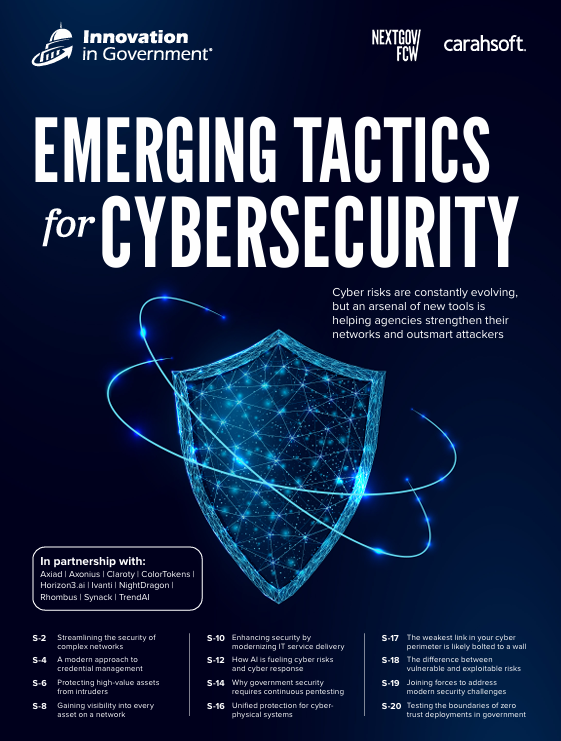
· Bassam Al-Khalidi, Chief Innovation Officer at Axiad, discusses how new authentication options are improving the user experience and streamlining oversight for IT teams.
· Louis Eichenbaum, Federal CTO at ColorTokens, explains how a microsegmentation platform can secure network traffic and prevent adversaries from reaching government data.
· Brian “Stretch” Meyer, Field CTO at Axonius Federal Systems, details how a clear view into all vulnerabilities, applications and devices is the basis for a higher level of cybersecurity maturity.
· Mike Riemer, Senior Vice President of the Network Security Group and Field CISO at Ivanti, notes that when agencies automate endpoint and patch management, they boost security and provide a consistent user experience.
· Jon Clay, Vice President of Threat Intelligence at TrendAI™, a business unit of Trend Micro, breaks down how artificial intelligence is introducing new vulnerabilities, but defenders are fighting back with unified, AI-driven protection.
· Mark Kuhr, CTO and Co-Founder of Synack, speaks on how penetration testing simulates realistic cyberattacks to allow agencies to think like an adversary and uncover hidden vulnerabilities.
· Jen Sovada, General Manager of the Public Sector at Claroty, educates on how a single platform can deliver deep visibility, precise risk management and operational resilience for these mission-critical systems.
· Diego Oliveira, Vice President of Corporate Development and Strategy at Rhombus, addresses how physical security has changed more in the last five years than in the previous 25, but this is the year when it becomes critical.
· Stephen Gates, Principal Security Subject Matter Expert at Horizon3.ai, reports on how autonomous, proactive penetration testing enables agencies to understand and remediate the security issues that truly matter.
Read more insights from Carahsoft and their cybersecurity partners when you download the full report