As AI lowers the barrier to entry for attackers, enterprises should recognize that viable threats are not limited to sophisticated, well-funded adversaries. AI-assisted hacking enables faster reconnaissance, more convincing phishing campaigns and automated vulnerability discovery and rapid exploitation at a scale most security models were never designed to handle.
This shift is just one of the driving forces behind Zero Trust adoption. Zero Trust is about more than prevention. It’s about limiting impact, reducing exposure, restoring control as quickly as possible and ensuring that security effectiveness can be improved over time.
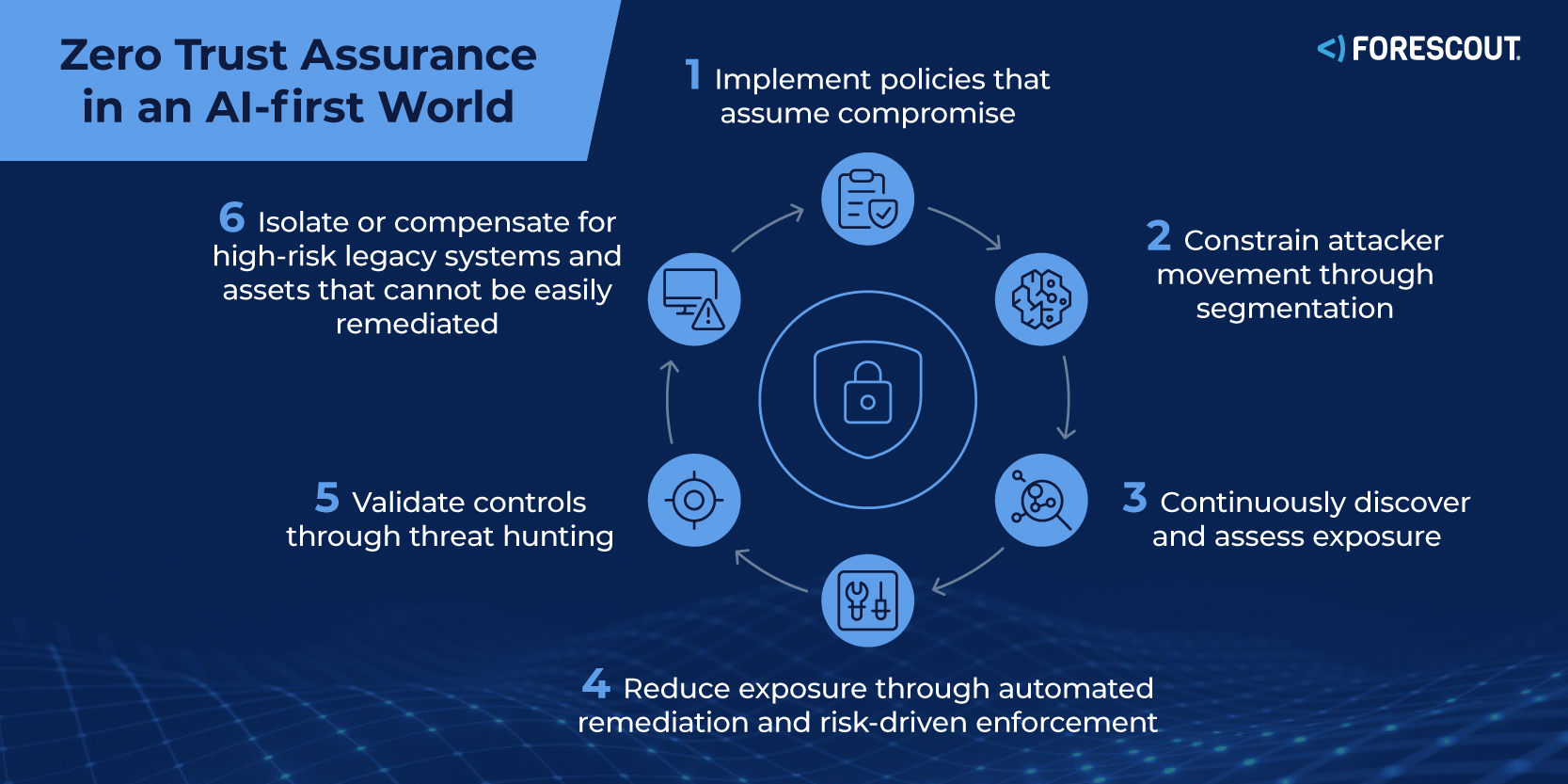
A Zero Trust architecture that delivers continuous improvement should:
- Implement policies that assume compromise
- Constrain attacker movement through segmentation
- Continuously discover and assess exposure
- Reduce exposure through automated remediation and risk-driven enforcement
- Validate controls through threat hunting
- Isolate or compensate for high-risk legacy systems and assets that cannot be easily remediated.
First, just assume that the bad guys are already inside the network.
Assume You’re Already Compromised
Patient attackers wait for the optimal opportunity to attack. Some are after fame, some are after money, some are after state secrets. A prime example of bad actors after financial data or state secrets is harvest now, decrypt later data theft, where an attacker steals encrypted data with the expectation that one day soon, post quantum computers will be able to decrypt it. Credible estimates for Q Day are anywhere from next year for well-funded nation-state actors to 2029 for others.
That uncertainty should shift security strategy from prevention to continuous improvement using visibility, context and accelerated response. Security teams need continuous awareness of assets, identities, communication flows and risk levels. Depending on your industry, you need cryptographic dependencies and a transition plan sooner rather than later.
This direction reflects a Zero Trust architectural shift to risk-aware segmentation policy models that provide greater contextual understanding of enterprise communications, trust relationships and exposure. Visibility helps security teams prioritize high-risk systems, identify legacy dependencies and focus resources on the areas that present the greatest operational and security risk.
The idea is to identify and reduce the conditions that give attackers operational footholds while supporting long-term security resilience.
When compromise is a given, security programs can revector around reducing attacker opportunities at every stage of an attack. Your next step is thinking through and implementing network segmentation.
Constrain Attacker Movement with Segmentation
Segmentation is all about recognizing potential vulnerabilities and limiting an attacker’s reach. A compromise can escalate from a foothold to a severe breach quickly as an attacker (or their agents) moves from one system to another. Each successful connection expands their options and multiplies business risk.
Segmentation addresses this challenge by creating boundaries around identities, applications, devices and business services. It can include identity and attribute-driven segmentation, risk-aware communications and mechanisms for identifying segmentation hygiene gaps. These capabilities help organizations understand which communication paths support business operations and which paths create unnecessary exposure.
Effective segmentation reduces risk because attackers have fewer pathways open to them. It constrains lateral movement and limits the blast radius of a compromise. Even if incident affects one area of the environment, that threat remains contained within defined boundaries.
Next, think about remediation, automatically if possible.
Continuously Reduce Exposure with Automated Remediation
The goal is to reduce enterprise exposure quickly and consistently. Automated remediation allows security teams to move at machine speed, triggering exposure reduction as soon as risk is identified. Active remediation includes automated actions like isolating affected devices, blocking risky communication paths, disabling vulnerable services and triggering segmentation or access policies when risk conditions are detected.
Detection, contextual analysis and automated response work together to shorten response cycles and limit attacker opportunities. The result is a Zero Trust security model centered on continuous risk reduction. Now, you need to think, validate controls and find gaps.
Validate Controls and Uncover Gaps with Threat Hunting
Threat hunting can help connect Zero Trust architecture with operational reality. Policies and segmentation may be well designed, but security teams still need evidence that those policies are working. Threat hunting helps provide that evidence.
Effective threat hunting examines the behaviors that matter most. That means looking for suspicious lateral movement, unexpected communication paths, unmanaged devices and privilege misuse. These activities provide insight into both attacker behavior and control effectiveness.
It also reveals gaps that visibility tools, policy reviews and audits may miss. Every unexpected path, unmanaged asset or policy violation discovered becomes an opportunity to strengthen security posture.
In a mature Zero Trust program, threat hunting contributes to a feedback loop that improves network security over time. But there will always be outliers in very large enterprises because of old technology and legacy gear or operational technology for industrial systems. Your Zero Trust environment needs to account for that.
Isolate or Compensate for High-Risk Legacy Systems And Assets That Cannot Be Easily Remediated
Because there are legacy and operational technology (OT) and cyber physical system (CPS) assets that are slow to remediate or resist typical IT “control and patch” centralized enforcement, organizations should think through segmentation and transition planning for those assets. For example, OT and CPS equipment should be segmented by asset type or traffic type to limit lateral movement if breached.
Assets that are non-Post Quantum Cryptography (PQC) safe need to be identified, inventoried, prioritized and accounted for in the organization’s PQC readiness transition planning. Where direct upgrades are impractical, segmentation can help protect legacy systems from becoming a liability.
Zero Trust Assurance
Zero Trust is ultimately a strategy for reducing risk, with the strongest architectures providing visibility, control, validation, remediation and adaptability. When organizations can identify exposure, constrain attacker movement, validate defenses through threat hunting and respond at machine speed, they create a security model that remains effective even when compromise occurs.
In an environment shaped by AI-enabled attacks, legacy technology challenges, and emerging post-quantum risks, the ultimate measure of Zero Trust is not whether intrusions happen, but how quickly and effectively risk can be reduced after they do. Zero Trust Assurance comes from being able to measure outcomes continuously and demonstrate that controls are working as intended under real-world conditions.
To hear more about Zero Trust Assurance and PQC readiness, please join Forescout for the upcoming webinar “From Quantum Visibility to Quantum Readiness: Prioritizing Cyber Risk Before Q-Day.”
Carahsoft Technology Corp. is The Trusted Government IT Solutions Provider, supporting Public Sector organizations across Federal, State and Local Government agencies and Education and Healthcare markets. As the Master Government Aggregator for our vendor partners, including Forescout, we deliver solutions for Geospatial, Cybersecurity, MultiCloud, DevSecOps, Artificial Intelligence, Customer Experience and Engagement, Open Source and more. Working with resellers, systems integrators and consultants, our sales and marketing teams provide industry leading IT products, services and training through hundreds of contract vehicles. Explore the Carahsoft Blog to learn more about the latest trends in Government technology markets and solutions, as well as Carahsoft’s ecosystem of partner thought-leaders.