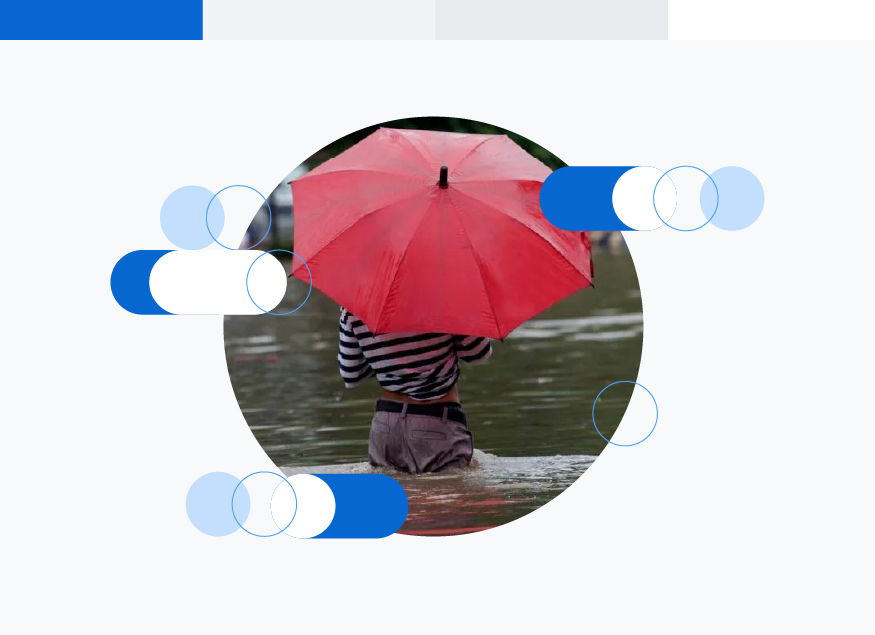
Roughly 2 billion people globally are at risk of flooding, with that number growing steadily every year. With flooding ranking as the number one most frequent and costly natural disaster, Federal, State and Local Governments must find ways to translate historical and real-time data into predictive models for emergency response. Digital twins powered by Artificial Intelligence (AI) substantially shorten simulation cycles, compare complex variables and precisely estimate future flood scenarios.
Challenges with Traditional Forecast Models
Examining the traditional forecast modeling process uncovers a series of disadvantages that mean an early warning flooding system is not functioning at maximum potential. These flood algorithms often have long modeling and simulation times, and analysts do not have the luxury to run outcomes multiple times to make the model as accurate as possible when it comes to emergency response. As forecasting areas get larger, these models need more time, more compute power and more analysts to run properly.
There are also issues with the data input into traditional forecast models. Analysts have data that is either unreliable or unavailable in the locales necessary to issue an accurate early flood warning. Incorrect data can also be created when outdated models misrepresent geospatial features. When this invalid data cannot be compared with other current or historical data points, the overall quality of the data decreases.
Along with the disadvantages of the traditional models themselves, the nature of flooding itself presents its own unique set of challenges for analysts. Freeform or uncontained water is an incredibly difficult element to measure properly, especially when it is in motion. Additionally, weather forecasts are often microregional. Rainfall can differ drastically between two different areas only hundreds of feet apart, making accurate assessments of rainfall across entire municipalities or counties near impossible.
To address these challenges, analysts examine existing models and determine how emerging technology can complement those frameworks to function in a more proactive manner.
Digital Twins and Flood Management

Predictive models are at the cornerstone of emergency response, and the merging of the physical world with digital information is crucial to outputting accurate information for public servants to utilize in the field. This is achieved through the creation of digital twins, or virtual representations of real-life components and processes. In this case, digital twins of an Area of Interest (AOI), such as a town or a county, can consist of multiple variables that can contribute to different factors in a flood scenario, including elevation, stormwater infrastructure, commercial and residential constructions, precipitation and natural geographic features. The model then forecasts flooding based on real-time and historical data.
To create a digital twin, analysts select a designated AOI and break it down into a gridded matrix. These cells can be as precise as 50 feet by 50 feet, depending on the resolution required for a specific model and the resolution of the available geospatial data. This way, the model can take into account the spatial variation of different geological data elements within the AOI, including infiltration rate and soil type. Relevant data points are often available through the town or county in question, or through the United States Geological Survey (USGS). Once compiled, this information can be processed in a Geographic Information System (GIS) to create a digital twin to be used in flood forecasting.
However, the digital twin can remain static for some time, but can often change based on:
- Changes in the landscape due to urbanization
- Structures are built and demolished
- Coastlines and water levels change
The more data and more current data that is incorporated into the digital twin, the more accurate the flood forecast and the more efficient the emergency response will be.
The Power of the Hybrid Model
As stated previously, one of the major challenges facing public servants concerning flood management is the time it takes to run simulations. AI models, trained on a series of input and output data, dramatically cut down model run times during storm events. Analysts can produce forecasts in seconds or minutes, where prior it may have taken hours or days to produce the underlying hydraulic and hydrologic model. This rapid prediction via model scoring process means that multiple AI models can be run at once that can take uncertainty in multiple parameters into account, reconcile differentiating flooding estimates and produce more accurate estimates.
When AI meets the real-world accuracy of digital twins, Government agencies can quickly and effectively plan for worst-case scenarios in flood emergencies. These hybrid models can pinpoint areas on a large scale that are susceptible to complex issues during a flood, such as trash accumulation. Subsequently, these models can outline in real-time the cause and effect of decisions made by Government officials. In other words, if officials make infrastructure changes to solve a water challenge in one location, a hybrid model can show if the solution inadvertently created additional challenges elsewhere.
According to experts in the field, collaboration is the key to flood management success. This synergetic approach is echoed in the use of digital twins and AI predictive models. Using historical and real-time data to simulate future events will ultimately allow Government officials to plan and respond to flood scenarios safely and effectively.
Discover how digital twins and accompanying technology can transform flood management by watching SAS’s webinar “From Sensors to Digital Twins: Real-Time Flood Management with Data & AI”.