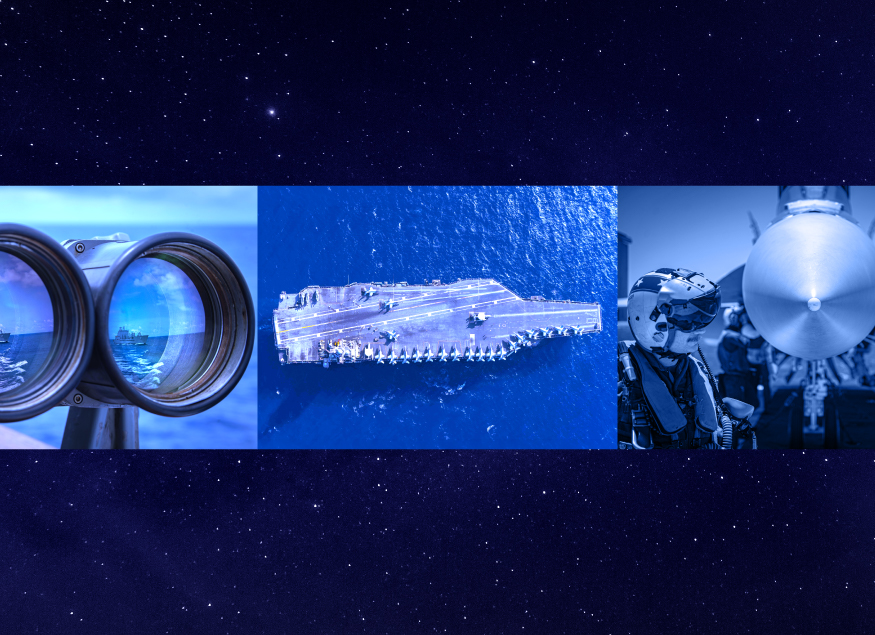
Sea-Air-Space 2026 convened naval leaders, defense technologists and industry partners with renewed urgency. Across panels, one message resonated clearly: the United States cannot sustain maritime superiority through technology and tactics alone. The industrial, organizational and digital foundations of naval power are being re-examined and, in many cases, rebuilt.
From domestic shipbuilding to space-enabled operational speed and the cultural transformation modern cybersecurity requires, the conference presented a sea services enterprise in motion.
Five critical insights emerged to define the path forward for naval readiness in an era of sustained great power competition.
Shipbuilding Strength Starts with Industrial and Commercial Foundations
Panel discussions on maritime dominance challenged the foundational assumption that naval strength begins with warships – it starts with the economics and infrastructure behind it. To put this in prospective, the United States was a world leader in shipbuilding up until 1975. Today we build less than .1% of global commercial ships, and China has become the #1 global shipbuilder followed by South Korea and Japan. Without a self-sustaining domestic shipbuilding sector anchored in commercial demand, the U.S. cannot field or sustain the naval force it needs. This is a strategic imperative.
Assured shipping access emerged as a critical operational concern. In crisis, the assumption that commercial shipping will always be available dissolves as capacity reprices, realigns and becomes politically unavailable. This gap between theoretical and reliable access directly affects forward naval operations, contested logistics and distributed maritime operations that depend on commercial sealift.
The policy implication that maritime power cannot be separated from maritime commerce is clear. Deregulatory frameworks, investment incentives and alignment across Government agencies were cited as necessary conditions, not peripheral considerations, for restoring the industrial base to include maintenance and repair, that will deliver naval deterrence credible and sustainable.
Force Design Modernization Demands Speed, Scale and Cost Discipline
Lt. Gen. Paul Rock and the Marine Corps leaders framed Force Design not as a completed transformation but as an ongoing operational imperative. The shift from legacy formations toward multi-domain distribution across the littorals, with reduced signature and expanded logistics reach, requires industry to deliver capability faster, at greater volume and at a sustainable cost structure. Uniformed and industry panelists alike returned to speed, scale and cost as the defining metrics of partnership value.
Logistics modernization stood out as a near-term priority. Maj. Gen. Andy Niebel, Assistant Deputy Commandant for Installation and Logistics, described sustaining distributed forces forward as a defining Force Design execution challenge especially in a contested environment. Advanced manufacturing, including producing and repairing components at forward locations and resolving technical data rights barriers, were highlighted as targets for industry engagement. Rear-echelon sustainment alone cannot support the dispersed, low-signature posture Force Design envisions.
Admiral (Ret) Mike Rogers, former Commander of U.S. Cyber Command and National Security Agency, also emphasized engaging industry at the “problem level” rather than the “solution level” by presenting operational deficiencies to the Private Sector instead of prescribing widget requirements. This approach unlocks more solutions and better leverages innovation from non-traditional suppliers, dual-use technology providers and venture-backed entrants into the defense industrial ecosystem.
Space is the Enabling Domain for Every Other Domain of Operations
Multi-domain integration discussions reinforced the principle that space is not one domain among equals. It is the foundational layer upon which sea, air, land and cyber operations depend on timing, navigation, targeting and communications. Rear Admiral Tracy Hines, Deputy Director of Global Space Operations at U.S. Space Command, noted that no military operation of consequence occurs today without space as an enabler, a reality our adversaries have designed capabilities to exploit.
The Space Development Agency’s (SDA) acquisition model is a template for delivering space capabilities at operational speed. By structuring satellite constellations around two-year launch cycles with five-year satellite lifetimes, SDA compresses traditional spiral development into a continuous refresh cycle, limiting requirements creep, maintaining technological currency and ensuring the architecture evolves faster than adversary counter-space capabilities.
Developing dedicated maritime space officers and a trained sea services cadre was cited as essential to realizing this capability. Space domain awareness, or understanding the real-time health, availability and vulnerability of orbital and terrestrial space assets, requires personnel who understand both the naval operating environment and the physics and threat dynamics of space. Artificial intelligence (AI) tools are increasingly helping analysts manage the volume and complexity of space situational data.
Cyber Resilience Requires Visibility into Operational Technology
Cybersecurity panelists drew a distinction with significant implications for naval acquisition and maintenance: Operational Technology (OT) presents a fundamentally different threat surface than traditional IT. Legacy systems built decades ago without cybersecurity in mind are now network-connected, creating vulnerabilities that adversaries are actively seeking to exploit across afloat and shore infrastructure.
Coast Guard leaders highlighted their model of deploying cyber protection teams to assess port and maritime transportation systems, treating cybersecurity readiness as part of physical safety and operational resilience. The emphasis was not on perfect security but maintaining impact and the ability to respond and recover after penetration, making resilience the goal rather than prevention alone.
Building cyber resilience at scale requires cultural and technological change. Panelists noted that cybersecurity must evolve from an individual compliance exercise to a shared organizational process where intelligence flows directly to operators, vulnerabilities are treated as tactical liabilities and industry partnerships provide reach and expertise no single service can generate internally. AI was identified as valuable for managing threat noise, prioritizing response actions and balancing speed with security.
Interoperability Is Won Through the Convergence of Training and Technology
Interoperability discussions returned to the lesson that technological superiority does not guarantee operational success. The most capable systems deliver a decisive advantage only when operators are trained to employ them together across services, with coalition partners and in degraded communications and distributed command environments. Admiral Thad Allen, former Commandant of the U.S. Coast Guard, framed joint maritime interoperability not as a coordination challenge, but as a warfighting imperative built into training regimens, not assumed from capability inventories.
Ms. Barbara Supplee, Executive Vice President of the Army and Navy Business Group at SAIC, cited AI as a meaningful interoperability accelerator when applied to the right problems, including reducing operational data processing time, helping communities get ahead of emerging threats and enabling distributed forces to maintain a coherent common operating picture. But panelists cautioned that AI adoption must be paired with institutional investment in training operators to use new tools effectively, not simply acquiring them.
Panelists emphasized that the most valuable interoperability gains come from working through complexity together by embedding analysts and operators with joint and industry partners, surfacing unit-level capability gaps and designing experiments that change one variable at a time to generate actionable insight. The sea services are making progress, but leaders were clear that integration must accelerate to match how quickly adversaries are learning to operate across domains simultaneously.
Sea-Air-Space 2026 reinforced that sustainable maritime superiority requires synchronized investment across industrial foundations, space capabilities, cyber resilience, Force Design execution and multi-domain training. The seas services are not simply fielding new platforms; they are rethinking the economic, organizational and technological systems that generate and sustain naval power. Progress depends on industry partners that understand the full challenge and can deliver at the speed, scale and cost the mission demands.
Explore Carahsoft’s defense portfolio of leading solutions that support naval modernization priorities including AI, cybersecurity, cloud infrastructure and advanced analytics.
Contact the Aerospace and Maritime team at DOW@carahsoft.com or (888) 662-2724 to discuss how Carahsoft’s technology partners can support your mission requirements.