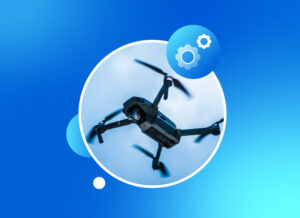
Government drone programs have reached a defining moment of opportunity. Speaking at Carahsoft’s inaugural Drones in Public Sector Summit, retired U.S. Air Force Colonel Dawn Zoldi, CEO of P3 Tech and Publisher at Autonomy Global, described an industry gaining remarkable momentum. As The Trusted Government IT Solutions Provider™, Carahsoft convened the Summit to help Government leaders and industry partners explore how unmanned aircraft systems (UAS) and counter-UAS technology are shaping the future of Public Sector missions.
Using a phrase borrowed from the flight line, Zoldi opened her keynote with a clear message. “I frame this keynote in terms of clearing for takeoff because we are, as an industry, at an inflection point,” she told the audience. “I’ve seen more movement really in the past year than I’ve seen in the last five years combined.”
That energy set the tone for a wide-ranging look at how defense acquisition, public safety operations and policy are advancing together to expand drone adoption across Government.
Drones Become a Trusted Part of Everyday Government Operations
Zoldi opened with a simple observation: drones have moved well beyond the testing phase. “Drones are delivering capabilities, and the Government has figured out that drones are a staple,” she said. Agencies across Government have embraced UAS as an everyday operational tool, extending the technology’s reach into nearly every mission area.
On the defense side, Zoldi highlighted the Department of War’s (DoW) Drone Dominance initiative and its Gauntlet II exercise, held in August, as evidence of the growing investment military leaders are making to expand UAS capability. She also pointed to the Army’s Rapid Assessment Program for Tactical Operational Readiness (RAPTOR), along with ongoing Defense Advanced Research Projects Agency (DARPA) and service-specific programs strengthening acquisition activity across every military branch.
Public safety agencies are moving with similar energy. Zoldi traced Drone as a First Responder (DFR) programs back to the Chula Vista Police Department’s work under the Federal Aviation Administration’s (FAA) Integration Pilot Program (IPP). What began with officers launching drones from rooftops has evolved into drone-in-a-box (DIB) systems that deploy aircraft automatically when a 911 call comes in. “It saved so much time and money, including responses that never even have to happen,” she said, noting that the model is now expanding into the energy sector and other critical infrastructure missions.
Inspections represent a third fast-growing use case. Zoldi cited companies like Skydio, which secured early waivers to inspect bridges by drone, as an example of how aerial inspection now helps keep workers safe in demanding environments such as mines, tunnels and elevated structures.
Counter-Drone Technology Advances Alongside Growth

As drone adoption accelerates, so does investment in technology that keeps that airspace secure. “Counter drone is the yin to drone’s yang,” Zoldi said, describing a growing ecosystem of solutions built to protect missions ranging from wildfire suppression to major public events.
She pointed to real-world deployments as proof the market is responding, including counter-drone technology used across multiple host cities during the World Cup. She also highlighted interceptor systems and airspace management platforms such as Airspace Link’s AirHub Portal, which give operators a unified view of authorized drone traffic and countermeasure activity.
Policy Continues to Open New Pathways for Drone Integration
Zoldi, a licensed attorney, walked through a wave of executive orders (EO), rules and interagency initiatives that have advanced drone policy this year. She highlighted EO 14307, which promotes American Drone Dominance, as a policy generating significant attention. She also previewed the FAA’s Part 108 beyond visual line of sight (BVLOS) rule, which would allow routine drone flights outside an operator’s direct sight line. Zoldi noted the FAA’s recent confirmation that the rule has reached the Office of Information and Regulatory Affairs (OIRA), the final review stage before publication.
On the counter-UAS front, Zoldi praised the SAFER SKIES Act, which extends mitigation authority to State, Local, Tribal and territorial (SLTT) agencies. An Interim Final Rule (IFR) took effect in July, opening a new training pathway for agencies through the “Detect and Warn” online course, a prerequisite for the in-person “Mitigation” coursework offered through the National Counter UAS Training Center (NCUTC) at Redstone Arsenal. Adoption of this training is still in its early stages, with more agencies expected to build this capability over time. During a later session, Zoldi and other experts also discussed the pending Section 2209 regulation, which would allow critical infrastructure asset owners to define protective airspace around their facilities.
Streamlined Procurement Helps Missions Move Faster
Zoldi credited Carahsoft’s role as a Master Government Aggregator™ for helping agencies move quickly by using established contract vehicles rather than building new acquisition processes from scratch.
Her advice to Government and industry alike was to build for interoperability from day one, pointing to the Modular Open Systems Architecture (MOSA) approach that the DoW has championed. In her vision, counter-drone systems, airspace management platforms and detection technology work together on a single system and one operational screen, whether the end user sits in a military command center or a city public safety operations room.
Leadership Will Power the Next Phase of Government Drone Integration
Zoldi closed her keynote by returning to her aviation metaphor. “It’s a singular moment. When you’re cleared for takeoff, it’s the moment when every prior condition has been satisfied,” she said. “We really are cleared for takeoff.”
Her closing message centered on people. When asked what stands between Government and full drone integration, Zoldi pointed to leadership as the most important factor, a nod to the program managers, policy staff and industry executives in the room already driving the mission forward. As agencies advance toward Part 108 finalization and expanded counter-UAS authority, her message was one of confidence: the technology already works, and the opportunity now is for policy, procurement and people to move forward together.
As Government Agencies continue investing in drone and counter-UAS technology, Carahsoft, The Trusted Government IT Solutions Provider™, is helping accelerate that progress by connecting agencies with proven UAS and counter-drone solutions through established contract vehicles.
Learn more about Carahsoft’s Autonomy and Robotic solutions portfolio to discover UAS and counter-UAS technologies available to Government agencies.
Reach the Carahsoft Autonomy and Robotics team at AutonomousTech@Carahsoft.com or (888) 662-2724 to discuss drone and counter-UAS solutions for your mission.