


Private AI Infrastructure for DDIL Environments · Now on GSA through Carahsoft
Sovereignty isn't a setting. It's the architecture.
Gridlight is the private AI control plane for defense and public sector organizations where data can't leave the building and downtime isn't an option — delivering cloud-like AI outcomes on infrastructure your agency already owns, from garrison to the tactical edge.
Request a Briefing See the 90-Day Pilot PathCarahsoft Technology Corp. is Gridlight's public sector distributor
Bringing private, on-premises AI infrastructure to Federal, Defense, State & Local, and Education customers — mission capable from garrison networks to disconnected, tactical edge deployments
Available Through Carahsoft
Private AI infrastructure, built for the mission — not the cloud
Gridlight is the abstraction layer between your agency and your AI — a private inference platform that runs on hardware you control, routes every request to the right model for the workload, and keeps your data exactly where it belongs: inside your perimeter.
Through Carahsoft's reseller network and contract vehicles, Federal civilian, Defense, Intelligence Community, State & Local, and Education customers can now deploy Gridlight without a single byte of mission data leaving their environment — including sites with no internet connection at all.
Genuinely on-premises
Not a private cloud tenancy. Runs with the network cable unplugged.
Hardware-agnostic
Deploys on the mixed, aging fleet your program already owns.
Live in 30 days
Deploy, prove, and expand on a scoped pilot — no 18-month IT program.
The Problem With Cloud AI in Government
Built for where cloud AI can't go
Three structural barriers stand between the public sector and commercial AI. Gridlight was architected to remove all three — not paper over them with a policy.
BARRIER 01
Data can't leave — and the network can't be trusted to
CUI, ITAR, classified, and mission-critical data have to stay inside the perimeter. And in DDIL environments — denied, disrupted, intermittent, limited — there may be no path out at all. Cloud AI, public or "in-tenant," was never built for either boundary.
BARRIER 02
Costs are unpredictable
Per-token billing turns adoption into a compounding, unbudgetable line item. Fixed appropriations need fixed, known costs — not a meter that runs with usage.
BARRIER 03
Every program rebuilds
N contractors, N tools, N compliance packages, N ATOs. Gridlight is the shared control plane every program and every use case runs on.
What That Means in Practice
Your perimeter, always
Six architectural facts — not policy promises — that make Gridlight deployable where cloud AI is a non-starter.
Built for DDIL
Denied, disrupted, intermittent, limited connectivity isn't a degraded mode here — it's the baseline design assumption. An air-gapped site. A ship. A forward operating base. A factory floor. No connection required, ever.
Your data stays yours
Nothing is uploaded, nothing trains anyone else's model, nothing crosses your firewall. This is architectural, not a policy promise.
It answers from your material
Not from what a model read on the internet years ago. Every answer cites the document and section it came from.
It uses hardware you already own
Mixed, aging, non-uniform hardware is normal and expected — not a problem to solve before you start.
One platform, many capabilities
Text, images, video, 3D, and audio in one system with one set of controls — not six vendors and six ATOs.
Costs are fixed and known
Licensed by the compute capacity you run, not by usage. Costs do not rise as adoption does.
The Platform
One platform. A full set of mission capabilities.
Gridlight shares the same security model, the same controls, and the same interface across every capability below — deployed once, governed once.
Retrieval
Ask questions of your own material
Point Gridlight at contracts, policies, manuals, drawings, or recordings. Ask in plain language. Get an answer that cites where it came from.
Search
Search that understands meaning
Matches meaning, not just words — "staff leave entitlement" finds the holiday policy even when the document never uses those words.
Vision & Speech
Understand pictures and speech
Hand it a photograph, a diagram, or a scanned form and ask about it. Hand it a recording and get an accurate transcription — on the same in-house infrastructure.
Generation
Create
Image generation from a description. Video. 3D models with mesh processing for engineering and simulation. Music, sound effects, and natural-sounding voice output.
Fine-Tuning
Specialize it to your mission
Produces a small adapter that teaches the system your terminology and domain — without retraining from scratch, and without a document ever leaving your network.
Simulation
Model what happens next
Takes a described situation and projects likely outcomes — for planning and decision support, not prediction.
Deploys On What You Already Own
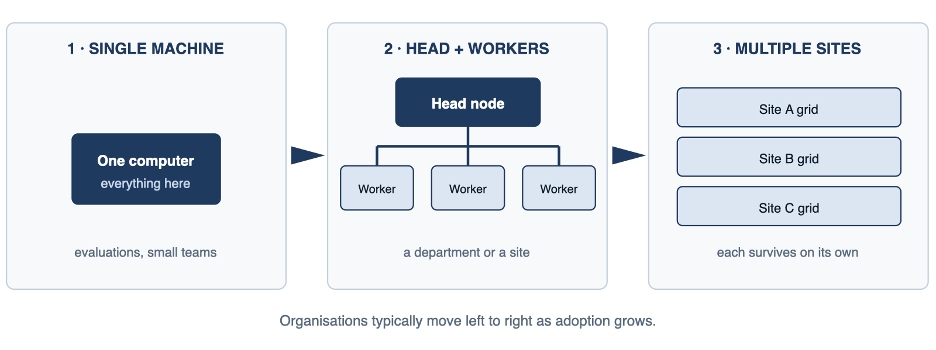
From a single laptop to a multi-site grid
Gridlight is deliberately hardware-agnostic — built for the reality that agencies own a mixture of equipment bought at different times, from different manufacturers, for different reasons. NVIDIA servers, Apple desktops, and Intel laptops can run in the same grid — and so can ruggedized, transit-case compute built for expeditionary and tactical environments. Edge NPUs and TPUs handle lightweight work — search, classification, transcription — on a fraction of the power a GPU draws, which is exactly what a remote site, a vehicle, or a battery-powered deployment needs.
Production-Ready, Not a Prototype
What clears ATO review
Everything above is what Gridlight does. This is what an AO, an ISSM, and a SOC actually need to see before they'll sign off.

SSO through what you already run
Active Directory, SAML, or OIDC — no separate user list to maintain.
Certificate-based machine trust
Traffic encrypted; machines in the grid authenticate to each other with certificates, not shared passwords.
Tamper-evident audit trail
Every action logged and exportable into whatever SIEM your SOC already runs.
Role-based access, per-document tiers
Sensitive material is visible only to those entitled to it — enforced on every single query.
Enforced tenancy
One directorate cannot retrieve another's material. Routing rules can require regulated workloads to run only on hardware carrying the right approvals.
No single point of failure
Coordinators elect a leader automatically. A failed machine reroutes work without the user seeing an error — reduced capacity, never an outage.
What Makes It Different
Three things, stated plainly
01
It is genuinely on-premises
Not "private cloud." Not "your tenancy in our data center." The software runs on hardware you control and works with the network cable unplugged — usually the deciding factor for defense, regulated industries, and anyone with a data-residency obligation.
02
It treats mixed hardware as normal
Most platforms assume a uniform fleet of identical, current-generation accelerators. Gridlight measures what each machine can actually do and places work accordingly — deploy onto what you already own.
03
It is one platform, not six
Text, search, vision, speech, image, video, 3D, and audio share one deployment, one security boundary, one set of controls. That matters less on day one than in year two — the alternative is six vendors, six audits, six renewals.
Built for Every Stakeholder in the Program
One platform, a message for every seat at the table
How Programs Get Started
A scoped, outcome-defined pilot
No 18-month integration program. Gridlight stands up inside your environment on a defined timeline, proves the outcome, and expands from there.
DAYS 0–30
Deploy
Gridlight stands up inside your environment; the first use case is scoped against your mission priorities.
DAYS 31–60
Prove
First workflow goes live. Baseline versus result is captured against the metric you define.
DAYS 61–90
Expand
More use cases land on the same platform, the same ATO, the same controls. Costs stay flat.
"You define the success metric — hours saved, response time, accuracy, cost. We measure it against your baseline and report the number in 30 days. Your data never leaves the building."
Frequently Asked
What agencies ask first
No. There is no outbound path for your content. Gridlight is designed to run with no internet connection at all.
Yes — denied, disrupted, intermittent, and limited connectivity is the baseline design assumption, not an edge case. A site or platform that goes fully dark keeps running at full capability; there is no "call home" the system depends on.
A single, reasonably modern computer. A graphics card makes it faster but isn't required — most evaluations begin on hardware the organization already has.
Yes — a strong fit for remote or power-constrained sites, handling search, classification, and transcription efficiently. Pair with a GPU or a well-specified CPU machine for large-model workloads at that site.
Work moves to another machine automatically. In a grid, losing one node reduces capacity — it doesn't cause an outage.
Yes, through fine-tuning, which produces a small adapter reflecting your domain and terminology — trained on your material, inside your network.
By the compute capacity you run, not by usage. Costs do not rise as adoption does — an appropriations-friendly model built for fixed budgets.